Dark Patterns and Deceptive Design
🗂️ Interactive Notebook: Open Study Companion (Video Summary, Flashcards, Mind Map) ↗
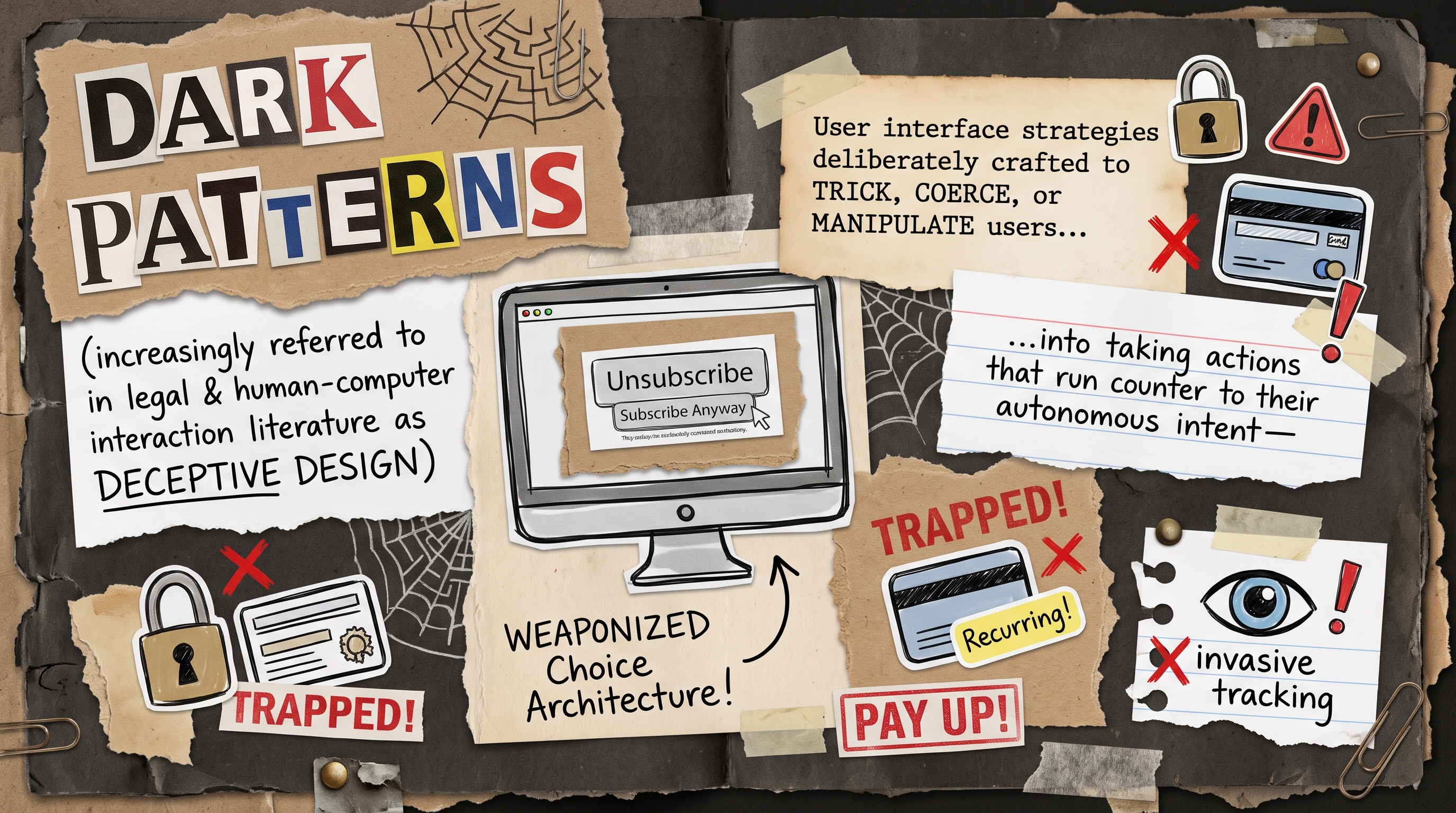
Dark patterns (increasingly referred to in legal and human-computer interaction literature as deceptive design) are user interface strategies deliberately crafted to trick, coerce, or manipulate users into taking actions that run counter to their autonomous intent—most commonly surrendering personal data, consenting to invasive tracking, or enrolling in recurring financial obligations.[1] Rather than arising from poor design or usability oversights, dark patterns represent weaponized choice architecture: projecting a deceptive facade of seamless user convenience that conceals the systematic inversion of behavioral economics and human-computer interaction (HCI) principles to maximize corporate extraction at the expense of user agency.[2]
Theoretical Foundations: From Nudges to Weaponized Choice Architecture
To understand how dark patterns function, it is necessary to situate them within behavioral economics and dual-process cognitive psychology. In traditional behavioral economics, Richard Thaler and Cass Sunstein introduced choice architecture—the principle that there is no "neutral" way to present options, and that the arrangement of choices inevitably influences decision-making.[3] While ethical choice architects use benign nudges to promote user welfare, deceptive designers deploy sludge (excessive, unjustified friction preventing users from acting in their best interest) and dark nudges (frictionless pathways toward inadvertent or regrettable decisions).[3:1]
Exploitation of Dual-Process Cognition
Deceptive interfaces primarily target the interplay between fast, heuristic-driven cognition (System 1) and slow, deliberative reasoning (System 2):
- System 1 Exploitation: Users navigating digital interfaces rely heavily on visual scanning, muscle memory, and established UI/UX conventions (e.g., assuming a bright primary button represents the safe progression forward, or assuming ticking a checkbox signifies opting in rather than opting out).[4] Dark patterns weaponize these heuristics so users execute unintended actions on autopilot before deliberative thought engages.[4:1]
- System 2 Exhaustion: Conversely, when a user attempts to exercise privacy rights or cancel a billing cycle, interfaces introduce artificial cognitive load—dense legal prose, multi-page retention labyrinths, and double-negative phrasing—designed to induce decision fatigue until the user abandons the task.[5]
Core Cognitive Biases Targeted
- Status Quo & Default Bias: Users overwhelmingly accept pre-configured settings due to the cognitive effort required to evaluate alternatives or the false assumption that defaults represent a recommended standard, reflexively taking the path of least resistance engineered by the platform.[1:1]
- Sunk Cost Fallacy: By delaying the disclosure of mandatory fees until the final step of a lengthy checkout flow, interfaces exploit the time and effort a user has already invested in the transaction, reducing the likelihood they will abandon the cart.[5:1]
- Loss Aversion & Scarcity Heuristics: Fabricated countdown timers and low-stock indicators deploy digital smoke and mirrors to trigger an acute fear of missing out, short-circuiting price comparison and rational evaluation.[4:2]
- Social Proof & Bandwagon Effects: Automated notifications claiming dozens of other shoppers are viewing or purchasing an item create artificial validation and competitive pressure.[4:3]
- Affect Heuristic (Guilt & Shame): Emotionally loaded opt-out copy manipulates self-perception to steer users away from declining an offer.[4:4]
User experience specialist Harry Brignull coined the term "dark patterns" in 2010 to catalog manipulative UI practices.[1:2] While "dark patterns" remains the dominant term in academic HCI literature and statutory texts, Brignull and several standards bodies later transitioned toward deceptive patterns or manipulative design to foster inclusive language and emphasize the intentionality of the underlying deception.[1:3][6] Academic researchers note, however, that "deceptive" alone only captures false-belief mechanisms, whereas the broader phenomenon encompasses outright coercion, obstruction, and behavioral exploitation.[6:1]
Taxonomies of Manipulative Interface Design
Over the past decade, HCI scholars, computer scientists, and consumer protection agencies have consolidated fragmented examples into formal taxonomies. In a foundational CHI 2018 study, Colin M. Gray et al. classified practitioner-identified dark patterns into five overarching strategic categories: Nagging, Obstruction, Sneaking, Interface Interference, and Forced Action.[2:1] Subsequent large-scale empirical work by Arunesh Mathur et al. at Princeton University and regulatory syntheses by the U.S. Federal Trade Commission (FTC) expanded these into detailed operational mechanisms.[4:5][5:2]
| High-Level Strategy | Core Mechanism | Representative Variants | Targeted Vulnerability |
|---|---|---|---|
| Obstruction | Injecting artificial friction ("sludge") to deter an action that harms corporate revenue or data collection.[2:2] | Roach Motel, Hard to Cancel, Price Comparison Prevention | Decision fatigue, time constraints, inertia |
| Sneaking | Hiding, disguising, or delaying material transaction details until after commitment.[2:3] | Forced Continuity, Hidden Subscription, Drip Pricing, Sneak into Basket | Sunk cost fallacy, inattentional blindness |
| Interface Interference | Manipulating visual hierarchy and language to privilege specific outcomes over others.[2:4] | Confirmshaming, Disguised Ads, Trick Wording, Preselection, Visual Interference | Visual heuristics, affect heuristic, default bias |
| Forced Action | Coercing users into performing tangential, undesirable tasks to access core functionality.[2:5] | Privacy Zuckering, Forced Enrollment, Gamified Coercion | Asymmetric bargaining power, task lock-in |
| Social & Temporal Pressure | Fabricating or exaggerating external demand and time constraints.[4:6] | Fake Urgency, Fake Scarcity, Deceptive Activity Messages | Loss aversion, bandwagon effect |
| Nagging | Persistently interrupting a user's workflow with repeated requests after refusal.[2:6] | Asymmetric "Yes / Ask Me Later" modals | Willpower depletion, annoyance avoidance |
Deep Dive: Signature Dark Pattern Archetypes
Roach Motels and Asymmetric Friction
Coined in Brignull's early taxonomy and heavily scrutinized by regulators, the Roach Motel describes an architecture that makes entering a commercial or data-sharing relationship effortless—often requiring a single click—while making exit labyrinthine, ensuring users fall into a trap of perpetual recurring billing.[2:7][7] Common implementations include allowing instant online sign-ups while requiring users to place a telephone call during restricted business hours, navigate six or more sequential retention screens, or send certified physical mail to terminate the account.[7:1]
Regulatory enforcement by the FTC against Amazon revealed that the company internally named its Prime cancellation architecture the "Iliad Flow"—an explicit reference to Homer's epic about the arduous, decade-long Trojan War.[8][9] While enrollment could be triggered via prominent single-click buttons prior to full disclosure of auto-renewal terms, subscribers attempting to cancel had to navigate a four-page, six-click, fifteen-option retention gauntlet laden with misdirection, visual attractors steering away from termination, and warnings of lost benefits.[8:1][9:1] In September 2025, the FTC secured a historic $2.5 billion settlement under the Restore Online Shoppers' Confidence Act (ROSCA), mandating simple, symmetric cancellation mechanisms.[8:2][9:2]
Forced Continuity and Hidden Subscription Loops
Closely paired with Roach Motels, Forced Continuity occurs when a free or discounted introductory trial silently converts into a recurring paid subscription without adequate upfront disclosure, reminder notifications, or explicit affirmative consent.[2:8][5:3] A Hidden Subscription goes further by disguising an ongoing billing obligation as a one-time purchase—burying the recurring charge inside hyperlinked Terms of Service or faint, low-contrast footnotes while displaying the one-time or introductory price in bold typography.[1:4][4:7] In retail crawls, Mathur et al. documented e-commerce platforms enrolling shoppers into annual $89–$95 "VIP" memberships through pre-selected checkout options or unassuming discount checkboxes.[4:8]
Confirmshaming
Confirmshaming weaponizes copywriting and emotional framing to induce guilt, embarrassment, or self-doubt when a user declines an offer, newsletter, or upgrade.[1:5][4:9] Instead of offering a neutral dismissal label such as "No, thank you" or "Decline", the interface forces the user to click self-deprecating statements such as "No thanks, I like paying full price", "I don't care about protecting my family's health", or "No, I prefer staying uninformed".[4:10][9:3] Mathur et al.'s automated crawl of 11,000 shopping websites identified confirmshaming across 164 distinct retail domains, making it one of the most widespread linguistic dark patterns on the web.[4:11]
Disguised Ads and Visual Interference
Disguised Ads camouflage commercial advertisements or affiliate links as native interface controls, editorial articles, or system prompts.[1:6][2:9] Classic examples include file-hosting portals displaying massive green "Download" buttons that actually launch adware or unrelated software installers while hiding the genuine download link as tiny plain text, or comparison-shopping engines presenting paid placements as objective, algorithmically neutral rankings.[2:10][5:4]
Broader Visual Interference (also called False Hierarchy) executes an attentional sleight of hand by manipulating color contrast, button sizing, and spatial placement to subvert user intent.[1:7][4:12] By manipulating visual principles analyzed in Gestalt Psychology-The Mechanics of the Whole, designers ensure that on cookie consent banners, for instance, "Accept All" appears as a prominent, high-contrast primary button, whereas "Manage Preferences" or "Reject All" is rendered as unstyled, low-contrast grey text that appears disabled to the human eye—despite remaining technically clickable.[4:13][10]
Trick Wording, Sneak into Basket, and Drip Pricing
- Trick Wording (Trick Questions): Interfaces deploy syntactic ambiguity, confusing double negatives, or inverted interaction paradigms—such as requiring a user to check a box to opt out of marketing emails, or pairing a "Do Not Sell My Personal Information" label with an ambiguous "Off" toggle switch.[4:14][5:5]
- Sneak into Basket: Additional items—such as extended warranties, greeting cards, shipping insurance, or charitable donations—are silently injected into a user's cart via opt-out radio buttons on preceding pages rather than explicit user selection, sitting in plain sight within itemized summaries where rushed shoppers overlook them.[2:11][4:15]
- Drip Pricing (Hidden Costs): Advertised base prices omit mandatory "service," "resort," or "care and handling" fees until the final payment screen, neutralizing cross-platform price comparison and exploiting sunk transaction effort.[4:16][5:6]
Empirical Impact & Behavioral Efficacy
Academic experiments confirm that dark patterns are not merely minor annoyances; they dramatically distort market outcomes and override price sensitivity.
In a landmark 2021 experimental study (Shining a Light on Dark Patterns), legal scholars Jamie Luguri and Lior Jacob Strahilevitz tested representative samples of American consumers using simulated interfaces offering a dubious data-protection subscription.[7:2][11] Their findings demonstrated profound behavioral distortion:
- Compounding Conversion Rates: Compared to a neutral baseline interface (where 11.3% of users accepted the program), mild dark patterns more than doubled acceptance rates, while aggressive dark patterns nearly quadrupled acceptance rates.[7:3][11:1]
- Insidious Efficacy of "Mild" Patterns: Aggressive dark patterns provoked measurable user anger and backlash, whereas mild dark patterns (such as subtle visual hierarchy shifts and gentle obstruction) manipulated users without triggering conscious resentment—allowing firms to extract revenue while avoiding reputational damage.[11:2]
- Erosion of Price Elasticity: When dark patterns were active, the monetary cost of the subscription became statistically immaterial to consumer uptake; decision architecture, rather than price, dictated purchasing behavior.[11:3]
- Regressive Distributional Harm: Less-educated consumers were disproportionately susceptible to mild dark patterns compared to college-educated subjects, demonstrating that weaponized choice architecture acts as a regressive tax on vulnerable populations.[11:4]
At the ecosystem level, Mathur et al.'s crawl of roughly 53,000 product pages across 11,000 popular shopping sites revealed that dark patterns are heavily concentrated among high-traffic retailers and enabled by a turnkey Dark Patterns-as-a-Service ecosystem: 22 third-party Shopify and e-commerce plugins systematically supplied retailers with fake urgency timers, deceptive social-proof notifications, and confirmshaming popups.[4:17]
Regulatory & Legal Landscape
Recognizing that traditional contract law doctrines of "notice and consent" harbored a foundational blind spot by assuming rational evaluation while interfaces actively subvert human cognition, global regulators have shifted toward structural prohibitions on manipulative choice architecture.
"Providers of online platforms shall not design, organise or operate their online interfaces in a way that deceives or manipulates the recipients of their service or in a way that otherwise materially distorts or impairs the ability of the recipients of their service to make free and informed decisions."[10:1][12]
European Union Framework
- Digital Services Act (DSA): Directly applicable across the EU since February 2024, Article 25(1) codifies an explicit statutory prohibition to decisively draw the line against interface designs that materially distort or impair free and informed user decisions, with Recital 67 specifically naming "dark patterns" such as exploitative visual prominence (false hierarchy), repetitive nagging prompts, and asymmetrical cancellation hurdles.[10:2][12:1]
- GDPR & Unfair Commercial Practices Directive (UCPD): Article 25(2) of the DSA carves out practices already governed by the GDPR and UCPD to prevent statutory overlap.[10:3][12:2] Under the GDPR, European Data Protection Board (EDPB) guidelines and Data Protection Authority rulings strictly penalize asymmetric cookie banners where rejecting tracking requires substantially more clicks than accepting it.[10:4] Meanwhile, the UCPD prohibits commercial practices that materially distort economic behavior, prompting ongoing European legislative initiatives toward a comprehensive Digital Fairness framework to close remaining gaps around hyper-nudging and addictive design.[12:3][13]
United States Enforcement
- FTC Section 5 & ROSCA: Following its comprehensive 2022 staff report Bringing Dark Patterns to Light, the FTC escalated enforcement under Section 5 of the FTC Act (prohibiting unfair or deceptive acts) and the Restore Online Shoppers' Confidence Act (ROSCA).[5:7] High-profile actions—culminating in settlements against Fortnite developer Epic Games (over unintentional in-game purchases) and Amazon ($2.5 billion over Prime enrollment and cancellation sludge)—established clear precedent that interface layout itself can constitute unlawful deception even if fine-print disclosures technically exist on the page.[5:8][8:3][9:4]
- Symmetric Cancellation Standards: Regulatory scrutiny has coalesced around the principle of symmetry in choice: cancelling a recurring subscription or revoking data consent must be at least as simple, accessible, and available through the same medium as initial enrollment—even amid litigation challenging formal agency rulemaking such as the FTC's broader "Click-to-Cancel" Negative Option Rule.[5:9][9:5]
- State Privacy Statutes: Laws such as the California Consumer Privacy Act (CCPA), as amended by the California Privacy Rights Act (CPRA), alongside privacy statutes in Colorado and Connecticut, explicitly invalidate user consent obtained through dark patterns, defining them by statute as interfaces having the substantial effect of subverting or impairing user autonomy, decision-making, or choice.[5:10]
Emerging Frontiers & Countermeasures
Generative AI and Hyper-Nudging
Traditional dark patterns rely on static A/B testing across broad user cohorts.[7:4] Emerging interfaces powered by large language models (LLMs), conversational agents, and real-time behavioral telemetry enable personalized dark patterns (or hyper-nudging).[3:2][13:1] Dynamic systems can infer an individual user's real-time cognitive fatigue, emotional state, or susceptibility to specific biases (e.g., whether a specific shopper responds more strongly to social proof versus scarcity or authority) and synthesize bespoke manipulative framing on the fly, complicating static regulatory audits.[3:3][13:2]
Ethical Counter-Architecture ("Bright Patterns")
Mitigating weaponized choice architecture requires enforceable design standards rather than placing the burden of vigilance on users:
- Friction Symmetry: Matching the exact click count, visual prominence, and channel availability of opt-in and opt-out pathways.[9:6][10:5]
- Neutral Choice Framing: Replacing confirmshaming and asymmetric color coding with objective, equally weighted action buttons (e.g., identical button styling for "Accept Optional Cookies" and "Reject Optional Cookies").[10:6]
- Active & Upfront Disclosure: Presenting total all-in pricing at the start of a browse session (eliminating drip pricing) and requiring explicit, unbundled affirmative action before converting any free trial into a paid billing cycle.[5:11][9:7]
- Empirical Regulatory Audits: Adopting Luguri and Strahilevitz's proposal for standardized A/B testing audits during regulatory investigations—measuring whether a disputed interface causes statistically significant spikes in unintended consumer commitments compared to a neutral control template.[7:5][11:5]
🎴 Interactive Web Practice (Comprehension Check)
Question 1 (Foundational Theory): How does "weaponized choice architecture" invert the original behavioral economics concept of a "nudge," and what constitutes "sludge"?
Answer: In classical behavioral economics, a nudge is a benign alteration in choice architecture designed to facilitate decisions that enhance user welfare without restricting options (e.g., defaulting retirement savings contributions). Weaponized choice architecture inverts this principle by engineering interfaces that benefit the firm at the expense of user intent and financial welfare. "Sludge" represents artificial friction—cognitive overload, multi-step cancellation mazes, dense legalese, and confusing navigation—deliberately introduced to obstruct users from exercising their rights or exiting commercial relationships.
Question 2 (Cognitive Exploitation): How do dark patterns exploit the interaction between System 1 heuristics and System 2 exhaustion?
Answer: Dark patterns exploit System 1 (fast, reflexive, pattern-matching cognition) by manipulating familiar visual cues, color contrast, and muscle memory so users click unintended options before deliberative thought intervenes. Simultaneously, when users attempt to execute actions unfavorable to the firm (such as cancelling a service or rejecting tracking), interfaces deliberately exhaust System 2 (slow, analytical reasoning) by deploying confusing double negatives, multi-screen retention gauntlets, and ambiguous toggles, inducing cognitive fatigue until the user capitulates.
Question 3 (Architectural Archetypes): What defines a "Roach Motel" interaction design, and what specific operational mechanisms were highlighted in the FTC's enforcement against Amazon Prime's "Iliad Flow"?
Answer: A Roach Motel is an interface pattern that makes entering a commercial subscription or data-sharing arrangement seamless and frictionless (often a single click), while making cancellation convoluted, opaque, and arduous. In the FTC's action against Amazon, the internal "Iliad Flow" forced subscribers seeking cancellation through a four-page, six-click, fifteen-option gauntlet filled with visual misdirection, warnings of lost perks, and counter-offers, demonstrating structural asymmetry between effortless sign-up and labyrinthine exit.
Question 4 (Empirical Behavioral Findings): According to Luguri and Strahilevitz's empirical research, why are "mild" dark patterns structurally more dangerous than "aggressive" dark patterns, and what distributional impact was observed?
Answer: While aggressive dark patterns produce high conversion rates, they also trigger overt consumer anger, suspicion, and potential public backlash. In contrast, mild dark patterns (such as subtle visual interference and minor friction) double conversion rates without provoking conscious user resentment, allowing corporations to harvest revenue while escaping brand damage. Furthermore, the researchers found that less-educated consumers were disproportionately susceptible to mild patterns, revealing that weaponized choice architecture functions as an invisible, regressive tax on vulnerable users.
Question 5 (Regulatory Standards): How do Article 25 of the EU Digital Services Act and the FTC's enforcement under ROSCA address the legal doctrine of "notice and consent"?
Answer: Traditional contract law assumed that if terms were disclosed somewhere on a page, "notice and consent" was satisfied. The EU DSA (Article 25) and FTC enforcement under Section 5 and ROSCA dismantle this defense by establishing that interface layout itself can be inherently deceptive or coercive. Regulators now require "symmetry in choice," mandating that revoking consent or terminating a subscription must be just as simple, direct, and accessible through the same digital channel as enrollment, invalidating consent acquired through asymmetric or manipulative UI framing.
Question 6 (Technological Frontiers): How does the transition from static A/B-tested dark patterns to Generative AI-driven "hyper-nudging" alter digital marketing compliance and consumer risk?
Answer: Traditional dark patterns use uniform interfaces tested across aggregate demographic segments, making them detectable through automated web crawls and static regulatory audits. Generative AI enables dynamic "hyper-nudging," where real-time behavioral telemetry, sentiment analysis, and interaction speed allow systems to infer individual psychological vulnerabilities on the fly. Interfaces can instantaneously craft personalized emotional appeals, fabricated urgency, or customized confirmshaming copy tailored to exploit a specific user's momentary fatigue, making detection and compliance auditing far more challenging.
Resonant Notes
The following notes in the vault share direct thematic, structural, and strategic connections with Dark Patterns and Deceptive Design:
🟣 Core Lexical Syllabus & Applied Metaphoric Expressions
- frictionless (Classical Physics, Force & Equilibrium) — Captures the engineered asymmetry of weaponized choice architecture, where pathways toward unbundled purchases, tracking consent, and subscription sign-ups are frictionless, while exit routes are choked with punitive sludge.
- on-autopilot (Machines & Mechanics) — Frames the reflexive, heuristic-driven System 1 cognitive state wherein users navigate visual layouts, scan buttons, and click pre-selected options on autopilot before slow, deliberative System 2 reasoning can intervene.
- a-facade (Buildings & Structures) — Illustrates how deceptive interfaces project an outward facade of user convenience, helpful defaults, and transparent design, concealing an engineered backend of surveillance tracking, data extraction, and recurring financial lock-in.
- smoke-and-mirrors (Magic & The Supernatural) — Diagnoses deceptive copywriting, fabricated countdown timers, and bogus social-proof activity notifications deployed as smoke and mirrors to artificially induce urgency and panic buying.
- fall-into-a-trap (Hunting, Tracking & Trapping) — Embodies how consumers unwittingly fall into the trap of Roach Motels, sneak-into-basket additions, and forced continuity loops, lured by free trials or one-click discounts into recurring financial obligations.
- sleight-of-hand (Magic & The Supernatural) — Captures visual interference, false hierarchy, and trick wording, functioning as an attentional sleight of hand that misdirects user attention toward bright confirmshaming prompts while obscuring unstyled, low-contrast opt-outs.
- in-plain-sight (Light & Vision) — Conceptualizes how manipulative interface mechanisms, drip fees, and pre-ticked checkboxes sit in plain sight directly on the screen, exploiting inattentional blindness so users look directly at deceptive choices without registering their predatory nature.
- blind-spot (Light & Vision) — Diagnoses the critical blind spot of traditional contract law and neoclassical "notice and consent" doctrines, which assumed rational agents reading terms while ignoring how spatial UI layouts systematically override human autonomy.
- path-of-least-resistance (Classical Physics, Force & Equilibrium) — Illustrates how deceptive choice architects channel cognitive misers along the path of least resistance using pre-selected defaults, glowing primary action buttons, and bundled agreements to maximize corporate capture.
- draw-the-line (Color & Art) — Articulates the decisive regulatory enforcement threshold under the EU Digital Services Act (Article 25) and FTC Section 5 / ROSCA, where courts and competition authorities draw the line between ethical conversion rate optimization and unlawful deceptive manipulation.
🔴 Choice Architecture, UX Design & Cognitive Manipulation
- Difference Between UI and UX Design — Examines how information architecture, user journeys, and visual hierarchy shape digital products, demonstrating the operational threshold where user-centered interface design is inverted into deceptive extraction.
- Gestalt Psychology-The Mechanics of the Whole — Analyzes the pre-attentive visual grouping heuristics (proximity, similarity, visual contrast) that deceptive designers deliberately manipulate to construct false hierarchies and camouflage critical disclosures.
- The Attention Economy — Explores the macro-economic and platform incentives driving digital applications to deploy manipulative notification algorithms, streaks, and variable reward schedules to capture finite human consciousness.
🟡 Surveillance Capitalism, Behavioral Economics & Consumer Exploitation
- Shoshana Zuboff-The Age of Surveillance Capitalism — Establishes the macroeconomic foundation of behavioral modification, detailing how digital platforms extract behavioral surplus through manipulative interfaces to fuel speculative prediction markets.
- Consumers — Investigates consumer behavior, bounded rationality, and the systematic erosion of consumer sovereignty under algorithmic profiling and behavioral nudging.
- Planned Obsolescence — Draws a direct structural parallel between engineered physical product failure and deceptive software architectures; both represent deliberate anti-consumer mechanisms designed to sustain corporate extraction.
- Capitalism and Schizophrenia — Explores Deleuze and Guattari's concepts of decoded flows and machinic capture, contextualizing dark patterns as digital apparatuses that link unconscious desire directly to corporate extraction circuits while bypassing deliberative agency.
- The Decoy Effect — Analyzes asymmetric dominance, context-dependent valuation, and choice menu architecture deployed in SaaS and digital commerce to manipulate buyer preference.
- Platform Enshittification — Diagnoses the multi-stage decay of two-sided digital monopolies, where initial consumer subsidies give way to algorithmic lock-in, merchant surplus extraction, and deceptive interfaces.
🟢 Regulatory Governance & Market Dynamics
- Why Canada Will Never Have a WeChat — Case study analyzing regulatory antitrust barriers, data minimization mandates, and statutory enforcement against dark patterns in multi-service digital ecosystems.
- DM - Website Optimization — Details technical conversion rate optimization (CRO) and user testing methodologies, providing the operational contrast between ethical conversion optimization and predatory choice architecture.
References
Harry Brignull / Types of Deceptive Pattern / deceptive.design ↩︎ ↩︎ ↩︎ ↩︎ ↩︎ ↩︎ ↩︎ ↩︎
Colin M. Gray, Yubo Kou, Bryan Battles, Joseph Hoggatt, and Austin L. Toombs / The Dark (Patterns) Side of UX Design (CHI 2018) / researchgate.net ↩︎ ↩︎ ↩︎ ↩︎ ↩︎ ↩︎ ↩︎ ↩︎ ↩︎ ↩︎ ↩︎ ↩︎
UK Competition and Markets Authority / Evidence Review of Online Choice Architecture and Consumer and Competition Harm / gov.uk ↩︎ ↩︎ ↩︎ ↩︎
Arunesh Mathur, Gunes Acar, Michael J. Friedman, Elena Lucherini, Jonathan Mayer, Marshini Chetty, and Arvind Narayanan / Dark Patterns at Scale: Findings from a Crawl of 11K Shopping Websites / princeton.edu ↩︎ ↩︎ ↩︎ ↩︎ ↩︎ ↩︎ ↩︎ ↩︎ ↩︎ ↩︎ ↩︎ ↩︎ ↩︎ ↩︎ ↩︎ ↩︎ ↩︎ ↩︎
Federal Trade Commission / Bringing Dark Patterns to Light: FTC Staff Report / ftc.gov ↩︎ ↩︎ ↩︎ ↩︎ ↩︎ ↩︎ ↩︎ ↩︎ ↩︎ ↩︎ ↩︎ ↩︎
arXiv Preprint / Integrating Dark Pattern Taxonomies / arxiv.org ↩︎ ↩︎
Jamie Luguri and Lior Jacob Strahilevitz / Shining a Light on Dark Patterns (Journal of Legal Analysis) / oup.com ↩︎ ↩︎ ↩︎ ↩︎ ↩︎ ↩︎
Federal Trade Commission / FTC v. Amazon.com, Inc. (ROSCA) Case Proceedings / ftc.gov ↩︎ ↩︎ ↩︎ ↩︎
Davis+Gilbert LLP / An Amazonian-Sized Settlement: FTC Secures $2.5 Billion Against Amazon for Use of "Dark Patterns" In Prime Enrollment Scheme / dglaw.com ↩︎ ↩︎ ↩︎ ↩︎ ↩︎ ↩︎ ↩︎ ↩︎
DSA Library / Article 25: Online Interface Design and Organisation / dsa-library.com ↩︎ ↩︎ ↩︎ ↩︎ ↩︎ ↩︎ ↩︎
Jamie Luguri and Lior Jacob Strahilevitz / Shining a Light on Dark Patterns (Coase-Sandor Working Paper Series) / uchicago.edu ↩︎ ↩︎ ↩︎ ↩︎ ↩︎ ↩︎
Christine Utz et al. / Understanding the Scope of Article 25 of the DSA in Regulating Dark Patterns / hal.science ↩︎ ↩︎ ↩︎ ↩︎
European Parliamentary Research Service / Regulating Dark Patterns in the EU: Towards Digital Fairness / europa.eu ↩︎ ↩︎ ↩︎