The Sacred and the Numinous (Otto & Eliade)
🗂️ Interactive Notebook: Open Study Companion (Video Summary, Flashcards, Mind Map) ↗
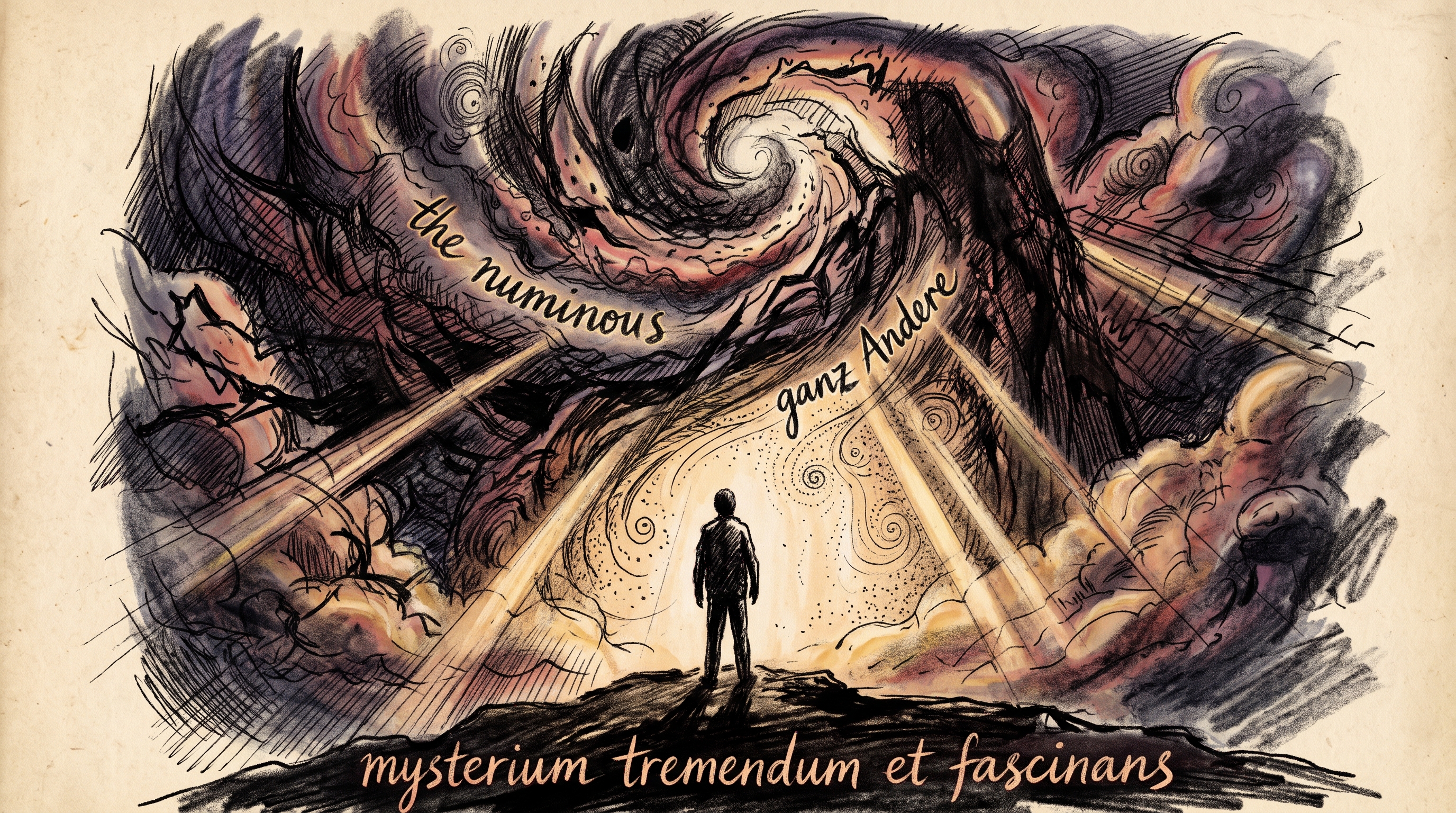
In modern religious phenomenology, philosophical theology, and comparative religion, the systematic study of religious experience is anchored by two towering twentieth-century frameworks: German theologian Rudolf Otto's The Idea of the Holy (Das Heilige, 1917) and Romanian-born historian of religions Mircea Eliade's Patterns in Comparative Religion (1949) and The Sacred and the Profane (1957). Otto approaches religious experience from an interior, psychological, and epistemological horizon, isolating an irreducible, non-rational category of mind coined the numinous—an encounter with the transcendent "wholly other" (ganz Andere) characterized by the polar dynamic of awe and attraction (mysterium tremendum et fascinans). In direct historical and morphological complement, Eliade shifts the analytical terrain from subjective affect to objective ontological structures, examining how the sacred breaks through profane reality via hierophanies, organizing physical space around an axis mundi and cyclical time through the ritual reenactment of cosmogonic myths (illud tempus). Together, Otto and Eliade establish that the sacred is not a derivative byproduct of social utility or moral duty, but a foundational, sui generis structure of human consciousness and reality.
1. The Dual Horizons of Religious Phenomenology
At the turn of the twentieth century, the intellectual investigation of religion was threatened by two powerful reductionisms:[1][2]
- Rationalistic Moralism: Rooted in post-Enlightenment theology and Neo-Kantianism (exemplified by Albrecht Ritschl), this view reduced the divine to a bundle of conceptual predicates and equated religion almost exclusively with ethical duty and civic morality (as critiqued in Good Taste and Naïve Realism and Religion vs. Spirituality).[1:1]
- Naturalistic and Sociological Functionalism: Championed by positivist sociology—most notably David Émile Durkheim (1858–1917) in Durkheimian Sociology—and evolutionary anthropology (James George Frazer, E.B. Tylor), which treated religion as a socio-biological mechanism, explaining away sacred reverence as nothing more than hypostasized social solidarity (collective effervescence) or primitive pseudo-science.[2:1][3]
Against these paradigms, Rudolf Otto and Mircea Eliade mounted a rigorous defense of religion as a sui generis phenomenon—an autonomous mode of human experience and reality that cannot be dissolved into sociological, psychological, or ethical categories without losing its essential nature.[1:2][2:2]
Yet their methodologies approached this shared conviction from opposite ends of the phenomenological spectrum:[1:3][4]
- Rudolf Otto (Subjective Psychology of Encounter): Operates from the inside out, investigating the non-rational, pre-reflective states of consciousness that seize the human subject when confronted by divine presence.[1:4]
- Mircea Eliade (Objective Morphology of Manifestation): Operates from the outside in, charting the universal patterns, spatial geometries, cosmic symbols, and ritual cycles through which the sacred objectifies itself within human history and culture.[2:3][4:1]
2. Rudolf Otto: The Numinous and the Psychology of Encounter (1917)
In Das Heilige (1917; translated into English in 1923 as The Idea of the Holy), German Lutheran theologian and Marburg scholar Rudolf Otto undertook an epistemological and psychological recovery of the non-rational factor in divine experience.[1:5]
Intellectual Foundations
Otto developed his framework through a convergence of three distinct intellectual traditions:[1:6][5]
- Friedrich Schleiermacher’s Romantic Intuition: Schleiermacher’s 1799 treatise On Religion: Speeches to its Cultured Despisers insisted that religion is grounded in feeling (Gefühl) and intuition of the infinite, rather than metaphysical dogma or moral action.[5:1]
- Jakob Friedrich Fries’s Epistemology of Ahndung: Otto drew on post-Kantian philosopher J.F. Fries to argue for an innate mental faculty—Ahndung (aesthetic-religious inkling or premonition)—capable of apprehending genuine transcendent reality beyond empirical sense-data and discursive concepts.[6]
- Cross-Cultural Comparative Travels: Extensive fieldwork in North Africa, India, Japan, and China (1911–1912) exposed Otto to Bhakti Hinduism, Sanskrit scriptures, and Zen Buddhism, convincing him that an identical experiential core underpins world traditions prior to theological schematization (resonating with the contemplative frameworks of Two Kinds of Nothingness-Astrophysics and Buddhist Philosophy and Perennial Philosophy).[7]
The Rational vs. The Non-Rational Divine
Otto distinguishes sharply between the rational and non-rational dimensions of religion:[1:7]
- The Rational Dimension: Concepts that can be clearly grasped by discursive thought and translated into linguistic definitions—such as divine spirit, omnipotence, supreme goodness, purpose, and personhood.[1:8] While orthodox theologies rightly affirm these predicates, they remain secondary attributes attached to an underlying mystery that exceeds conceptual capture.[1:9]
- The Non-Rational Dimension (Das Irrationale): The primordial, unnamable experiential reality that eludes discursive categories.[1:10]
In modern European languages, the word "holy" (heilig, sacred) has been completely moralized, functioning as a synonym for moral perfection or ethical goodness.[1:11] To strip away this secondary moral overlay and isolate the primordial, non-rational factor, Otto coined the term the numinous (derived from the Latin numen, meaning a divine nod, commanding presence, or presiding spiritual power, by analogy with omen / ominous).[1:12]
Creature-Consciousness (Kreaturgefühl) vs. Absolute Dependence
Otto directly challenges Schleiermacher’s famous definition of religion as the "feeling of absolute dependence" (schlechthinniges Abhängigkeitsgefühl):[1:13]
- The Flaw of Subjectivism: Schleiermacher located the feeling in self-consciousness, treating God as a secondary inference deduced from one's own sense of limitation.[1:14]
- Quantitative Scaling: By calling it "dependence," Schleiermacher merely inflated an ordinary worldly emotion into an "absolute," failing to recognize that sacred encounter is qualitatively different from natural helplessness.[1:15]
In response, Otto formulates the concept of creature-consciousness or creature-feeling (Kreaturgefühl):[1:16]
- Creature-consciousness is the subjective shadow cast by an immediate, objective apprehension of the numen outside the self.[1:17]
- It is the feeling of a creature submerged in its own ontological nothingness, trembling before that which is supreme above all creatures.[1:18] Otto cites Abraham's intercession in Genesis 18:27 as its archetype: "Behold now, I have taken upon me to speak unto the Lord, which am but dust and ashes."[1:19] (This ego-dissolution directly mirrors the neurobiological deactivation of self-referential narrative identity in the Default Mode Network (DMN) and the contemplative openings explored by Iain McGilchrist).
Anatomy of the Mysterium Tremendum et Fascinans
The conceptual core of The Idea of the Holy is Otto’s phenomenological dissection of the numinous complex into the formula mysterium tremendum et fascinans:[1:20]
| Analytical Dimension | Experiential Meaning | Affective Moments | Archetypal Manifestations |
|---|---|---|---|
| Mysterium | The Wholly Other (Das ganz Andere); ineffable transcendence beyond conceptual categories. | Stupor (stupor), blank wonder, speechless arrest before the unclassifiable. | The esoteric veil, cosmic void, absolute ontological alterity, mystical nothingness. |
| Tremendum | The Repelling Pole; daunting, terrifying majesty that humbles creaturely pride. | 1. Awfulness (daemonic dread / shuddering), 2. Overpoweringness (majestas / unapproachable might), 3. Energy / Urgency (energicum / volcanic vitality). | The Wrath of God (ira Dei), consuming fire, volcanic eruption, annihilation of the finite ego. |
| Fascinans | The Attracting Pole; irresistible, magnetic allure evoking blissful longing. | Rapture, beatitude, Dionysian intoxication, yearning for communion, peace that passes understanding. | Divine love, grace, mercy, atonement, salvation, mystical union (unio mystica), shanti or nirvana. |
1. Mysterium (The Wholly Other)
The mysterium is not merely an intellectual puzzle awaiting a scientific solution; it is that which is intrinsically alien to the everyday world—the wholly other (das ganz Andere).[1:21] It confronts human consciousness with stupor—not psychological confusion, but an utter, speechless arrest of the intellect before that which transcends all creaturely analogies (an altered state bordering the ontological ruptures analyzed in Louis Sass - Phenomenological Psychopathology and the Self).[1:22]
2. Tremendum (The Repelling Element)
The tremendum expresses the daunting, terrifying aspect of the holy, comprising three structural moments:[1:23]
- Daemonic Dread (Tremor): The primordial root of religious shuddering (deîma panikón), distinct from natural fear. It causes the flesh to creep and the blood to run cold.[1:24] (Phenomenologically, this contrasts sharply with Sigmund Freud's uncanny, where dread arises from a familiar, repressed impulse resurfacing; Otto's numinous dread arises precisely from that which is fundamentally non-human, transcendent, and alien). In mature theism, this raw dread is sublimated into the Wrath of God (ira Dei / orgē)—an unpredictable, volcanic energetic force that operates like stored-up lightning before being moralized into judicial justice.[1:25]
- Overpoweringness (Majestas): The consciousness of absolute ontological plenitude and supreme power. In the presence of majestas, the human ego experiences its own radical insignificance, culminating in the mystical desire for self-extinction (annihilation).[1:26]
- Energy or Urgency (Energicum): The numinous is never static or inert; it pulsates with supreme vitality, movement, passion, and force. It is the "living God," the consuming flame celebrated by Jacob Boehme and Johann Wolfgang von Goethe (1749-1832).[1:27]
3. Fascinans (The Attracting Element)
Simultaneously with the terror of the tremendum, the numinous exerts a potent, intoxicating attraction.[1:28] This polar harmony (coincidentia oppositorum) between dread and desire is the supreme hallmark of religious encounter (directly reflecting Goethe's Metaphysics of Polarity):[1:29]
- While the tremendum drives the trembling creature away in horror, the fascinans draws the soul inward with ecstatic allure, transport, and beatitude.[1:30]
- In early religious stages, this manifests as magical attempts to seize the numen's power; in mature mysticism, it flowers into the Dionysian element—the longing for salvation, divine grace, communion, and the eternal peace of nirvana (resonating with the romantic longing of Sehnsucht and Nietzsche's Dionysian transport).[1:31]
Schematization and the A Priori Category of the Holy
How does this terrifying, non-rational force relate to rational ethics and theological doctrines? Borrowing Immanuel Kant’s epistemological concept of schematization—where pure mental categories are mediated to sensory experience via temporal schemata—Otto argues that the non-rational numinous is synthetically bound to rational and moral concepts:[1:32][5:2]
| Non-Rational Numinous Moment | Rational / Moral Schema | Resulting Complex Religious Concept |
|---|---|---|
| Tremendum (Daemonic Dread & Wrath) | Moral Retribution & Divine Justice | Righteous Holiness & Ethical Judgment |
| Majestas (Overpowering Might) | Rational Causality & Supreme Rule | Divine Omnipotence & Cosmic Sovereignty |
| Mysterium (The Wholly Other) | Transcendence of Sensory Limits | Absolute Infinity & Omniscience |
| Fascinans (Ecstatic Allure & Beatitude) | Benevolence, Goodwill & Mercy | Divine Love, Grace, & Redeeming Pity |
| The Numinous Complex (Total Synthetic Unity) | Rational & Moral Perfection | The Holy (Sanctus / Qadosh / Hagios) |
Otto insists that the connection between the numinous and the moral is not an accidental historical association, but an a priori synthetic necessity embedded within the human spirit: the divinatory faculty (Vermögen der Divination) or sensus numinis.[1:33][6:1] External natural stimuli (thunder, dark forests, mountain abysses) do not generate religion; rather, they serve as occasions that awaken the dormant a priori category within the mind.[1:34]
Aesthetic Media of Awakening: The Sublime, Darkness, and Silence
Because the numinous cannot be taught through propositional syllogisms (non doceri potest), it can only be awakened through indirect symbolic media and ideograms:[1:35]
- The Sublime: Following Kant and Edmund Burke, Otto identifies aesthetic sublimity (vast mountain peaks, roaring cataracts, starry infinities) as the primary natural schema of the numinous, staging the identical balance of terror and awe.[1:36]
- Darkness and Semi-Gloom: In sacred architecture (such as Gothic cathedrals and Hindu cave temples), semi-darkness obscures physical boundaries, evoking the mysterious unapproachability of the mysterium (analyzed across Aesthetics in Religion and contrasted with modern alienation in Anthony Vidler-The Architectural Uncanny).[1:37]
- Silence: The pregnant stillness of liturgical rites (the Catholic elevation of the Host, Quaker silent meetings) externalizes creaturely arrest before divine presence.[1:38]
- Emptiness: In Chinese Daoist landscape painting, Zen rock gardens, and Islamic mosque courtyards, vast horizontal expanses evoke the "wholly other" through the material presence of nothingness (paralleling The Core Instruction - Turning the Gaze Inward and Two Kinds of Nothingness-Astrophysics and Buddhist Philosophy).[1:39][7:1]
3. Mircea Eliade: The Morphology of the Sacred and the Profane (1949/1957)
While Otto explored the subjective emotional intensities of holy encounter, Romanian comparative religion scholar Mircea Eliade shifted the analytical lens to objective cultural morphology in Patterns in Comparative Religion (1949) and The Sacred and the Profane (1957).[2:4][4:2]
The Ontological Bifurcation of the World
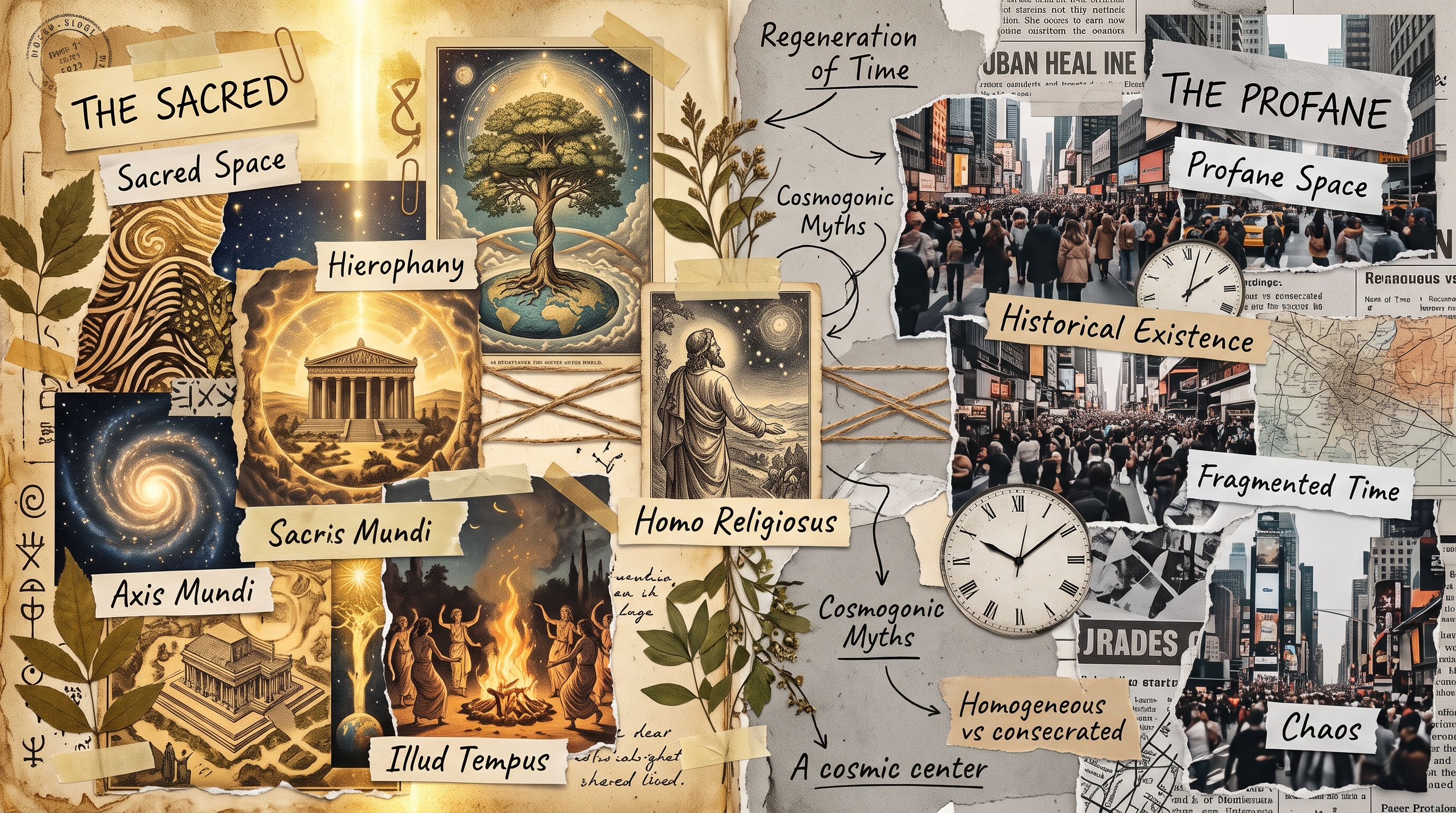
For Eliade, the world as experienced by religious humanity (homo religiosus) is never homogeneous or neutral.[2:5] Rather, it is fractured into two mutually exclusive, radically opposed ontological modes of being:[2:6]
- The Sacred: The sphere of absolute reality, permanence, power, cosmic order, and ultimate meaning.[2:7]
- The Profane: The sphere of ordinary, ephemeral, homogeneous, and historical existence—characterized by chaotic flux, contingency, and illusion.[2:8]
"Man becomes aware of the sacred because it manifests itself, shows itself, as something wholly different from the profane. To designate the act of manifestation of the sacred, we have proposed the term hierophany." — Mircea Eliade, The Sacred and the Profane[2:9]
Hierophany and Cratophany
Eliade coins the term hierophany (from the Greek hieros, "sacred," and phainein, "to reveal" or "bring to light") to denote any act whereby the sacred manifests itself through physical reality.[2:10]
- The Dialectics of the Hierophany: When an ordinary material object—a stone, a tree, an animal, or a river—becomes the vessel of a hierophany, a profound paradox occurs. The object ceases to be merely profane, becoming saturated with transcendent reality, while simultaneously remaining physical.[2:11] A sacred stone remains materially a stone to external inspection, yet for the believer, its empirical surface has been transmuted into an aperture to the divine (prefiguring the embodied "sensational forms" analyzed by Birgit Meyer and the sacramental perception in Hans Urs von Balthasar (1905–1988)).[2:12][8]
- Cratophany and Ontological Power: For archaic consciousness, the sacred is inextricably synonymous with power (kratos) and reality (being) (a relational dynamic shared with Animism).[2:13] The sacred is that which is saturated with efficacy and durability.
- Ontological Thirst: Because the profane realm is unstable, ephemeral, and threatened by non-being, homo religiosus is gripped by a desperate "ontological thirst"—an existential yearning to participate in absolute reality, escape the meaningless flux of historical becoming (the absurdity diagnosed by Albert Camus), and anchor human life in the eternal structures of the cosmos.[2:14]
Sacred Space and the Axis Mundi
In the profane mode of being, space is completely homogeneous and neutral—a geometric continuum where every point is qualitatively identical to every other.[2:15] For religious humanity, however, space is radically non-homogeneous; it is interrupted by qualitative ruptures and cosmic fissures:[2:16]
             [ HEAVEN / TRANS-HUMAN REALM ]
                           ▲
                           │  (Cosmic Communication)
                           │
      ═════════════════════╪═════════════════════  ◄── Surface of Consecrated Cosmos
             CHAOS  ◄─── [CENTER] ───►  CHAOS
                           │    (Axis Mundi)
                           │
                           ▼
          [ CHTHONIC / UNDERWORLD DOMAIN ]
- Cosmos vs. Chaos: Consecrated space constitutes "Cosmos"—the organized, ordered, habitable world consecrated by the gods. Beyond its borders lies "Chaos"—the profane, formless wilderness populated by demons, monsters, and foreigners who mirror the unformed state of reality prior to Creation.[2:17]
- The Center of the World and the Axis Mundi: Every consecrated sacred precinct functions as the "Center of the World." At this center stands the axis mundi (the cosmic pillar, sacred mountain, World Tree, or temple tower) connecting the three cosmological tiers: Heaven, Earth, and the Underworld.[2:18][9] Through this vertical axis, passage between human and divine realms becomes operational, establishing the ritual thresholds articulated by Arnold van Gennep (1873–1957).[2:19]
- Cosmogony as the Exemplary Template: Whenever homo religiosus founds a city, erects a dwelling, or establishes an altar, the act is never a purely functional construction. It is a ritual repetition of the primordial cosmogony (the creation of the universe by the gods). By driving a central pole into the earth or performing a foundation rite, humanity transforms unformed Chaos into an ordered Cosmos.[2:20]
Sacred Time, Illud Tempus, and the Eternal Return
Just as space is fractured into heterogeneous zones, temporal duration is split into two incompatible registers:[2:21][4:3]
- Profane Time: Ordinary, historical duration. It is linear, irreversible, and driven by wear, decay, and death (embodying the thermodynamic march of Entropy and Time as Change).[2:22][4:4]
- Sacred Time: The liturgical time of festivals and rituals. Crucially, sacred time is circular, reversible, and eternal—a primordial mythical time made present.[2:23][4:5]
Illud Tempus and the Abolition of History
In ritual celebration, the community does not merely commemorate a past historical event; it re-enters illud tempus ("that time" / in illo tempore)—the mythical era ab origine when the cosmos or social institutions were first brought into being by divine creators.[2:24][4:6]
- In his landmark study The Myth of the Eternal Return (1949), Eliade identifies the "terror of history": archaic humanity’s deep-seated dread of irreversible, meaningless historical suffering.[4:7]
- By periodically abolishing linear duration through cyclical new-year rites (dissolving old forms, extinguishing fires, and ritually regenerating the cosmos), traditional humanity periodically purges the wear-and-tear of historical time, starting existence fresh with full ontological vitality.[2:25][4:8]
Myth as the Exemplary Model (Imitatio Dei)
For Eliade, myth is never an idle fiction or primitive fairy tale; it is a sacred history detailing how reality came to be.[2:26][10] Because divine beings established every meaningful human practice, myth provides the exemplary archetype for all human activities—agriculture, sexuality, architecture, warfare, and dining.[2:27][10:1] To be authentic is to imitate the gods (imitatio dei), an archetypal vision that links directly to Carl Jung's analytical psychology, Joseph Campbell and the Hero's Journey, and Northrop Frye's archetypal literary theory.[2:28]
Cosmic Sacrality and Modern Camouflaged Sacrality
For homo religiosus, nature is never merely "natural"; it is transparent to the divine:[2:29]
- Ouranian Hierophanies: The celestial vault directly manifests infinite transcendence and supreme majesty simply through its towering height.[2:30]
- Aquatic Hierophanies: Waters represent the primeval reservoir of all virtualities (fons et origo); immersion dissolves form (symbolic death/cleansing), while emersion reenacts cosmogonic creation.[2:31]
- Terra Mater: The earth is experienced as the universal mother, uniting vegetative fertility and human childbirth into a shared cosmic mystery.[2:32]
Modernity and the Return of the Repressed Sacred
In modern secular society, humanity claims to have achieved total desacralization, casting off transcendent anchors to become purely historicist subjects who make their own history (a cultural shift analyzed in The Work of Art in the Age of Mechanical Reproduction as the destruction of ritual aura).[2:33]
Yet Eliade insists that a purely profane existence is impossible.[2:34] Because modern secular humans descend from homo religiosus, the sacred cannot be annihilated; it merely retreats into the unconscious, re-emerging in camouflaged myths and degraded rituals:[2:35][11]
- Secular Rites: New Year’s celebrations, birthdays, and housewarmings preserve the ancient cosmogonic structure of spatial consecration and cyclical renewal (as traced in The Secularization of Religious Holidays).[2:36]
- Mass Media and Narrative: Cinema, popular literature, and superhero comics stage ancient initiatory trials and the primordial battle between Cosmos and Chaos (mirroring Joseph Campbell and the Hero's Journey and Don DeLillo Major Themes Analysis).[2:37][10:2]
- Political Ideologies: Marxism secularizes Judeo-Christian eschatology—casting the proletariat as the suffering righteous redeemer, the capitalist crisis as the apocalyptic final battle, and communism as the Golden Age at the end of history.[2:38]
In Eliade's famous aphorism, the sacred is not a temporary stage in cultural evolution, but an indelible element in the structure of human consciousness.[11:1]
4. Comparative Synthesis: Otto vs. Eliade
| Comparative Dimension | Rudolf Otto (The Idea of the Holy, 1917) | Mircea Eliade (The Sacred and the Profane, 1957) |
|---|---|---|
| Disciplinary Locus | Philosophical theology, epistemology, and psychology of religion | History of religions, comparative mythology, and religious morphology |
| Primary Masterwork | Das Heilige (1917) | Patterns in Comparative Religion (1949); The Sacred and the Profane (1957) |
| Epistemic Starting Point | Subjective Encounter: Affective, pre-reflective states of consciousness | Objective Manifestation: Structural patterns and cosmic spatial-temporal forms |
| Foundational Concept | The Numinous (das Numinose); strictly sui generis value | Hierophany; the dialectical manifestation of the sacred in physical matter |
| Core Affective Polarity | Mysterium tremendum et fascinans (daemonic dread vs. intoxicating allure) | Cosmos vs. Chaos; consecrated order vs. formless profane dissipation |
| Ontological Status | Transcendent "Wholly Other" (ganz Andere) confronting finite creaturehood | Pure being and absolute reality (being) confronting ephemeral becoming |
| Orientation to Nature | Nature as external trigger/ideogram awakening the latent a priori faculty | Nature as hierophanic vessel; cosmic sacrality (sky, water, earth) |
| Spatial Manifestation | Evoked through negative aesthetic media: darkness, semi-gloom, silence, emptiness | Structured around the axis mundi and the consecrated Center of the World |
| Temporal Dynamic | Eternal present of mystical encounter; suspension of discursive time | Cyclical Reversibility: Ritual return to mythical primordial time (illud tempus) |
| Diagnosis of Modernity | Atrophy of the divinatory faculty via rationalization and ethical reduction | Desacralization and historicism, offset by ubiquitous camouflaged sacrality |
| Primary Reductionist Foil | Kantian ethical rationalism (Ritschl) & Schleiermacher's subjective feeling | Durkheimian sociological functionalism & Marxist economic determinism |
5. Critical Receptions, Revisions, and Contemporary Interrogations
Both monographs reshaped twentieth-century humanities, yet each ignited enduring scholarly controversies:[1:40][2:39][5:3]
1. The Theological Clash: Barth vs. Tillich
- Karl Barth and Dialectical Neo-Orthodoxy: While Barth welcomed Otto's assault on liberal Protestant moralism and praised his concept of God as the ganz Andere, he vehemently rejected Otto's assertion of an innate human a priori religious faculty (sensus numinis).[5:4] For Barth, locating a capacity for revelation within human consciousness was a dangerous return to natural theology, undermining the sovereign, unmerited self-disclosure of God in Jesus Christ.[5:5]
- Paul Tillich and Existential Correlation: Conversely, Tillich integrated Otto’s mysterium tremendum into his existential theology, defining God as the "Ground of Being" and religion as the state of being grasped by an "Ultimate Concern" (echoing Søren Kierkegaard's dread and faith).[12]
2. Depth Psychology: Carl Jung and Archetypal Numinosity
- Carl Gustav Jung adopted Otto’s term "numinous" as an indispensable empirical category of analytical psychology.[13] For Jung, an encounter with an archetype from the collective unconscious carries an autonomous, overwhelming affective charge that seizes the conscious ego, providing the energetic engine for individuation.[13:1]
- Similarly, Jung's analysis of mandalas as symbols of psychic wholeness and the Self directly validates Eliade’s morphology of the axis mundi and the Center of the World.[13:2]
3. The Constructivist Epistemological Critique
In the late twentieth century, constructivist philosophers of religion (led by Wayne Proudfoot and Steven T. Katz) mounted a devastating challenge against the phenomenological premise of a pure, universal, pre-linguistic religious experience:[14]
- Proudfoot argued in Religious Experience (1985) that Otto's appeal to "ineffability" and "irreducibility" is an intellectual protective strategy designed to immunize theological claims from empirical critique.[14:1]
- Constructivists maintain that human experiences do not occur in an unmediated vacuum; all affective states—including numinous dread or sacred awe—are inherently constituted, structured, and interpreted in advance by cultural language, doctrinal concepts, and social training.[14:2]
4. Anthropological Materialism: Birgit Meyer and "Sensational Forms"
Contemporary scholars of material religion, notably anthropologist Birgit Meyer, critique Otto’s post-Romantic tendency to treat physical objects merely as transparent, disposable shells for disembodied interior feelings.[2:40][8:1]
- Meyer argues that divine presence is never unmediated; rather, the sacred is actively produced, authenticated, and experienced through authorized "sensational forms"—concrete bodily rituals, visual icons, architectural thresholds, and media technologies that tune the human sensorium.[8:2]
- While honoring Eliade’s insight that physical matter becomes the vessel of the sacred, contemporary materialists reject Eliade's ahistorical, universalist archetypes, demonstrating that sacred objects are embedded in shifting configurations of political power and colonial history.[8:3]
🎴 Interactive Web Practice (Comprehension Check)
Question 1 (Otto's Numinous vs. Eliade's Hierophany): How do Rudolf Otto and Mircea Eliade fundamentally differ in their starting points for analyzing the sacred, and how does Otto's mysterium tremendum et fascinans complement Eliade's axis mundi?
Answer: Rudolf Otto and Mircea Eliade represent the two complementary poles of twentieth-century religious phenomenology:
- Otto's Interior Psychology of Encounter: Otto begins from the subjective, non-rational states of consciousness that seize the human individual when confronted by divine presence. His core category is the numinous, an irreducible, sui generis mental state structured by the dialectical tension of the mysterium tremendum et fascinans—a terrifying, overpowering majesty (tremendum) that simultaneously exerts an ecstatic, irresistible attraction (fascinans) before the ineffable "Wholly Other" (ganz Andere).
- Eliade's Objective Morphology of Manifestation: Eliade shifts the analytical terrain from internal psychological affect to external cultural and spatial forms. His foundational category is the hierophany—the historical act by which the sacred manifests itself through ordinary physical objects (stones, trees, waters) without destroying their empirical nature.
- Structural Complementarity: While Otto identifies the raw psychological and experiential energy of the holy (the visceral shudder of creature-consciousness before overpowering majesty), Eliade explains how that overwhelming power is anchored and stabilized within human civilization through the axis mundi—a cosmic pillar at the Center of the World that opens communication between Heaven, Earth, and the Underworld, transforming unformed, terrifying Chaos into an ordered, habitable Cosmos.
Question 2 (Creature-Consciousness vs. Ontological Thirst): Contrast Rudolf Otto's concept of creature-consciousness (Kreaturgefühl) with Mircea Eliade's concept of ontological thirst. What existential problem does each address?
Answer: Both concepts articulate the fundamental posture of human beings before transcendent reality, but from opposing existential directions:
- Otto's Creature-Consciousness (Kreaturgefühl): Formulated as a direct critique of Schleiermacher's "feeling of absolute dependence," creature-consciousness is the subjective shadow cast by an immediate encounter with the numinous majestas outside the self. It is the overwhelming awareness of one's own radical unworthiness, finitude, and nothingness—epitomized by Abraham declaring himself "but dust and ashes." It addresses the human illusion of autonomy, shattering the ego's pride before the absolute reality of the divine.
- Eliade's Ontological Thirst: Arises from the acute anxiety experienced by homo religiosus when confronted by the profane world—a realm characterized by ephemeral becoming, meaningless historical flux, decay, and non-being. "Ontological thirst" is the desperate existential craving to participate in true, immutable being, to dwell within absolute reality, and to saturate human action with cosmic permanence by imitating divine archetypes.
Question 3 (Schematization vs. The Myth of the Eternal Return): How does Otto explain the relationship between non-rational awe and moral theology, and how does Eliade's illud tempus resolve the "terror of history"?
Answer: Otto and Eliade address the relationship between transcendent reality and human temporal/moral life through distinct mechanisms:
- Otto's Epistemological Schematization: Adapting Immanuel Kant's theory of schemata, Otto argues that the raw, non-rational moments of the numinous are synthetically connected to rational, ethical concepts through an innate a priori category (the divinatory faculty). Thus, the terrifying tremendum (daemonic wrath) is moralized into divine justice; overpowering majestas is schematized into sovereign omnipotence; and ecstatic fascinans is transformed into divine love, benevolence, and redeeming grace. This schematization turns the raw, terrifying numen into the ethically integrated concept of "The Holy."
- Eliade's Illud Tempus and the Abolition of Time: Archaic humanity suffers from the "terror of history"—the anxiety caused by irreversible linear time filled with unpredictable, meaningless suffering and death. Traditional cultures resolve this through ritual re-entry into illud tempus ("that mythical time" ab origine). By ritually repeating cosmogonic myths during annual festivals, the community periodically destroys historical time and regenerates the cosmos anew, washing away historical guilt and physical weariness to begin existence fresh in the primordial fullness of creation.
Question 4 (The Survival of the Sacred in Modernity): Why do both Otto and Eliade reject the claim that modern secular society has successfully eradicated the sacred, and what evidence does Eliade provide for "camouflaged sacrality"?
Answer: Neither Otto nor Eliade accepts the positivist thesis that secularization represents the permanent obsolescence of the sacred:
- Otto's View: The capacity for religious apprehension is an innate, universal a priori category of human cognition (the sensus numinis). While intellectual rationalism and moralism can numb this faculty, it cannot be excised from the human psyche; it remains dormant, ready to be awakened by aesthetic sublimity, deep silence, darkness, or personal crisis.
- Eliade's View of Camouflaged Sacrality: Homo religiosus is the ancestor of modern humanity; therefore, the sacred is an indelible element in the structure of consciousness itself. Even when exiled from institutional religion, the sacred survives in disguised, desacralized forms across secular culture:
- Secular Rituals: New Year's celebrations, housewarmings, and birthdays retain the ancient ritual structure of periodic cosmic regeneration and spatial consecration.
- Narrative and Cinema: Novels, films, and comic books serve as modern "mythological repositories," reenacting initiatory ordeals, journeys to the underworld, and the cosmic struggle between order and monster-chaos.
- Political Ideologies: Totalitarian and secular movements replicate Judeo-Christian eschatology—Marxism, for instance, casts the proletariat as the suffering Messiah, capitalism as the demonic reign, and the revolution as the apocalyptic transition to an earthly paradise.
Resonant Notes
The following notes in the vault share direct thematic, sociological, and philosophical connections with Rudolf Otto and Mircea Eliade:
🔴 Phenomenology of the Sacred, Awe & The Sublime
- The Numinous — Vault conceptual anchor; provides the dedicated lexical and philosophical profile of Otto's coinages (numen, mysterium tremendum et fascinans, creature-consciousness), detailing its linguistic roots and psychological legacy.
- The Sublime — The primary aesthetic schema and natural analogue for the numinous; explores how unmasterable terrestrial and cosmic phenomena provoke the paradoxical harmony of terror and ecstatic elevation analyzed by Kant and Burke.
- Immanuel Kant-The Transcendental Sublime — Foundational epistemological foil; provides Otto with the framework of a priori categories and schematization, though Otto inverts Kant's rationalism to humble human intellect before the transcendent Ganz Andere.
- Edmund Burke-The Physiological Sublime — Somatic counterpart; investigates how physical scale, darkness, obscurity, and the threat of pain trigger visceral bodily contractions, supplying the physiological grounding for Otto's daemonic dread and tremor.
- Aesthetics in Religion — Comprehensive analytical companion; explores how human traditions deploy sacred architecture, semi-darkness, ritual silence, and sensory synesthesia to mediate both Otto's numinous awe and Eliade's consecrated spatial centers.
- Hans Urs von Balthasar (1905–1988) — Theological parallel; Balthasar’s theological aesthetics recovers divine glory (Herrlichkeit) as an objective form (Gestalt) that seizes the observer in enraptured transport, echoing Eliade's hierophany and Otto's fascinans.
- Goethe's Metaphysics of Polarity & Johann Wolfgang von Goethe (1749-1832) — Provides the dialectical machinery of coincidentia oppositorum; Goethe's polarity and demonic force (das Dämonische) illuminate how the numinous simultaneously repels in terror and allures in bliss.
- Sehnsucht — German Romantic yearning for an unattainable transcendent home, serving as the affective mirror to both Otto's mysterium fascinans and Eliade's existential "ontological thirst."
- Søren Kierkegaard — Existential theological kinship; Kierkegaard's concepts of "fear and trembling" and the suprarational leap of faith parallel Otto's non-rational holy and the radical shattering of human complacency.
🟡 Depth Psychology, Myth & Temporal Dialectics
- Carl Gustav Jung — Primary psychological heir; Jung adopted Otto's "numinous" as an empirical hallmark of archetypal encounters from the collective unconscious, while his analysis of mandalas mirrors Eliade's morphology of the axis mundi and psychic center.
- Joseph Campbell and the Hero's Journey — Mythological successor; draws directly on Eliade’s morphology of sacred time, cosmogonic myths, and ritual archetypes to chart the universal monomyth of separation, initiation, and return.
- Northrop Frye's - Anatomy of Criticism & Northrop Frye — Archetypal literary theory; structures Western literature around cyclical seasonal myths (mythoi), operationalizing Eliade's exemplary mythic models within secular narrative.
- Freud's The Uncanny (Das Unheimliche) & Sigmund Freud — Critical psychological foil; Freud's unheimlich is the dread triggered when a familiar repressed memory resurfaces, whereas Otto's numinous dread is provoked by that which is fundamentally alien (Ganz Andere); Eliade utilizes Freud's return of the repressed to explain modern camouflaged sacrality.
- Default Mode Network (DMN) — Neuroscientific correlate of creature-consciousness; the down-regulation of the brain's midline cortical hubs during profound awe, psychedelic ego-dissolution, and mystical absorption provides empirical backing for Otto's Kreaturgefühl.
- Iain McGilchrist — Cognitive architecture; aligns with Otto's dichotomy between rational schematization and non-rational encounter, showing how left-hemisphere categorization isolates predicates while right-hemisphere attention remains open to living, unmasterable presence.
- Louis Sass - Phenomenological Psychopathology and the Self — Investigates ontological shock, apophany, and altered awareness, clarifying the diagnostic boundary between psychotic hyper-salience and authentic numinous stupor.
- Albert Camus — Existential foil; while Camus insists on staring into the meaningless silence of the Absurd without appealing to transcendent comforting illusions, Eliade charts how homo religiosus escapes existential absurdity through the eternal return of myth.
- Time as Change & Entropy — Thermodynamic and physical contrast; modern physics defines time as linear, irreversible decay and entropy, which archaic societies systematically combated through the periodic ritual regeneration of illud tempus.
- Two Kinds of Nothingness-Astrophysics and Buddhist Philosophy & The Core Instruction - Turning the Gaze Inward — Contemplative parallels; Buddhist emptiness (śūnyatā) and mystical nothingness represent Eastern phenomenological realizations of Otto's Ganz Andere.
🟢 Sociology of the Sacred, Material Mediation & Ritual Space
- Birgit Meyer — Contemporary materialist and anthropological corrective; Meyer's ethnography of "sensational forms" challenges Otto's disembodied interiority, demonstrating that divine presence is actively generated, mediated, and authorized through material artifacts, bodily techniques, and media.
- David Émile Durkheim (1858–1917) & Durkheimian Sociology — Sociological reductionist foil; while Durkheim pioneered the radical dichotomy between the sacred and the profane, he reduced the sacred to collective effervescence and the self-worship of society, whereas Otto and Eliade defend the sacred as an autonomous, sui generis ontological category.
- Durkheimian Sociology and Reified Gestalt — Sociological companion; examines how incandescent encounters with the sacred crystallize into rigid, enduring dogmas and institutional structures that regulate human culture across generations.
- Arnold van Gennep (1873–1957) — Ritual morphological parallel; Gennep’s tripartite structure of rites of passage (separation, liminality, incorporation) directly informs Eliade's spatial thresholds and cosmic transitions between Chaos and Cosmos.
- The Secularization of Religious Holidays — Sociological verification; traces how sacred cyclical festivals lose their cosmogonic potency, transforming into commercialized civic holidays that preserve only degraded, cryptoreligious motifs.
- Religion vs. Spirituality — Contemporary sociological companion; contrasts historical institutional schematization (dogmatic creeds, liturgical laws) with the modern search for unmediated, personal encounters with the numinous.
- Animism — Cosmological horizon; explores relational worldviews where nature is saturated with spiritual agency and cosmic transparency, reflecting Eliade's hierophanic trees, waters, and stones.
- Anthony Vidler-The Architectural Uncanny — Spatial counterpoint; explores modern urban estrangement and rootlessness emerging precisely because secular architecture lacks the consecrated axis mundi and sacred center that anchored traditional settlements.
- The Work of Art in the Age of Mechanical Reproduction & Walter Benjamin (1892–1940) — Cultural-materialist foil; Benjamin traces how mass reproduction liquidates the magical "cult value" and ritual "aura" of traditional artifacts, mapping the historical path of desacralization analyzed by Eliade.
References
Rudolf Otto / The Idea of the Holy: An Inquiry into the Non-Rational Factor in the Idea of the Divine and Its Relation to the Rational / Translated by John W. Harvey / Oxford University Press (1923) / archive.org ↩︎ ↩︎ ↩︎ ↩︎ ↩︎ ↩︎ ↩︎ ↩︎ ↩︎ ↩︎ ↩︎ ↩︎ ↩︎ ↩︎ ↩︎ ↩︎ ↩︎ ↩︎ ↩︎ ↩︎ ↩︎ ↩︎ ↩︎ ↩︎ ↩︎ ↩︎ ↩︎ ↩︎ ↩︎ ↩︎ ↩︎ ↩︎ ↩︎ ↩︎ ↩︎ ↩︎ ↩︎ ↩︎ ↩︎ ↩︎ ↩︎
Mircea Eliade / The Sacred and the Profane: The Nature of Religion / Translated by Willard R. Trask / Harcourt, Brace & World (1959) / archive.org ↩︎ ↩︎ ↩︎ ↩︎ ↩︎ ↩︎ ↩︎ ↩︎ ↩︎ ↩︎ ↩︎ ↩︎ ↩︎ ↩︎ ↩︎ ↩︎ ↩︎ ↩︎ ↩︎ ↩︎ ↩︎ ↩︎ ↩︎ ↩︎ ↩︎ ↩︎ ↩︎ ↩︎ ↩︎ ↩︎ ↩︎ ↩︎ ↩︎ ↩︎ ↩︎ ↩︎ ↩︎ ↩︎ ↩︎ ↩︎ ↩︎
Émile Durkheim / The Elementary Forms of the Religious Life / Translated by Joseph Ward Swain / George Allen & Unwin (1915) / archive.org ↩︎
Mircea Eliade / The Myth of the Eternal Return: Cosmos and History / Translated by Willard R. Trask / Princeton University Press (1954) / press.princeton.edu ↩︎ ↩︎ ↩︎ ↩︎ ↩︎ ↩︎ ↩︎ ↩︎ ↩︎
Philip C. Almond / Rudolf Otto: An Introduction to His Philosophical Theology / University of North Carolina Press (1984) / uncpress.org ↩︎ ↩︎ ↩︎ ↩︎ ↩︎ ↩︎
Todd A. Gooch / The Numinous and Modernity: An Interpretation of Rudolf Otto's Philosophy of Religion / De Gruyter (2000) / degruyter.com ↩︎ ↩︎
Gregory D. Alles / Rudolf Otto: Autobiographical and Social Essays / De Gruyter (1996) / degruyter.com ↩︎ ↩︎
Birgit Meyer / Mediation and the Genesis of Presence: Toward a Material Approach to Religion / University of Utrecht Inaugural Lecture (2012) / uu.nl ↩︎ ↩︎ ↩︎ ↩︎
Mircea Eliade / Patterns in Comparative Religion / Translated by Rosemary Sheed / Sheed & Ward (1958) / archive.org ↩︎
Mircea Eliade / Myth and Reality / Translated by Willard R. Trask / Harper & Row (1963) / harpercollins.com ↩︎ ↩︎ ↩︎
Mircea Eliade / The Quest: History and Meaning in Religion / University of Chicago Press (1969) / press.uchicago.edu ↩︎ ↩︎
Paul Tillich / Systematic Theology, Volume 1 / University of Chicago Press (1951) / press.uchicago.edu ↩︎
Carl Gustav Jung / Psychology and Religion: West and East (Collected Works Vol. 11) / Princeton University Press (1969) / press.princeton.edu ↩︎ ↩︎ ↩︎
Wayne Proudfoot / Religious Experience / University of California Press (1985) / ucpress.edu ↩︎ ↩︎ ↩︎