The Hard Problem of Consciousness
🗂️ Interactive Notebook: Open Study Companion (Video Summary, Flashcards, Mind Map) ↗
The hard problem of consciousness, formulated by philosopher David Chalmers in 1995, addresses the explanatory mystery of why and how objective, physical brain processes give rise to subjective, first-person qualitative experiences (qualia).[1] Unlike the "easy problems" of consciousness—which investigate functional mechanisms such as attention, memory integration, and behavioral reportability—the hard problem asks why these neurobiological functions do not occur "in the dark," devoid of any inner felt quality.[1:1]
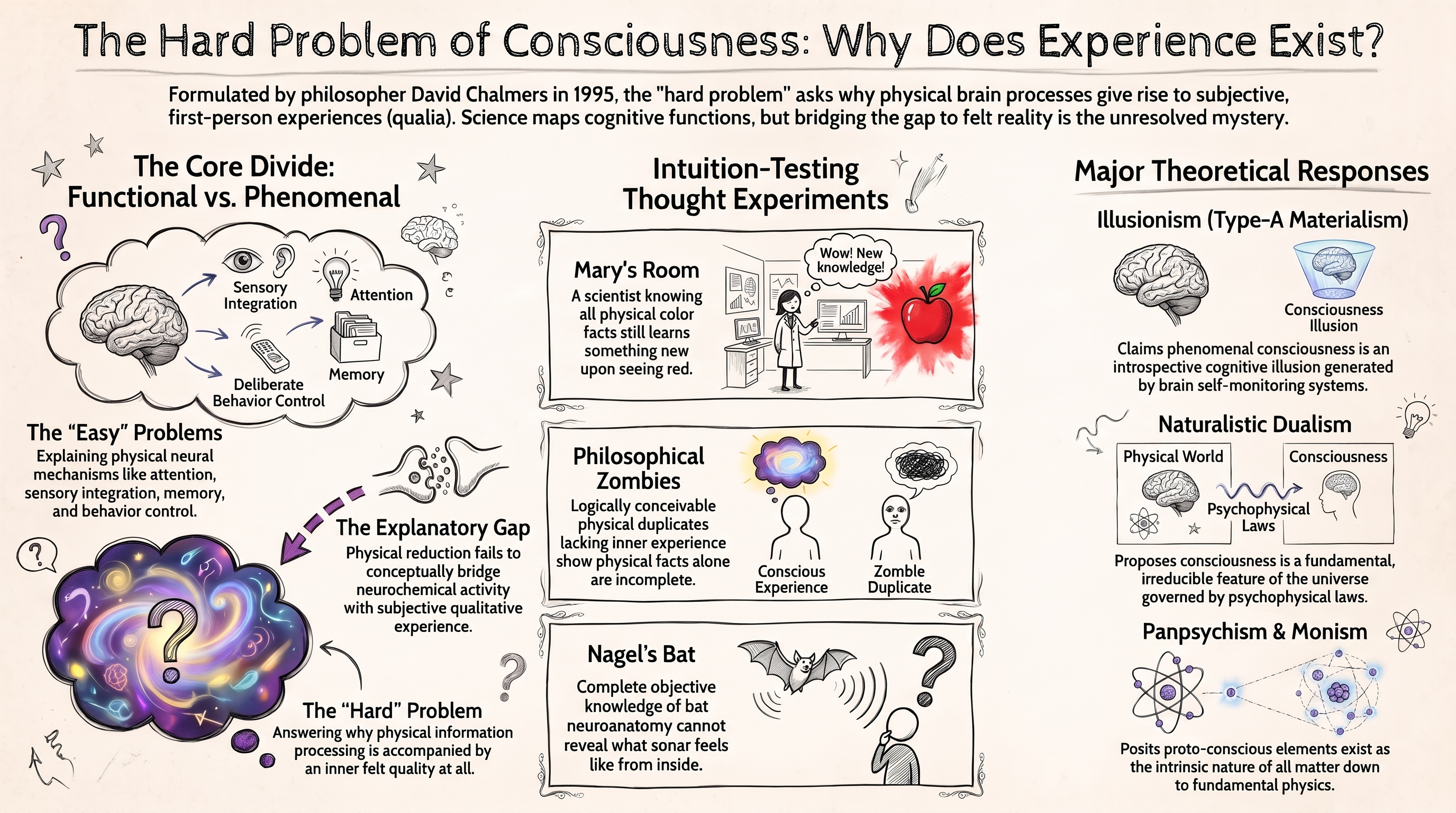
The Easy Problems vs. The Hard Problem
In his seminal 1995 paper "Facing Up to the Problem of Consciousness" and subsequent 1996 monograph "The Conscious Mind: In Search of a Fundamental Theory", David Chalmers divided consciousness research into two distinct categories to prevent cognitive science from conflating functional behavioral processing with subjective phenomenology.[1:2][2] This divide sits at the modern apex of The Mind-Body Dichotomy within Philosophy of Mind.
The Easy Problems of Consciousness
The "easy problems" are by no means simple; resolving them demands decades of rigorous experimental research in cognitive psychology, neurobiology, and computational modeling.[1:3] However, Chalmers designates them as "easy" in a conceptual sense: they are functional problems that fit squarely within the reductive methods of physical science.[1:4] To explain a cognitive function, researchers need only specify a physical or computational mechanism that performs the target task.[1:5]
Key examples of the easy problems include:
- Sensory Discrimination and Categorization: The biological mechanism by which sensory organs and neural networks react differentially to environmental inputs (explored in Perception vs. Apperception and Gestalt Psychology-The Mechanics of the Whole).[4]
- Information Integration: How the nervous system binds disparate sensory features—color, motion, acoustic pitch—into coherent mental representations (the classic Binding Problem examined in The Neuroscience of Consciousness).[5]
- Reportability of Mental States: The neural mechanisms that allow an organism to introspect its internal states and verbally articulate them.
- Focus of Attention: The attentional gating and precision-weighting mechanisms governing how the brain prioritizes specific signals over background noise (detailed in Bayesian Brain Hypothesis and William James).[6]
- Deliberate Control of Behavior: How executive neural circuits modulate voluntary motor output (cf. Deconstruction of the Central Controller).[7]
- The Wakefulness-Sleep Transition: The neurochemical and electrophysiological shifts in brainstem and thalamocortical networks that regulate arousal and coma states.[1:6]
The Hard Problem of Consciousness
The hard problem persists even after every functional, computational, and behavioral mechanism in the brain has been exhaustively mapped.[1:7] Once cognitive neuroscience explains how retinal wavelengths trigger visual cortex activity, how the amygdala signals threat, and how motor cortices execute a reflex, the central metaphysical puzzle remains intact: Why is the performance of these physical functions accompanied by an inner qualitative life?[1:8]
Why should electrochemical signaling inside three pounds of wet biological tissue feel like anything at all? Why couldn't a biological organism process environmental stimuli, avoid predators, and reproduce purely as an organic automaton operating on autopilot without an inner light of experience? Positing a mini-spectator inside the brain to "view" this inner movie commits the classic category mistake of the Ghost in the Machine dismantled by Gilbert Ryle (cf. Gilbert Ryle's-The Concept of Mind).[8]
| Dimension | The "Easy Problems" (Cognitive & Functional Mechanisms) | The "Hard Problem" (Phenomenal Qualia & Subjectivity) |
|---|---|---|
| Core Question | How does the brain process information, discriminate stimuli, and coordinate adaptive behavior? | Why and how does physical information processing give rise to subjective, first-person qualitative experience? |
| Explanatory Target | Cognitive functions: sensory integration, memory retrieval, attention gating, verbal report | Phenomenal consciousness (qualia): the felt redness of red, the sting of pain, raw experiential presence |
| Epistemic Method | Third-person objective science: neuroimaging, electrophysiology, computational modeling | First-person phenomenological analysis, conceptual rigor, and psychophysical bridging laws |
| Philosophical Foil | Complex computational architectures, robotic agents, and cybernetic feedback systems | The Philosophical Zombie (p-zombie)—a physically identical replica devoid of inner experience |
| Reductive Tractability | High; fully addressable via mechanistic decomposition and neural circuit mapping | Contested; resists standard functional reduction because function does not logically entail feeling |
"It is widely agreed that experience arises from a physical basis, but we have no good explanation of why and how it so arises. Why should physical processing give rise to a rich inner life at all? It seems objectively unreasonable that it should, and yet it does." — David Chalmers[1:9]
Core Conceptual Foundations
Qualia and Phenomenal Consciousness
At the core of the hard problem lies the concept of qualia (singular: quale)—the introspectively accessible, qualitative properties of conscious mental states.[3] Coined in its modern sense by C.I. Lewis and central to contemporary philosophy of mind, qualia describe "how things feel": the visceral burn of heat, the crisp aroma of eucalyptus, or the emotional ache of nostalgia.[3:1]
Philosopher Ned Block clarified this landscape by separating two concepts frequently conflated under the broad banner of "consciousness":[4]
- Phenomenal Consciousness (P-consciousness): Raw experiential feeling—what Thomas Nagel famously encapsulated as "what it is like" for an organism to be that organism.[4:1][5] P-consciousness represents the direct explanatory target of the hard problem.
- Access Consciousness (A-consciousness): The direct availability of mental representations for use in rational reasoning, speech production, and executive behavioral control.[4:2] While A-consciousness is functionally reducible and belongs to Chalmers's easy problems, P-consciousness resists straightforward functional translation.[1:10][4:3]
The boundaries between minimal affective feeling and higher-order reflective consciousness are systematically evaluated in Sentience vs. Consciousness.
The Explanatory Gap
In 1983, philosopher Joseph Levine introduced the concept of the explanatory gap to characterize the epistemic divide separating physical substrates from qualitative phenomenology.[6]
In standard scientific reductions, explaining the micro-mechanisms fully deduces and demystifies the macro-phenomenon:[2:1][6:1]
- Explaining the molecular structure and thermal motion of
transparently accounts for why water freezes at 0°C and boils at 100°C. - Explaining DNA base-pair replication transparently accounts for biological inheritance.
In consciousness studies, this transparent deduction breaks down.[6:2] Even if neurobiology provides a complete physical identity statement (e.g., "pain is the firing of C-fibers and anterior cingulate activation"), there remains no conceptual necessity linking the physical state to the phenomenal sensation.[6:3] A scientist can fully grasp the electrochemistry of nociception without understanding why that firing must feel agonizing rather than ticklish, or why it shouldn't occur without any phenomenal feeling whatsoever.[6:4]
Classical Thought Experiments
To isolate phenomenal consciousness from physical structure and functional behavior, philosophers deploy three renowned thought experiments designed to show that physicalist descriptions alone fail to exhaust mental reality.
1. Thomas Nagel's Bat: "What Is It Like to Be a Bat?" (1974)
In his landmark essay, Thomas Nagel argued that consciousness is intrinsically subjective, whereas physical science operates through objective, third-person descriptions.[5:1] Nagel selected the microchiropteran bat because it is an advanced mammalian species whose primary sensory interface—echolocation (sonar)—is fundamentally alien to human sensory physiology.[5:2]
Nagel pointed out that a human scientist could acquire exhaustive physical knowledge of bat neurobiology:
- Every acoustic receptor in the bat's ears.
- Every neural pathway in its auditory cortex and superior colliculus.
- Every motor feedback loop governing nocturnal flight.
Yet, even complete mastery of this physical data would never answer the fundamental question: what is it like for a bat to perceive the world through echolocation?[5:3] Human imaginative projections only tell us what it would be like for a human to fly in the dark; they cannot deliver the first-person phenomenal perspective of the bat itself.[5:4] Nagel concluded that physicalism cannot be defended until we have an intelligible framework explaining how objective physical properties could constitute subjective points of view.[5:5]
2. Frank Jackson's Knowledge Argument: Mary's Room (1982)
Frank Jackson framed the epistemic inadequacy of physicalism through the thought experiment of Mary, a brilliant neuroscientist imprisoned from birth in a black-and-white room and forced to investigate the outside world through a monochrome monitor.[7]
Mary specializes in the neurophysiology of vision and learns all the physical facts concerning human color perception:[7:1]
- The exact optical wavelengths (e.g., 700 nanometers for red).
- Retinal phototransduction mechanisms and cone opsin reactions.
- The transmission of action potentials through the optic nerve to lateral geniculate nuclei and cortical area V4.
- The muscular contractions required to say the sentence "the rose is red."
When Mary is released from her room and beholds a ripe red apple for the very first time, does she learn anything new?[7:2] Jackson argued that she undeniably learns a new fact: what it is like to see red.[7:3] Because she already possessed all physical information before her release, the new knowledge she gains must be non-physical (or at least non-deducible from physical facts alone), demonstrating that complete physicalism is incomplete.[7:4]
3. David Chalmers's Philosophical Zombies (The Conceivability Argument)
Expanded by Robert Kirk and formulated rigorously by David Chalmers, a philosophical zombie (p-zombie) is a hypothetical being that is physically, behaviorally, and functionally identical to a normal human being down to the exact subatomic particle, but possesses zero subjective experience (qualia).[1:11][2:2][8]
When pricked with a pin, a p-zombie's C-fibers fire, autonomic systems spike heart rate, and its vocal cords yell, "Ouch! That hurts!"—yet inside, there is no pain, no distress, and no phenomenal sensation.[2:3][8:1]
Chalmers's Conceivability Argument Against Physicalism:
1. Premise 1: Philosophical zombies are logically conceivable without contradiction.
2. Premise 2: If philosophical zombies are logically conceivable, they are metaphysically possible.
3. Premise 3: If philosophical zombies are metaphysically possible, phenomenal consciousness is not logically supervenient on physical properties alone.
4. Conclusion: Physicalism is false; consciousness requires an expanded ontology.
The goal of the argument is not to claim that zombies exist biologically, but that their logical coherence proves consciousness is not an automatic, logically entailed consequence of physical arrangement.[2:4]
Major Philosophical and Scientific Responses
Thinkers divide into five primary metaphysical and empirical camps depending on whether they accept the premises of the explanatory gap or reject them as conceptual confusions.
| Philosophical Camp | Core Ontological Thesis | Status of Qualia | Key Proponents | View on Machine Consciousness |
|---|---|---|---|---|
| Type-A Materialism (Illusionism & Eliminativism) | Denies the hard problem; solving the easy functional problems fully explains consciousness.[9] | Illusory; an introspective user-interface fiction generated by brain self-monitoring schemas.[10][11] | Daniel Dennett, Keith Frankish, Patricia Churchland | Substrate-neutral: AI models executing equivalent self-monitoring loops will produce identical reports. |
| Type-B Materialism (A Posteriori Physicalism) | Accepts the explanatory gap and conceivability of zombies, but denies that conceivability entails metaphysical possibility.[9:1] | Real, but strictly identical to physical brain states (a posteriori psychophysical identity).[4:4][6:5][9:2] | Ned Block, Brian Loar, Joseph Levine, Christopher Hill | Substrate-dependent: requires replicating the specific biological/physical substrates that instantiate phenomenal states. |
| Property Dualism & Naturalistic Dualism | Mind and matter are fundamental, distinct properties of a unified natural universe; requires psychophysical bridging laws.[1:12][2:5] | Irreducible, non-physical intrinsic properties supervening on physical substrates via fundamental laws.[2:6] | David Chalmers, Thomas Nagel | Possible if synthetic substrates instantiate the appropriate psychophysical organizational invariants. |
| Panpsychism & Russellian Monism | Mentality is the intrinsic, categorical nature of physical matter itself; physics describes only extrinsic mathematical relations.[12][13] | Fundamental; proto-phenomenal properties exist at the basic quantum/particle level and combine in brains.[12:1][13:1] | Bertrand Russell, Galen Strawson, Philip Goff | Dependent on how synthetic networks solve the "combination problem" of binding micro-experiences into a unified mind. |
| Mysterianism (Cognitive Closure) | Consciousness has a natural physical basis, but human cognitive architecture is evolutionarily closed to comprehending it.[14] | Real, but an epistemological horizon barred by the innate biological limits of human conceptual faculties.[14:1] | Colin McGinn, Noam Chomsky | Agnostic; we cannot construct or verify conscious machines if we cannot comprehend the psycho-physical nexus. |
1. Type-A Materialism (Illusionism and Eliminativism)
Thinkers in this camp argue that the hard problem is an intellectual mirage rooted in Cartesian intuitions.[9:3] Once all cognitive functions—attention, verbal reporting, internal state monitoring, and voluntary action—are scientifically accounted for, nothing remains to be explained.[9:4]
- Daniel Dennett's Multiple Drafts: Dennett argued that qualia are a philosophical invention resulting from an unexamined belief in the "Cartesian Theater"—a mythical central stage in the brain where sensations are displayed to an internal viewer.[10:1] Dennett contends that cognitive science must replace first-person phenomenology with heterophenomenology, treating subjective claims as narrative data rather than literal non-physical properties.[10:2]
- Keith Frankish's Illusionism: Frankish formalizes this critique by asserting that phenomenal consciousness is a functional illusion.[11:1] Just as a software operating system projects desktop icons to simplify internal hardware dynamics (an idea resonating with The Interface Theory of Perception (ITP)), the brain generates simplified quasi-phenomenal representations of its own neural events, tricking the introspecting subject into believing they possess ineffable, non-physical sensations.[11:2]
- Patricia Churchland's Neurophilosophy: Churchland argues that declaring consciousness intractable commits an "argument from ignorance" fallacy.[15] She parallels the hard problem to 19th-century vitalism, which claimed that biological "life" could never be explained by physical chemistry and required a mysterious élan vital.[15:1]
2. Type-B Materialism (A Posteriori Physicalism)
Type-B physicalists admit that an explanatory gap exists and that philosophical zombies are logically conceivable, but they deny that conceivability entails metaphysical possibility.[9:5]
Thinkers like Ned Block and Brian Loar argue that mental states are strictly identical to physical neurobiological states, much as water is identical to
3. Property Dualism and Naturalistic Dualism
David Chalmers rejected both reductive physicalism and Cartesian substance dualism (the idea of an immaterial soul), proposing instead Naturalistic Dualism.[1:13][2:7] Under this framework, the universe contains fundamental physical properties (mass, charge, spacetime) alongside fundamental phenomenal properties (qualia).[1:14][2:8]
Just as 19th-century physics had to expand its ontology to introduce electromagnetic fields as irreducible primitives when mechanical physics failed to account for Maxwell's equations, cognitive science must introduce fundamental psychophysical bridging laws that systematically link physical information processing to phenomenal experience.[1:15][2:9]
4. Panpsychism and Russellian Monism
Growing out of Bertrand Russell's 1927 critique of physicalism, Russellian Monism notes that physical science describes only the relational and mathematical properties of matter—how particles attract, repel, and distribute in spacetime—while remaining entirely silent on what matter is in itself (its intrinsic, categorical nature).[12:2][13:2]
Panpsychism posits that the intrinsic nature of physical matter is proto-experiential.[12:3][13:3] Rather than attempting to derive feeling from fundamentally unfeeling matter (an emergence miracle), panpsychism proposes that rudimentary mental properties exist at the subatomic level, which then combine into unified conscious subjects inside complex biological brains (confronting the ongoing philosophical challenge known as the "Combination Problem").[12:4][13:4]
5. Mysterianism (Cognitive Closure)
Formulated by Colin McGinn, New Mysterianism argues that the mind-body problem is insoluble not because consciousness is supernatural, but because human cognitive architecture has evolutionary boundaries.[14:2]
Just as a dog or chimpanzee is structurally "cognitively closed" to grasping quantum mechanics or differential calculus due to biological brain constraints, human beings—whose cognitive faculties evolved strictly for mammalian survival, tool manipulation, and social maneuvering—may lack the conceptual apparatus required to understand how physical brain tissue generates subjective experience.[14:3]
Leading Empirical Frameworks & The Hard Problem
While empirical neuroscience primarily investigates the Neural Correlates of Consciousness (NCC), contemporary neuroscientific paradigms attempt to address the hard problem through distinct architectural models:
| Framework | Key Thinkers | Core Neural Mechanism | Stance Toward the Hard Problem |
|---|---|---|---|
| Global Neuronal Workspace Theory (GNWT) | Bernard Baars, Stanislas Dehaene, Jean-Pierre Changeux | Non-linear "ignition" across frontoparietal networks broadcasting information globally.[16] | Solves Access Consciousness; critics argue it leaves the phenomenal "Hard Problem" unanswered.[1:16][16:1] |
| Integrated Information Theory (IIT) | Giulio Tononi, Christof Koch, Marcello Massimini | Physical cause-effect power quantified mathematically as integrated information ( | Directly confronts the hard problem by positing that irreducible causal integration is subjective experience.[17:1] |
| Predictive Processing & Active Inference | Karl Friston, Andy Clark, Anil Seth | Hierarchical top-down predictive simulation updated by sensory prediction errors.[18] | Sidesteps the hard problem in favor of the "Real Problem": explaining specific phenomenal properties via biological mechanisms.[18:1] |
| Higher-Order Theories (HOT) | David Rosenthal, Hakwan Lau, Richard Brown | Prefrontal meta-representations monitoring and indexing first-order sensory cortical states.[19] | Treats consciousness as higher-order introspective awareness, bridging sensation and conceptual apperception.[19:1] |
Global Neuronal Workspace Theory (GNWT)
GNWT models the brain as an ensemble of specialized, unconscious modules.[16:2] Information enters consciousness only when it crosses an activation threshold, triggering a non-linear "ignition" across long-range axons connecting the prefrontal cortex and parietal networks.[16:3] Once ignited, this information is broadcast globally across the brain, making it simultaneously accessible for working memory, motor planning, and verbalization.[16:4] Critics emphasize that GNWT explains access consciousness, leaving the phenomenal transition from broadcast to feeling unexplained.[1:17][4:6]
Integrated Information Theory (IIT)
IIT takes a radical, axiomatic path: instead of starting with brain anatomy, it starts with the self-evident phenomenological properties of experience (intrinsic existence, composition, information, integration, and exclusion) and mathematically deduces the causal architecture a physical substrate must possess to instantiate them.[17:2] Consciousness is measured as
Predictive Processing and The "Real Problem"
Championed by Anil Seth, predictive processing views the brain as an embodied Bayesian prediction machine (detailed in Bayesian Brain Hypothesis and Glitches in The Bayesian Brain).[18] Sealed inside the skull, the brain generates top-down generative models of the world to minimize prediction error, creating what Seth terms a "controlled hallucination."[18:2] Rather than stalling before the metaphysical hard problem, Seth advocates addressing the "Real Problem" of consciousness: mapping, predicting, and controlling the phenomenological characteristics of subjective states in terms of biological mechanisms, trusting that the metaphysical gap will gradually dissolve just as the mysteries of biological "life" dissolved with molecular genetics.[18:3]
🎴 Interactive Web Practice (Comprehension Check)
Question 1 (The Easy vs. Hard Problem Distinction): Why does David Chalmers argue that completely solving all the "Easy Problems" of cognitive neuroscience leaves the "Hard Problem" unresolved?
Answer: The Easy Problems concern the objective, mechanistic, and computational functions of the nervous system—such as sensory discrimination, information binding, attentional focusing, behavioral reportability, and voluntary motor output. These problems fit cleanly within the reductive framework of physical science, where explaining a phenomenon requires only specifying the physical or computational mechanism that performs the function. In contrast, the Hard Problem asks why and how the physical execution of these cognitive functions is accompanied by first-person subjective experience (qualia). Even if an exhaustive wiring diagram of every synapse and neurotransmitter were complete, physicalists would still face an explanatory gap: why does neural computation feel like anything from the inside, rather than operating entirely in the dark without phenomenal awareness?
Question 2 (The Conceivability of Philosophical Zombies): How does the philosophical zombie thought experiment function as an argument against reductive physicalism, and what is the difference between logical conceivability and metaphysical possibility?
Answer: A philosophical zombie (p-zombie) is a hypothetical entity that is physically, behaviorally, and functionally identical to a normal human being down to every subatomic particle, but possesses zero subjective experience (no qualia or inner life). Chalmers uses this thought experiment to demonstrate that phenomenal consciousness does not logically supervene on the physical. If a molecule-for-molecule physical duplicate without consciousness is logically conceivable (contains no inherent contradiction), then physical facts alone do not strictly entail phenomenal facts; an additional ontological ingredient or psychophysical law is required. While Type-A materialists deny that p-zombies are even coherent, Type-B materialists accept their logical conceivability but reject their metaphysical possibility, arguing that phenomenal consciousness is empirically identical to brain states in our universe (analogous to water being H2O) even if conceivable otherwise.
Question 3 (Major Metaphysical Responses: Illusionism vs. Panpsychism): Contrast Keith Frankish and Daniel Dennett's "Illusionism" with Philip Goff and Galen Strawson's "Panpsychism" in their handling of qualia.
Answer: Illusionism (a form of Type-A Materialism) denies the existence of qualia altogether. Thinkers like Dennett and Frankish argue that the brain's internal monitoring mechanisms construct schematic, simplified user-interface representations of its own complex neural states. These self-monitoring heuristics lead introspective subjects to form the compelling but false belief that they possess ineffable, non-physical qualitative feelings. Once functional introspection and reporting mechanisms are explained, the hard problem dissolves as a pseudo-problem. Conversely, Panpsychism and Russellian Monism accept qualia as undeniable realities. Noting that physics describes only matter's extrinsic, relational, and mathematical behaviors while remaining silent on its intrinsic categorical nature, panpsychists propose that proto-consciousness or experiential properties constitute the intrinsic nature of matter itself at the fundamental micro-level, which combines to form complex animal minds.
Question 4 (Empirical Consciousness Science: Access vs. Phenomenality): How do Global Neuronal Workspace Theory (GNWT) and Integrated Information Theory (IIT) differ in addressing the boundary between Access Consciousness and Phenomenal Consciousness?
Answer: GNWT (pioneered by Baars, Dehaene, and Changeux) focuses primarily on Access Consciousness—the functional availability of information across the brain for working memory, motor planning, and verbal report. Conscious awareness occurs when localized neural activations cross a non-linear threshold ("ignition") and are globally broadcast via long-range frontoparietal networks. Critics point out that GNWT solves an Easy Problem: it explains access and reporting, but leaves unexplained why global broadcast feels like anything. In contrast, IIT (pioneered by Tononi) targets Phenomenal Consciousness directly. Taking phenomenological axioms as its starting point, IIT claims consciousness is identical to integrated information (Φ), measuring a system's irreducible intrinsic cause-effect power on itself. For IIT, consciousness does not require prefrontal global broadcast or executive access; it resides natively in the densely recurrent posterior cortical "hot zone."
Resonant Notes
The following notes in the vault share direct thematic, cognitive, and philosophical connections with The Hard Problem of Consciousness:
🔴 Philosophy of Mind, Qualia & The Explanatory Gap
- Philosophy of Mind — Deconstructs the Cartesian Theater and the internal spectator, examining how modular neurobiology challenges traditional metaphysical models of mind.
- The Mind-Body Dichotomy — Traces the historical evolution of substance dualism, property dualism, and physicalism, contextualizing Chalmers's Hard Problem within Western intellectual history.
- Sentience vs. Consciousness — Details the taxonomic boundary separating minimal affective sentience (valenced feelings of pain/pleasure) from higher-order metacognitive awareness and sapience.
- The Neuroscience of Consciousness — Investigates empirical searches for the Neural Correlates of Consciousness (NCC), the binding problem, and the anatomical front-versus-back debate.
- Ghost in the Machine & Gilbert Ryle's-The Concept of Mind — Exposes the category mistake of treating consciousness as an occult internal entity residing within an organic mechanical chassis.
- David Hume's Bundle Theory (1739) — Parallels modern neurobiological findings by demonstrating that introspective inquiry uncovers only a fleeting bundle of perceptions rather than an immutable, indivisible ego.
- Derek Parfit's Reductionism (1984) — Demonstrates that personal identity is not an indivisible metaphysical entity, but a continuum of psychological connections that decentralize the unitary conscious subject.
🟡 Cognitive Architectures, Predictive Processing & Neurobiology
- Bayesian Brain Hypothesis & Glitches in The Bayesian Brain — Models consciousness as a controlled hallucination generated by hierarchical predictive coding, where perceptual experience emerges from minimizing prediction error.
- Default Mode Network (DMN) — Identifies the resting-state cortical hub responsible for constructing autobiographical narrative, self-referential simulation, and the Phenomenal Self-Model.
- Deconstruction of the Central Controller — Synthesizes split-brain findings, readiness potentials, and modular neurobiology to dismantle the illusion of a centralized executive driver in the human brain.
- The Interface Theory of Perception (ITP) — Donald Hoffman’s evolutionary theorem proving that sensory perception evolved to hide objective reality behind an adaptive desktop interface tailored for survival rather than veridical truth.
- Perception vs. Apperception — Maps the critical cognitive boundary separating baseline, pre-reflective sensory reception from higher-order, reflective mental synthesis.
- Bergson’s Eliminative Model of Perception and Memory — Formulates the brain as an action-oriented eliminative filter designed to restrict sensory input to what is practically relevant for survival.
- Gestalt Psychology-The Mechanics of the Whole — Investigates how perceptual systems impose emergent structural organization onto fragmented sensory data, illustrating the visual dynamics of the Binding Problem.
🟢 Phenomenology, Perception & Alternative Metaphysics
- Theory of Mind - The Cognitive Architecture of Social Intelligence — Analyzes the cognitive evolutionary machinery required to attribute mental states, intentions, and subjective feelings to other agents.
- Aldous Huxley's The Doors of Perception (1954) — Formulates the concept of the brain as a biological "reducing valve," examining how altered neurochemical states temporarily suspend predictive constraints to flood phenomenal awareness.
- Constructs of the Mind-Unmasking Consciousness in East and West & Vasubandhu's-Triṃśikā-vijñaptimātratā — Integrates Western cognitive science with Buddhist Yogācāra analyses of representation-only (vijñaptimātratā), deconstructing the egoic constructs encasing pure awareness.
- Defining a Simulacrum — Examines Jean Baudrillard's theory of simulation and hyperreality, providing a cultural and philosophical counterpart to synthetic AI linguistic fluency detached from phenomenal grounding.
- William James — Highlights James's pioneering analysis of selective attention, habit formation, and the continuous stream of thought that laid the foundation for modern consciousness studies.
- Louis Sass - Phenomenological Psychopathology and the Self — Investigates how disruptions in pre-reflective self-awareness and hyper-reflexivity alter the phenomenological texture of conscious experience.
- Iain McGilchrist — Explores the hemispheric lateralization of attention, contrasting the left hemisphere's narrow, manipulative focus with the right hemisphere's open, holistic awareness of living context.
References
David J. Chalmers / Facing Up to the Problem of Consciousness / Journal of Consciousness Studies ↩︎ ↩︎ ↩︎ ↩︎ ↩︎ ↩︎ ↩︎ ↩︎ ↩︎ ↩︎ ↩︎ ↩︎ ↩︎ ↩︎ ↩︎ ↩︎ ↩︎ ↩︎
David J. Chalmers / The Conscious Mind: In Search of a Fundamental Theory / Oxford University Press ↩︎ ↩︎ ↩︎ ↩︎ ↩︎ ↩︎ ↩︎ ↩︎ ↩︎ ↩︎
Michael Tye / Qualia / Stanford Encyclopedia of Philosophy ↩︎ ↩︎
Ned Block / On a Confusion about a Function of Consciousness / Behavioral and Brain Sciences ↩︎ ↩︎ ↩︎ ↩︎ ↩︎ ↩︎ ↩︎
Thomas Nagel / What Is It Like to Be a Bat? / The Philosophical Review ↩︎ ↩︎ ↩︎ ↩︎ ↩︎ ↩︎
Joseph Levine / Materialism and Qualia: The Explanatory Gap / Pacific Philosophical Quarterly ↩︎ ↩︎ ↩︎ ↩︎ ↩︎ ↩︎
Frank Jackson / Epiphenomenal Qualia / The Philosophical Quarterly ↩︎ ↩︎ ↩︎ ↩︎ ↩︎
Robert Kirk / Zombies / Stanford Encyclopedia of Philosophy ↩︎ ↩︎
David J. Chalmers / Consciousness and its Place in Nature / consc.net ↩︎ ↩︎ ↩︎ ↩︎ ↩︎ ↩︎ ↩︎ ↩︎
Daniel C. Dennett / Consciousness Explained / Little, Brown and Company ↩︎ ↩︎ ↩︎
Keith Frankish / Illusionism as a Theory of Consciousness / Journal of Consciousness Studies ↩︎ ↩︎ ↩︎
Philip Goff, William Seager, and Sean Allen-Hermanson / Panpsychism / Stanford Encyclopedia of Philosophy ↩︎ ↩︎ ↩︎ ↩︎ ↩︎
Galen Strawson / Realistic Monism: Why Physicalism Entails Panpsychism / Journal of Consciousness Studies ↩︎ ↩︎ ↩︎ ↩︎ ↩︎
Colin McGinn / Can We Solve the Mind-Body Problem? / Mind ↩︎ ↩︎ ↩︎ ↩︎
Patricia S. Churchland / The Hornswoggle Problem / Journal of Consciousness Studies ↩︎ ↩︎
Stanislas Dehaene and Jean-Pierre Changeux / Experimental and Theoretical Approaches to Conscious Processing / Neuron ↩︎ ↩︎ ↩︎ ↩︎ ↩︎
Giulio Tononi, Melanie Boly, Marcello Massimini, and Christof Koch / Integrated Information Theory: From Consciousness to its Physical Substrate / Nature Reviews Neuroscience ↩︎ ↩︎ ↩︎ ↩︎ ↩︎
Anil K. Seth / Being You: A New Science of Consciousness / Penguin Random House ↩︎ ↩︎ ↩︎ ↩︎
Richard Brown, Hakwan Lau, and Joseph E. LeDoux / Understanding the Higher-Order Approach to Consciousness / Trends in Cognitive Sciences ↩︎ ↩︎