Modernism — Formal Rupture, Epistemological Crisis, and the Avant-Garde Imperative
🗂️ Interactive Notebook: Open Study Companion (Video Summary, Flashcards, Mind Map) ↗
Modernism was a sweeping philosophical, artistic, literary, and architectural movement that emerged in the late nineteenth century and reached its historical apex between World War I and World War II. Driven by rapid industrialization, mass urbanization, scientific paradigm shifts, and the catastrophic trauma of mechanized warfare, Modernists consciously broke with inherited Victorian, Romantic, and Enlightenment traditions. Guided by the avant-garde imperative to "Make It New," practitioners across disciplines abandoned linear narrative, representational illusionism, diatonic tonal harmony, and historical ornament in favor of radical abstraction, psychological interiority, medium-specific self-criticism, and architectural functionalism.
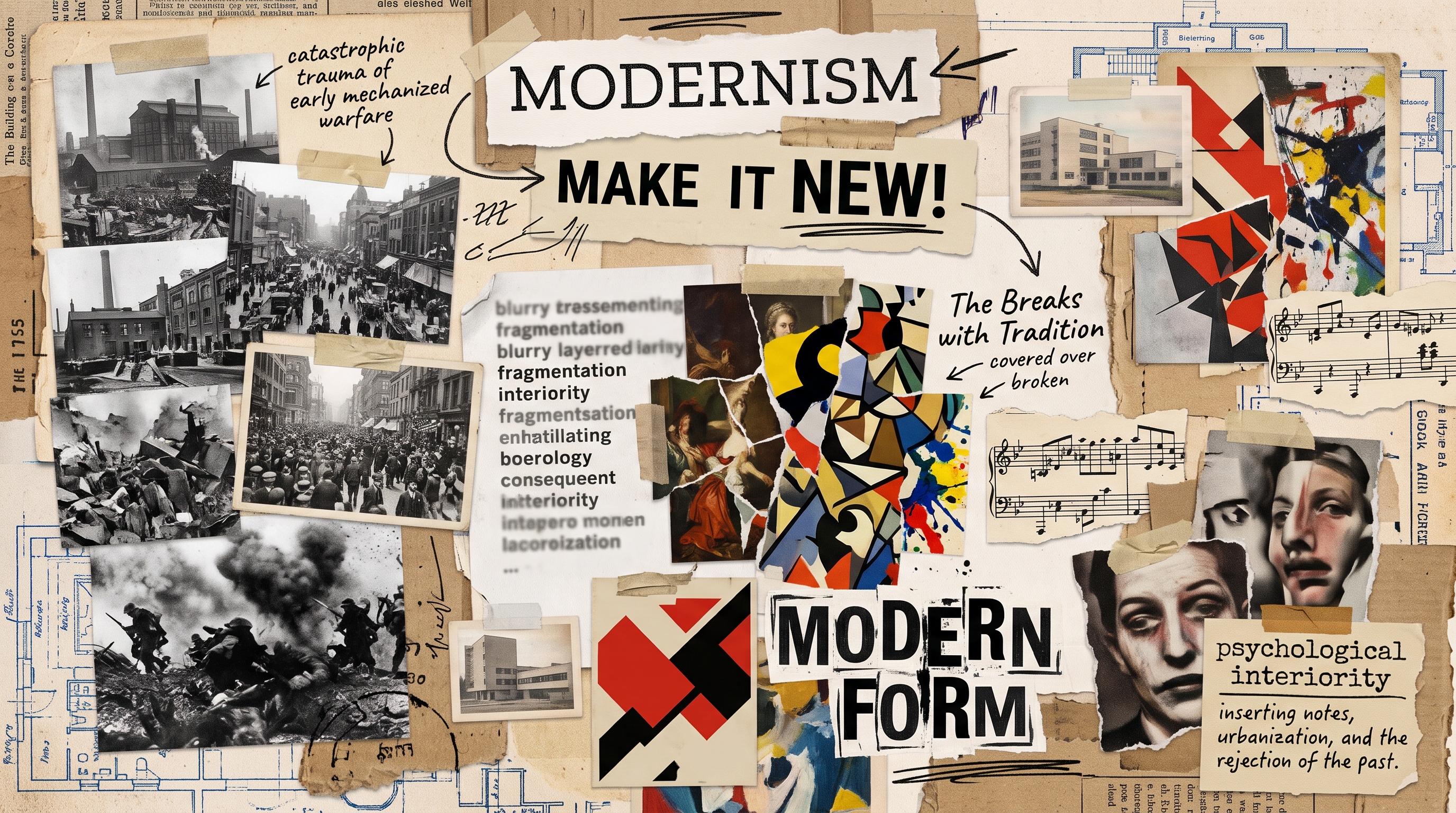
Defining Modernism & Modernity
To understand Modernism, cultural theorists and historians distinguish between the objective material conditions of the era and the subjective aesthetic responses they provoked:[1]
- Modernity refers to the socio-historical condition characterized by industrial capitalism, mass urbanization, technological acceleration, bureaucratic rationalization, and secularization—a transformation traced in The Road to the Enlightenment and analyzed sociologically in The Metropolis and Mental Life.
- Modernism denotes the diverse cluster of aesthetic, philosophical, and avant-garde movements (roughly c. 1890–1945) that interrogated, resisted, celebrated, or sought to master the lived experience of modernity.[1:1]
At its core, Modernism rejected the nineteenth-century positivist belief in linear historical progress, unified human identity, and objective realism.[2] Inherited cultural systems—once viewed as sacred and immutable—increasingly appeared as a fragile facade built on sand. In their place, Modernist works foregrounded epistemological uncertainty, fractured subjectivity, and the material medium itself—requiring audiences and readers to actively participate in constructing meaning from fragmented, discontinuous forms.[1:2]
"Things fall apart; the centre cannot hold; / Mere anarchy is loosed upon the world..."
— W. B. Yeats, The Second Coming (1920), a foundational articulation of the Modernist crisis of metaphysical, religious, and cultural authority.[3]
Historical & Intellectual Catalysts
Modernism did not arise in an aesthetic vacuum; it was precipitated by a series of intellectual ruptures that dismantled Enlightenment certainties regarding time, space, morality, and human consciousness.[4]
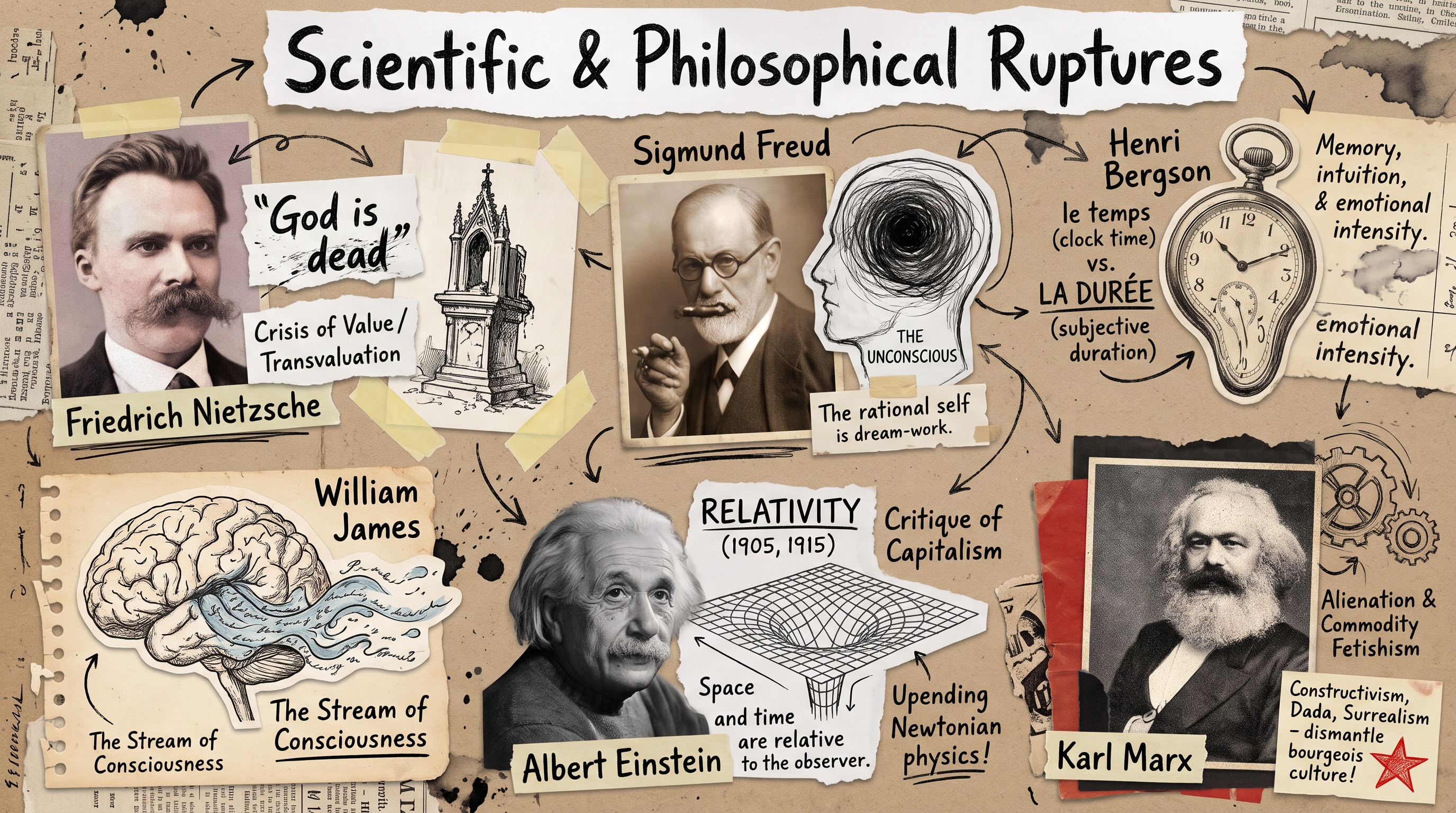
Scientific & Philosophical Ruptures
- Friedrich Nietzsche & the Crisis of Value: Nietzsche's diagnosis that "God is dead" signaled the collapse of absolute metaphysical foundations in Western culture. Urging a radical transvaluation of all values, Nietzsche inspired avant-garde iconoclasm, demanding that artists construct new aesthetic and vitalist meanings upon what had become an intellectual blank canvas.[3:1]
- Sigmund Freud & Psychoanalysis: In treatises like The Interpretation of Dreams and Freud's The Uncanny (Das Unheimliche), Freud shattered the Enlightenment model of the rational, transparent subject. By mapping the volcanic drives of the unconscious, repression, and dream-work, psychoanalysis redirected literature and painting toward interior neuroses, suppressed desires, and psychological fragmentation.[4:1]
- Henri Bergson & Subjective Duration: In Henri Bergson’s Creative Evolution and Time and Free Will, Bergson distinguished between spatialized, mechanical clock time (le temps) and la durée (duration)—time as qualitative, indivisible, and subjectively experienced through memory and intuition. This temporal rupture directly inspired Modernist experiments with non-linear narrative, retrospection, and psychological duration.[4:2]
- William James & Consciousness: James described mental life not as a mosaic of discrete ideas, but as an uninterrupted, turbulent "stream of consciousness," providing the conceptual blueprint for the interior monologues of High Modernist prose.[4:3]
- Albert Einstein & Relativity: Einstein's Special (1905) and General (1915) Theories of Relativity overturned Newtonian physics. By demonstrating that space and time are not invariant, Euclidean containers, but relative to the observer's frame of reference, Einstein popularized an epistemic relativism that resonated deeply with Cubist multi-perspectivalism and literary focalization.[4:4]
- Karl Marx & Critique of Capitalist Alienation: Marxist diagnoses of commodity fetishism, reification (later systematized in Georg Lukács's formulation of reification (Verdinglichung) in History and Class Consciousness (1923)), and class conflict inspired radical avant-garde movements—including Soviet Constructivism, Dada, and Surrealism—that sought to demolish bourgeois institutions and reconcile art with revolutionary collective life.[4:5]
The Trauma of World War I
If late nineteenth-century industrialization unsettled traditional sensibilities, the First World War (1914–1918) completely severed the Western imagination from its past.[5] Mechanized slaughter—involving poison gas, trench warfare, high-explosive artillery, and aerial bombardment—shattered Victorian narratives of moral enlightenment, imperial grandeur, and inevitable human progress.[5:1]
As trench warfare tore the fabric of society asunder, millions of soldiers were reduced to disposable cogs in the machine. Returning writers and visual artists confronted a deeply traumatized civilization, convinced that nineteenth-century academic realism, pastoral romanticism, and neoclassical rhetoric were morally bankrupt and complicit in imperial slaughter.[1:3] Radical formal disruption became the only ethical means of documenting a fractured world.
Core Manifestations Across Disciplines
Literary Modernism
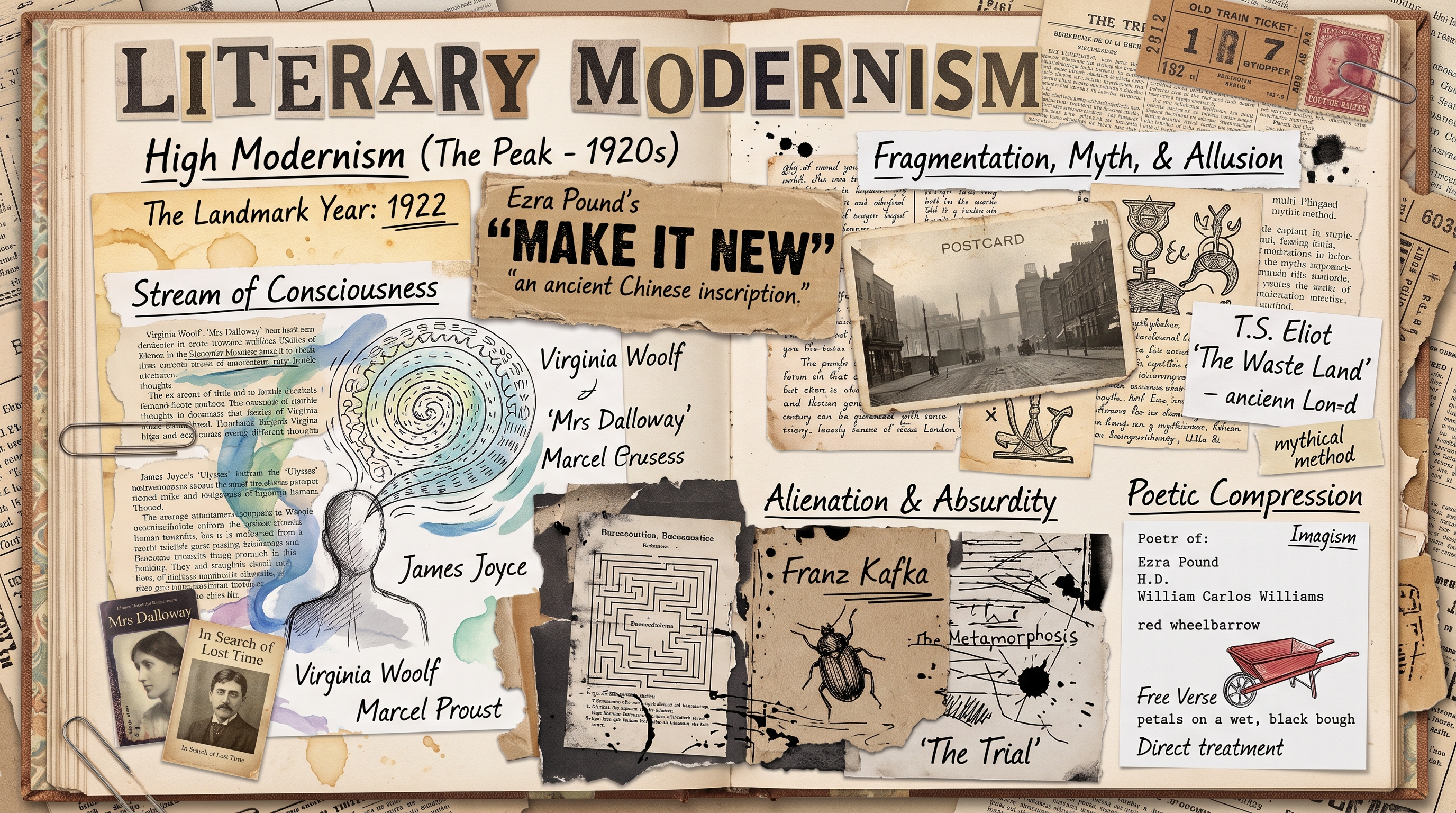
Literary Modernism reached its monumental zenith during the 1920s—frequently designated "High Modernism"—with the miraculous watershed year 1922 witnessing the simultaneous appearance of James Joyce's Ulysses, T. S. Eliot's The Waste Land, and Virginia Woolf's Jacob's Room.[6] Guided by Ezra Pound's rallying cry to "Make It New," Modernist writers discarded conventional exposition, third-person omniscience, and chronological plotting.[7]
- Stream of Consciousness & Interior Monologue: Virginia Woolf (Mrs Dalloway, To the Lighthouse), James Joyce (1882-1941) (Ulysses, A Portrait of the Artist as a Young Man), and Marcel Proust (In Search of Lost Time) rendered the porous, associative flux of subjective perception, exploring how involuntary memory and sensory stimuli momentarily suspend linear clock-time.[1:4]
- Fragmentation, Myth, & The Mythical Method: In The Waste Land, T. S. Eliot pioneered the "mythical method"—juxtaposing scenes of sterile urban alienation with dense, multilingual collages of Dante, the Upanishads, Baudelaire, and Grail legends to impose aesthetic order upon contemporary chaos.[6:1]
- Alienation & Bureaucratic Grotesque: In Central Europe, Franz Kafka (1883-1924) (The Metamorphosis, The Trial, The Castle) utilized lucid, unadorned prose to depict solitary individuals ensnared by opaque, irrational bureaucratic machines—establishing the archetypal Modernist diagnosis of institutional absurdity and metaphysical homelessness.[8]
- Poetic Compression & Imagism: Spearheaded by Ezra Pound, H.D. (Hilda Doolittle), and William Carlos Williams, Imagism purged poetry of Victorian sentimental didacticism, demanding direct treatment of the thing, precise rhythmic phrasing, and instantaneous sensory revelation.[8:1]
Visual Arts & the Avant-Garde
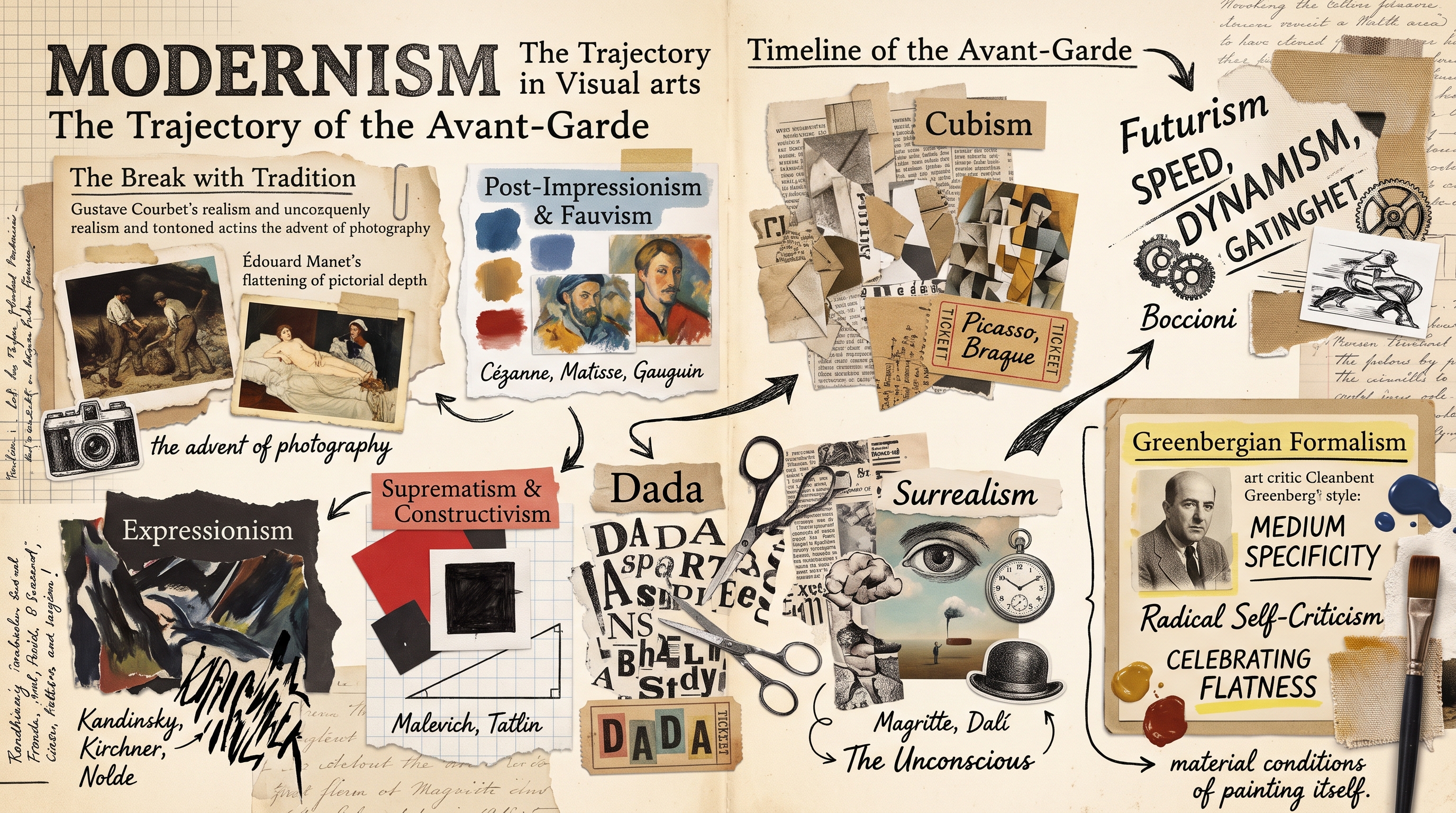
In the visual arts, Modernism traced a trajectory from mid-nineteenth-century French revolts against academic neoclassicism—inaugurated by Gustave Courbet's realism and Édouard Manet's flattening of pictorial depth—to the radical non-representational abstraction of the mid-twentieth century.[9] Relieved of the functional burden to mimic external nature by the advent of photography and cinematography (as analyzed in The Work of Art in the Age of Mechanical Reproduction), avant-garde painters turned their gaze inward to interrogate the material conditions of painting itself.[2:1]
| Avant-Garde Movement | Core Period | Key Practitioners | Defining Aesthetic & Ideological Characteristics |
|---|---|---|---|
| Post-Impressionism & Fauvism | c. 1885–1910 | Paul Cézanne, Henri Matisse, Paul Gauguin | Discarded optical illusionism in favor of structured geometric color planes and non-naturalistic chromatic intensity. |
| Cubism | c. 1907–1920 | Pablo Picasso, Georges Braque, Juan Gris | Deconstructed three-dimensional objects into simultaneous geometric facets, dismantling Renaissance single-point linear perspective.[9:1] |
| Futurism | 1909–1944 | Filippo Tommaso Marinetti, Umberto Boccioni | Glorified speed, mechanical dynamism, industrial noise, and militarism; sought to burn down academies and libraries. |
| Expressionism | c. 1905–1925 | Ernst Ludwig Kirchner, Wassily Kandinsky, Emil Nolde | Distorted physical forms and color palettes to externalize raw psychological anguish, spiritual crisis, and metropolitan alienation. |
| Suprematism & Constructivism | c. 1913–1930 | Kazimir Malevich, Vladimir Tatlin, El Lissitzky | Advanced non-objective geometric abstraction (Black Square) or subordinated autonomous art to utilitarian industrial production for the Soviet collective.[9:2] |
| Dada | c. 1916–1924 | Marcel Duchamp, Tristan Tzara, Hannah Höch, John Heartfield | Radical anti-art movement provoked by WWI; weaponized absurdity, ready-mades, chance collages, and photomontage to skewer bourgeois rationality.[9:3] |
| Surrealism | c. 1924–1945 | André Breton, René Magritte, Salvador Dalí, Max Ernst | Harnessed Freudian automatism, dream mechanics, and uncanny juxtaposition to unlock the unconscious mind from moral and rational constraints. |
Mid-twentieth-century American art critic Clement Greenberg formulated a highly influential teleological theory of Modernism.[9:4] Greenberg argued that the defining essence of Modernism was radical self-criticism: each artistic medium was required to purge itself of any effects borrowed from sister arts (such as narrative drama borrowed from literature, or three-dimensional volumetric illusion borrowed from sculpture). For painting, this meant embracing the irreducible flatness of the picture plane, celebrating pigment, line, and support as autonomous physical realities rather than windows into an illusionary world.[2:2]
Architecture & Industrial Design
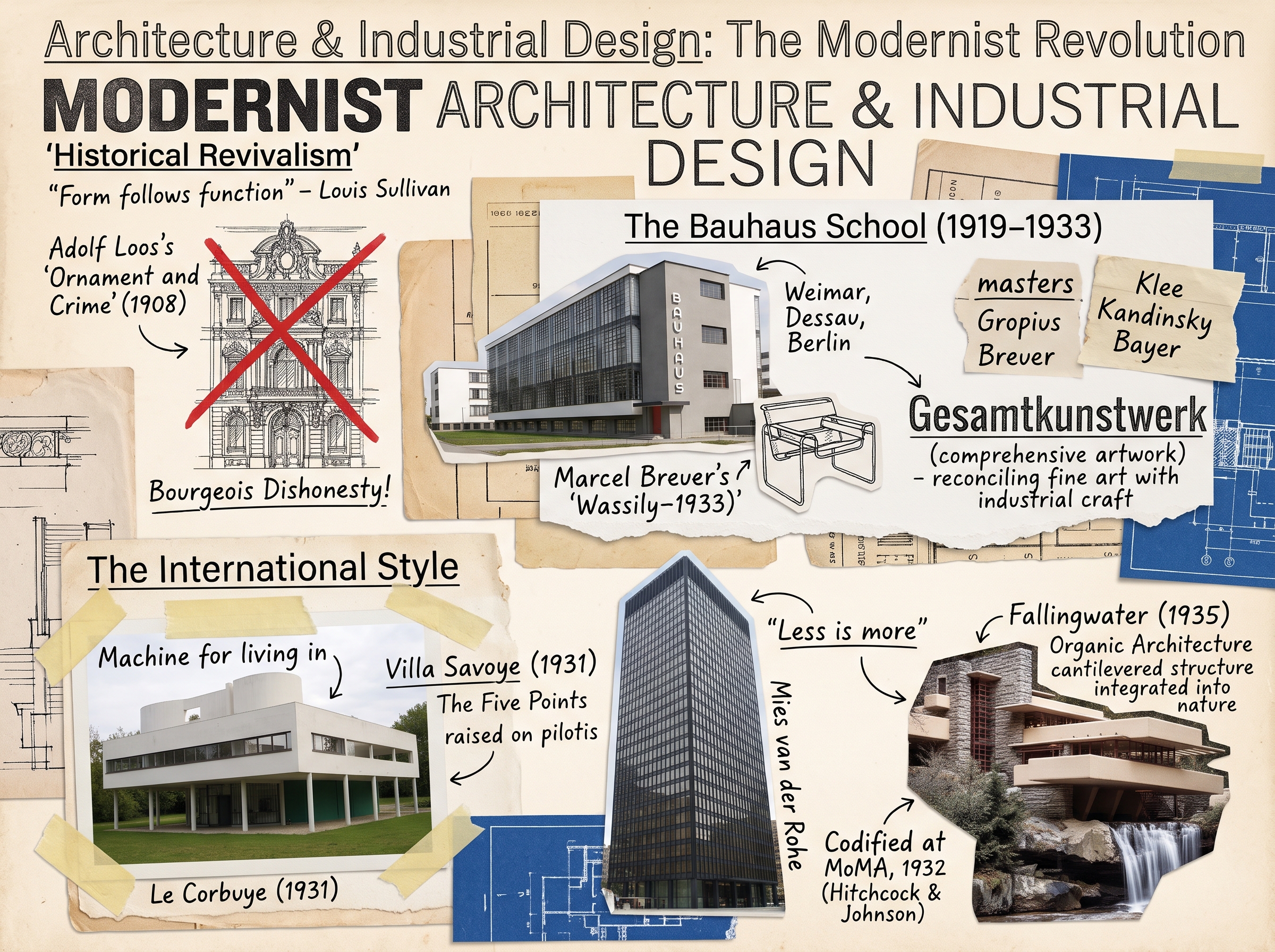
Modernist architects rejected nineteenth-century historical revivalism (Neo-Gothic, Beaux-Arts eclecticism) and applied surface ornament, viewing decorative facades as bourgeois dishonesty. Operating under Louis Sullivan's functionalist dictum "form follows function" and Adolf Loos's incendiary polemic Ornament and Crime (1908), architects embraced industrial materials—reinforced concrete, structural steel, and plate glass—believing that rational, unadorned design could engineer a hygienic, democratic society.[5:2]
- The Bauhaus School (1919–1933): Founded by Walter Gropius in Weimar (and later Dessau and Berlin), the Bauhaus sought to reconcile fine art with industrial craft under the banner of the Gesamtkunstwerk (comprehensive artwork). Faculty masters including Paul Klee (1879–1940), Wassily Kandinsky, Marcel Breuer, and Herbert Bayer revolutionized tubular-steel furniture, sans-serif typography, textiles, and functional architecture.[10]
- The International Style: Codified by Henry-Russell Hitchcock and Philip Johnson at MoMA in 1932, this architectural idiom prioritized rectilinear volume over heavy mass, asymmetric dynamic equilibrium, transparent glass curtain walls, and the complete elimination of historical ornament.[11]
- Architectural Visionaries:
- Le Corbusier formulated his "Five Points of Architecture" (exemplified by the Villa Savoye, 1931), conceiving of the home as a functional "machine for living in" raised on reinforced concrete pilotis.[11:1]
- Ludwig Mies van der Rohe, the final director of the Bauhaus, distilled architectural purism into the famous maxim "Less is more," pioneering the minimalist glass-and-steel skyscraper aesthetic (such as the Seagram Building in New York).[2:3]
- Frank Lloyd Wright championed "Organic Architecture," rejecting European functionalist severity in favor of cantilevered structures (Fallingwater) seamlessly integrated into natural topography.[12]
Music & Performing Arts
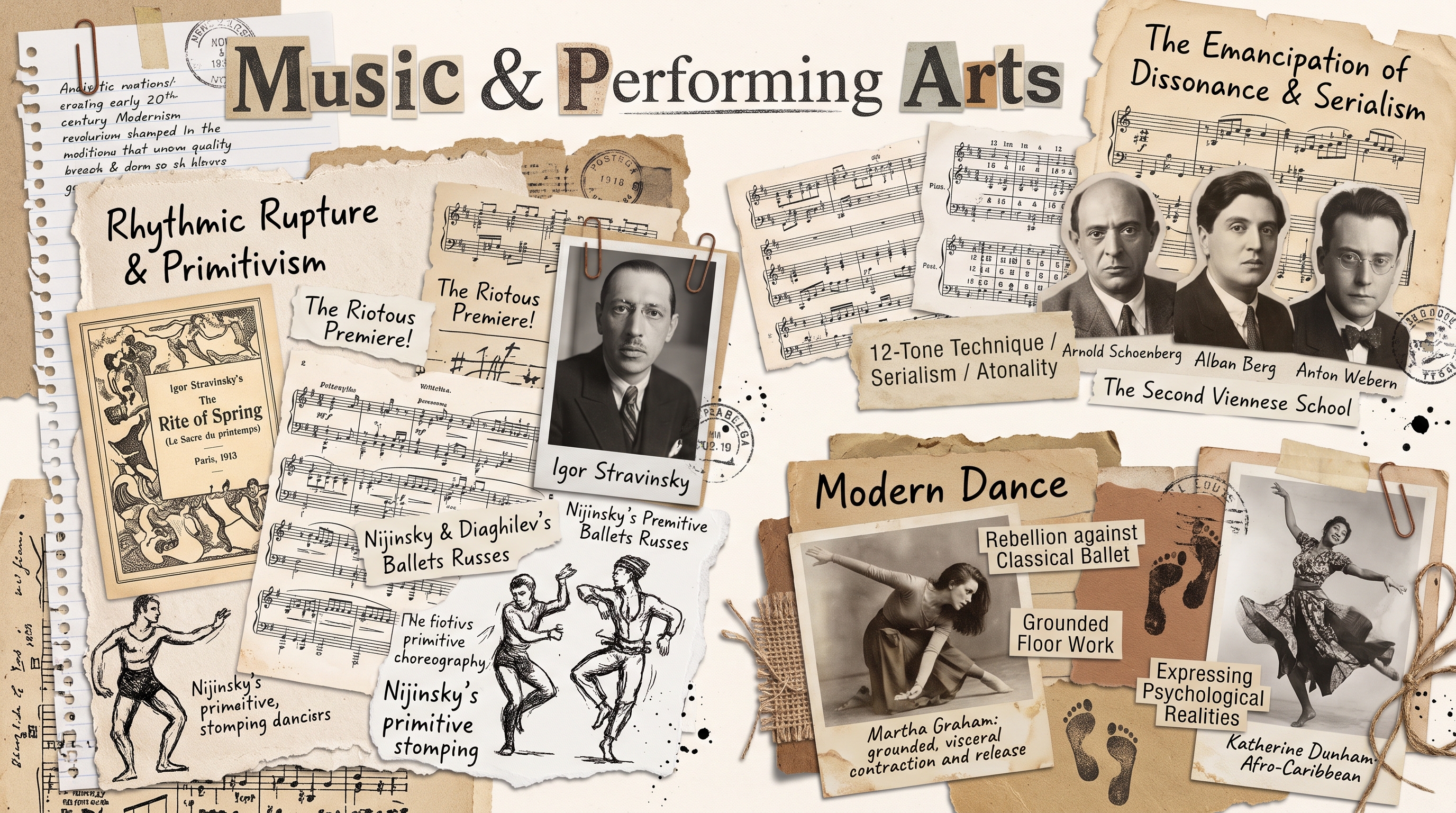
In Western art music, Modernism systematically dissolved the diatonic tonal hierarchy that had governed musical composition since the Renaissance.
- The Emancipation of Dissonance & Serialism: Austrian composer Arnold Schoenberg abandoned traditional tonal key centers (atonality) before developing the twelve-tone technique (serialism) in the early 1920s.[13] Serialism treated all twelve pitches of the chromatic scale with absolute mathematical equality, preventing any single note from establishing harmonic dominance. Schoenberg, alongside pupils Alban Berg and Anton Webern, formed the influential Second Viennese School.
- Rhythmic Rupture & Primitivism: Russian composer Igor Stravinsky shattered metric regularity with jarring polyrhythms, bitonality, and percussive driving energy.[13:1] The riotous 1913 Paris premiere of The Rite of Spring (Le Sacre du printemps), choreographed by Vaslav Nijinsky for Sergei Diaghilev's Ballets Russes, marked a decisive watershed in twentieth-century performing arts.[13:2]
- Modern Dance: Choreographers such as Martha Graham and Katherine Dunham rebelled against the artificial weightlessness and decorative formalism of classical ballet, introducing grounded floor work, visceral torso contraction and release, and Afro-Caribbean movement vocabularies to express profound psychological realities.[8:2]
Global & Transnational Modernisms
Since the late 1990s—pioneered by scholars such as Douglas Mao, Rebecca L. Walkowitz, and Susan Stanford Friedman—academic scholarship has dismantled the Eurocentric canon through the New Modernist Studies.[14] This critical framework expands Modernism along three distinct vectors: temporal (extending beyond the traditional 1890–1945 window), vertical (dissolving the rigid divide between elite "high art" and commercial mass culture), and spatial (decentering metropolitan Paris, London, and New York to map planetary, postcolonial, and diasporic modernisms).[6:2][15]
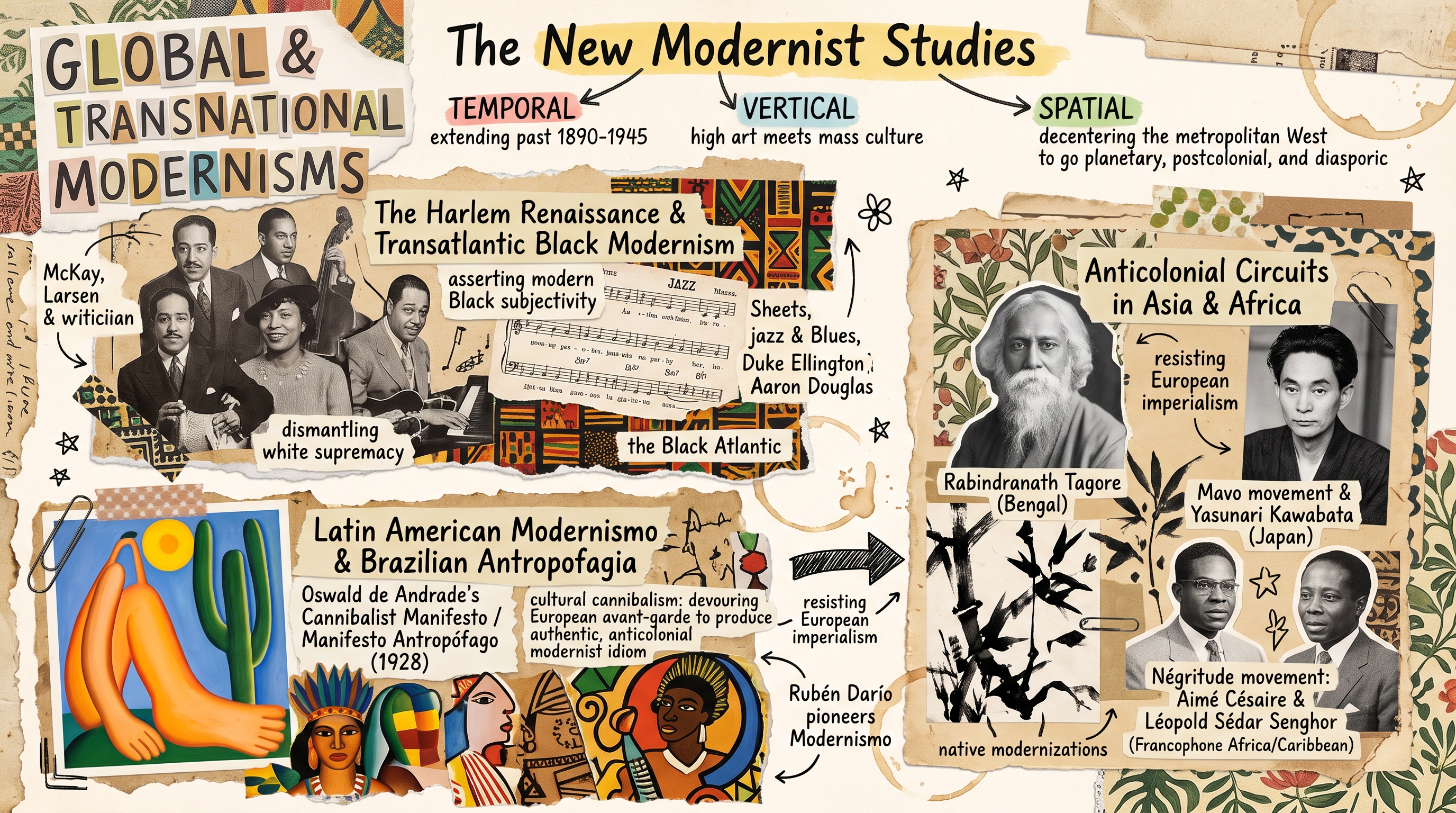
Crucial global and diasporic constellations include:
- The Harlem Renaissance & Transatlantic Black Modernism: Flourishing in New York during the 1920s and 1930s, writers, musicians, and visual artists—including Langston Hughes, Zora Neale Hurston, Nella Larsen, Claude McKay, Aaron Douglas, and Duke Ellington—forged a revolutionary Black Modernism.[16] Rather than viewing modernity purely through the lens of European disillusionment, Harlem Renaissance creators synthesized jazz and blues syncopation, vernacular oral traditions, and African heritage to assert modern Black subjectivity, dismantle white supremacy, and challenge colonial hierarchies across the Black Atlantic.[16:1]
- Latin American Modernismo & Brazilian Antropofagia: In the Hispanophone world, Rubén Darío pioneered Modernismo in the late nineteenth century as an assertion of Latin American aesthetic independence. In 1920s Brazil, Oswald de Andrade published the Manifesto Antropófago ("Cannibalist Manifesto," 1928), while painter Tarsila do Amaral proposed "cultural cannibalism"—devouring European avant-garde techniques and digesting them alongside Indigenous and Afro-Brazilian cultures to produce an authentic, anticolonial modernist idiom.
- Anticolonial Circuits in Asia & Africa: Across Bengal (Rabindranath Tagore), Japan (the radical Mavo movement and New Sensationalist writers like Yasunari Kawabata), and the Francophone Negritude movement (Aimé Césaire, Léopold Sédar Senghor), colonized and non-Western artists selectively appropriated Modernist techniques to resist European imperialism and negotiate native modernizations.[15:1]
Internal Contradictions, Decline, & Postmodern Transition
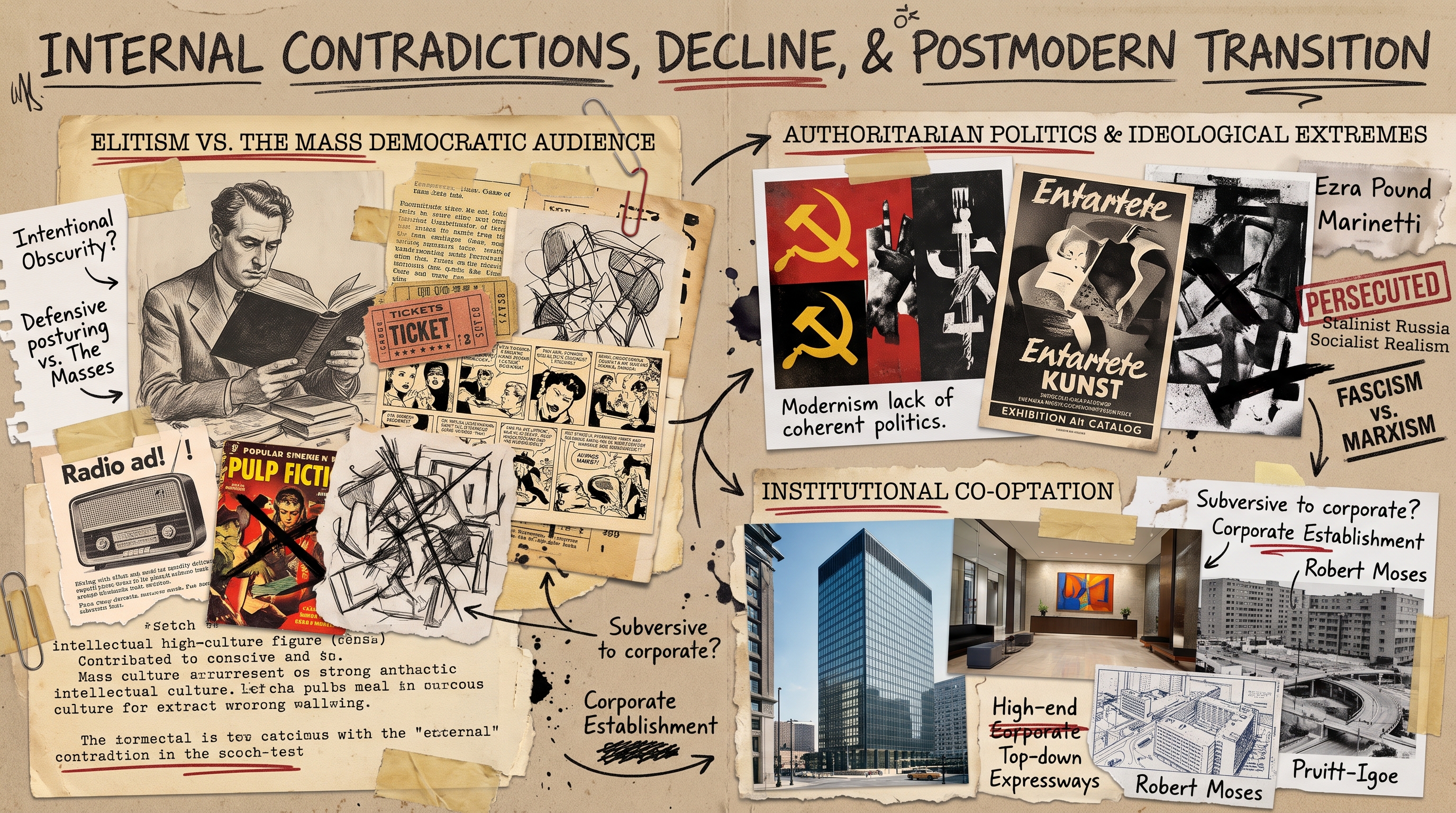
Despite its revolutionary vigor, High Modernism harbored profound ideological contradictions that ultimately precipitated its decline:[1:5]
- Elitism vs. The Mass Democratic Audience: Canonical High Modernists frequently positioned their complex formal experiments in hostile opposition to mass literacy, popular cinema, pulp journalism, and radio broadcasting. This defensive posturing cultivated an intentional obscurity that alienated working-class audiences and turned high culture into an exclusive preserve.[6:3]
- Authoritarian Politics & Ideological Extremes: Modernism lacked a coherent political ideology. While Surrealists and Constructivists allied with revolutionary Marxism, several prominent Modernists—including Ezra Pound, Filippo Tommaso Marinetti, Wyndham Lewis, and Knut Hamsun—embraced fascism and authoritarian dictatorship, viewing strongmen as social sculptors capable of imposing aesthetic order on chaotic democratic societies.[1:6] Conversely, totalitarian regimes viciously persecuted Modernism, with the Third Reich staging the notorious 1937 Entartete Kunst ("Degenerate Art") exhibition and Stalinist Russia mandating Socialist Realism.
- Institutional Co-optation: By the 1950s and 1960s, the once-subversive avant-garde had hardened into the official corporate establishment.[9:5] Abstract expressionist canvases hung in commercial bank lobbies, International Style glass monoliths became the uniform face of multinational capital, and top-down Modernist urban planning (such as Robert Moses's expressways and the Pruitt-Igoe housing project) destroyed historic communities—sparking sharp sociological critiques from theorists like Anthony Vidler and Northrop Frye.[11:2]
Modernism vs. Postmodernism
Beginning in the late 1950s and 1960s, an epistemic shift known as Postmodernism directly challenged Modernist orthodoxy across philosophy, art, architecture, and literature:[1:7]
| Dimension | Modernism (c. 1890–1950) | Postmodernism (c. 1960–Present) |
|---|---|---|
| Attitude Toward Fragmentation | Laments fragmentation as a tragic loss of metaphysical unity; seeks order through art and myth.[3:2] | Celebrates fragmentation, playful indeterminacy, irony, and the collapse of all grand narratives (métarécits). |
| High vs. Low Culture | Enforces a strict hierarchy between autonomous, serious "high art" and commercial mass kitsch.[6:4] | Collapses hierarchies; enthusiastically embraces Pop Art, commercial advertising, kitsch, genre pastiche, and television. |
| Originality & Authorship | Cultivates radical originality, individual genius, and medium purity ("Make It New").[2:4] | Emphasizes intertextual pastiche, appropriation, simulation, and Roland Barthes's "death of the author."[1:8] |
| Architectural Ethos | "Less is more" (Mies van der Rohe); structural functionalism, purity, total absence of ornament.[2:5] | "Less is a bore" (Robert Venturi); eclectic double-coding, historical quotation, decorative wit, and vernacular signage.[1:9] |
Despite this postmodern transition, Modernism remains the foundational aesthetic grammar of contemporary life—establishing the permanent principle that human culture must continuously invent new formal vocabularies to confront historical reality.[5:3]
🎴 Interactive Web Practice (Comprehension Check)
Question 1 (Epistemological Rupture & Temporality): How did Henri Bergson's distinction between clock time and la durée, paired with the psychological theories of William James and Sigmund Freud, dismantle the narrative conventions of nineteenth-century realism?
Answer: Nineteenth-century realism operated on the assumption of an objective, shared Euclidean reality governed by uniform clock-time and populated by stable, psychologically transparent characters. Plots progressed chronologically along a linear chain of cause and effect, mediated by an authoritative, omniscient third-person narrator.
The intellectual convergence of Bergson, James, and Freud shattered this consensus:
1. Henri Bergson's La Durée: Bergson demonstrated that spatialized clock time (discrete, mechanical seconds ticking on a dial) is a social abstraction. Inward subjective duration (*la durée*) is fluid, qualitative, and continuous, wherein past memories and present sensations permeate one another without rigid boundaries.
2. William James's Stream of Consciousness: James demonstrated that human thought does not occur in isolated, rational beads, but flows as an uninterrupted, multi-layered stream saturated with fleeting associations.
3. Sigmund Freud's Unconscious: Freud proved that human motivation is steered by repressed, non-rational instinctual drives and unresolved childhood traumas, meaning characters can no longer be depicted as fully rational or self-aware.
In literature (exemplified by Virginia Woolf, James Joyce, and Marcel Proust), these insights compelled authors to discard the omniscient external narrator. Instead, narrative structure moved directly inside the characters' mental sensorium, using interior monologues, temporal flashbacks, and stream of consciousness to show how a single external day (as in Mrs Dalloway or Ulysses) contains vast infinities of subjective memory, emotional duration, and psychological depth.
Question 2 (Aesthetic Formalism & Medium Specificity): Explain Clement Greenberg's concept of Modernist "self-criticism" and medium specificity. Why did Greenberg argue that the historical mission of modern painting was to embrace two-dimensional flatness?
Answer: Clement Greenberg located the defining essence of Modernism in radical self-criticism, drawing an explicit philosophical parallel to Immanuel Kant (who used reason to interrogate the limits of reason itself). Greenberg argued that each artistic discipline had to critically evaluate its own unique material properties and purge itself of every convention borrowed from other artistic mediums:
- Throughout the Renaissance and academic tradition, painting had subordinated itself to literature (by depicting dramatic narratives and storytelling) and to sculpture (by using shading, linear perspective, and chiaroscuro to fabricate the optical illusion of three-dimensional volume in physical space).
- Greenberg argued that three-dimensional sculptural illusionism was fundamentally dishonest to the actual physical reality of the medium. The only irreducible, unique characteristic that painting shares with no other art form is the flatness of the two-dimensional picture plane.
Therefore, for painting to secure its aesthetic autonomy and survive in the modern era, it had to stop functioning as a transparent window looking onto an imaginary three-dimensional world. Instead, it was compelled to foreground its own flat material support, pure pigment, and spatial boundaries—a teleological trajectory that progressed historically from Manet and Cézanne through Cubism to the pure color fields and gestural abstraction of Post-Painterly Abstraction.
Question 3 (Dialectics of Modernity & Avant-Garde Contradictions): In what ways did the architectural crusade of the International Style and the Bauhaus betray its original social-democratic mission, and how did twentieth-century critics expose this transformation?
Answer: When Walter Gropius and Hannes Meyer directed the Weimar and Dessau Bauhaus, functionalist architecture was conceived as an egalitarian, utopian social-democratic project. Stripping away costly decorative ornament, utilizing prefabricated modular elements, and deploying industrial materials (reinforced concrete, plate glass, steel tubing) was intended to lower construction costs and mass-produce hygienic, light-filled, affordable social housing for the working class.
However, as the Bauhaus diaspora emigrated to the United States and the movement was rebranded by Henry-Russell Hitchcock and Philip Johnson as the International Style at MoMA in 1932, the movement underwent a profound ideological co-optation:
1. Depoliticization & Corporate Capture: The socialist welfare ethos was erased, leaving only the aesthetic shell of volumetric minimalism and unornamented glass curtain walls. American corporate capitalism realized that the stripped-down, standardized steel-and-glass cube was the cheapest, most efficient architectural form for commercial financial towers and corporate office parks. The architecture of working-class liberation became the visual monument of multinational corporate dominance.
2. Psychological & Spatial Alienation: Critics like Anthony Vidler (The Architectural Uncanny) demonstrated that by systematically eliminating domestic alcoves, shadows, and ornamental privacy, total modernist transparency transformed modern living spaces into uncanny, exposed sites of psychological dread. Similarly, Northrop Frye diagnosed modern high-rise glass monoliths as producing a "condominium mentality" (see From Walls of Wood to Walls of Glass)—generating physical proximity without organic civic solidarity and reducing metropolitan residents to atomized spectators living in transparent vertical boxes.
Resonant Notes
The following notes in the vault share direct thematic, historical, and aesthetic connections with Modernism:
🔴 Avant-Garde Movements, Visual Grammar & Aesthetic Theory
- The Bauhaus School — Walter Gropius's revolutionary avant-garde institution in Weimar and Dessau; unified fine art, craft, and industrial technology into the Gesamtkunstwerk, developing modern visual grammar and functionalist International Style architecture.
- Paul Klee (1879–1940) — Master of Form at the Bauhaus whose pedagogical notebooks (The Thinking Eye) established the dynamic laws of abstract visual grammar, linear energy ("taking a line for a walk"), and chromatic polarity.
- The Dehumanization of Art — José Ortega y Gasset's 1925 aesthetic treatise analyzing how the modern avant-garde deliberately discarded nineteenth-century sentimental realism to construct an unpopular, self-reflexive art of pure aesthetic forms.
- The Avant-Garde — Sociological and philosophical investigation into the historical emergence of artistic vanguards, tracking their evolution from radical political resistance to institutionalized orthodoxy.
- Guillaume Apollinaire (1880–1918) — Modernist poet and aesthetic champion of Cubism whose Calligrammes and L'Esprit Nouveau united modern typography, industrial speed, and poetic collage.
- Giorgio de Chirico (1888-1978) — Pioneer of Pittura Metafisica whose deserted, arcaded Italian piazzas and ominous classical statues exposed the silent psychological dread underlying modern urban rationality.
- René Magritte — Belgian surrealist whose philosophical canvases (The Treachery of Images) systematically interrogated the arbitrary linguistic and pictorial conventions linking representation to physical reality.
- The Work of Art in the Age of Mechanical Reproduction & Walter Benjamin (1892–1940) — Benjamin's landmark analysis of how photography and cinema dissolved the sacred "aura" of traditional art, transmuting art from ritual contemplation into mass political mobilization.
🟡 Epistemology, Psychology & The Fragmented Subject
- Virginia Woolf — Canonical High Modernist novelist who developed the stream of consciousness and interior monologue to map the fluid, porous boundaries between subjective duration and external reality.
- James Joyce (1882-1941) — Pioneer of High Modernist prose whose Ulysses deployed the mythical method, polyphonic parodies, and associative interiority to capture the sensory totality of modern life.
- Franz Kafka (1883-1924) — Prague novelist whose surreal, bureaucratic parables anatomized existential dread, alienation, and the dehumanizing apparatuses of modern legal and administrative authority.
- Henri Bergson’s Creative Evolution — Bergson's vitalist philosophy of la durée and élan vital, which provided Modernist writers and artists with a metaphysical alternative to mechanistic, spatialized clock-time.
- Freud's The Uncanny (Das Unheimliche) — Sigmund Freud's psychological diagnostic of the return of the repressed, analyzing how familiar, domestic spaces suddenly morph into alienating sites of dread.
- The Sublime & The Sublime, Awe, and Epiphany — Historical analysis of how encounters with unrepresentable magnitude and formless terror evolved from eighteenth-century Romantic aesthetics into Modernist epiphanies and existential crises.
- The Specular Revolution - Optics, Interiority, and the Modern Self — Historical investigation into how early modern optical technologies constructed the introspective modern ego, which Modernist psychology subsequently deconstructed.
🟢 Urban Modernity, Media Ecology & Postmodern Successors
- The Metropolis and Mental Life & Georg Simmel (1858-1918) — Simmel's foundational sociology of urban consciousness; analyzes how sensory overstimulation and the monetary economy compel metropolitan dwellers to adopt a protective, intellectually calculating "blasé attitude."
- Anthony Vidler-The Architectural Uncanny — Vidler's architectural critique demonstrating how the Modernist crusade for hygiene, functionalism, and glass transparency paradoxically intensified urban alienation and spatial homelessness.
- From Walls of Wood to Walls of Glass - Northrop Frye’s Geography of Isolation — Frye's critique of the International Style glass skyscraper; argues that transparent curtain walls produce an atomized "condominium mentality" characterized by physical proximity without communal solidarity.
- Ayn Rand's The Fountainhead - An Explanation — Dramatizes the uncompromising philosophical struggle of modernist functional architecture against neoclassical historicism through protagonist Howard Roark.
- McLuhan's The Medium is the Message — Marshall McLuhan's media ecology thesis examining how the transition from typographic print culture to electric, acoustic media environments dismantled linear Modernist consciousness.
- Innis (1950) - Empire and Communications & Innis (1951) - The Bias of Communication — Harold Innis's political economy of communication, analyzing how changes in media infrastructure reorganize imperial governance and spatial monopolies.
- Postmodernism — Direct philosophical and aesthetic successor to Modernism; replaces the tragic search for lost metaphysical unity with ironic pastiche, simulation, and the celebration of grand narrative collapse.
- Zygmunt Bauman's sociological framework of Liquid Modernity — Bauman's diagnosis of the transition from heavy, solid industrial Modernism to the precarious, hyper-mobile, and individualized currents of liquid modernity.
- a-facade — Metaphoric expression capturing how Victorian social conventions and nineteenth-century academic art erected an artificial surface of moral order that collapsed under wartime industrialization.
- built-on-sand — Metaphoric expression illustrating the epistemological fragility of Enlightenment progress narratives when confronted with mechanized warfare and Freudian unconscious drives.
- the-fabric-of-society — Metaphoric expression depicting the fragile social cohesion torn apart by the First World War and rapid urban industrialization.
- cog-in-the-machine — Metaphoric expression characterizing the reduction of human workers and trench soldiers into interchangeable, alienated components within modern industrial apparatuses.
- on-autopilot — Metaphoric expression framing the habitual, dissociative cognitive defense adopted by urban dwellers navigating sensory-rich metropolitan environments.
- unravel — Metaphoric expression capturing how tonal musical systems, Euclidean geometry, linear narrative conventions, and metaphysical certainties systematically unwound under Modernist critique.
- blank-canvas — Metaphoric expression conceptualizing the clean slate of formal experimentation confronting the twentieth-century avant-garde following the collapse of historicist traditions.
References
Kathleen Kuiper & The Editors of Encyclopaedia Britannica / Modernism: Definition, Characteristics, History, Art, & Literature / britannica.com ↩︎ ↩︎ ↩︎ ↩︎ ↩︎ ↩︎ ↩︎ ↩︎ ↩︎ ↩︎
The Editors of Encyclopaedia Britannica / Modernism in the Visual Arts and Architecture / britannica.com ↩︎ ↩︎ ↩︎ ↩︎ ↩︎ ↩︎
Encyclopedia.com / Modernity: Overview / encyclopedia.com ↩︎ ↩︎ ↩︎
Skuola.net Academic Archive / Philosophical and Scientific Influences of the 20th Century / skuola.net ↩︎ ↩︎ ↩︎ ↩︎ ↩︎ ↩︎
Open University & Encyclopaedia Britannica / Modernism in Art and Design and Its Influence on 20th-Century Society / britannica.com ↩︎ ↩︎ ↩︎ ↩︎
Perlego Study Guides / What is Modernist Literature? Characteristics, Examples & History / perlego.com ↩︎ ↩︎ ↩︎ ↩︎ ↩︎
American Poetry Review / The Heroics of Style, Part Three (Ezra Pound's Make It New) / aprweb.org ↩︎
The Editors of Encyclopaedia Britannica / Modernist Literature: Examples, Characteristics, & Movements / britannica.com ↩︎ ↩︎ ↩︎
Tate Gallery / Art Terms: Modernism / tate.org.uk ↩︎ ↩︎ ↩︎ ↩︎ ↩︎ ↩︎
Alexandra Griffith Winton / The Bauhaus, 1919–1933 (Heilbrunn Timeline of Art History) / metmuseum.org ↩︎
Museum of Modern Art (MoMA) / Art Terms: International Style / moma.org ↩︎ ↩︎ ↩︎
Richard Guy Wilson / The International Style Exhibition at MoMA / usmodernist.org ↩︎
ArcGIS Musicology Archive / Modernism in Music: Schoenberg and Stravinsky / arcgis.com ↩︎ ↩︎ ↩︎
Douglas Mao & Rebecca L. Walkowitz / The New Modernist Studies (PMLA) / semanticscholar.org ↩︎
Douglas Mao (ed.) / The New Modernist Studies (Twenty-First-Century Critical Revisions) / cambridge.org ↩︎ ↩︎
Denise Murrell (ed.) / The Harlem Renaissance and Transatlantic Modernism / metmuseum.org ↩︎ ↩︎