The Enlightenment — Autonomous Reason, Natural Rights, and the Secular State
🗂️ Interactive Notebook: Open Study Companion (Video Summary, Flashcards, Mind Map) ↗
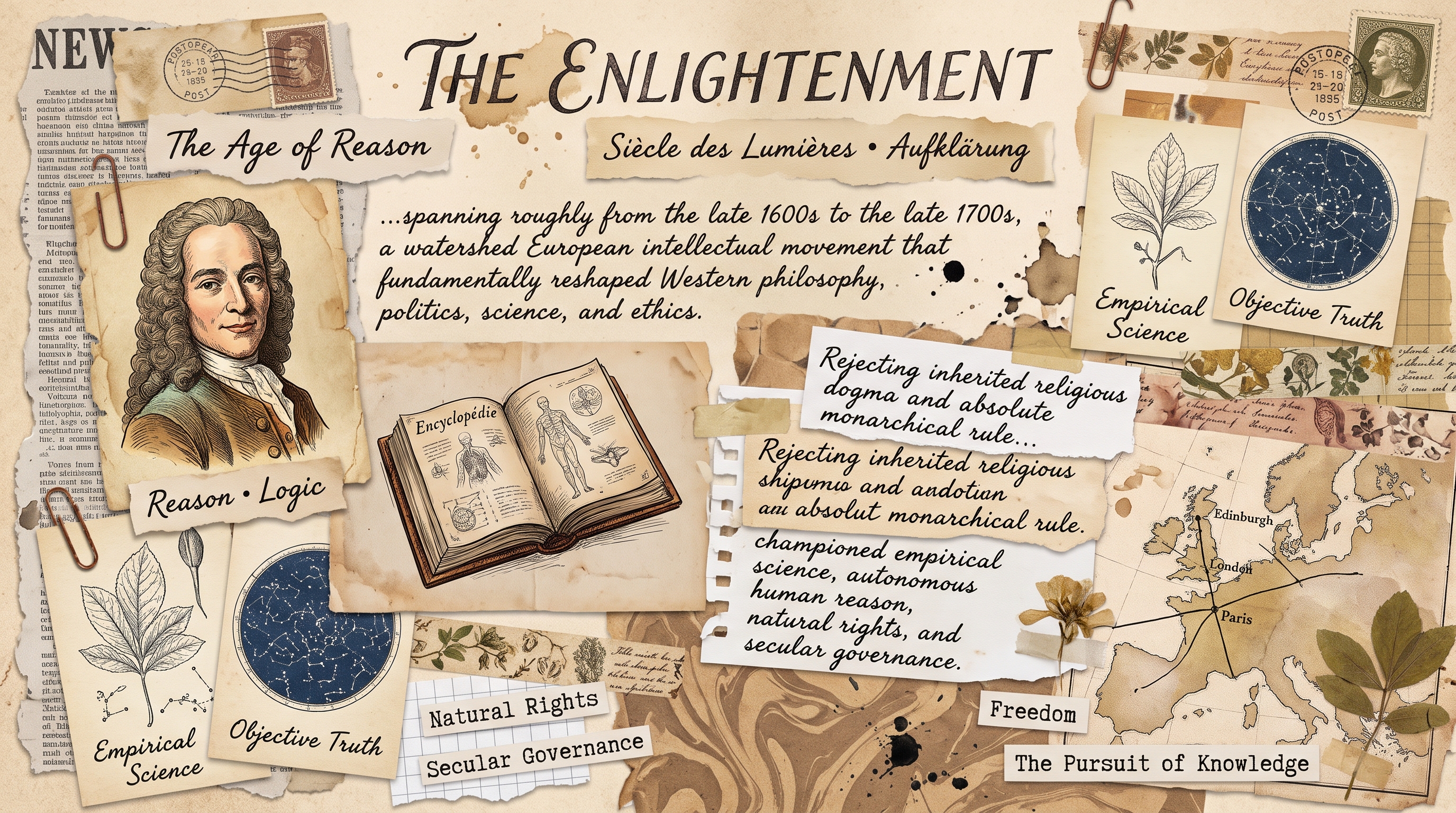
The Enlightenment (also known as the Age of Reason, Siècle des Lumières, or Aufklärung), spanning roughly from the late seventeenth to the late eighteenth century, was a watershed European intellectual movement that fundamentally reshaped Western philosophy, politics, science, and ethics.[1] Building upon the epistemological ruptures traced in The Road to the Enlightenment and the emergence of bounded modern subjectivity analyzed in The Specular Revolution - Optics, Interiority, and the Modern Self, Enlightenment thinkers rejected inherited religious dogma, scholastic metaphysics, and hereditary monarchical absolutism. In their place, philosophers championed empirical science, autonomous human reason, unalienable natural rights, and secular governance as instruments for discovering objective truth and engineering a freer, more egalitarian society.[1:1]
Historical Origins & Intellectual Precursors
Historians conventionally bracket the Enlightenment between two major political milestones: England's Glorious Revolution of 1688 and the outbreak of the French Revolution in 1789.[1:2] Rather than emerging in a vacuum, Enlightenment philosophy synthesized three earlier intellectual upheavals that systematically eroded medieval scholasticism and ecclesiastical monopoly over truth:[1:3]
- Renaissance Humanism: As explored in The Renaissance and A Treatise on Painting (Trattato della pittura), the fourteenth- to sixteenth-century recovery of Classical Greek and Roman literature revived an emphasis on earthly flourishing, civic virtue (humanitas), empirical observation, and critical philology—reorienting intellectual inquiry away from cloistered theological contemplation toward active engagement with the secular world.[1:4]
- The Protestant Reformation: By fracturing the monolithic spiritual and administrative authority of the Roman Catholic Church in 1517, Protestant reformers normalized theological dissent and unmediated personal scrutiny of sacred texts.[1:5] By mandating vernacular translation and personal scripture reading, the Reformation dismantled the Latinate monopoly that had historically kept lay populations in the dark, unintentionally laying the cultural groundwork for mass literacy and individual conscience.[1:6]
- The Scientific Revolution: The methodological breakthroughs of the seventeenth century—initiated by Nicolaus Copernicus (1473–1543) and culminated by Isaac Newton—provided the Enlightenment with its epistemological engine.[1:7] In 1687, Newton published Philosophiae Naturalis Principia Mathematica, uniting celestial astrophysics and terrestrial mechanics under universal mathematical laws.[2] Newton's triumph demonstrated that the cosmos operated as an intelligible, law-governed clockwork mechanism—convincing early modern philosophers that human psychology, morality, and political institutions could likewise be understood, diagnosed, and reformed through systematic empirical observation and reason.[1:8]
"Enlightenment is man's emergence from his self-imposed immaturity. Immaturity is the inability to use one's understanding without guidance from another... Sapere Aude! 'Have courage to use your own understanding!'—that is the motto of enlightenment." — Immanuel Kant (1784)[3]
Core Philosophical Pillars
Enlightenment thought was never a single, monolithic doctrine; thinkers across Britain, France, Germany, and North America fiercely debated metaphysics, epistemology, and political architecture.[1:9] Nevertheless, a shared cluster of foundational commitments united the movement:
1. Autonomous Reason & Empiricism
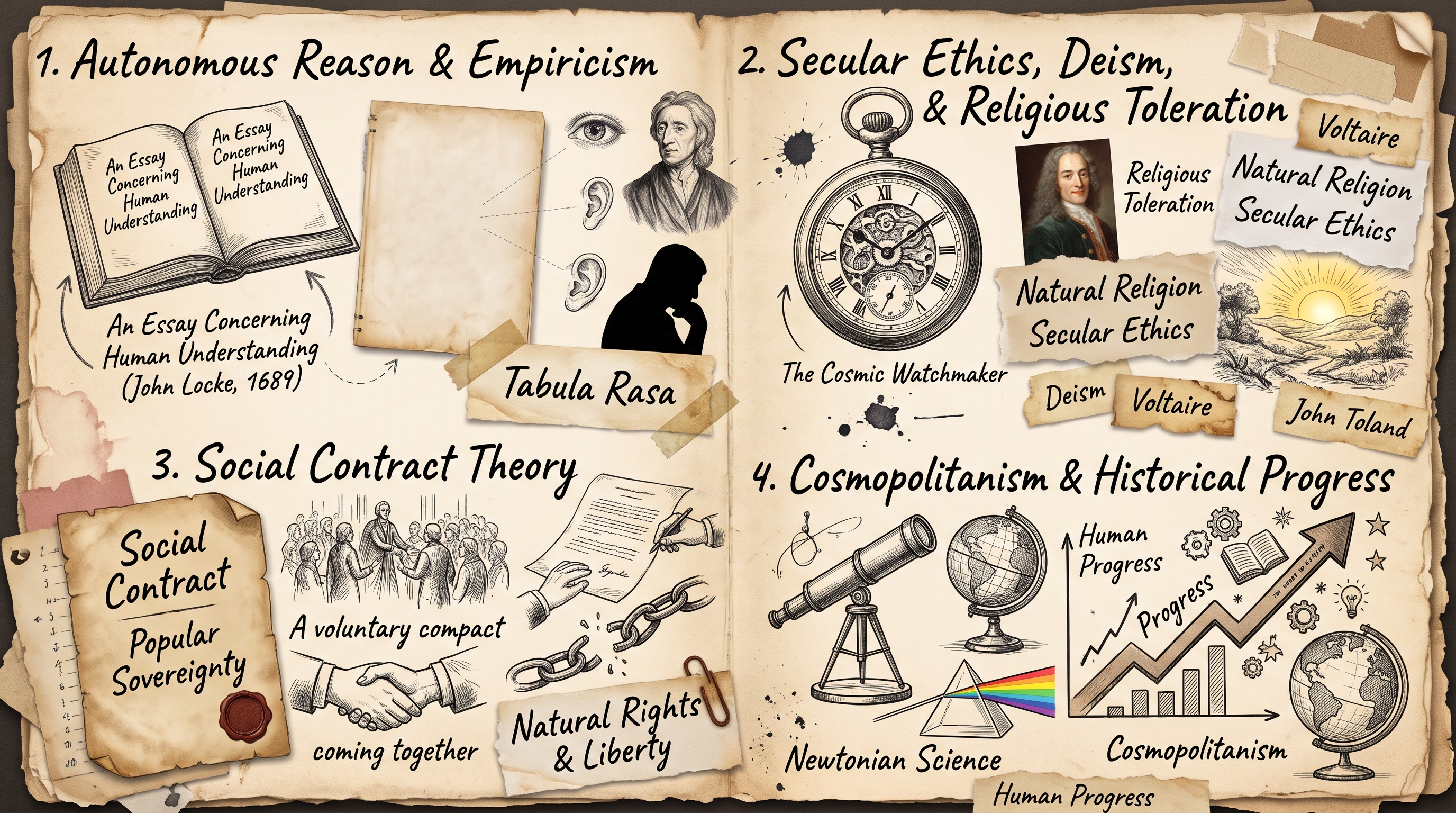
Thinkers elevated critical, independent human reason above ancestral custom, aristocratic birthright, and ecclesiastical dogma.[1:10] Drawing heavily on John Locke's An Essay Concerning Human Understanding (1689), Enlightenment psychology largely rejected Cartesian doctrines of innate ideas—an epistemological departure from the dualism examined in The Mind-Body Dichotomy and Ghost in the Machine—viewing the human mind at birth as an impressionable blank slate (tabula rasa) shaped exclusively by sensory experience and reflection.[1:11] Consequently, human nature was understood as malleable rather than fundamentally depraved: reforming pedagogical methods, legal codes, and civic institutions could directly elevate human character and eradicate institutional cruelty.[1:12]
2. Secular Ethics, Deism, & Religious Toleration
For the first time in post-classical European history, philosophers systematically sought to ground morality on a secular, naturalistic basis rather than divine revelation or fear of otherworldly damnation.[4] While radical materialists (such as Baron d'Holbach and Denis Diderot) advanced forthright atheism, many prominent Enlightenment figures embraced Deism—often termed "natural religion."[1:13] Deists argued that rational scrutiny of cosmic order proved the existence of a supreme creator (the cosmic "watchmaker" who established invariant physical laws), while rejecting scriptural miracles, sacerdotal mediation, and sectarian rituals as irrational superstitions designed to prop up clerical tyranny—exposing them as a deceptive facade built on sand.[1:14] Thinkers such as John Toland (Christianity Not Mysterious, 1696) and Voltaire campaigned relentlessly for freedom of conscience, arguing that state-enforced religious uniformity inevitably tore the fabric of society through sectarian bloodshed.[2:1]
3. Social Contract Theory & Popular Sovereignty
Medieval and early modern absolutism legitimized state authority through the theological doctrine of the Divine Right of Kings, treating royal hierarchy as a sacred reflection of cosmic order.[1:15] Enlightenment political philosophers inverted this paradigm. Reinterpreting and revising Thomas Hobbes, political theorists conceptualized the state as an artificial social contract: a voluntary compact constructed by free, rational individuals to secure their natural rights, civil liberty, and collective welfare.[1:16] Political authority was thus contingent rather than eternal; when rulers violated that trust and devolved into despotism, citizens retained the moral and legal right to reform or dissolve the government.[5]
4. Cosmopolitanism & Historical Progress
Armed with empirical science and constitutional law, Enlightenment intellectuals articulated an optimistic, linear conception of history as cumulative human progress.[2:2] Discarding nostalgic medieval myths of a lost Golden Age, thinkers argued that expanding scientific discovery, unhindered philosophical inquiry, and institutional democratization would progressively eliminate ignorance, disease, and material scarcity.[1:17] This historical confidence went hand-in-hand with an emergent cosmopolitanism, envisioning a universal "Republic of Letters" that transcended parochial national borders and helped plant the seeds of modern international human rights frameworks.[1:18]
Key Thinkers & Foundational Works
John Locke (1632–1704)
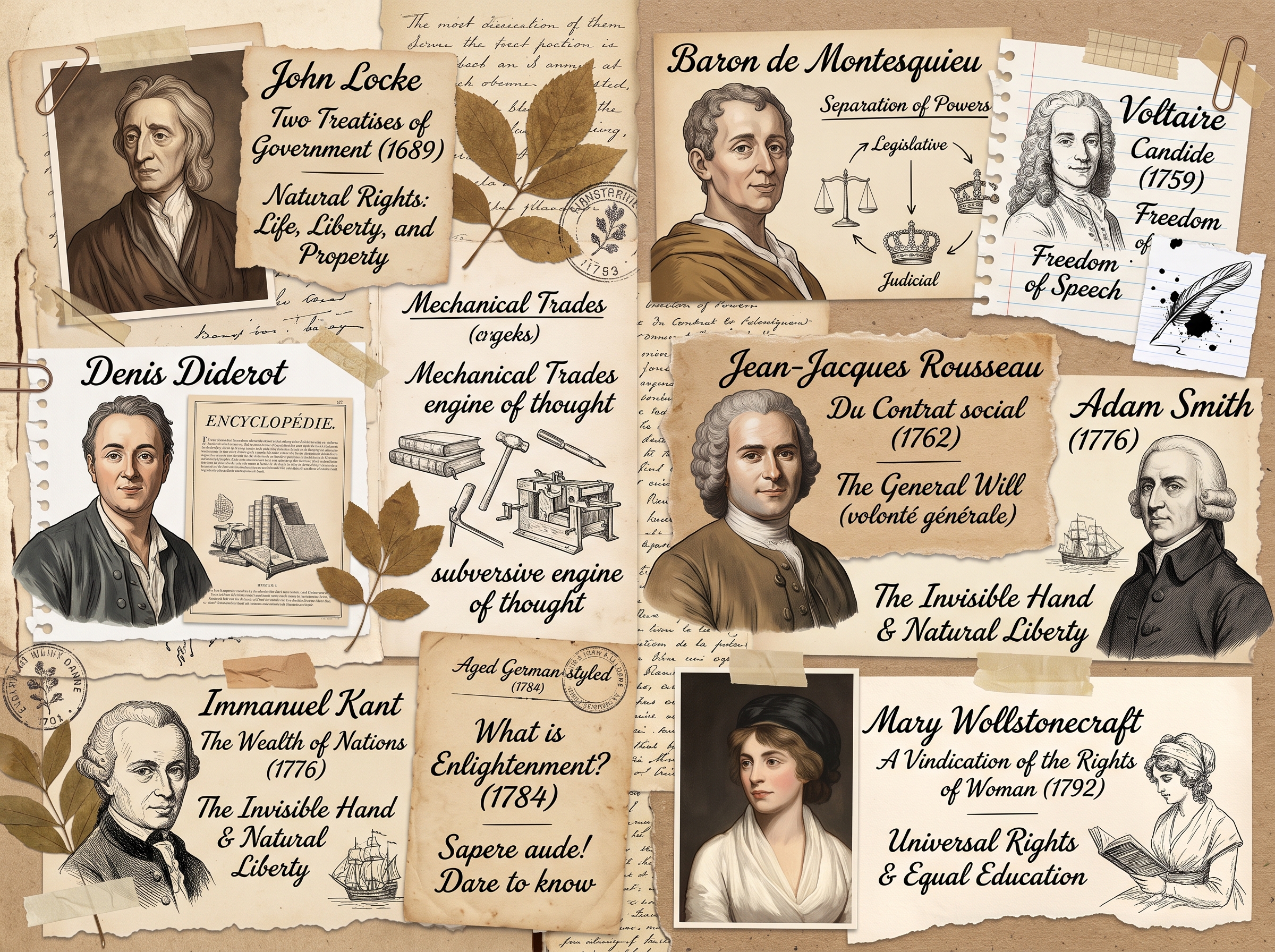
An Oxford scholar, physician, and political theorist, Locke laid the dual foundations of Enlightenment empiricism and liberal constitutionalism.[5:1] In An Essay Concerning Human Understanding (1689), he established the tabula rasa model of mind, arguing that all human knowledge originates in sensation and reflection.[1:19] In his Two Treatises of Government (1689), published in the wake of England's Glorious Revolution, Locke refuted Sir Robert Filmer's patriarchal absolutism, arguing that in a pre-political "state of nature," all human beings are free and equal under natural law, possessing unalienable natural rights to life, liberty, and property.[5:2] Civil government exists solely as an impartial fiduciary trust by the consent of the governed; when a magistrate breaches that contract, sovereign authority reverts back to the political community, who possess the natural right of resistance.[5:3]
Baron de Montesquieu (1689–1755)
French jurist Charles-Louis de Secondat, Baron de Montesquieu, pioneered comparative political sociology and institutional jurisprudence. After lampooning French autocracy and Catholic orthodoxy through the satirical perspective of Persian travelers in Persian Letters (1721), he published his magnum opus, The Spirit of the Laws (De l'esprit des lois, 1748).[2:3] Montesquieu examined how geography, climate, economic commerce, and cultural customs shape legal systems, formulating the doctrine of the separation of powers.[6] He argued that political liberty survives only when legislative, executive, and judicial functions are partitioned across distinct institutional bodies capable of checking and balancing one another, preventing any single faction from acquiring tyrannical dominion.[6:1]
Voltaire (1694–1778)
Born François-Marie Arouet, Voltaire was the preeminent French philosophe—a prolific dramatist, historian, public intellectual, and polemicist who weaponized satire against religious intolerance, judicial torture, and aristocratic privilege.[7] Exiled to England in the 1720s, he published Lettres philosophiques (Letters on the English, 1734), celebrating British constitutional limits, Newtonian science, and commercial religious pluralism in sharp contrast to French autocracy.[8] In his satirical novella Candide (1759), Voltaire skewered Leibnizian metaphysical optimism in the wake of the devastating 1755 Lisbon earthquake, concluding that humanity must abandon speculative metaphysics and practically "cultivate our garden."[8:1] His courageous legal defense of persecuted Protestants (exemplified by the Jean Calas affair) established religious toleration and free speech as central rallying cries of the European Enlightenment.[7:1]
Denis Diderot (1713–1784)
A radical materialist philosopher, novelist, and art critic, Diderot served as the driving intellectual engine and co-editor (alongside mathematician Jean le Rond d'Alembert) of the monumental Encyclopédie, ou dictionnaire raisonné des sciences, des arts et des métiers (1751–1772).[9] Spanning twenty-eight original folio volumes (and expanding to thirty-five), the Encyclopédie was designed not merely as an informational repository, but as a subversive ideological instrument to "change the common way of thinking."[2:4] By placing mechanical trades, artisanal crafts, and metallurgy on equal footing with liberal arts, and utilizing subtle cross-references (renvois) to expose theological absurdities, Diderot democratized technical knowledge and challenged ecclesiastical censorship.[9:1]
Jean-Jacques Rousseau (1712–1778)
A Genevan philosopher and composer who forged an ambivalent, often antagonistic relationship with the Parisian philosophes, Rousseau critiqued the moral vanity and inequality bred by polite urban culture. In Discourse on the Origin of Inequality (1755) and The Social Contract (Du contrat social, 1762), Rousseau argued that civilized social institutions had corrupted humanity's natural, uncorrupted state (pitié and self-preservation), replacing freedom with competitive vanity (amour-propre).[10] To reclaim moral liberty within organized society, Rousseau envisioned a radical democratic republicanism where sovereign law expresses the general will (volonté générale)—the collective interest of citizens deliberating exclusively for the common good rather than private factions.[10:1] Obeying laws one has co-authored as an equal citizen reconciles sovereign authority with authentic moral autonomy.[10:2]
Adam Smith (1723–1790)
A central luminary of the Scottish Enlightenment alongside David Hume (whose empirical critique of identity is analyzed in David Hume's Bundle Theory (1739)), Smith bridged moral psychology and classical political economy.[11] Following The Theory of Moral Sentiments (1759)—which grounded human morality in sympathetic imagination and the perspective of an "impartial spectator"—Smith published An Inquiry into the Nature and Causes of the Wealth of Nations (1776).[11:1] Dismantling mercantilist dogma, which treated wealth as a zero-sum hoarding of gold bullion through protectionist state cartels, Smith demonstrated that national wealth stems from the division of labor, capital reinvestment, and open market exchange, arguing that individuals pursuing their own productive interest under the rule of law coordinate social prosperity more effectively than central planners.[11:2]
Immanuel Kant (1724–1804)
Writing from Königsberg at the zenith of the German Aufklärung, Kant synthesized British empiricism and continental rationalism, revolutionizing epistemology, aesthetics (explored in Immanuel Kant-The Transcendental Sublime), and moral philosophy.[3:1] In his celebrated 1784 essay An Answer to the Question: What is Enlightenment? (Beantwortung der Frage: Was ist Aufklärung?), Kant defined enlightenment as humanity's emancipation from "self-imposed immaturity" through the courageous exercise of reason without external tutelage.[3:2] Distinguishing between the "private use of reason" (civic obedience within official occupational duties) and the unrestricted "public use of reason" (scholarly inquiry addressing the global reading public), Kant famously observed that while his generation did not live in an already enlightened age, it definitively occupied an age of enlightenment where intellectual barriers were progressively receding.[3:3]
Mary Wollstonecraft (1759–1797)
Confronting the glaring patriarchal blind spots of male Enlightenment theorists—particularly Rousseau, who argued in Émile (1762) that women should be educated strictly to please and serve men—English philosopher Mary Wollstonecraft published A Vindication of the Rights of Woman in 1792.[12] Extending the universalist logic of Lockean empiricism and natural rights, Wollstonecraft demonstrated that women's apparent superficiality was an artificial product of systematic miseducation rather than biological nature.[12:1] Because women possess the exact same rational capacity and moral faculties as men, genuine social virtue requires equal access to rigorous academic education, legal autonomy, civil rights, and companionate marriage.[13]
| Thinker | Primary Region | Key Work(s) | Central Contribution |
|---|---|---|---|
| John Locke | England | Two Treatises of Government (1689); Essay Concerning Human Understanding (1689) | Tabula rasa empiricism; unalienable natural rights (life, liberty, property); governance by consent.[1:20] |
| Baron de Montesquieu | France | Persian Letters (1721); The Spirit of the Laws (1748) | Separation of executive, legislative, and judicial powers; institutional checks and balances.[6:2] |
| Voltaire | France | Lettres philosophiques (1734); Candide (1759); Treatise on Tolerance (1763) | Freedom of speech, religious toleration, Deism, and devastating satire against judicial and clerical abuse.[8:2] |
| Denis Diderot | France | Encyclopédie (1751–1772, co-editor); Rameau's Nephew | Democratization and secularization of scientific and technical knowledge; radical philosophical materialism.[9:2] |
| Jean-Jacques Rousseau | Geneva / France | Discourse on Inequality (1755); The Social Contract (1762); Émile (1762) | Radical democratic republicanism; popular sovereignty; the collective general will (volonté générale).[10:3] |
| Adam Smith | Scotland | The Theory of Moral Sentiments (1759); The Wealth of Nations (1776) | Classical political economy; critique of mercantilism; division of labor, productivity, and market coordination.[11:3] |
| Immanuel Kant | Prussia (Germany) | Critique of Pure Reason (1781); What is Enlightenment? (1784) | Epistemic autonomy (Sapere aude); categorical moral imperative; freedom of the public sphere.[3:4] |
| Mary Wollstonecraft | England | A Vindication of the Rights of Men (1790); A Vindication of the Rights of Woman (1792) | Foundational feminist philosophy; extension of universal natural rights and rational education to women.[12:2] |
The Public Sphere & Dissemination of Ideas
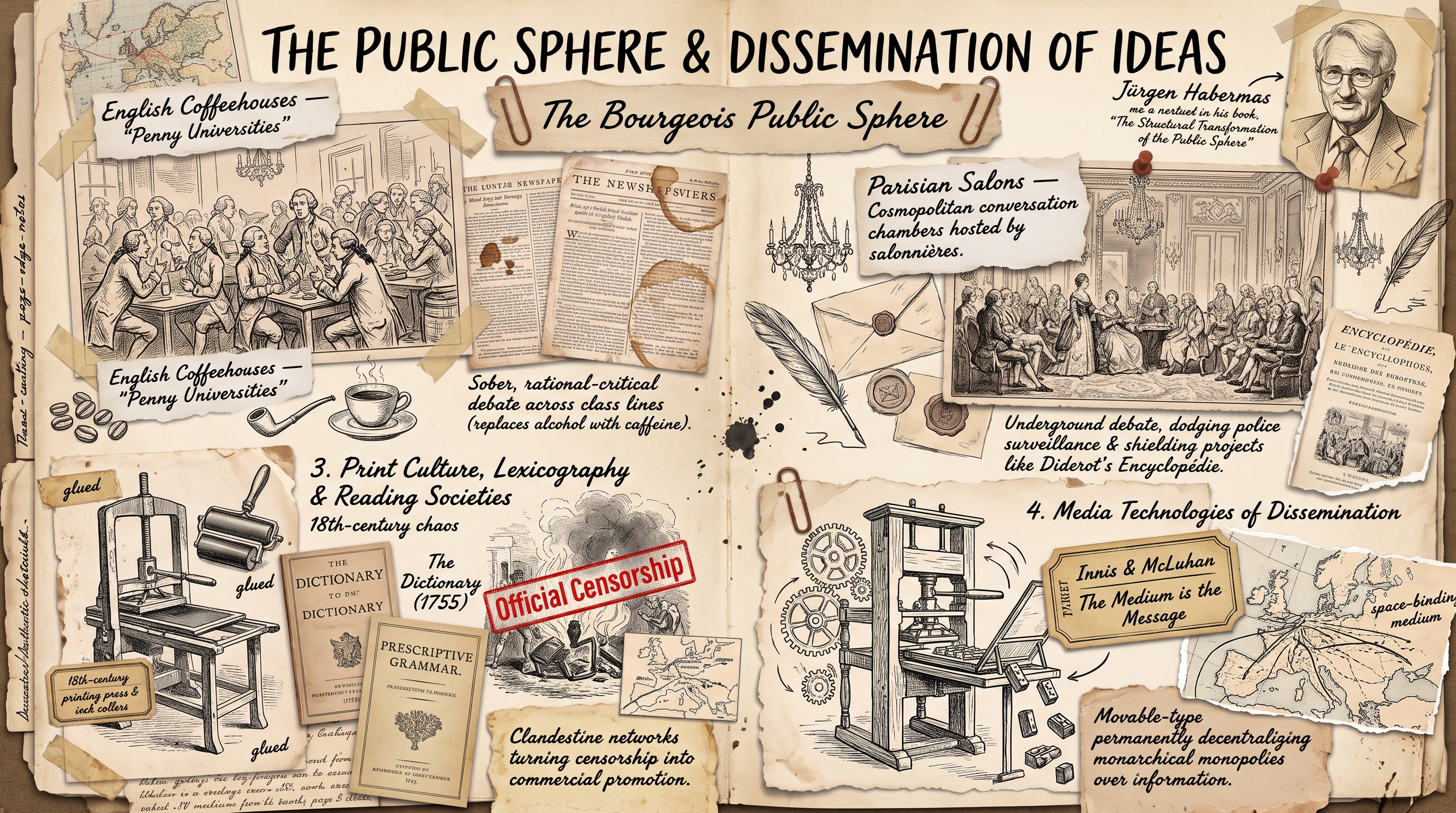
As sociologist Jürgen Habermas demonstrated in Jürgen Habermas's The Structural Transformation of the Public Sphere, Enlightenment ideas did not propagate primarily through traditional university faculties, which frequently remained bastions of scholasticism and clerical orthodoxy.[14] Instead, intellectual exchange was mediated through a newly forged bourgeois public sphere (Öffentlichkeit) and a transnational Republic of Letters that operated outside the direct control of the royal court and church hierarchy.[15]
Several key institutional and spatial environments powered this communicative ecosystem:
- English Coffeehouses: Emerging in the late seventeenth century, London coffeehouses operated as egalitarian "penny universities."[14:1] By replacing alcohol with caffeinated stimulants, these spaces fostered sober, rational-critical debate, allowing merchants, journalists, natural philosophers, and parliamentarians to read newspapers and debate public policy across traditional class lines.[14:2][15:1]
- Parisian Salons: In autocratic France, where public assembly faced strict police surveillance, intellectual life centered upon private aristocratic and upper-bourgeois salons, hosted predominantly by educated women (salonnières) such as Madame Geoffrin and Julie de Lespinasse.[15:2] Salons functioned as structured, cosmopolitan conversation chambers where philosophes, foreign ambassadors, and reformist nobles debated radical manuscripts and coordinated patronage networks that shielded controversial undertakings like Diderot's Encyclopédie.[15:3]
- Print Culture, Lexicography, & Reading Societies: Rising literacy rates coincided with a dramatic expansion in periodical journalism, lending libraries, Masonic lodges, provincial scientific academies, and clandestine publishing presses.[15:4] As explored in The Freeze-Drying of Language — The Dictionary (1755), Prescriptive Grammar, and the Social Stratification of Speech, the mid-eighteenth century witnessed systematic campaigns to codify, standardize, and discipline the vernacular tongue. When royal and ecclesiastical censors issued condemnations and public book burnings, underground networks in Amsterdam, Geneva, and Neuchâtel smuggled illicit editions across borders—turning official censorship into inadvertent commercial promotion.[8:3]
- Media Technologies of Dissemination: As theorized in Innis (1950) - Empire and Communications and McLuhan's The Medium is the Message, the physical infrastructure of movable-type printing acted as a powerful space-binding medium, enabling rapid dissemination of secular, critical texts that permanently decentralized monarchical monopolies over information and public discourse.[15:5]
Political Impact, Contradictions, & Counter-Movements
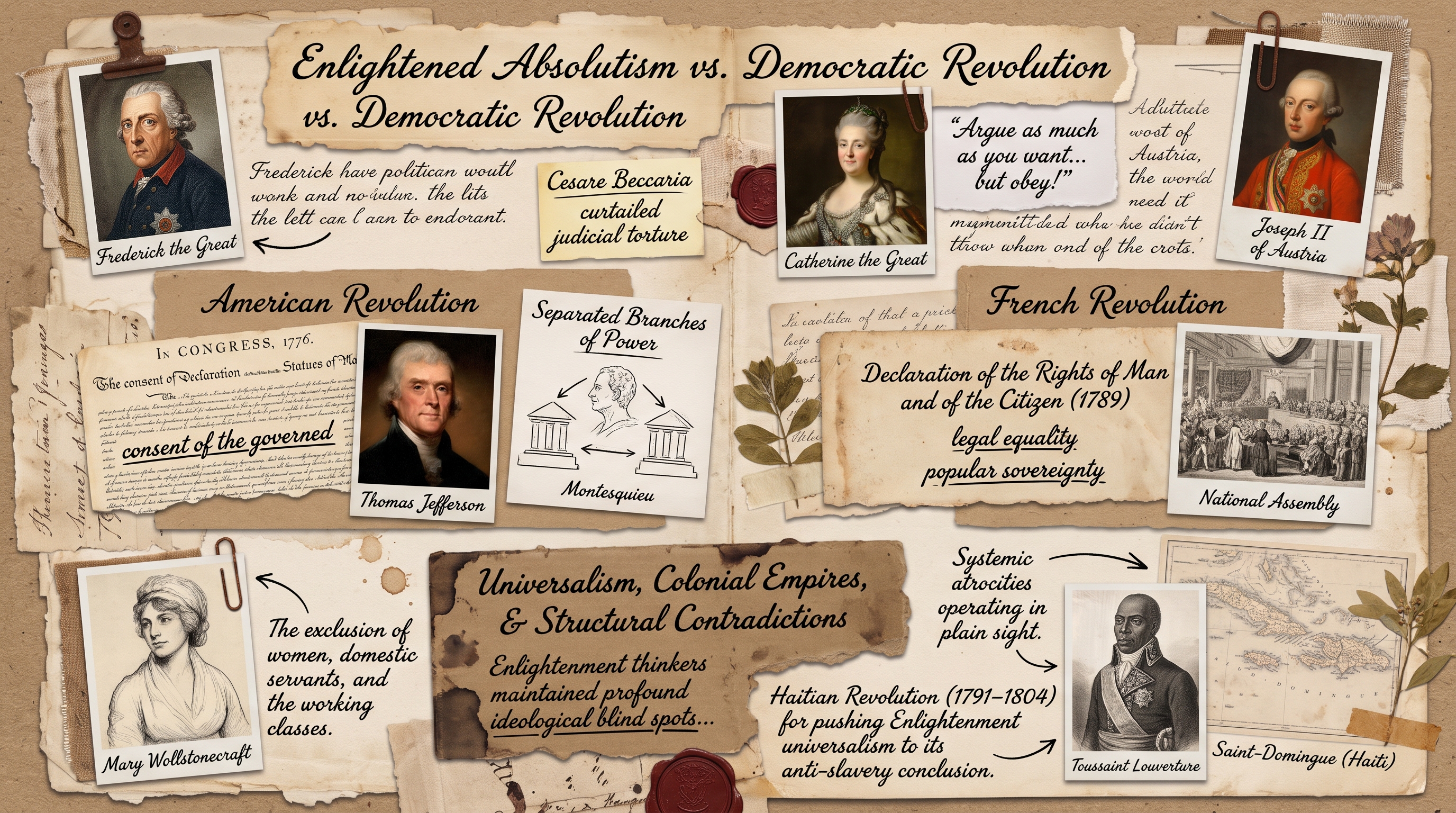
Enlightened Absolutism vs. Democratic Revolution
Initially, several European autocrats sought to co-opt Enlightenment rationality to modernize their realms without relinquishing autocratic control—a historical phenomenon termed Enlightened Absolutism (or Enlightened Despotism). Monarchs like Frederick II of Prussia, Catherine the Great of Russia, and Joseph II of Austria corresponded with Voltaire and Diderot, streamlined tax collection, patronized scientific academies, curtailed judicial torture (guided by Italian penal reformer Cesare Beccaria), and codified legal frameworks. However, these rulers preserved royal command structures, epitomized by Frederick's governance formula as paraphrased by Kant: "Argue as much as you want and about what you want, but obey!"[3:5] This bureaucratic modernization anticipated the administrative state apparatuses later analyzed in Michel Foucault.
Ultimately, the philosophical premise of inherent natural rights proved irreconcilable with hereditary absolutism, catalyzing the Atlantic Revolutions:
- The American Revolution (1775–1783): In drafting the Declaration of Independence (1776), Thomas Jefferson translated Lockean social contract theory and unalienable natural rights into political reality, proclaiming government legitimacy to rest strictly upon the "consent of the governed."[2:5] A decade later, the framers of the United States Constitution (1787) embedded Montesquieu's institutional architecture of separated executive, legislative, and judicial branches into constitutional law.[6:3]
- The French Revolution (1789–1799): In 1789, the National Assembly shattered the feudal Ancien Régime, promulgating the Declaration of the Rights of Man and of the Citizen (Déclaration des droits de l'homme et du citoyen).[1:21] The document codified legal equality, meritocratic taxation, freedom of religious belief, and popular sovereignty—transforming radical Enlightenment theories into statutory constitutional law.[1:22]
Despite their stirring proclamations of universal liberty, Enlightenment thinkers maintained profound ideological blind spots. Most prominent male philosophers excluded women, domestic servants, and non-property-owning working classes from political enfranchisement, prompting Mary Wollstonecraft's vigorous rejoinder.[12:3][13:1]
Furthermore, while many Enlightenment intellectuals condemned chattel slavery in theoretical treatises, eighteenth-century European empires dramatically expanded the transatlantic slave trade, and several thinkers (including Voltaire, Hume, and Kant) formulated pseudo-scientific racial taxonomies that colonial authorities utilized to justify imperial subjugation. In practice, imperial powers chose to turn a blind eye to systemic atrocities operating in plain sight across Caribbean plantations. It required the self-liberation of enslaved revolutionaries in Saint-Domingue during the Haitian Revolution (1791–1804)—led by Toussaint Louverture—to push Enlightenment universalism to its uncompromised anti-slavery conclusion, exposing metropolitan hypocrisy and forcing universal freedom into historical practice.
Counter-Enlightenment, Romanticism, & Modern Critiques
By the late 1790s, the descent of the French Revolution into the Jacobin Reign of Terror and subsequent Napoleonic imperialism ignited fierce philosophical counter-movements:
- Burkean Conservatism: In Reflections on the Revolution in France (1790), statesman Edmund Burke (whose aesthetic theory is examined in Edmund Burke-The Physiological Sublime) mounted a foundational conservative critique. Burke argued that dismantling organic social institutions and ancestral customs in favor of abstract, geometric political blueprints inevitably tore the social fabric, producing chaos, moral degeneration, and military despotism.
- The Romantic Rebellion: The emergent Romantic movement rebelled against what it diagnosed as the sterile, mechanistic reductionism of Enlightenment rationalism. As explored across The Sublime and The Sublime, Awe, and Epiphany, artists, poets, and philosophers (such as Goethe, Wordsworth, and Schelling) championed visceral emotional intuition, untamed wilderness, cultural particularism, and the transcendental depth of the unconscious against cold calculative rationality.
- Critical Theory & The Dialectic of Enlightenment: In the twentieth century, scarred by the industrial horrors of Auschwitz and total war, Frankfurt School theorists Max Horkheimer and Theodor Adorno published Dialectic of Enlightenment (1947). They argued that when Enlightenment reason is severed from emancipatory ethical ends and reduced to pure instrumental rationality (Zweckrationalität—as conceptualized by Max Weber (1864-1920)), it ceases to liberate humanity and instead morphs into technical domination, administrative surveillance, and industrial subjugation. Furthermore, posthumanist perspectives explored in Vital Materialism and Animism demonstrate how the Cartesian-Baconian mastery of nature as passive, dead matter generated acute global ecological crises.
Nevertheless, modern constitutional democracy, international human rights jurisprudence, secular public education, scientific methodology, and institutional freedom of speech remain direct inheritors of the eighteenth-century Age of Reason.[1:23]
🎴 Interactive Web Practice (Comprehension Check)
Question 1 (Epistemological Foundations): Contrast John Locke's empirical concept of the tabula rasa with Cartesian rationalism, and explain how Locke's psychology fueled the Enlightenment's passion for institutional and educational reform.
Answer: René Descartes and the continental rationalist tradition maintained that the human mind is endowed from birth with innate ideas (including innate knowledge of God, mathematical truths, and geometric axioms) that can be deduced through pure reason independent of sensory experience.
In contrast, John Locke's An Essay Concerning Human Understanding (1689) rejected innate ideas, arguing that the infant mind is a blank slate (tabula rasa). All ideas, categories, and knowledge originate entirely in two empirical sources: external sensation (perceiving the physical world) and internal reflection (mental operations upon those sensory inputs).
This epistemological shift had radical sociopolitical consequences: if the human mind possesses no innate ideas, human beings are not born inherently depraved or divinely pre-programmed for subordinate social castes. Because human character, morality, and intellect are shaped entirely by environmental experience, reforming schools, legal codes, religious upbringing, and political institutions could directly cultivate rational, virtuous, and productive citizens. This empirical malleability transformed education and institutional reform from peripheral concerns into the primary engines of human progress.
Question 2 (Communicative Architecture): How did the rise of the bourgeois public sphere (as conceptualized by Jürgen Habermas) alter the relationship between state power and public opinion during the Enlightenment?
Answer: In traditional feudal and absolutist societies, political power was theatrical and courtly: the monarch and ecclesiastical hierarchy displayed their authority downward before a passive, unrepresented populace (what Habermas terms "representative publicity"). Ordinary citizens had no legitimate institutional platform to debate or challenge sovereign state policy.
The emergence of the bourgeois public sphere (Öffentlichkeit) in the eighteenth century established an autonomous social realm situated between private domestic life and the sovereign state. Powered by English coffeehouses, Parisian salons, Masonic lodges, reading societies, and a surging print culture of uncensored newspapers and pamphlets, private individuals gathered to engage in rational-critical debate. Within these spaces, arguments were theoretically judged by the force of reason rather than inherited aristocratic status or clerical office.
This shift gave birth to public opinion as a sovereign political force: for the first time in European history, state authority, judicial rulings, and economic policies were compelled to justify their legitimacy before the public tribunal of reason, laying the social foundation for democratic accountability and constitutional governance.
Question 3 (Contradictions & Dialectics): Why do modern critical theorists and postcolonial scholars argue that Enlightenment universalism was structurally ambivalent, and how was this contradiction challenged during the Atlantic Revolutions?
Answer: While Enlightenment philosophers articulated universal declarations of natural rights, human dignity, and intellectual freedom, their historical practice was marked by profound structural exclusions. Male theorists largely categorized women as emotionally volatile and naturally destined for domestic subordination, and several leading thinkers (including Voltaire, Hume, and Kant) formulated hierarchical racial taxonomies that provided intellectual cover for European colonial expansion and chattel slavery.
This structural contradiction was aggressively challenged during the Atlantic Revolutions. While the American and French Revolutions compromised on the issue of race and slavery to appease propertied commercial elites, the enslaved population of Saint-Domingue initiated the Haitian Revolution (1791–1804). Led by Toussaint Louverture, Haitian revolutionaries took the Enlightenment's universalist declarations of human liberty literally, defeating French, British, and Spanish imperial armies to establish the world's first free Black republic and abolish slavery.
In twentieth-century critical theory (notably Horkheimer and Adorno's Dialectic of Enlightenment), scholars demonstrated that when reason is stripped of moral reflection and converted into pure instrumental calculability (Zweckrationalität), it risks facilitating technocratic administration, bureaucratic totalitarianism, and ecological devastation—revealing that the struggle for genuine emancipation requires continuous, self-critical vigilance.
Resonant Notes
The following notes in the vault share direct thematic, historical, and epistemological connections with The Enlightenment:
🔴 Intellectual Genealogies, Epistemology & Scientific Precursors
- The Road to the Enlightenment — Direct companion historical treatise mapping the four-century transition from medieval scholasticism and the Renaissance to the Protestant Reformation and the Scientific Revolution.
- The Renaissance — Explores the fourteenth- to sixteenth-century Italian and Northern European rebirth of classical humanism (studia humanitatis), civic virtue, and philological textual criticism that challenged medieval scholastic orthodoxies.
- Nicolaus Copernicus (1473–1543) — Foundational astronomical treatise De revolutionibus orbium coelestium, which initiated the Scientific Revolution by mathematically displacing the Earth from the cosmic center.
- The Specular Revolution - Optics, Interiority, and the Modern Self — Examines how early modern flat glass mirrors, linear perspective, and optical geometry severed the individual from the communal web, giving rise to the bounded, introspective modern ego.
- The Mind-Body Dichotomy & Ghost in the Machine — René Descartes' radical bifurcation of reality into thinking substance (res cogitans) and mechanical body (res extensa), establishing the mechanistic worldview that Locke and later empiricists sought to reform.
- David Hume's Bundle Theory (1739) — Radical Scottish Enlightenment empiricism applying Newtonian experimental method to human psychology, demonstrating that introspective scrutiny reveals only fleeting sensory impressions rather than a unified self.
- A Treatise on Painting (Trattato della pittura) — Leonardo da Vinci's foundational aesthetic treatise demonstrating how empirical anatomical dissection and linear optical geometry elevated art into an intellectual science (scienza e discorso mentale).
🟡 Political Philosophy, Sovereignty & The Public Sphere
- Jürgen Habermas's The Structural Transformation of the Public Sphere — Landmark sociological analysis detailing how eighteenth-century coffeehouses, salons, and print capitalism constructed the bourgeois public sphere (Öffentlichkeit) that held sovereign states accountable to rational critique.
- The Freeze-Drying of Language — The Dictionary (1755), Prescriptive Grammar, and the Social Stratification of Speech — Companion historical study analyzing how eighteenth-century Enlightenment intellectuals codified, standardized, and disciplined vernacular tongues into authoritative national languages.
- The Enclosure of the Intangible Commons — Intellectual Property, Artificial Scarcity, and the Colonization of Knowledge — Traces how early modern patent statutes and English copyright laws (the Statute of Anne, 1710) emerged alongside the print revolution and Enlightenment market theories to enclose the intellectual commons.
- Nocturnalization - The Industrialization of Light — Investigates how early modern royal absolutism deployed street illumination and architectural lighting at Versailles as mechanisms of state prestige and sovereign surveillance.
- Michel Foucault — Analyzes the historical emergence of disciplinary power, penal reform, and panoptic surveillance as sovereign monarchies modernized into rationalized administrative states during the eighteenth century.
- Innis (1950) - Empire and Communications & Innis (1951) - The Bias of Communication — Harold Innis's media ecology theory examining how movable type print operated as a space-binding technology that broke ecclesiastical information monopolies and decentralized political authority.
- McLuhan's The Medium is the Message — Marshall McLuhan's analysis of how print typography conditioned the Western human sensorium toward linear causality, detachment, individualism, and mechanistic science.
🟢 Modernity, Critical Theory & Counter-Movements
- Immanuel Kant-The Transcendental Sublime — Analyzes Kant's aesthetic theory in the Critique of Judgment, showing how the human encounter with formless cosmic magnitude triggers sensible paralysis followed by the supersensible triumph of Reason and moral dignity.
- Edmund Burke-The Physiological Sublime — Explores Burke's empiricist aesthetic treatise on terror, obscurity, and power, which directly informed his profound conservative critique of abstract French revolutionary rationalism.
- The Sublime & The Sublime, Awe, and Epiphany — Interdisciplinary investigation into how the aesthetic sublime emerged in eighteenth-century thought as a vital counterpoint and experiential challenge to mechanistic rationalism.
- Max Weber (1864-1920) — Weber's sociological frameworks of formal rationalization (Zweckrationalität), bureaucratic efficiency, and the "disenchantment of the world" (Entzauberung der Welt) that accompanied Enlightenment secularization.
- Walter Benjamin’s Theses on the Philosophy of History — Radical twentieth-century critique deconstructing the linear, triumphant Enlightenment dogma of historical progress, conceptualizing history instead as an accumulating wreckage before the "Angel of History."
- Vital Materialism & Animism — Posthuman and ecological critiques challenging the Cartesian-Baconian conception of nature as passive, inert matter engineered exclusively for instrumental human exploitation.
- Zygmunt Bauman's sociological framework of Liquid Modernity — Diagnoses the contemporary fate of Enlightenment universalism and solid modern institutions as they dissolve into precarious, individualized market currents.
- a-facade — Metaphoric expression illustrating how absolute monarchs and ecclesiastical dogmatists projected an outward display of sacred inviolability to conceal systemic institutional decay.
- built-on-sand — Metaphoric expression capturing the epistemic fragility of hereditary privileges and scholastic dogmas when subjected to empirical critique.
- in-the-dark — Metaphoric expression depicting the pre-modern lay condition of exclusion from vernacular literacy and philosophical debate.
- blind-spot — Metaphoric expression characterizing the severe contradictions of Enlightenment universalism regarding gender inequality, chattel slavery, and colonial exploitation.
- in-plain-sight — Metaphoric expression capturing how colonial abuses and the transatlantic slave trade operated openly across eighteenth-century mercantile empires.
- the-fabric-of-society — Metaphoric expression illustrating the fragile civic bonds threatened by religious warfare and authoritarian despotism.
- turn-a-blind-eye — Metaphoric expression diagnosing the moral acquiescence of early modern elites who ignored colonial chattel slavery while theorizing natural human liberty.
- smoke-and-mirrors — Metaphoric expression characterizing the theological rationalizations and court pageantry deployed by absolutist regimes to maintain ideological compliance.
- unravel — Metaphoric expression capturing how feudal privileges, monarchical divine-right doctrines, and scholastic dogma systematically unwound under empirical and revolutionary critique.
References
Brian Duignan / Enlightenment: European History / britannica.com ↩︎ ↩︎ ↩︎ ↩︎ ↩︎ ↩︎ ↩︎ ↩︎ ↩︎ ↩︎ ↩︎ ↩︎ ↩︎ ↩︎ ↩︎ ↩︎ ↩︎ ↩︎ ↩︎ ↩︎ ↩︎ ↩︎ ↩︎ ↩︎
Encyclopaedia Britannica Editors / The Enlightenment Timeline / britannica.com ↩︎ ↩︎ ↩︎ ↩︎ ↩︎ ↩︎
Immanuel Kant (trans. Ted Humphrey) / An Answer to the Question: What is Enlightenment? (1784) / nypl.org ↩︎ ↩︎ ↩︎ ↩︎ ↩︎ ↩︎
William Bristow / Enlightenment — Stanford Encyclopedia of Philosophy / plato.stanford.edu ↩︎
William Uzgalis / John Locke — Stanford Encyclopedia of Philosophy / plato.stanford.edu ↩︎ ↩︎ ↩︎ ↩︎
Hilary Bok / Baron de Montesquieu, Charles-Louis de Secondat — Stanford Encyclopedia of Philosophy / plato.stanford.edu ↩︎ ↩︎ ↩︎ ↩︎
J.B. Shank / Voltaire — Stanford Encyclopedia of Philosophy / plato.stanford.edu ↩︎ ↩︎
Wikipedia Contributors / Voltaire / en.wikipedia.org ↩︎ ↩︎ ↩︎ ↩︎
Charles T. Wolfe & J.B. Shank / Biography of Denis Diderot — Stanford Encyclopedia of Philosophy / plato.stanford.edu ↩︎ ↩︎ ↩︎
Encyclopaedia Britannica Editors / General Will / britannica.com ↩︎ ↩︎ ↩︎ ↩︎
Samuel Fleischacker / Adam Smith's Moral and Political Philosophy — Stanford Encyclopedia of Philosophy / plato.stanford.edu ↩︎ ↩︎ ↩︎ ↩︎
Karen Sottosanti / A Vindication of the Rights of Woman / britannica.com ↩︎ ↩︎ ↩︎ ↩︎
Eileen Hunt Botting (ed.) / A Vindication of the Rights of Woman by Mary Wollstonecraft / mekliganjcollege.org ↩︎ ↩︎
Wikipedia Contributors / English Coffeehouses in the 17th and 18th Centuries / en.wikipedia.org ↩︎ ↩︎ ↩︎
Alan Charles Kors (ed.) / Coffeehouses and Cafes — Encyclopedia of the Enlightenment / oxfordreference.com ↩︎ ↩︎ ↩︎ ↩︎ ↩︎ ↩︎