Brooks' Law (The Mythical Man-Month & Communication Overhead)
🗂️ Interactive Notebook: Open Study Companion (Video Summary, Flashcards, Mind Map) ↗
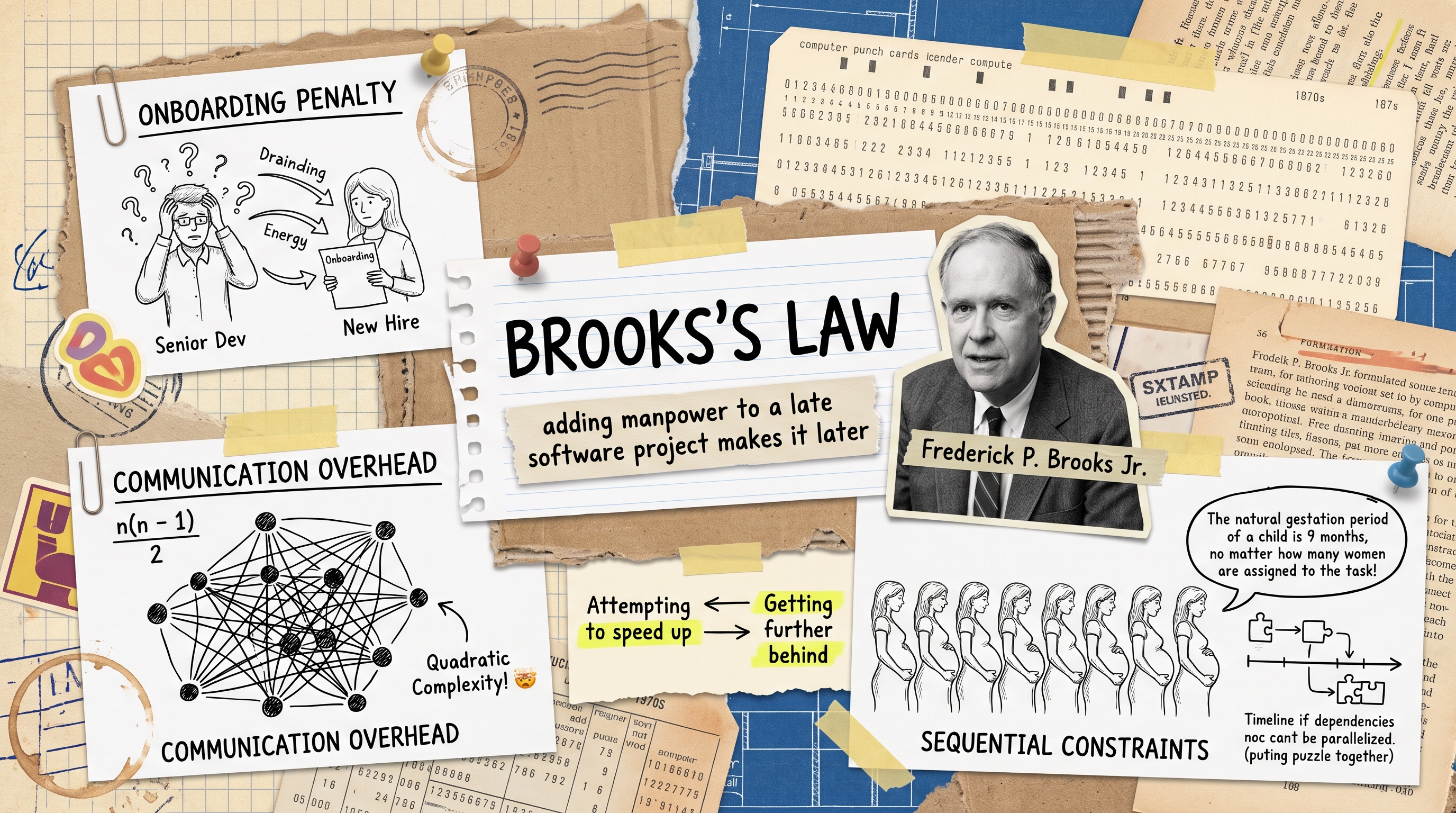
Formulated by computer scientist Frederick P. Brooks Jr. in his seminal 1975 work The Mythical Man-Month, Brooks's Law posits that "adding manpower to a late software project makes it later."[1] Unlike industrial manufacturing or agriculture, complex knowledge work cannot treat labor and calendar time as interchangeable commodities.[2] Attempting to accelerate a delayed software project by injecting new personnel introduces three compounding systemic penalties: the non-linear ramp-up curve of onboarding (which drains existing senior capacity), the quadratic explosion of communication overhead governed by the pairwise formula
Historical Genesis: The IBM OS/360 Crucible
Brooks's Law did not emerge from abstract management theory; it was forged during one of the most ambitious, costly, and turbulent engineering undertakings of the twentieth century: the development of IBM Operating System/360 (OS/360).[2:2]
In 1964, after serving as the lead hardware architect for the IBM System/360 mainframe family, Frederick Brooks transitioned to manage the development of its unified operating system.[2:3] IBM bet the company's future on a single, upward-compatible software architecture capable of running across an entire spectrum of machines—from small commercial batch processors to scientific supercomputers.[2:4]
As the software effort fell perilously behind schedule between 1964 and 1966, IBM executives reacted with conventional industrial logic: they poured hundreds of additional programmers into the struggling divisions.[1:2][2:5] The result was what Brooks later characterized as a "tar pit" where great beasts struggle fiercely only to sink deeper.[2:6] Despite consuming roughly 5,000 man-years of effort across more than a thousand personnel—exceeding NASA's Apollo flight software budget in relative manpower—OS/360 shipped late, consumed far more memory than specified, and suffered from pervasive control-program defects in its initial releases.[2:7][3]
"Oversimplifying outrageously, we state Brooks's Law: Adding manpower to a late software project makes it later. This then is the demythologizing of the man-month." — The Mythical Man-Month[3:1]
When Brooks departed IBM in 1965 to found the Department of Computer Science at the University of North Carolina at Chapel Hill, IBM CEO Thomas J. Watson Jr. asked him why software engineering proved exponentially harder to manage than hardware engineering.[2:8] Brooks's decade-long reflection produced the 1975 collection of essays The Mythical Man-Month, transforming his post-mortem of OS/360 into foundational systems engineering doctrine.[1:3][2:9]
Deconstructing the "Man-Month" Myth
At the heart of Brooks's thesis is a critique of the accounting unit traditionally used to estimate and schedule projects: the man-month (or person-month).[3:2] A man-month represents the hypothetical volume of output generated by one worker over thirty days.[1:4]
While accounting costs scale linearly as the product of headcount multiplied by calendar months, engineering progress does not.[3:3] Treating the man-month as an invariant unit of output relies on the false premise that workers and months are freely interchangeable—that a twelve-month task assigned to one engineer can be completed in one month by twelve engineers.[2:10][3:4] When managers treat intellectual contributors as mere cogs in a machine, they overlook the structural nature of complex task dependencies.
Brooks identifies four structural realities of task partitioning that shatter the interchangeability of people and time:[3:5]
1. Perfectly Partitionable Tasks (Zero Communication)
In routine physical labor—such as reaping wheat, picking cotton, or painting independent hotel rooms—tasks divide cleanly with negligible coordination between workers.[4][5] Doubling the workforce halves the completion time until physical workspace congestion occurs.[4:1] Software engineering virtually never occupies this category.[1:5]
2. Unpartitionable Sequential Tasks
Certain processes harbor strict causal and temporal dependencies that prohibit parallelization.[3:6] In Brooks's famous analogy: "The bearing of a child takes nine months, no matter how many women are assigned."[4:2][5:1] In software systems, iteratively debugging subtle race conditions, establishing core architectural invariants, and awaiting compilation or integration test feedback loops exhibit hard sequential constraints that extra headcount cannot compress.[3:7][6]
3. Partitionable Tasks Requiring Communication
Most software engineering falls into a middle tier: modules can be divided across multiple developers, provided those developers continuously synchronize interfaces, state assumptions, and data contracts.[1:6][2:11] The effort required to coordinate those boundaries represents pure overhead subtracted from productive execution.[1:7]
4. Tasks with Complex Interrelationships
In systems programming—such as operating system kernels, distributed databases, and monolithic enterprise platforms—subtasks exhibit dense bidirectional coupling.[1:8][2:12] As headcount crosses a critical threshold, the cognitive and administrative burden of resolving cross-component side effects grows faster than the raw coding capacity added by each newcomer, causing marginal productivity to turn negative.[1:9][3:8]
| Task Archetype | Classic Analogy | Software Equivalent | Effect of Adding Headcount |
|---|---|---|---|
| Perfectly Partitionable | Reaping wheat or picking fruit | Isolated data entry or independent UI localization | Linearly decreases duration |
| Sequential / Incompressible | Gestating a baby (9 months) | Root-cause debugging of non-deterministic race conditions | Zero impact on duration; inflates direct cost |
| Partitionable + Coordination | Building a commercial skyscraper | Multi-service feature integration with defined APIs | Diminishing returns; reaches an asymptotic floor |
| Densely Coupled Interrelationships | Writing a cohesive novel by committee | Core OS kernel scheduling or coupled legacy monoliths | Negative marginal return; actively delays schedule |
The Three Systemic Drivers of Schedule Reversal
When an engineering organization violates Brooks's Law by injecting emergency staff into an already slipping timeline, three distinct mathematical and operational mechanisms combine to push the delivery date backward.[1:10][4:3]
1. The Non-Linear Ramp-Up Curve and Assimilation Tax
New engineers do not arrive at a codebase with immediate velocity.[4:4] Unlike standardized assembly-line roles, software systems are bespoke socio-technical artifacts full of tacit domain rules, undocumented historical compromises, local build quirks, and subtle architectural invariants.[5:2][7]
Onboarding imposes a two-way productivity tax:[4:5][5:3]
- Zero or Negative Initial Output: During ramp-up, newcomers generate little deployable functionality and run an elevated risk of introducing regressions—creating negative output by inadvertently breaking fragile invariants they do not yet comprehend.[4:6]
- Cannibalization of Senior Velocity: Because architectural context exists largely as tacit knowledge in the minds of veteran contributors, onboarding requires experienced engineers to pause critical-path execution to conduct code walkthroughs, review pull requests thoroughly, and untangle environmental issues.[5:4][7:1] This continuous mentoring drag can cause senior architects to burn out under the strain of competing priorities.
If a late project has two months remaining and a newly hired developer requires six weeks to reach break-even productivity while consuming 25% of a senior architect's bandwidth during that window, the project suffers an immediate, unrecoverable net deficit in critical-path velocity right when deadlines are tightest.[3:9][7:2]
2. Combinatorial Explosion of Communication Overhead
Software defects cluster disproportionately at the boundaries between modules written by different individuals.[5:5][6:1] Preventing interface mismatches requires continuous bilateral alignment across team members.[1:11][6:2]
Brooks models communication topology as an undirected complete graph where
Furthermore, if coordination requires ad-hoc sub-team alignments across arbitrary subsets of workers rather than simple pairs, potential group permutations approach
- 2 engineers:
channel - 5 engineers:
channels - 10 engineers:
channels - 25 engineers:
channels - 50 engineers:
channels[1:15]
While total labor capacity grows linearly (
3. The "Regenerative Schedule Disaster" Feedback Loop
Brooks illustrates how reactive staffing triggers a cascading failure cycle—termed a regenerative schedule disaster.[3:10]
Consider a project estimated at 12 man-months, assigned to 3 engineers for 4 months, with a target milestone at the end of Month 2:[3:11]
- Slippage Detection: Due to initial optimism or unforeseen integration hurdles, the team reaches the Month 2 milestone at the end of Month 3 (one month late, with 6 man-months of core work still remaining).[3:12]
- Reactive Intervention: Refusing to slip the original Month 4 release date, management calculates that 6 man-months of remaining work divided into 1 remaining calendar month requires 6 engineers. Factoring in training overhead, management hires 2 additional engineers to bring the team to 5, hoping to finish by Month 5.[3:13]
- Training Drain: Throughout Month 4, one veteran engineer spends full-time training the two newcomers, leaving only two productive veterans working on the critical path while the remaining work barely shrinks.[3:14]
- Repartitioning & Integration Shock: In Month 5, the codebase must be sliced into five parallel workstreams instead of three, multiplying system interfaces from 3 pairwise channels to 10.[3:15] System integration and bug-fixing—originally scoped for two weeks—balloon under cross-module regressions introduced by newly onboarded staff, pushing final delivery past Month 6.[3:16]
Had management simply accepted the initial slip and kept the original 3 engineers unaugmented, the project would have completed peacefully at the end of Month 5—earlier, cheaper, and with higher architectural coherence.[3:17] Instead, treating schedule compression on autopilot without considering system dynamics throws a wrench in the works of delivery.
Companion Principles in Brooksian Systems Theory
Brooks's Law operates within a broader constellation of software engineering dynamics introduced across The Mythical Man-Month and its subsequent expansions.[1:17]
Conceptual Integrity and the Surgical Team
Brooks argues that conceptual integrity is the single most vital attribute of system quality: it is better for a system to omit anomalous features and reflect one unified set of design ideas than to contain many independent, uncoordinated ideas.[1:18][2:13]
To achieve conceptual integrity without suffering
Conway's Law Isomorphism
Formulated by Melvin Conway in 1967 and cited heavily by Brooks, Conway's Law states that organizations which design systems are constrained to produce designs which are copies of the communication structures of these organizations.[8][9] When managers dump emergency hires onto a delayed project, they inadvertently force the software architecture itself to fracture along hasty organizational seams, degrading modularity and cementing technical debt.[7:3][8:1]
Essential vs. Accidental Complexity ("No Silver Bullet")
In his landmark 1986 essay "No Silver Bullet — Essence and Accidents of Software Engineering" (appended to the 20th Anniversary Edition), Brooks borrows from Aristotle to divide software difficulty into two distinct categories:[1:20][2:14]
- Accidental Complexity: Friction stemming from tooling, syntax, slow compilers, manual memory management, or awkward deployment pipelines.[1:21] High-level languages, cloud infrastructure, and modern IDEs strip away vast amounts of accidental complexity.[1:22]
- Essential Complexity: The irreducible intellectual difficulty inherent in specifying, designing, and testing interlocking conceptual structures, business rules, and edge-case state transitions.[1:23] Because essential complexity requires deep human alignment and domain synthesis, no single tool or methodology can yield an order-of-magnitude productivity leap—and throwing unaligned bodies at essential complexity only amplifies confusion.[1:24]
Empirical Critiques, Nuances, and Exceptions
Brooks candidly admitted that his law was an "outrageous oversimplification" meant to shock managers out of industrial-age fallacies.[3:18][4:7] Subsequent empirical research in system dynamics and open-source ecosystems has refined the exact boundary conditions under which Brooks's Law holds or breaks down.[5:7][10]
System Dynamics Modeling (Abdel-Hamid & Madnick)
In their landmark 1991 work Software Project Dynamics: An Integrated Approach, Tarek Abdel-Hamid and Stuart Madnick built differential-equation feedback simulations of software staffing.[5:8][11] Their findings revealed a crucial temporal boundary:[5:9]
- Always Costlier, Not Always Later: Adding staff to a struggling project virtually always inflates total man-month expenditure due to assimilation overhead.[5:10]
- The Timing Cutoff: Adding personnel early in a late project (e.g., when less than 30–40% of schedule has elapsed and architectural interfaces are already frozen) can successfully shorten calendar completion dates, provided hiring ceases well before system integration and testing phases begin.[5:11][7:4] Brooks's Law triggers strictly when staffing interventions occur late in the lifecycle, where onboarding lag outlasts the remaining project runway.[4:8][5:12]
Open-Source Ecosystems: Brooks's Law vs. Linus's Law
In his 1997 treatise The Cathedral and the Bazaar, Eric S. Raymond contrasted traditional closed-door corporate engineering ("the Cathedral," governed by Brooks's Law) with the sprawling, decentralized development of the Linux kernel ("the Bazaar").[10:1] Raymond coined Linus's Law: "Given enough eyeballs, all bugs are shallow."[10:2]
Why didn't thousands of contributors collapse the Linux kernel under
Brooks's
- A tiny core of maintainers (the hub) preserves conceptual integrity and absorbs the dense Brooksian communication cost among themselves.[10:6]
- Hundreds of "halo" contributors work asynchronously on strictly separable, parallel subtasks (device drivers, bug characterization, isolated patches) without ever needing to coordinate laterally with one another.[10:7]
Empirical studies of thousands of Free and Open-Source Software (FOSS) repositories by Charles Schweik and Robert English (2007–2012) confirmed that adding peripheral contributors during growth stages statistically correlated with higher project survival and velocity—validating that modular architecture and asynchronous gatekeeping neutralize quadratic communication explosion.[5:13][12]
Modern Mitigations in Software Architecture & Org Design
Contemporary engineering organizations actively design both their technical architectures and team topologies specifically to circumvent the mathematical traps of Brooks's Law.[7:5][9:1]
1. Microservices and Bounded Contexts
Monolithic codebases maximize shared mutable state, forcing developers into a single coupled coordination pool.[7:6] Where architectural boundaries are built on sand, any team expansion creates a fragile house of cards.
By applying Domain-Driven Design (DDD) Bounded Contexts and Service-Oriented / Microservice Architectures with strict, versioned API contracts, organizations partition one 100-person complete graph (4,950 channels) into twelve autonomous 8-person teams (28 internal channels per team), communicating across team lines solely via stable, asynchronous programmatic interfaces.[7:7][9:2]
2. Amazon's "Two-Pizza Teams" & Team Topologies
Popularized by Amazon in the early 2000s and formalized by Matthew Skelton and Manuel Pais in Team Topologies (2019), modern organizational architecture caps delivery units at 5 to 9 engineers ("two-pizza teams") to keep internal communication channels below ~36 and safeguard team cognitive load.[8:2][9:3]
Skelton and Pais execute an Inverse Conway Maneuver—deliberately structuring small, long-lived Stream-Aligned Teams backed by self-service Platform Teams so that adding organizational headcount creates new decoupled value streams rather than bloating existing teams.[8:3][9:4]
3. Reducing Accidental Ramp-Up Friction
While essential domain complexity cannot be automated away, modern DevOps engineering aggressively compresses the accidental ramp-up curve that once took months on IBM mainframes:[1:25][11:1]
- Ephemeral Cloud Development Environments: Containerized dev environments (e.g., Docker, DevContainers) eliminate multi-week local setup, allowing new hires to compile and run tests on Day 1.
- Continuous Integration & Automated Regression Suites: Comprehensive CI/CD test harnesses catch regressions automatically before code merges, dramatically lowering the risk of negative output from newly onboarded developers.[4:9]
- Architectural Decision Records (ADRs) & AI Code Assistants: Documenting historical trade-offs alongside LLM-assisted codebase indexing externalizes tacit architectural knowledge, reducing the senior mentorship bandwidth drained during onboarding.[5:14][7:8]
4. Strategic Remedies When a Project Is Actually Late
When an engineering leader confronts a genuinely late project today, Brooksian doctrine dictates four viable alternatives to panic-hiring:[3:19][7:9]
- Ruthless Scope Pruning (Descope): Freeze the headcount, preserve the deadline, and strip non-essential features until the remaining essential complexity fits the existing team's proven velocity.[7:10] This prioritizes effectiveness over superficial efficiency.
- Realistic Rescheduling: Acknowledge sunk estimation optimism early and slip the release date to reflect actual throughput without incurring the assimilation tax of emergency hires.[3:20]
- Offload Peripheral Work Only: If headcount must be added, never inject newcomers into the coupled critical path; assign them strictly isolated tasks—such as building automated QA harnesses, migration scripts, documentation, or decoupled administrative tooling—to free up veteran engineers.[7:11][10:8]
- The "Bermuda Plan" (Team Reduction): In extreme cases of communication paralysis, organizations occasionally apply the inverse of Brooks's Law—colloquially dubbed the Bermuda Plan—removing 70–80% of developers from an overcrowded project and leaving an elite core of 3–5 senior architects to finish the software cleanly without coordination gridlock.[4:10]
Recent 2026 empirical evaluations of autonomous multi-agent LLM coding swarms demonstrate that Brooks's Law transcends human biology.[6:6] When orchestrating
🎴 Interactive Web Practice (Comprehension Check)
Question 1 (The Man-Month Fallacy & Task Partitioning): Why does Frederick Brooks argue that the "man-month" is a dangerous myth in complex knowledge work, and how does the degree of task partitionability dictate the outcome of adding headcount?
Answer: The man-month fallacy stems from the industrial-age assumption that labor headcount and calendar duration are freely interchangeable commodities—the belief that if an initiative requires twelve man-months, twelve engineers can complete it in one month. In complex cognitive domains like software engineering, this assumption shatters across task archetypes:
- Perfectly Partitionable Tasks: Division of labor creates linear acceleration only when subtasks require zero lateral communication (e.g., harvesting wheat or independent data entry).
- Unpartitionable / Sequential Tasks: Hard causal dependencies prohibit parallelization (e.g., in Brooks's famous maxim, "The bearing of a child takes nine months, no matter how many women are assigned"). Iterative debugging, root-cause state tracing, and architecture compilation cannot be compressed by adding personnel.
- Partitionable Tasks Requiring Coordination: Adding developers requires them to continuously synchronize interfaces, negotiate schemas, and align system states. The effort required to coordinate those boundaries represents overhead that actively subtracts from execution velocity.
- Densely Interrelated Tasks: When subcomponents exhibit dense bidirectional coupling, the cognitive burden of resolving cross-module side effects grows faster than the added coding capacity, turning marginal productivity negative.
Question 2 (Combinatorial Communication Dynamics & Graph Theory): How does pairwise communication overhead scale mathematically as team size expands, and how does this quadratic explosion trigger the "Regenerative Schedule Disaster"?
Answer: When team members must coordinate bilateral decisions, the communication topology forms an undirected complete graph where $n$ workers represent nodes and communication pathways represent edges, governed by the combinatorial formula:
$$C = \frac{n(n - 1)}{2}$$
While raw labor capacity scales linearly ($\mathcal{O}(n)$), communication and synchronization friction escalate quadratically ($\mathcal{O}(n^2)$). A 5-person team maintains 10 bilateral channels; expanding to 25 engineers explodes the network to 300 channels, and 50 engineers generates 1,225 channels. Every channel demands alignment meetings, PR reviews, Slack threads, and merge conflict resolutions.This mathematical reality sparks the Regenerative Schedule Disaster when management responds to a slipping deadline by injecting emergency personnel:
- Senior Cannibalization: Newcomers require onboarding and architectural mentoring, pulling senior engineers away from critical-path development.
- Negative Velocity: Unfamiliar with tacit domain nuances and fragile system invariants, new hires introduce regressions that require veteran debugging.
- Partitioning Shock: Slicing the codebase into more parallel workstreams multiplies cross-component interfaces, creating integration bottlenecks that push delivery further back than the original unaugmented projection.
Question 3 (Architectural Countermeasures & Boundary Exceptions): What organizational and architectural strategies—such as Conway's Law, Team Topologies, and Linus's Law—enable modern engineering systems to circumvent Brooks's Law?
Answer: Modern organizations circumvent quadratic communication collapse through structural decoupling:
- Conway's Law & Bounded Contexts: Melvin Conway noted that system designs mirror organizational communication structures. By applying Domain-Driven Design (DDD) bounded contexts and decoupled microservice architectures, organizations convert a monolithic 100-person complete graph ($C = 4,950$) into twelve autonomous, loosely coupled pods ($C = 28$ internal channels each), interacting strictly via stable, versioned API contracts.
- Team Topologies & Two-Pizza Teams: Capping teams at 5 to 9 members (Amazon's "two-pizza" rule) protects cognitive load. Utilizing an Inverse Conway Maneuver, enterprises establish cross-functional Stream-Aligned Teams supported by self-service Platform Teams, ensuring added headcount creates independent value streams rather than team bloat.
- Topological Decoupling (Linus's Law): In open-source systems (The Cathedral and the Bazaar), development shifts from a complete graph to a hub-and-spoke (core-periphery) topology. A small, elite maintainer core preserves conceptual integrity (the surgical team model), while hundreds of peripheral contributors submit modular patches without lateral peer coordination.
- Lifecycle Timing Thresholds: Abdel-Hamid and Madnick's system dynamics research demonstrates that adding headcount early in a project lifecycle (before 30–40% of schedule elapses and while architectures remain fluid) can compress duration, whereas Brooks's Law becomes lethal only when applied late during integration and testing.
Resonant Notes
The following notes in the vault share direct thematic, structural, and operational connections with Brooks's Law and Communication Overhead:
🔴 Project Management, Schedule Compression & Critical Path Governance
- PM - Monitoring and Controlling — Analyzes schedule compression trade-offs, directly contrasting fast tracking against crashing and warning against the diminishing returns of adding manpower to critical path tasks.
- PM - Work Breakdown Structure — Details deliverable-oriented work package decomposition and dependency sequencing, defining the structural limits of task partitionability and critical path compression.
- PM - Managing Resources — Explores resource allocation, resource leveling, and human capital constraints, illustrating how onboarding friction and over-allocation undermine delivery velocity.
- Project Management Lifecycles and Gate Deliverables — Details phase-gate governance and exit criteria required to detect schedule slippage early, before panic-hiring triggers project distress.
- Project Risk Management - A Comprehensive Guide to Identifying and Managing Project Threats — Provides frameworks for identifying systemic execution vulnerabilities, modeling how reactive personnel interventions amplify secondary project risks.
- The Ultimate Project Management Jargon Lexicon — Authoritative reference defining critical execution concepts including the critical path, schedule float, crashing, and RACI governance.
🟡 Systems Architecture, Modularity & Communication Theory
- Signal vs Static - Breaking Down Communication Noise — Deconstructs how expanding communication channels introduces information entropy, semantic distortion, and coordination static into collaborative workflows.
- Every Business Is a Software Business - Core Frameworks and Enterprise Transformation — Examines Conway's Law, digital architecture decoupling, and why legacy organizational silos reproduce rigid software monoliths.
- Difference Between Agile and Waterfall — Contrasts predictive, heavyweight sequential scheduling (prone to late-stage integration shock) with adaptive, short-cadence feedback loops that mitigate Brooksian traps.
- Frank Gehry's Master-Builder Model - De-Risking Megaprojects Through Simulation and Execution — Demonstrates the real-world power of the "surgical team" and single-point conceptual integrity, front-loading simulation to achieve flawless downstream execution.
- Entropy — Explores the physical and informational principle of systemic degradation, explaining why complete communication networks collapse under unmanaged organizational entropy without structured interfaces.
- Timothy John Berners-Lee — Examines decentralized network protocol design and modularity, providing the foundational architectural philosophy behind decoupled distributed systems.
🟢 Organizational Dynamics, Cognitive Load & Team Topologies
- Difference Between Efficiency and Effectiveness — Distinguishes between blindly optimizing localized labor throughput (efficiency) and aligning team architecture with deliverable integrity (effectiveness).
- The Anatomy of a Project Disaster - RMS Titanic Case Study — Post-mortem analysis of how siloed communication, unmanaged organizational pressure, and suppressed engineering warnings precipitate systemic catastrophe.
- From Cogs to Collaboration - The Evolution of Management Thought — Traces the historical departure from Taylorist scientific management—which treated human workers as interchangeable mechanical units—to modern autonomous knowledge teams.
- The Flow State — Analyzes the neurological conditions required for deep creative work, highlighting how onboarding demands and meeting-heavy communication channels shatter developer flow.
- The McNamara Fallacy — Warns against managing complex systems strictly by quantitative metrics (such as raw headcount or man-months) while ignoring qualitative dynamics like tacit knowledge and team coherence.
- Baumol's Cost Disease — Examines the economic realities of specialized, non-standardizable human labor, reinforcing why complex software engineering resists brute-force industrial scaling.
References
Wikipedia Contributors / The Mythical Man-Month / en.wikipedia.org ↩︎ ↩︎ ↩︎ ↩︎ ↩︎ ↩︎ ↩︎ ↩︎ ↩︎ ↩︎ ↩︎ ↩︎ ↩︎ ↩︎ ↩︎ ↩︎ ↩︎ ↩︎ ↩︎ ↩︎ ↩︎ ↩︎ ↩︎ ↩︎ ↩︎ ↩︎
Frederick P. Brooks Jr. / The Mythical Man-Month: Essays on Software Engineering (Anniversary Edition) / charleston.edu ↩︎ ↩︎ ↩︎ ↩︎ ↩︎ ↩︎ ↩︎ ↩︎ ↩︎ ↩︎ ↩︎ ↩︎ ↩︎ ↩︎ ↩︎
Frederick P. Brooks Jr. / Chapter 2: The Mythical Man-Month (Excerpt) / goucher.edu ↩︎ ↩︎ ↩︎ ↩︎ ↩︎ ↩︎ ↩︎ ↩︎ ↩︎ ↩︎ ↩︎ ↩︎ ↩︎ ↩︎ ↩︎ ↩︎ ↩︎ ↩︎ ↩︎ ↩︎ ↩︎
Wikipedia Contributors / Brooks's Law / en.wikipedia.org ↩︎ ↩︎ ↩︎ ↩︎ ↩︎ ↩︎ ↩︎ ↩︎ ↩︎ ↩︎ ↩︎
ResearchGate Contributors / The System Dynamics of Brooks' Law in Team Production / researchgate.net ↩︎ ↩︎ ↩︎ ↩︎ ↩︎ ↩︎ ↩︎ ↩︎ ↩︎ ↩︎ ↩︎ ↩︎ ↩︎ ↩︎ ↩︎
Bornbee Technologies / Brooks Law: The Mythical Agent-Month / bornbee.com ↩︎ ↩︎ ↩︎ ↩︎ ↩︎ ↩︎ ↩︎ ↩︎
Think Insights / Brooks's Law: Why Adding People Delays Late Software Projects / thinkinsights.net ↩︎ ↩︎ ↩︎ ↩︎ ↩︎ ↩︎ ↩︎ ↩︎ ↩︎ ↩︎ ↩︎ ↩︎
Matthew Skelton & Manuel Pais / Team Topologies: Organizing Business and Technology Teams for Fast Flow (Excerpt) / infoq.com ↩︎ ↩︎ ↩︎ ↩︎
Martyoo / Organizational Laws, Cognitive Load, and Team Topologies / medium.com ↩︎ ↩︎ ↩︎ ↩︎ ↩︎
Eric S. Raymond / The Cathedral and the Bazaar / utexas.edu ↩︎ ↩︎ ↩︎ ↩︎ ↩︎ ↩︎ ↩︎ ↩︎ ↩︎
Alexis Leon / Brooks's Law Revisited and Software Project Dynamics / alexisleon.com ↩︎ ↩︎
Arthur Davis / Returns to Scale of Organisational Coordination (Schweik & English Citation) / thealtimist.com ↩︎