Parkinson's Law and Student Syndrome (The Psychology of Schedule Slippage)
🗂️ Interactive Notebook: Open Study Companion (Video Summary, Flashcards, Mind Map) ↗
Project schedules routinely slip even when individual tasks contain generous time buffers. Behavioral economics and operations research trace this paradox to the interaction of two cognitive-behavioral mechanisms: Parkinson's Law, wherein work expands in complexity or slackens in pace to consume its full allotted duration, and Student Syndrome, wherein hyperbolic discounting delays task initiation until deadline pressure becomes acute. Together, these forces systematically destroy local safety margins—guaranteeing that early completions never accumulate while unexpected delays compound downstream.
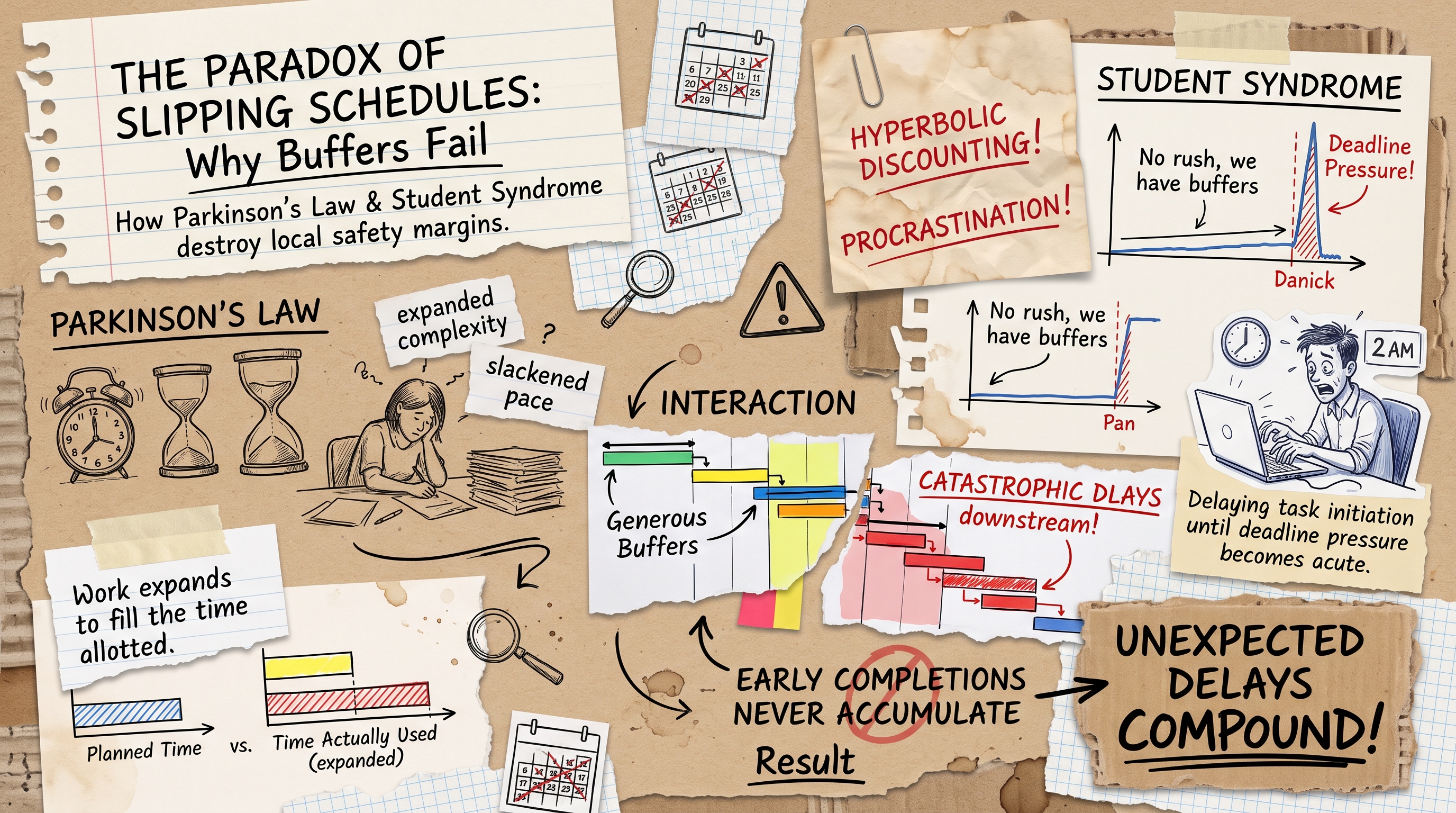
Theoretical Foundations: Two Engines of Schedule Erosion
Traditional deterministic scheduling—such as the Critical Path Method (CPM)—treats task durations as purely technical variables governed by work volume and resource capacity. In practice, human execution responds dynamically to the perceived distance of a deadline, turning time estimates into self-fulfilling behavioral anchors.
Parkinson's Law: Institutional and Behavioral Mechanics
British naval historian Cyril Northcote Parkinson introduced his eponymous axiom in a satirical 1955 essay for The Economist, later expanded into the 1957 book Parkinson's Law: The Pursuit of Progress.[1] Observing that administrative staffing in the British Admiralty grew by 5% to 7% annually even as the Royal Navy's fleet and active personnel declined sharply, Parkinson formulated a dual critique of institutional bloat and individual time elasticity.[1:1]
"Work expands so as to fill the time available for its completion."[1:2]
While Parkinson focused heavily on bureaucratic self-perpetuation—driven by what he termed the Law of Multiplication of Subordinates and the Law of Multiplication of Work—organizational psychologists subsequently validated the principle at the micro-task level.[1:3] In a landmark 1967 experimental study, Judith Bryan and Edwin Locke demonstrated that Parkinson's Law operates as a goal-setting phenomenon: when individuals are assigned excess time to complete a task, they unconsciously calibrate their cognitive effort and working rate downward so that completion coincides with the allotted horizon.[2]
Operations researchers Genaro Gutierrez and Panagiotis Kouvelis later formalized Parkinson's Law using stochastic activity completion models, distinguishing two behavioral pathways through which work expands to consume slack:[3]
- Pace Slackening (Effort Dilution): When the deadline sits comfortably in the future, physiological arousal and attentional intensity drop, stretching active execution hours without increasing output quality.[4]
- Scope Inflation (Gold-Plating): Rather than sitting visibly idle, conscientious workers fill surplus calendar time with unrequested refinements—expanding a concise brief into a sprawling report or refactoring functional code—converting contingency time into non-essential scope.[3:1]
Student Syndrome: Hyperbolic Discounting at the Task Level
Coined by physicist and management theorist Eliyahu M. Goldratt in his 1997 book Critical Chain, Student Syndrome describes the systematic deferral of focused effort until the final portion of an assigned window.[5] Just as students given a four-week syllabus deadline frequently postpone serious work until the final days, project contributors given padded estimates treat built-in safety time as license to prioritize more urgent, immediate demands.[5:1]
In behavioral economics, Student Syndrome is a direct manifestation of present bias and hyperbolic discounting, formalized in Piers Steel's Temporal Motivation Theory (TMT):[6]
Within this framework, the perceived utility (
(Expectancy): Perceived probability of successfully completing the task. (Value): Subjective reward or aversion to penalty associated with task completion. (Impulsiveness): Individual sensitivity to temporal delay. (Delay): Time remaining until the deadline or reward realization.
When a task carries a generous time buffer,
The Anatomy of Schedule Slippage: How Task Buffers Evaporate
To understand why schedules slip despite conservative planning, one must examine how task estimates are constructed and subsequently consumed.
The Estimation Trap and Defensive Padding
Human time estimation suffers from two opposing distortions depending on organizational incentives:
- The Planning Fallacy: Behavioral research by Roger Buehler, Dale Griffin, and Michael Ross demonstrates that when individuals estimate purely from an "inside view"—visualizing an idealized, step-by-step execution scenario while ignoring historical base rates of disruption—they systematically underestimate actual completion times.[7]
- Defensive Padding: In accountability-driven workplaces where missing a promised date incurs reputational penalties while finishing early yields little reward, contributors compensate by estimating near the tail of the probability distribution.[5:3] Instead of quoting a median (50% probability) duration of 5 days, an experienced contributor quotes an 80% to 90% confidence estimate of 10 to 12 days to absorb potential interruptions, unclear specifications, and technical blockers.[5:4] When organizations fall into this trap, project schedules expand artificially before work even begins.
Task completion times follow a right-skewed probability distribution (such as a log-normal or beta distribution). Minimum focused execution time has a hard floor, whereas potential delays from external dependencies, rework, or resource contention have a long upper tail. Adding defensive contingency shifts the scheduled target far to the right of median focused effort.[5:5]
The Two-Stage Squandering of Individual Safety Margins
Once a padded estimate is enshrined as an official task deadline, Student Syndrome and Parkinson's Law operate sequentially and synergistically to consume the embedded safety margin:
- Front-End Erosion via Student Syndrome: Knowing that a 5-day task has been scheduled for 10 days, the assignee delays initiation for the first 5 days to handle competing requests.[5:6] By the time active work begins on Day 6, 100% of the contingency buffer is already spent, leaving zero margin before a single line of work has been tested against reality.[5:7] When unforeseen technical obstacles inevitably emerge (Murphy's Law), they throw a wrench in the works, and the task breaches its 10-day deadline.[5:8]
- Back-End Erosion via Parkinson's Law: Even when a contributor starts promptly on Day 1 and encounters no technical blockers—finishing the core deliverable by Day 5—the task is rarely handed off early.[4:1] Institutional norms penalize early completion: delivering in half the scheduled time signals to management that the initial estimate was inflated, resulting in tighter future deadlines without commensurate reward.[4:2] Consequently, the contributor slows down or polishes the deliverable until Day 10.[4:3] Because individual buffers are built on sand, deterministic project timelines collapse like a house of cards.
| Dimension | Student Syndrome | Parkinson's Law |
|---|---|---|
| Temporal Phase | Front-end (pre-initiation and early window) | Mid-to-back-end (active execution through handoff) |
| Primary Cognitive Driver | Hyperbolic discounting and low initial urgency | Goal-calibration to time horizon; loss aversion over future slack |
| Behavioral Manifestation | Deferred start; diversion to lower-value urgent tasks | Reduced work rate, scope creep, and unnecessary perfectionism |
| Effect on Task Buffer | Burns safety margin before task uncertainty is discovered | Absorbs remaining slack even when execution goes smoothly |
| Schedule Outcome | High vulnerability to late finish when blockers arise | Elimination of early finishes; tasks complete exactly on due date |
Why Task-Level Safety Margins Fail to Protect Project Schedules
Project managers frequently assume that if every individual task carries a generous safety margin, the overall project timeline must be heavily insulated. Network mathematics and behavioral dynamics prove the exact opposite.
Asymmetry of Variance Propagation
In any linked network of dependent activities, positive and negative variances propagate asymmetrically:[4:4]
- Gains Do Not Accumulate: Because of Parkinson's Law, tasks rarely finish early.[4:5] Even when an upstream specialist completes a deliverable three days ahead of schedule, downstream resources are typically scheduled onto other assignments until their planned start date and cannot immediately absorb the handoff.[8] Early finishes evaporate into idle waiting gaps.
- Delays Always Compound: Whenever Student Syndrome leaves an upstream task exposed to an unexpected complication, the resulting overrun pushes back the start date of every dependent successor task.[8:1] Because each successor then repeats the cycle of local buffer erosion or faces truncated execution windows, lateness cascades unconditionally down the chain.[5:9]
Merge Bias at Parallel Convergence Points
Complex projects rarely consist of a single linear sequence; they involve parallel workstreams merging at integration milestones. At any merge node where
Even if each parallel task has an independent 50% probability of finishing on time, the probability that an integration milestone with four independent feeding tasks starts on schedule drops to:
Because Parkinson's Law suppresses early finishes (
Bad Multitasking as a Systemic Multiplier
Student Syndrome rarely occurs in a vacuum; workers delay starting Task A because they are scrambling to meet an imminent deadline on Task B, or cycling across three concurrent projects to demonstrate visible responsiveness to multiple stakeholders.[5:10] Goldratt identified bad multitasking—switching between unfinished tasks prior to completion—as the primary amplifier of schedule slippage.[5:11]
Consider three tasks that each require 5 days of focused effort:
- Sequential Execution: Executed sequentially with dedicated focus, Task 1 finishes on Day 5, Task 2 on Day 10, and Task 3 on Day 15.
- Interleaved Multitasking: If a contributor interleaves them in 1-day increments—even ignoring cognitive context-switching penalties—Task 1 finishes on Day 13, Task 2 on Day 14, and Task 3 on Day 15.[5:12]
Interleaving nearly triples the lead time of the first two deliverables while introducing setup overhead and cognitive friction at every transition. When workers operate on autopilot across fractured priorities, overall organizational throughput stalls.
Embedding contingency time inside individual tasks simultaneously maximizes planned project duration and minimizes actual schedule reliability. Local buffers trigger the very procrastination and pace-slackening behaviors that destroy contingency before real project risk materializes.[8:2]
Structural Countermeasures: Behavioral and Operational Design
Counteracting Parkinson's Law and Student Syndrome requires redesigning how uncertainty is buffered, how progress is measured, and how incentives govern handoffs.
| Scheduling Dimension | Deterministic CPM / Gantt | Critical Chain Project Management (CCPM) |
|---|---|---|
| Task Duration Basis | 80–90% confidence estimate (defensive local padding) | 50% median focused effort ("time-on-tool" target) |
| Buffer Placement | Distributed locally inside every individual task | Stripped from tasks and aggregated into shared buffers |
| Intermediate Milestones | Rigid, calendar-fixed task completion due dates | Floating target durations; relay-runner handoffs |
| Early Finish Treatment | Lost to idle gaps, pace slackening, or gold-plating | Immediately handed off to accelerate successor tasks |
| Governance Metric | Earned Value (SPI/CPI) against fixed task baselines | Buffer consumption rate relative to critical chain progress |
| Primary Behavioral Risk | Parkinson's Law, Student Syndrome, and bad multitasking | Under-buffering or punitive culture eroding trust |
Critical Chain and Statistical Buffer Pooling
Goldratt's Critical Chain Project Management (CCPM) resolves local buffer waste by separating focused execution estimates from uncertainty protection:[8:3]
- Strip Task Estimates to Median Focused Effort: Planners schedule individual activities at their 50th-percentile "time-on-tool" duration—an aggressive target achievable only without interruptions or unexpected setbacks—removing hidden local padding.[5:13]
- Resolve Resource Contention First: Rather than defining a purely topological critical path assuming infinite capacity, CCPM levels resource conflicts to identify the Critical Chain—the longest sequence of both task-dependent and resource-dependent activities.[5:14]
- Aggregate Safety into Shared Buffers: The contingency stripped from individual tasks is pooled into shared buffers placed at strategic network boundaries:[8:4]
- Project Buffer: Placed between the final task on the critical chain and the external delivery date to absorb cumulative critical-chain variance.[8:5]
- Feeding Buffers: Placed wherever non-critical paths merge into the critical chain, insulating the main constraint from parallel merge bias.[5:15]
- Resource Buffers: Advance wake-up signals alerting critical specialists of an approaching handoff so early finishes can be picked up immediately without idle gaps.[5:16]
By the Central Limit Theorem and variance aggregation rules, the standard deviation of a sequence of
Because
Relay-Runner Execution and Dynamic Buffer Management
Removing intermediate task due dates eliminates the calendar anchors that trigger both Parkinson's Law and Student Syndrome.[8:6] CCPM replaces date-driven management with relay-runner (roadrunner) execution:[3:2]
- Eliminate Fixed Task Deadlines: Contributors receive estimated remaining durations rather than fixed milestone calendar dates; missing a 50th-percentile task estimate carries zero stigma because half of all tasks are statistically expected to draw from the shared buffer.[8:7]
- Enforce Single-Piece Flow (WIP Limits): Once a task starts, resources work at 100% dedicated focus with interruptions blocked until handoff is complete, passing the baton in a frictionless handoff immediately upon completion regardless of calendar date.[5:18]
- Track Buffer Consumption Rate: Management monitors the ratio of percentage of critical chain completed to percentage of project buffer consumed, intervening only when buffer burn rate outpaces chain progress.[8:8]
Behavioral Interventions for Individual and Agile Workflows
Even outside formal CCPM environments, teams can neutralize present bias and effort expansion through targeted structural habits:
- Shrink Temporal Distance (
) via Timeboxing: Breaking multi-week deliverables into daily or two-day demonstrable increments collapses in the Temporal Motivation Theory equation, preventing hyperbolic discounting from stalling initiation.[6:1] - Decouple Minimum Viable Scope from Refinement: Explicitly separating "Definition of Done" (functional baseline) from optional polish prevents surplus time from silently mutating into gold-plated scope creep.[4:6]
- Protect Early Finishers from the Ratchet Effect: Organizations must reward early handoffs with autonomy, learning slack, or explicit recognition rather than ratcheting future baselines downward—removing the rational incentive to hide early completions.[3:3]
Arbitrarily slashing task estimates by 50% without establishing a shared project buffer and removing blame for 50th-percentile overruns destroys trust. If management treats stripped median estimates as rigid commitments and punishes overruns, contributors quickly re-inflate estimates with hidden double-padding, triggering severe burnout, quality shortcuts, and defensive schedule gaming.[5:19]
🎴 Interactive Web Practice (Comprehension Check)
Question 1 (Behavioral Dynamics & Buffer Squandering): Contrast the operational mechanics of Parkinson's Law with Student Syndrome. Why does distributing safety margins locally inside individual tasks guarantee schedule slippage rather than protecting the delivery date?
Answer: Student Syndrome is a front-end behavioral distortion rooted in present bias and hyperbolic discounting: assignees perceive generous deadlines as permission to defer task initiation while attending to more urgent immediate distractions. Consequently, 100% of the embedded safety margin is burned before active execution begins, leaving zero contingency when unforeseen technical hurdles emerge.
Parkinson's Law, conversely, is a mid-to-back-end phenomenon driven by goal-calibration and institutional incentives: work expands through pace slackening (reduced effort intensity) or scope inflation (unnecessary gold-plating) to occupy all allotted calendar time. Furthermore, institutional norms penalize early completion (by ratcheting future estimates downward), giving workers an active incentive to withhold finished deliverables until the exact due date.
Distributing safety margins locally inside individual tasks fails because positive and negative variances propagate asymmetrically across dependencies: early finishes evaporate into idle waiting gaps or gold-plating (Parkinson's Law), whereas delays triggered by eleventh-hour discoveries (Student Syndrome) cascade unconditionally to downstream tasks. Thus, individual safety margins maximize total scheduled duration while providing zero net protection against overall delivery delay.
Question 2 (Statistical Mechanics & Network Convergence): How does the Central Limit Theorem explain the efficiency of pooled project buffers in Critical Chain Project Management (CCPM), and why does merge bias at parallel integration points act as a statistical ratchet?
Answer: Under deterministic scheduling, local buffers are added linearly ($\\sum \\sigma_i$), which inflates project duration. According to the Central Limit Theorem, when independent stochastic tasks are linked in sequence, the total standard deviation scales with the square root of the sum of individual variances:
$$\\sigma_{\\text{pool}} = \\sqrt{\\sum_{i=1}^{n} \\sigma_i^2}$$
Because $\\sigma_{\\text{pool}}$ is mathematically far smaller than the linear sum of standard deviations, pooling contingency into a centralized buffer provides equal or superior statistical confidence against overrun while reducing total scheduled buffer time by roughly 50%.At parallel convergence points (integration milestones), merge bias dictates that the downstream successor cannot begin until the latest of all incoming paths completes:
$$T_{\\text{start}} = \\max(T_1, T_2, \\dots, T_n)$$
If four parallel feeding tasks each have an independent 50% probability of on-time finish, the probability that the integration milestone starts on schedule drops to $0.5^4 = 0.0625$ (6.25%). Because Parkinson's Law prevents early finishes from offsetting delays while Student Syndrome pushes task completions into the long right tail, parallel merge nodes act as statistical ratchets that systematically lock in the worst-case overrun.Question 3 (Operational Countermeasures & Critical Chain Execution): How does CCPM's "relay-runner" work ethic neutralize both Parkinson's Law and Student Syndrome, and what organizational preconditions are required to prevent team burnout?
Answer: CCPM neutralizes the two behavioral traps through three coordinated operational shifts:
- Stripping Local Estimates to Median Durations (50% Probability): Task estimates are reduced to aggressive "time-on-tool" durations, collapsing temporal distance ($D$) and eliminating the license to procrastinate (mitigating Student Syndrome).
- Eliminating Fixed Task Deadlines (Relay-Runner Handoffs): Contributors do not manage toward fixed intermediate milestone dates. When a task is finished, the output is passed immediately to the successor resource like a track baton, preventing surplus time from being absorbed by pace slackening or gold-plating (mitigating Parkinson's Law).
- Dynamic Buffer Governance: Executive surveillance shifts from individual task adherence to monitoring the buffer consumption rate relative to critical chain completion.
Resonant Notes
The following notes in the vault share direct thematic, operational, and psychological connections with Parkinson's Law and Student Syndrome:
🔴 Project Scheduling, Constraint Management & Critical Path Governance
- Brooks' Law (The Mythical Man-Month & Communication Overhead) — Sister principle analyzing how reactive schedule interventions and adding headcount to delayed initiatives exponentially worsens project lateness through onboarding drag and communication entropy.
- PM - Work Breakdown Structure — Details activity duration estimation, three-point estimation (PERT), float mechanics, and critical path analysis required to deconstruct complex initiatives into manageable work packages.
- PM - Monitoring and Controlling — Analyzes schedule performance metrics (SPI and SV), change control governance, and the strategic trade-offs between fast-tracking and schedule crashing.
- PM - Managing Resources — Deconstructs resource allocation, leveling, and smoothing, demonstrating how resource contention amplifies multitasking drag and task handoff delays.
- Project Management Lifecycles and Gate Deliverables — Details phase-gate governance and exit criteria required to detect variance early and validate task deliverables against baseline commitments.
- Project Risk Management - A Comprehensive Guide to Identifying and Managing Project Threats — Provides frameworks for proactive risk identification, examining how defensive padding and hidden schedule contingencies distort quantitative risk modeling.
- The Ultimate Project Management Jargon Lexicon — Authoritative reference defining critical execution concepts including the critical path, schedule float, crashing, fast-tracking, and buffer governance.
🟡 Behavioral Economics, Temporal Discounting & Cognitive Biases
- The Eisenhower Matrix (Urgent vs. Important) — Deconstructs the cognitive conflict between immediate deadline pressure (urgency) and strategic value (importance), explaining why hyperbolic discounting drives workers to defer high-value tasks.
- Confirmation Bias — Explains why project contributors selectively interpret preliminary progress as evidence that generous deadlines will be met, ignoring early signals of schedule erosion.
- Cognitive Dissonance — Analyzes the psychological discomfort experienced by contributors when actual progress lags behind overly optimistic estimates, driving defensive justification and concealed delays.
- The McNamara Fallacy — Warns against relying solely on deterministic milestone dates and quantitative percentage-complete metrics while ignoring behavioral dynamics and human time elasticity.
- Cognitive Load Theory — Demonstrates how frequent context-switching, bad multitasking, and eleventh-hour deadline scrambles overload working memory and degrade execution quality.
- The Flow State — Examines the focused psychological conditions required for peak productivity, contrasting continuous deep work with the fractured attention caused by bad multitasking.
🟢 Agile Execution, Work-in-Progress Limits & Systems Dynamics
- Difference Between Agile and Waterfall — Contrasts long-horizon, deterministic waterfall scheduling (highly vulnerable to Student Syndrome and Parkinson's Law) with short-cadence, timeboxed iterations.
- Difference Between Efficiency and Effectiveness — Distinguishes between localized time absorption (busywork and pace-slackening efficiency) and actual milestone completion (strategic project effectiveness).
- Difference Between Just-in-Time (JIT) and Just-in-Case (JIC) — Explores buffer management philosophies, comparing unpooled task padding ("just-in-case" safety) with centralized, pull-based buffer replenishment ("just-in-time" flow).
- Frank Gehry's Master-Builder Model - De-Risking Megaprojects Through Simulation and Execution — Demonstrates the power of "thinking slow and acting fast," front-loading planning and simulation to eliminate downstream schedule slippage and execution rework.
- Execution - The Discipline of Getting Things Done — Focuses on organizational accountability, operational cadence, and closing the gap between strategic schedule goals and operational delivery.
- The Pareto Principle (80-20 Rule) — Demonstrates how 80% of schedule delays typically stem from 20% of feeding bottlenecks and unmanaged merge convergence points.
References
Cyril Northcote Parkinson / Parkinson's Law / Wikipedia ↩︎ ↩︎ ↩︎ ↩︎
Judith F. Bryan and Edwin A. Locke / Parkinson's Law as a Goal-Setting Phenomenon / Volley Library ↩︎
Genaro J. Gutierrez and Panagiotis Kouvelis / Parkinson's Law and Its Implications for Project Management / Management Science ↩︎ ↩︎ ↩︎ ↩︎
Robert Prieto / Parkinson's Law / ResearchGate ↩︎ ↩︎ ↩︎ ↩︎ ↩︎ ↩︎ ↩︎
Eliyahu M. Goldratt (analyzed in Oard) / Critical Chain Project Management / Baylor University Repository ↩︎ ↩︎ ↩︎ ↩︎ ↩︎ ↩︎ ↩︎ ↩︎ ↩︎ ↩︎ ↩︎ ↩︎ ↩︎ ↩︎ ↩︎ ↩︎ ↩︎ ↩︎ ↩︎ ↩︎
Piers Steel / The Nature of Procrastination: A Meta-Analytic and Theoretical Review of Quintessential Self-Regulatory Failure / PubMed ↩︎ ↩︎
Roger Buehler, Dale Griffin, and Michael Ross / Exploring the "Planning Fallacy": Why People Underestimate Their Task Completion Times / Journal of Personality and Social Psychology ↩︎
Realization Technologies / Critical Chain Project Management (CCPM): The Complete Guide / realization.com ↩︎ ↩︎ ↩︎ ↩︎ ↩︎ ↩︎ ↩︎ ↩︎ ↩︎