Conceptual Writing and Digital Poetics (Goldsmith & Perloff)
🗂️ Interactive Notebook: Open Study Companion (Video Summary, Flashcards, Mind Map) ↗
At the dawn of the twenty-first century, literary aesthetics experienced a foundational rupture driven by the proliferation of networked computing, search engines, and vast linguistic databases. This transformation found its dual intellectual crystallization in two landmark companion texts: literary critic Marjorie Perloff's scholarly monograph Unoriginal Genius: Poetry by Other Means in the New Century (2010) and conceptual poet Kenneth Goldsmith's practitioner manifesto Uncreative Writing: Managing Language in the Digital Age (2011). Together, Goldsmith and Perloff theorize the historic migration of creative agency within The Avant-Garde away from the two-hundred-year-old Romantic paradigm of original invention (inventio) and solitary confessional lyricism toward the practices of appropriation, transcription, archival curation, and algorithmic arrangement (dispositio). Treating language not as a transparent vehicle for personal emotion but as malleable binary data and acoustic material, conceptual writing bridges historical modernist collage, Oulipian procedural constraints, and contemporary internet ecology, anticipating the profound aesthetic and ethical dilemmas of generative artificial intelligence.
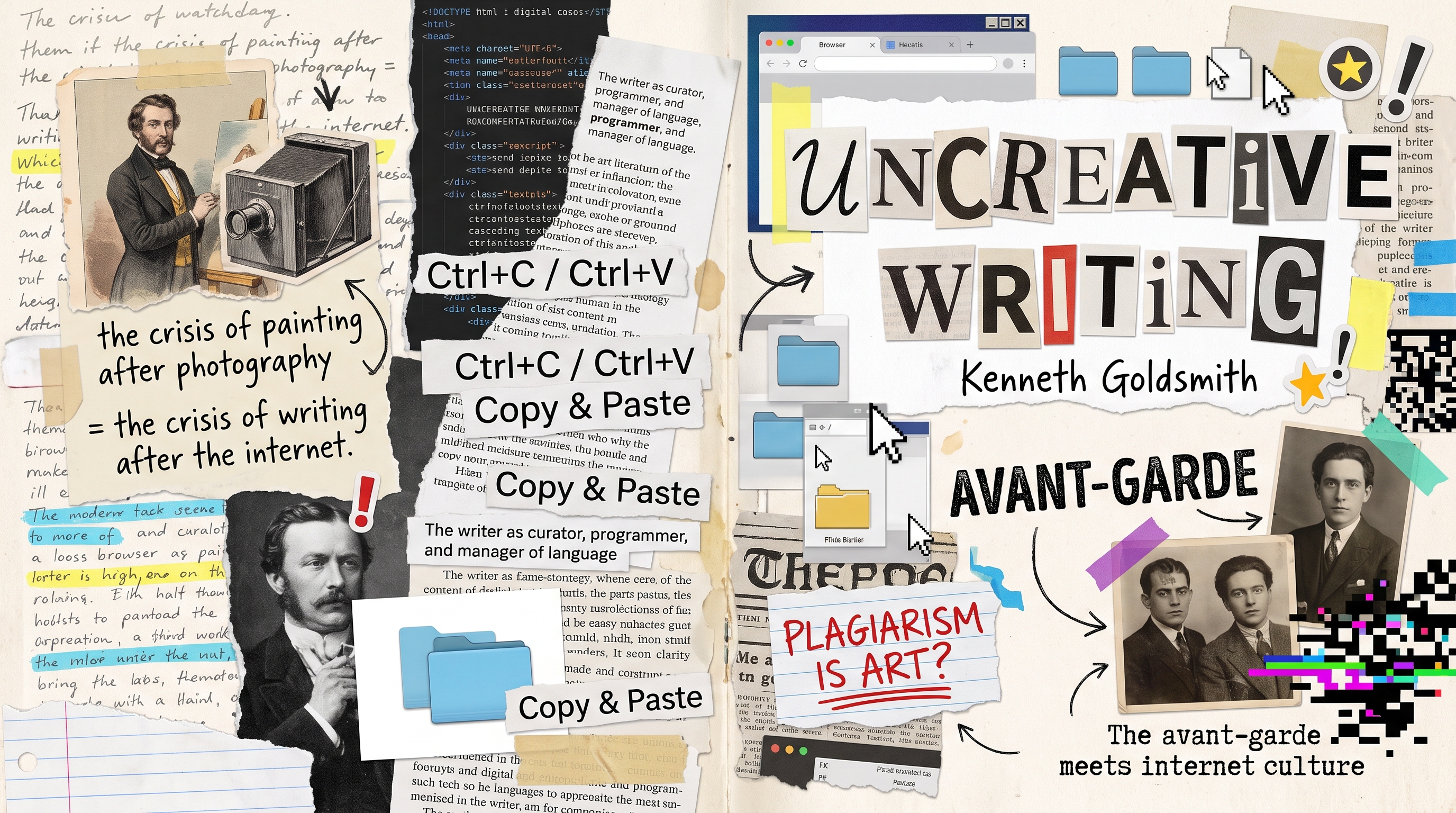
1. The Epistemological Rupture: From Invention to Curation
For over two centuries, Western literature operated under the Romantic assumption that authentic poetry is the spontaneous overflow of powerful feeling originating from an autonomous, inspired self. Both Perloff and Goldsmith contend that the digital revolution and the rise of hyper-information networks have rendered this model historically exhausted.[^1][^2]
The Photography Analogy & Walter Benjamin's Legacy
Goldsmith posits that literature in the digital age is undergoing the precise crisis that painting confronted following the nineteenth-century invention of photography—a technological transformation famously analyzed by Walter Benjamin (1892–1940) in The Work of Art in the Age of Mechanical Reproduction.[^2]
Just as the mechanical camera liberated and compelled painters to abandon strict representational mimesis in favor of Impressionism, Cubism, and abstraction (the radical turn away from sentimental reflection examined in The Dehumanization of Art), the personal computer and the internet compel writers to abandon the obligation to craft "original" sentences.[^2] Visual art spent the twentieth century mastering the readymade, sampling, and collage, while mainstream literature remained stubbornly conservative, clinging to eighteenth-century models of authorial genius. The digital environment forces literature to finally catch up with its sister arts.[^2]
"Context is the New Content"
A foundational principle uniting both theorists is that the physical act of reframing pre-existing language constitutes a profound creative gesture.[^1][^2] When vast oceans of text are freely accessible via search engines, the contemporary writer functions more like a curator, information architect, or computer programmer than a solitary visionary.[^2] Meaning is not extinguished; rather, it emerges obliquely through the writer's governing constraints, selection thresholds, and framing choices—an insight directly rooted in Ludwig Wittgenstein's formulation of meaning-as-use and Jacques Derrida's deconstruction of authorial presence (il n'y a pas de hors-texte).[^2]
Thinkership over Readership
Conceptual writing deliberately challenges conventional habits of consumption. By producing massive, exhaustive transcriptions and procedural compendiums, conceptual poets create works that resist traditional cover-to-cover reading.[^1][^2]
- The Conceptual Gesture: Borrowed from 1960s Conceptual Art (such as Sol LeWitt's rule-based wall drawings or Lawrence Weiner's linguistic statements), the aesthetic power of an uncreative work resides in its governing concept. Once the reader grasps the rule or constraint behind an 800-page book of retyped texts, they do not need to read every syllable to appreciate the intervention.[^2]
- Resistance to Kitsch: By offering a "thinkership" rather than a sentimental "readership," conceptual writing aggressively repels passive consumption and commercial Kitsch, demanding intellectual contemplation over emotional empathy.[^1][^2]
2. Marjorie Perloff: The Arrière-Garde & Citational Poetics (2010)
In Unoriginal Genius, Marjorie Perloff provides the rigorous scholarly and historical genealogy that legitimizes 21st-century conceptual poetics.[^1] Adapting Carl von Clausewitz's famous axiom that war is the continuation of politics by other means, Perloff's subtitle—Poetry by Other Means—situates twenty-first-century writing as an alternative continuation of literary craft within an ecology saturated by digital data.[^1]
The Paradox of the Arrière-Garde (Rearguard)
Rather than portraying conceptual poetics as an unprecedented, ahistorical rupture, Perloff formulates the crucial concept of the arrière-garde (rearguard).[^1] Perloff demonstrates that twenty-first-century appropriative writing fulfills the deferred, unfinished project of early-twentieth-century modernism and postwar concrete poetry—traditions whose radical formal possibilities were temporarily obscured by the mid-century dominance of confessional lyricism.[^1]
This formulation directly complicates linear, teleological accounts of the vanguard (such as Renato Poggioli's cyclical theory of succession and Peter Bürger's institutional critique), proving that avant-garde strategies do not simply die; rather, their dormant technical potentials are reactivated when communications media catch up with their formal demands.[^1]
Citational Precursors & The Lineage of Unoriginality
Perloff historicizes "originality," demonstrating that the obsession with unique invention is a brief historical anomaly stretching from late Romanticism to late-twentieth-century creative writing programs.[^1] In the eras of Geoffrey Chaucer, Edmund Spenser, and Alexander Pope, poetic brilliance was evaluated by how inventively an author imitated, translated, and re-framed inherited cultural materials.[^1]
- High Modernism (1922): The modern citational turn was inaugurated by T. S. Eliot's The Waste Land and Ezra Pound's The Cantos, alongside James Joyce's polyphonic borrowing in Ulysses.[^1] However, while modernist collage shored up fragments against cultural ruin through the controlling consciousness of a master-poet, twenty-first-century conceptualism flattens hierarchies entirely, treating mundane broadcast transcripts, digital code, and canonical literature as equal datasets.[^1]
- Walter Benjamin's The Arcades Project (Passagenwerk): Composed of thousands of transcribed quotations from nineteenth-century Parisian sources arranged into thematic convolutes, Benjamin's unfinished masterwork represents the primary proto-hypertextual ancestor of conceptual poetics.[^1] Benjamin pioneered a purely citational historiography linked to the urban gaze of The flâneur and Baudelaire's modernism, enacting the dialectical montage theorized in Walter Benjamin’s Theses on the Philosophy of History.[^1]
- Brazilian Concrete Poetry (The Noigandres Group): In the 1950s, Augusto de Campos, Haroldo de Campos, and Décio Pignatari treated words as spatial, graphic, and phonetic objects ("verbivocovisual"), pioneering "transcreation" (creative, cannibalistic translation). Drawing on Apollinaire's Calligrammes and the functional design of The Bauhaus School, the Brazilian concretists anticipated the visual space and non-linear reading of the digital screen.[^1]
Language Poetry vs. Conceptual Poetry
In her landmark analysis of contemporary poetics, Perloff establishes a decisive distinction between the Language Poetry of the 1970s–1980s and the Conceptual Poetics of the 2000s:[^1]
- Language Poetry: Influenced by post-structuralism, Language poets (such as Charles Bernstein, Ron Silliman, and Lyn Hejinian) violently fractured syntax, morphemes, and linear grammar to sabotage capitalist ideology at the level of the individual signifier.[^1]
- Conceptual Poetry: Conceptualists leave syntax completely intact. Rather than fragmenting words, they appropriate massive, coherent blocks of everyday, administrative, or legal language, shifting their focus to exposing the macro-architectures, data networks, and institutional protocols of late-capitalist society—a transition that directly mirrors Gilles Deleuze's shift from disciplinary enclosures to open modulation in Postscript on the Societies of Control.[^1]
3. Kenneth Goldsmith: Managing Language in the Digital Age (2011)
While Perloff acts as the academic theorist charting historical genealogies, Kenneth Goldsmith provides the energetic, polemical practitioner's playbook in Uncreative Writing.[^2]
Language as Material, Dataset, and Binary Code
Goldsmith argues that in a computerized media ecology, text has lost its transparent, immaterial status. On a hard drive or server, words are strings of binary code governed by the identical physical infrastructure that processes MP3 audio, JPEG images, and MPEG video, embodying the fundamental nature of information:[^2]
- Patchwriting and Sampling: Cutting, pasting, and rearranging found textual matter, translating hip-hop sampling and Dadaist collage into digital word processing.[^2]
- Databasing and Sorting: Treating extensive linguistic archives as raw datasets to be parsed, filtered, alphabetized, or re-indexed.[^2]
- Format Shifting: Converting text files into audio or image files to observe the resulting systemic glitches, revealing the physical materiality of digital code.[^2]
- Informational Volume & Entropy: Prioritizing the sheer velocity and bulk of data over the precious refinement of individual lines, mirroring the media saturation and cultural entropy diagnosed in Don DeLillo's White Noise.[^2]
Monumentalizing the Ephemeral: The Analog Archival Impulse
A central irony highlighted by Goldsmith is that while conceptual writing arises from the frictionless abundance of the internet, it frequently culminates in massive, physical, printed codices.[^2] By binding transient radio chatter, web forum threads, or daily news into monumental 800-page volumes, conceptual writers freeze digital ephemera into durable monuments, actively interrogating the material bias of communications theorized by Harold Innis.[^2]
Pedagogical Inversion: The Uncreative Classroom
Goldsmith grounded his theory in his pioneering course "Uncreative Writing," taught at the University of Pennsylvania beginning in 2003, where traditional academic values were systematically inverted:[^2]
| Traditional Creative Writing Pedagogy | Goldsmith's Uncreative Writing Classroom |
|---|---|
| Cultivation of unique individual voice and authentic personal expression | Erasure of authorial ego in favor of mechanical transcription and execution |
| Strict prohibition against plagiarism, identity theft, and copying | Explicit reward for sophisticated plagiarism, scraping, and patchwriting |
| Focus on psychological interiority, emotional vulnerability, and craft | Focus on constraint design, algorithmic curation, and data management |
| Production of novel metaphors and original lyric narratives | Recontextualization, databasing, and architectural reframing of found language |
Students were assigned exercises such as manually retyping five pages of another author's book (to experience the physical micro-decisions of punctuation and cadence), transcribing real-world audio recordings, or purchasing term papers from online essay mills and defending them conceptually in front of the class.[^2] Goldsmith argued that because students already spend their lives cutting and pasting digital data, bringing these illicit practices into the light transforms mindless habit into conscious artistic critique.[^2]
4. Landmark Case Studies in Digital Poetics
Both monographs anchor their theoretical claims in detailed analyses of radical contemporary texts:[^1][^2]
| Author & Title | Operational Strategy | Source Material | Theoretical & Aesthetic Consequence |
|---|---|---|---|
| Kenneth Goldsmith Day (2003)[^2] | Exhaustive, mechanical retyping word-for-word | The complete September 1, 2000 issue of The New York Times | Transforms disposable daily news into an 836-page monumental codex; demonstrates that all text is equal when treated as data. |
| Kenneth Goldsmith The American Trilogy (The Weather, Traffic, Sports)[^2] | Transcription of ambient media noise | Radio weather reports, 24 hours of holiday traffic broadcasts, and baseball commentary | Captures the ambient electronic "white noise" enveloping modern consciousness, turning banal broadcasts into uncanny civic portraits. |
| Marjorie Perloff on Charles Bernstein Shadowtime (2005)[^1] | Anagrammatic permutation, philosophical collage | The life, death, and writings of Walter Benjamin | Enacts Benjaminian dialectical historiography by weaving together historical documents, German/English wordplay, and philosophical fragments. |
| Susan Howe The Midnight (2003)[^1] | Archival documentary lyric | Photographs of book tissue interleafs, library marginalia, and family memoirs | Bridges material bibliographic history with personal elegy, proving that intimate memory can be articulated entirely through found archival traces. |
| Yoko Tawada & Caroline Bergvall Exophonic Writing[^1] | Writing in non-native tongues; translation errors | Dictionary definitions, cross-linguistic homophones, translation glitches | Defamiliarizes national languages and maternal idioms; demonstrates that language is an arbitrary, rule-governed system rather than a biological essence. |
| Jonathan Lethem The Ecstasy of Influence (2007)[^2] | Unattributed composite essay | Stitched together entirely from sentences written by other authors | Formally enacts its own argument: defending the public domain and creative commons through radical appropriation. |
| Simon Morris Getting Inside Jack Kerouac's Head[^2] | Daily blog retyping at the pace of one page per day | Jack Kerouac's On the Road | Replaces Beat spontaneous composition with disciplined, mechanical endurance, defamiliarizing a classic counter-cultural artifact. |
| Flarf Collective (Sullivan, Mohammad, Magee)[^2] | Google-scraping and algorithmic collage | Deliberately clumsy, offensive, and bizarre search-engine queries | Sculpts the vernacular sludge and accidental surrealism of the early internet into fractured, abrasive lyricism. |
| Christian Bök Eunoia (2001) & The Xenotext[^1] | Univocalic constraint; genetic encoding | English dictionary words; DNA sequences of extremophile bacteria | Pushes Oulipian constraint to physical extremes, treating chemical biology itself as a data storage medium for poetry. |
5. Comparative Synthesis: Perloff vs. Goldsmith
| Analytical Dimension | Marjorie Perloff (Unoriginal Genius, 2010) | Kenneth Goldsmith (Uncreative Writing, 2011) |
|---|---|---|
| Authorial Stance | Senior academic critic, literary historian, and theorist | Practicing conceptual artist, poet, professor, and archivist (UbuWeb) |
| Historical Thesis | The arrière-garde: digital writing retrieves and fulfills the unfinished project of early-20th-century modernism | The digital paradigm shift: literature is experiencing its equivalent of the 19th-century invention of photography |
| Linguistic Medium | Focus on citationality, multilingualism, concrete spatial layout, and translation | Focus on digital data, programming, scraping, databasing, and file-format manipulation |
| Relationship to Modernism | Traces direct lineages from Eliot, Pound, Stein, Benjamin, and the Brazilian Concretists | Traces lineages from Duchamp's readymades, Warhol's tape recordings, Cage's chance, and Burroughs' cut-ups |
| Pedagogical Agenda | Critical evaluation of contemporary literature for university scholars and students | Disruptive inversion of creative writing workshops through institutional subversion |
| Core Objective | Demonstrate that contemporary appropriation possesses genuine literary, aesthetic, and historical value | Free writers from the anxiety of original invention, training them to manage informational overflow |
6. Political Reckonings, Ethical Boundaries & Generative AI
Despite their profound influence, both monographs and the conceptual writing movement they championed encountered fierce critical resistance and political reckonings in the 2010s.[^1][^2]
The Authorial Ego Paradox
Critics pointed out a glaring contradiction at the heart of conceptual writing: while the movement claimed to annihilate the individual ego, abolish romantic genius, and celebrate mechanical unoriginality, its leading practitioners frequently relied upon charismatic self-promotion, high-profile institutional branding, and elite cultural gatekeeping—mirroring the elite mechanisms analyzed in Good Taste and Naïve Realism.[^2]
The Limits of Appropriation: The 2015 Michael Brown Controversy
The neutral, "anything-goes" ethos of treating all text as malleable data faced a catastrophic crisis in March 2015 at Brown University.[^2] Kenneth Goldsmith gave a public reading of an altered version of the official autopsy report of Michael Brown—an unarmed Black teenager killed by police in Ferguson, Missouri—ending the poem with a description of Brown's genitalia.[^3]
The performance ignited global outrage across literary communities:[^3]
- The Critique of Privilege: Scholars and poets such as Cathy Park Hong and John Keene argued that treating racial trauma, state violence, and real human bodies as neutral "found data" exposes a profound moral blindness.[^3]
- The Failure of Context: Critics demonstrated that context cannot be separated from political power; what white conceptualists celebrated as a playful, detached aesthetic gesture was experienced by marginalized communities as violent voyeurism and cultural exploitation, interrogating the limits of institutional recuperation within modern Counter-Culture.[^3]
Prophetic Precursors to Generative AI & Large Language Models
Viewed from the contemporary horizon of Large Language Models (such as GPT-4 and Gemini), Unoriginal Genius and Uncreative Writing read as astonishingly prophetic theoretical frameworks.[^2]
Goldsmith's central arguments—that the internet functions as a boundless linguistic archive, that writing is fundamentally an act of algorithmic curation, prompt-like framing, and data sorting, and that traditional copyright cannot withstand computational processing—accurately anticipated the central cultural dilemmas of synthetic text.[^2] Today, human writers find themselves literally operating as uncreative managers of language, orchestrating AI text generators while confronting cognitive phenomena like The Eliza Effect, where readers instinctively project intentionality and emotional depth into automated linguistic combinations.[^2]
🎴 Interactive Web Practice (Comprehension Check)
Question 1 (The Digital Shift & The Photography Analogy): Why does Kenneth Goldsmith compare the impact of networked computing on literature to the invention of photography on 19th-century painting, and what does he mean by "context is the new content"?
Answer: Kenneth Goldsmith argues that when photography was invented in the 19th century, it stripped painting of its historic monopoly over realistic, mimetic representation. Rather than destroying painting, however, the camera liberated painters to explore impressionism, cubism, and abstraction. Goldsmith asserts that 21st-century literature is undergoing the exact same transition due to the internet and networked computing.
Now that the internet functions as a massive, searchable repository of all existing text, the writer is no longer required to manufacture "original" descriptive or narrative sentences. Instead, language becomes a material substance and binary dataset to be curated, sorted, transcribed, and reframed.
By "context is the new content," Goldsmith means that the creative act shifts from inventing new words to altering the architectural frame surrounding existing words. Taking a utilitarian, mundane text (such as an administrative report or traffic broadcast) and placing it into a literary or artistic frame fundamentally changes its meaning, reception, and resonance without altering a single word.
Question 2 (Perloff's Arrière-Garde vs. Language Poetry): How does Marjorie Perloff's concept of the arrière-garde redefine the history of the avant-garde, and how does Conceptual Poetry differ from 1970s Language Poetry?
Answer: Marjorie Perloff formulates the concept of the arrière-garde (rearguard) to reject the linear, teleological assumption that the avant-garde progresses through continuous, unprecedented shocks until it dies. Instead, Perloff demonstrates that contemporary conceptual poetics retrieves, completes, and reactivates the radical, unfinished citational and spatial projects of early-20th-century modernism (T.S. Eliot, Ezra Pound, Walter Benjamin) and postwar Brazilian Concrete Poetry, which had been temporarily marginalized by mainstream confessional lyricism.
Perloff draws a sharp structural demarcation between 1970s/1980s Language Poetry and 2000s Conceptual Poetry:\n
- \n
- Language Poetry: Influenced by post-structuralist semiotics, Language poets violently fractured syntax, disrupted sentences, and fragmented words to challenge bourgeois capitalist ideology at the microscopic level of the signifier. \n
- Conceptual Poetry: Conceptualists leave syntax, grammar, and sentences completely intact. Rather than breaking words, they appropriate massive, unbroken blocks of bureaucratic, commercial, or legal discourse to critique the macroscopic systems, informational architectures, and institutional networks of digital late capitalism. \n
\n\n
Question 3 (The Michael Brown Reading & Ethical Limits of Appropriation): What critical and ethical vulnerabilities of conceptual writing were exposed by Kenneth Goldsmith's 2015 performance of Michael Brown's autopsy report?
\n\nAnswer: Kenneth Goldsmith's 2015 reading of Michael Brown's autopsy report exposed the profound ideological limitations of conceptualism's foundational claim that all text is merely neutral \"data\" that can be freely appropriated without regard to political context.
Critics, led by writers of color such as Cathy Park Hong and John Keene, demonstrated that:\n
- \n
- Treating the somatic record of state violence and racial trauma as a detached, Duchampian \"readymade\" relies upon an unacknowledged position of racial and social privilege. \n
- Language is never merely abstract data; it is deeply entangled with physical bodies, historical violence, and systemic inequality. Divorcing a text from its human stakes to perform an intellectual exercise in \"uncreativity\" transformed an ostensibly radical artistic practice into an act of voyeuristic exploitation, proving that context is inherently political and cannot be neutralized by aesthetic framing. \n
\n\n---\n\n## Resonant Notes\n\nThe following notes in the vault share direct thematic, sociological, and literary connections with Marjorie Perloff and Kenneth Goldsmith's formulations of conceptual poetics:\n\n### 🔴 The Avant-Garde, Modernism & Material Poetics\n- **The Avant-Garde** — Explores the historical trajectory of Dada, Surrealism, Fluxus, and Oulipo, establishing the operational lineage of readymades, procedural constraints, and institutional critique that Goldsmith and Perloff translate into 21st-century digital text management.\n- **Theories of the Avant-Garde (Poggioli & Bürger)** — Peter Bürger's institutional critique and Renato Poggioli's sociology of vanguard movements provide the primary theoretical foil to Perloff's *arrière-garde*, testing whether digital conceptualism ruptures aesthetic autonomy or repeats institutionalized gestures.\n- **The Work of Art in the Age of Mechanical Reproduction** & **Walter Benjamin (1892–1940)** — Benjamin’s diagnosis of how mechanical reproduction liquidates the ritual \"aura\" of the original art object serves as the direct historical precursor to the claim that digital reproduction shatters Romantic myths of unique, solitary authorship.\n- **The Dehumanization of Art** — José Ortega y Gasset’s analysis of modern art's refusal to provide sentimental reflection or mimetic representation parallels Goldsmith and Perloff's defense of \"unreadable\" conceptual texts that foreground formal constraints over personal lyricism.\n- **Guillaume Apollinaire (1880–1918)** — Apollinaire's typographical ideograms in *Calligrammes* and his radical suppression of punctuation established the historical foundation for visual poetics, directly anticipating the Brazilian Concrete poets analyzed by Perloff.\n- **The Bauhaus School** — Bauhaus functionalism and the systematic synthesis of machine production with aesthetic form anticipate Goldsmith's view of the contemporary writer as an informational architect, programmer, and document designer.\n- **James Joyce (1882-1941)** — Joyce’s monumental syntactic experiments in *Ulysses* and *Finnegans Wake* pioneered the foregrounding of language as dense, rhythmic acoustic material rather than a transparent narrative medium.\n- **Kitsch** — Clement Greenberg's formulation of kitsch as pre-digested cultural consumption highlights the friction generated by conceptual writing; by presenting massive, unreadable transcriptions, conceptual literature aggressively repels easy commodification.\n\n### 🟡 Media Ecology, Information Theory & Digital Modulation\n- **Marshall McLuhan (1911-1980)** & **McLuhan's The Medium is the Message** — McLuhan’s insight that the formal architecture of a medium reshapes human cognition underpins the conceptual dictum that \"context is the new content\" in networked digital environments.\n- **Innis (1951) - The Bias of Communication** & **Innis (1950) - Empire and Communications** — Harold Innis’s distinction between space-binding and time-binding media clarifies how conceptual poets harvest instantaneous, space-binding electronic data-streams and bind them into durable, time-binding physical codices.\n- **Nature of Information** & **Entropy** — Connects Goldsmith's treatment of text as malleable binary datasets to information theory; the boundless reproduction, sorting, and format-shifting of language reflect the physical dynamics and entropic noise of digital networks.\n- **Postscript on the Societies of Control** — Gilles Deleuze’s transition from disciplinary enclosures to continuous digital modulation and data profiling illuminates how conceptual writing operates within decentralized computer networks, manipulating the very algorithms that structure contemporary behavior.\n- **The Eliza Effect** & **The Auditory Uncanny Valley (Voice & AI Assistants)** — Exposes the cognitive tendency to attribute human consciousness, intentionality, and interiority to automated linguistic strings, foreshadowing how conceptual writing and generative LLMs destabilize traditional authorial presence.\n\n### 🟢 Appropriation, Counter-Culture & Postmodern Semiotics\n- **Walter Benjamin’s Theses on the Philosophy of History** — Benjamin's concept of dialectical montage—\"brushing history against the grain\" by blasting historical fragments out of the continuum of linear progress—serves as the compositional engine for Charles Bernstein's opera libretto *Shadowtime*.\n- **Counter-Culture** — Examines how underground subcultures mobilize DIY samizdat, mimeograph poetry, zines, and Situationist *détournement* against corporate media hegemony; Goldsmith and Perloff draw upon this lineage while confronting the inevitable co-optation of subversive literary tactics by academic and cultural institutions.\n- **Don DeLillo Major Themes Analysis** — DeLillo's exploration of media \"white noise,\" informational glut (\"blur and glut\"), and corporate brand mantras provides the fictional and sociological mirror to Goldsmith’s transcriptions of radio traffic, weather reports, and *The New York Times*.\n- **Defining a Simulacrum** — Jean Baudrillard's hyperreality—where copies precede and replace originals—provides the epistemological framework for uncreative writing, where language operates as a self-referential circulation of signs devoid of an underlying, authentic source.\n- **Jacques Derrida** — Derrida's deconstruction of phonocentrism and his insistence that *il n'y a pas de hors-texte* (\"there is no outside-text\") philosophically validate conceptual appropriation, demonstrating that all writing is an endless deferral and repetition of prior linguistic traces.\n- **Ludwig Wittgenstein** — Wittgenstein’s later philosophy of language-games and meaning-as-use confirms the assertion that reframing text creates new meaning; removing a transcription from its mundane utilitarian context and placing it in a literary frame fundamentally alters its rules and significance.\n- **The flâneur** & **The Painter of Modern Life, a seminal 1863 essay by French poet and art critic Charles Baudelaire** — Goldsmith’s conceptual writer acts as a digital *flâneur*, peripatetically drifting not through Parisian arcades, but through the endless corridors of internet search engines, chat rooms, and web archives to harvest vernacular debris.\n\n---\n\n## References\n\n[^1]: Marjorie Perloff / *Unoriginal Genius: Poetry by Other Means in the New Century* / University of Chicago Press (2010) / [University of Chicago Press](https://press.uchicago.edu/ucp/books/book/chicago/U/bo5886908.html)\n\n[^2]: Kenneth Goldsmith / *Uncreative Writing: Managing Language in the Digital Age* / Columbia University Press (2011) / [cup.columbia.edu](https://cup.columbia.edu/book/uncreative-writing/9780231149914)\n\n[^3]: Cathy Park Hong / *Delusions of Whiteness in the Avant-Garde* / Lana Turner: A Journal of Poetry and Opinion (2014) / [lanaturnerjournal.com](http://www.lanaturnerjournal.com)\n