Theories of the Avant-Garde (Poggioli & Bürger)
🗂️ Interactive Notebook: Open Study Companion (Video Summary, Flashcards, Mind Map) ↗
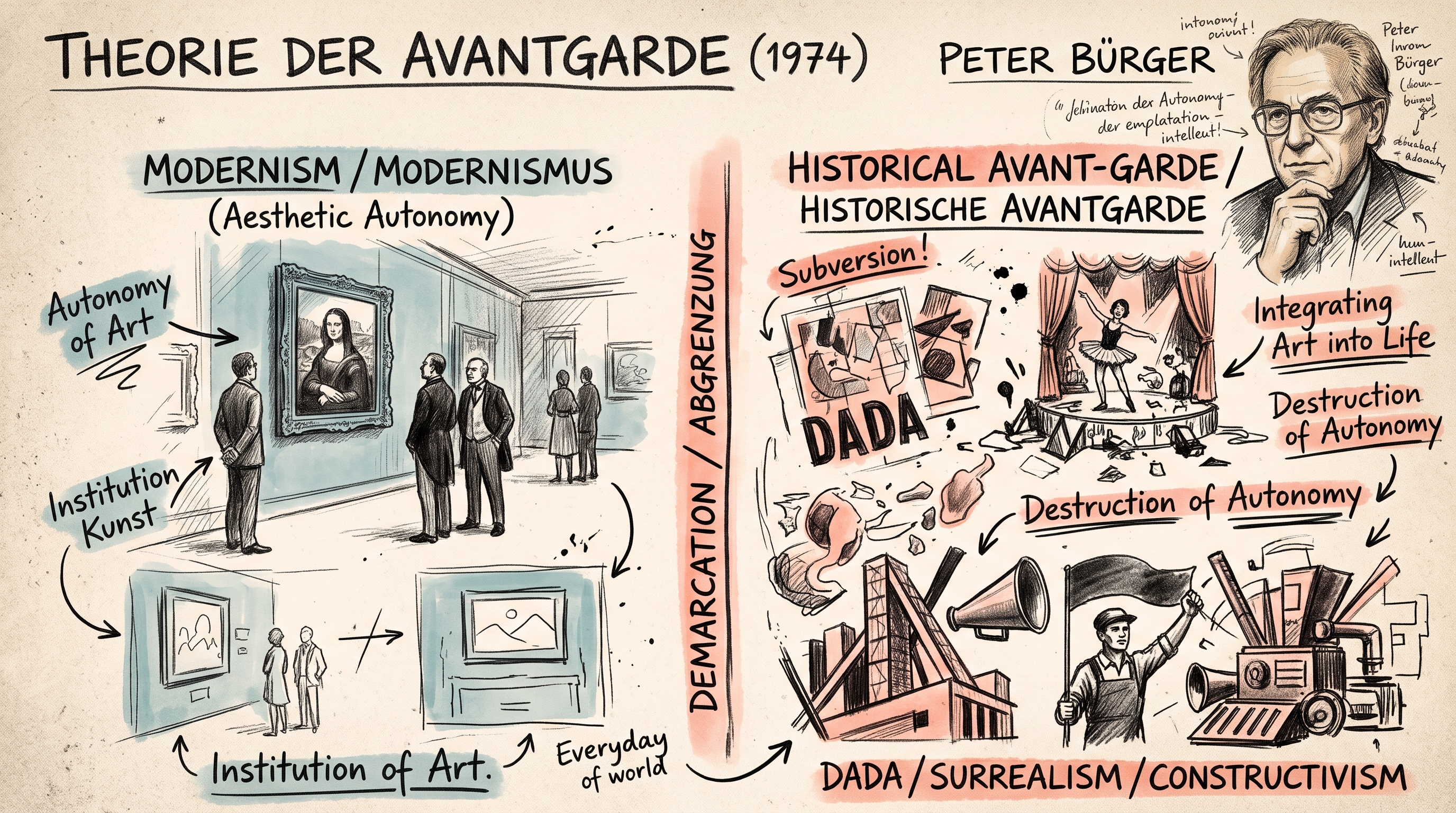
The study of the avant-garde in twentieth-century aesthetics is anchored by two foundational monographs that approach artistic rupture from opposing yet complementary critical horizons: Italian literary scholar Renato Poggioli's Teoria dell'arte d'avanguardia (1962) and German literary theorist Peter Bürger's Theorie der Avantgarde (1974). Poggioli approaches the vanguard through psychological and sociological typologies, analyzing it as a recurring mental posture and dynamic "movement" born of liberal bourgeois alienation, characterized by four dialectical moments: activism, antagonism, nihilism, and agonism. In stark contrast, Bürger executes a historical-materialist and institutional critique, demarcating formalist Modernism from the Historical Avant-Garde (Dada, early Surrealism, Russian Constructivism). For Bürger, the true vanguard is defined not by stylistic novelty or psychological rebellion, but by a systemic assault on the autonomous institution of art (Institution Kunst) in an effort to sublate (aufheben) aesthetic practice into revolutionary everyday life-praxis (Lebenspraxis). Together, Poggioli and Bürger delineate the trajectory from 19th-century bohemian agitation to the institutional recuperation of the postwar Neo-Avant-Garde.
1. Renato Poggioli: The Sociological & Psychological Typology (1962)
In Teoria dell'arte d'avanguardia (translated into English in 1968), Renato Poggioli examines the avant-garde not as an isolated stylistic category, but as an overarching sociological and psychological condition emerging from nineteenth-century Romanticism within bourgeois democratic-capitalist society.[1]
From the Traditional "School" to the Ideological "Movement"
Poggioli establishes a primary structural distinction between pre-modern artistic groupings and the modern vanguard:[1:1]
- The Traditional School (Scuola): Rooted in classical and academic frameworks, a school centers on a recognized master, an atelier/workshop, and an established canon of craft techniques. Its objective is the preservation, transmission, and incremental refinement of an unchanging aesthetic standard across generations (contrasting sharply with modern functionalist experiments such as The Bauhaus School).[1:2]
- The Modern Movement (Movimento): Originating in Romanticism and socio-political agitation, the movement rejects static perfection in favor of dynamic becoming. Rather than assembling around a master to acquire technical competence, members band together as partisan militants pursuing a shared ideological, cultural, and psychological trajectory.[2]
For Poggioli, the avant-garde movement can only emerge within liberal, bourgeois-capitalist democracies.[2:1] While the artist depends upon the free market and civil liberties for economic survival and expressive freedom, the commodification of art simultaneously induces profound social, psychological, and economic alienation.[2:2] The avant-garde movement acts as a protective, aristocratic-yet-bohemian subculture that wages symbolic warfare against the very bourgeois public that finances and consumes it—a tension foundational to modern counter-cultures.[2:3]
The Four Defining "Moments" of the Avant-Garde Psyche
Poggioli maps the operational lifecycle of the avant-garde across four psychological and ideological attitudes, or "moments":[2:4]
- Activism (The Moment of Action): The least ideological drive, representing the dynamic celebration of adventure, speed, and kinetic agitation for its own sake. The group takes action simply for the visceral thrill of movement and noise rather than a calculated tactical result.[2:5]
- Archetype: Italian Futurism, which glorified machine velocity, militarism, and urban tempo—channeling the sensory overstimulation diagnosed by Georg Simmel in The Metropolis and Mental Life.[2:6]
- Antagonism (The Moment of Opposition): The stance of systematic hostility directed outward against two primary adversaries: the Academy (the conservative custodian of aesthetic rules) and the Bourgeois Public (the philistine mass audience that consumes commercial Kitsch and enforces reified "good taste").[2:7]
- Social Function: Antagonism binds the group internally through shared antipathy toward the outside world, cultivating the detached posture of The flâneur and Charles Baudelaire's bohemian stance, manifesting in épater la bourgeoisie (shocking the middle class) and the calculated unpopularity analyzed in José Ortega y Gasset's The Dehumanization of Art.[2:8]
- Nihilism (The Moment of Destruction): When activism and antagonism exceed rational limits, they culminate in pure destructive ecstasy. The movement seeks the systematic demolition of all existing cultural, grammatical, and moral structures.[2:9]
- Aesthetic Tabula Rasa: The objective shifts from reforming art to eradicating the very category of art, prefiguring Marcel Duchamp's readymades, Dadaist phonetic poetry, and the digital information strategies examined in Conceptual Writing and Digital Poetics (Goldsmith & Perloff).[2:10]
- Agonism (The Moment of Self-Sacrifice): Derived from the Greek agon (contest, struggle), agonism represents the tragic, masochistic culmination of the vanguard mentality.[2:11] Obsessed with the future (futurism), the movement willingly accepts its own obsolescence, regarding its inevitable destruction as a necessary martyrdom that clears the ground for future movements.[2:12]
"In the febrile anxiety to go always further, the movement and its constituent human entity can reach the point where it no longer heeds the ruins and losses of others and ignores even its own catastrophe and perdition. It even welcomes and accepts this self-ruin as an obscure and unknown sacrifice to the success of future movements." — Renato Poggioli, The Theory of the Avant-Garde[2:13]
The Paradox of Succession and Institutional Recuperation
Poggioli demonstrates that because the avant-garde is driven by perpetual forward motion and agonistic sacrifice, it cannot achieve permanent stability without betraying its nature.[2:14] When an individual vanguard group exhausts its disruptive energy and is absorbed by the museum or commercial market, the condition of avant-gardism does not terminate.[2:15] Instead, it undergoes a crisis of succession ("the king is dead, long live the king!"), wherein perpetual rebellion becomes the paradoxical tradition of modern art.[2:16]
2. Peter Bürger: The Institutional Critique & Life-Praxis (1974)
In Theorie der Avantgarde, Peter Bürger shifts the analytical terrain from psychological attitudes to historical materialism and institutional analysis.[3] Bürger contends that Anglo-American formalist criticism (exemplified by Clement Greenberg's defense of high modernism against Kitsch) conflated two fundamentally opposed movements: Modernism and the Historical Avant-Garde.[4]
The Genealogy of the "Institution of Art" (Institution Kunst)
Bürger defines the "institution of art" as the apparatus of production, distribution, and reception, alongside the reigning ideas about art that determine how artworks function within a specific historical era.[3:1] Tracing Western art from the High Middle Ages through the late nineteenth century, Bürger demonstrates how art progressively severed itself from practical social life, culminating in the doctrine of aesthetic autonomy:[3:2]
| Historical Epoch | Social Function (Purpose) | Mode of Production | Mode of Reception |
|---|---|---|---|
| Sacral Art (High Middle Ages) | Cult object; embedded in religious ritual and liturgical worship | Collective craft / guild workshop | Collective (institutionalized ecclesial community) |
| Courtly Art (Absolutist Era) | Representational display; glorification of the prince and feudal hierarchy | Individual (emerging artisan status) | Collective (sociable aristocratic court) |
| Bourgeois Art (Enlightenment to Aestheticism) | Portrayal of bourgeois self-understanding; loss of direct social utility | Individual (genius ideology; solitary creator) | Individual (solitary, private contemplation) |
Under late-nineteenth-century Aestheticism (l'art pour l'art), art's detachment from practical life reached its absolute zenith.[3:3] Drawing upon Herbert Marcuse's 1937 treatise "The Affirmative Character of Culture", Bürger notes the deep ambivalence of this autonomy:[3:4]
- Critical Dimension: By refusing capitalist means-end rationality, autonomous art preserves utopian visions of human wholeness, beauty, and freedom that bourgeois society denies in practice.[3:5]
- Affirmative / Compensatory Dimension: Because those utopian ideals are confined strictly to an imaginary, cordoned-off sphere, autonomous art discharges social discontent without changing reality. It stabilizes the bourgeois status quo, functioning as a compensatory safety valve.[3:6]
Modernism vs. The Historical Avant-Garde
Bürger establishes a rigorous demarcation between system-immanent critique and institutional self-critique:[4:1]
- Modernism (System-Immanent Critique): Modernist movements (such as Impressionism, Symbolism, and Cubism) attack previous stylistic conventions, representational traditions, and narrative techniques. However, Modernism leaves the institution of art intact.[4:2] The modernist painting or poem still demands to be received as an autonomous, self-contained aesthetic masterpiece inside a gallery, museum, or private library.[4:3]
- The Historical Avant-Garde (Institutional Self-Critique): Movements of the 1910s and 1920s—specifically Dada, early Surrealism, and post-revolutionary Russian Constructivism—did not simply introduce a novel artistic style within The Avant-Garde.[4:4] Instead, they recognized that the social inconsequentiality of art stemmed directly from its institutional autonomy. Their assault was aimed at the framing apparatus itself: the museum, the commercial art market, the cult of individual genius, and the passive contemplation of the bourgeois spectator.[3:7]
Sublating Art into Life-Praxis (Lebenspraxis)
The fundamental project of the Historical Avant-Garde was the sublation of art into the praxis of life.[3:8] Bürger underscores that the avant-gardists did not seek to eliminate art through mindless vandalism, nor did they wish to subordinate art to the commodified, instrumental logic of daily capitalist business.[4:5] Rather, they pursued a Hegelian sublation (Aufhebung): simultaneously negating art as an isolated, bourgeois institution, preserving its liberatory creative power, and elevating it to reorganize everyday social reality.[4:6]
Bürger analyzes how this institutional assault operated across three core dimensions:[3:9]
- Negation of Individual Production: Marcel Duchamp's Readymades (such as Fountain, 1917) and Tristan Tzara's cut-up poetry recipes demonstrated that art requires no unique artisanal craft or individual genius. The readymade exposes the institutional frame as the sole mechanism that confers the status of "art" upon an object.[3:10]
- Negation of Individual Reception: The avant-garde replaced silent, solitary bourgeois contemplation with collective shock, confrontation, and agitation. Dadaist cabaret provocations were designed to shatter the spectator's passive detachment, echoing the urban shocks analyzed in Walter Benjamin's essay on mechanical reproduction.[3:11]
- Negation of Autonomous Purpose: Russian Constructivists and Productivists (Alexander Rodchenko, Varvara Stepanova, Vladimir Tatlin) moved directly into factories and printing presses following the 1917 Bolshevik Revolution, designing utilitarian worker clothing, communal kitchens, and agitprop kiosks to fuse aesthetic form with socialist construction—paralleling functionalist design workshops in The Bauhaus School.[4:7]
The Organic vs. The Non-Organic (Montage) Work of Art
Bürger introduces a formal distinction between two structural types of artwork:[3:12]
- The Traditional Organic Work: Classicist and bourgeois works present themselves as unified, living totalities. Every individual part is strictly subordinated to the overarching harmony of the whole, concealing the fact that the object has been artificially constructed.[3:13]
- The Avant-Gardiste Non-Organic Work: Exemplified by montage and collage (John Heartfield's political photomontages, Hannah Höch's assemblages, Kurt Schwitters's Merz art), the non-organic work tears fragments directly out of empirical reality (newspaper clippings, train tickets, machine cogs) and splices them together without smoothing over the seams.[3:14]
"The organic work of art seeks to make unrecognizable the fact that it has been made. The opposite holds true for the avant-gardiste work: it proclaims itself an artificial construct, an artifact. To this extent, montage may be considered the fundamental principle of avant-gardiste art." — Peter Bürger, Theory of the Avant-Garde[3:15]
Because the fragments retain their reference to external reality while refusing to coalesce into a harmonious unity, the viewer is denied an easy, closed interpretation. The artwork forces the recipient to confront the institutional question: "What is art, and how does it relate to the reality around me?"[3:16]
3. The Classical vs. Neo-Avant-Garde Dialectic
Both Poggioli and Bürger confront the historical exhaustion and recuperation of the avant-garde, but their frameworks explain this crisis through divergent mechanisms:[2:17][4:8]
| Analytical Dimension | Renato Poggioli (1962) | Peter Bürger (1974) |
|---|---|---|
| Disciplinary Locus | Sociological psychology and cultural morphology | Historical materialism and institutional analysis |
| Core Definition of the Vanguard | An agonistic, militant "movement" bound by shared alienation | An institutional assault seeking to sublate autonomous art into Lebenspraxis |
| Historical Scope | Cyclical and recurring from Romanticism through mid-century modernism | Historically unique and unrepeatable (Dada, early Surrealism, Constructivism, 1910–1930) |
| Target of Hostility | The Academy and the Bourgeois Public (épater la bourgeoisie) | The Institution of Art (Institution Kunst) and aesthetic autonomy |
| Evaluation of Modernism | High modernism represents the full aesthetic flowering of the vanguard movement | Modernism remains system-immanent, preserving aesthetic autonomy and the institution |
| Formal Organizing Principle | Stylistic hermeticism, linguistic obscurity, dynamic agitation | The non-organic work of art (montage, readymade, fragmentary collage) |
| Explanation of Failure | Inevitable agonistic self-sacrifice and supersession (dialectic of movements) | Institutional absorption: anti-art objects become museum commodities |
| View of the Neo-Avant-Garde | Natural continuation of the modern tradition of antitraditionalism | Inauthentic farce: institutionalizes the avant-garde as art, stripping it of subversive intent |
The Failure of the Historical Vanguard and the Farce of the Neo-Avant-Garde
Bürger arrives at a famously stark conclusion: the Historical Avant-Garde failed in its central objective.[3:17] It did not dismantle the institution of art, nor did it successfully merge art into everyday life-praxis. Instead, the resilient bourgeois institution neutralized the revolt by absorbing its weapons: Duchamp's urinals, Dadaist collages, and Surrealist paintings were mounted on museum pedestals and traded as high-value investment assets.[3:18]
From this failure, Bürger mounts a devastating critique of the post-World War II Neo-Avant-Garde (movements of the 1950s and 1960s such as Pop Art, Fluxus, Nouveau Réalisme, and Minimalism):[4:9]
- Institutionalization as High Art: When Andy Warhol exhibits Campbell's Soup cans or Brillo boxes in the 1960s, the gesture lacks the revolutionary institutional rupture of Duchamp's 1917 readymade, because the museum has already canonized the readymade as a legitimate aesthetic category.[4:10]
- Farce and Affirmation: Repeating the formal techniques of the historical vanguard (montage, chance, readymades, happenings) within an apparatus that now embraces them converts revolutionary anti-art into affirmative, market-friendly entertainment—a dynamic central to Jean Baudrillard's analysis in Defining a Simulacrum and late-capitalist commodification in Don DeLillo Major Themes Analysis.[3:19]
Hal Foster's Revision: The Return of the Real (1996)
Bürger's dismissal of the postwar Neo-Avant-Garde triggered one of the most consequential debates in late-twentieth-century art history. In The Return of the Real, art historian Hal Foster critiqued Bürger for relying on a rigid, linear narrative of heroic origin followed by farcical repetition.[4:11]
Drawing upon Freud's concept of deferred action (Nachträglichkeit), Foster argued that the Historical Avant-Garde was too caught up in traumatic rupture to fully comprehend the institutional structures it attacked. It was precisely the postwar Neo-Avant-Garde of the 1960s and 1970s—specifically Institutional Critique artists like Marcel Broodthaers, Daniel Buren, Hans Haacke, and Michael Asher—that systematically analyzed and laid bare the economic, ideological, and architectural apparatuses of the museum for the first time.[4:12] In our contemporary digital ecology, as explored in Postscript on the Societies of Control, this institutional framing has expanded beyond museum walls into algorithmic data modulation and platform architectures.[4:13]
🎴 Interactive Web Practice (Comprehension Check)
Question 1 (Sociological Psychology vs. Institutional Critique): How do Renato Poggioli and Peter Bürger fundamentally differ in their definitions of the avant-garde, and what constitutes the primary target of attack in each framework?
Answer: Renato Poggioli and Peter Bürger represent two distinct methodologies for analyzing the avant-garde:
- Poggioli's Sociological Psychology: Poggioli conceives of the avant-garde as a dynamic, recurring psychological and sociological "movement" born out of 19th-century Romanticism within liberal bourgeois capitalism. For Poggioli, the avant-garde is defined by four core attitudes or "moments": activism (pure dynamism), antagonism (opposition), nihilism (destructive tabula rasa), and agonism (masochistic self-sacrifice for the future). His primary targets are the Academy (guardians of traditional aesthetic craft) and the Bourgeois Public (consumers of kitsch and conventional good taste).
- Bürger's Historical-Materialist Institutional Critique: Bürger defines the avant-garde not as a recurring psychological posture, but as a historically specific, unrepeatable institutional rupture occurring between 1910 and 1930 (Dada, early Surrealism, Russian Constructivism). For Bürger, the avant-garde is distinguished from formalist Modernism by its target: rather than attacking previous styles or artistic techniques, the Historical Avant-Garde launched an institutional self-critique against the Institution of Art (Institution Kunst)—the apparatus of museums, galleries, markets, and the bourgeois doctrine of aesthetic autonomy that isolates art from practical life.
Question 2 (Sublation into Life-Praxis & The Non-Organic Work): What did Peter Bürger mean by the "sublation of art into life-praxis," and how does the structural logic of montage (the non-organic work) embody this project?
Answer: For Peter Bürger, the central objective of the Historical Avant-Garde was the Hegelian sublation (Aufhebung) of art into everyday life-praxis (Lebenspraxis). This did not mean destroying art through mindless vandalism or subjecting it to capitalist utility; rather, it meant abolishing the bourgeois isolation of autonomous art while preserving its emancipatory, creative power to reorganize society along free, aesthetic lines.
The technical vehicle for this project was the non-organic work of art, preeminently realized through montage and collage:
- Whereas the traditional, bourgeois organic work conceals its construction to present a harmonious, unified whole where all parts submit to the totality, the non-organic work tears fragments directly out of empirical reality (newspaper clippings, advertisements, factory components, bus tickets) and splices them together without concealing the seams.
- Because these fragments retain their stubborn connection to external reality and refuse to merge into an illusion of harmonious meaning, the viewer cannot passively contemplate a beautiful facade. The recipient is shocked out of contemplation and forced to confront the institutional apparatus itself: asking what constitutes art and how aesthetic form relates to social reality.
Question 3 (The Fate of the Vanguard & The Neo-Avant-Garde Dispute): Why did Peter Bürger conclude that the Historical Avant-Garde failed, and how did Hal Foster challenge Bürger's dismissal of the postwar Neo-Avant-Garde?
Answer: Peter Bürger concluded that the Historical Avant-Garde suffered total structural failure because it did not destroy the institution of art nor liberate everyday life-praxis. Instead, the bourgeois art institution demonstrated immense resilience: it absorbed anti-art gestures, placing readymades, collages, and manifestos on museum pedestals and transforming them into celebrated, high-value investment commodities. Because of this, Bürger dismissed the post-WWII Neo-Avant-Garde (Pop Art, Fluxus, Nouveau Réalisme) as an inauthentic farce that merely repeated historic anti-art techniques within an institution that now enthusiastically welcomed them, thereby institutionalizing the avant-garde as art.
Art historian Hal Foster refuted Bürger's thesis in The Return of the Real (1996) by applying the Freudian concept of deferred action (Nachträglichkeit):
- Foster argued that Bürger's linear narrative of "heroic origin followed by farcical repetition" misjudged the historical process. The Historical Avant-Garde was too immersed in initial traumatic rupture to fully grasp or analyze the institutional apparatus it attacked.
- It was precisely the postwar Neo-Avant-Garde—specifically the Institutional Critique artists of the 1960s and 1970s (such as Hans Haacke, Marcel Broodthaers, Daniel Buren, and Michael Asher)—that retroactively clarified, mapped, and systematically challenged the architectural, financial, and ideological mechanisms of the museum for the first time.
Resonant Notes
The following notes in the vault share direct thematic, sociological, and literary connections with the theoretical debate between Renato Poggioli and Peter Bürger:
🔴 Institutional Theory & Historical Avant-Garde vs. Modernism
- The Avant-Garde — The overarching historical anchor note in the vault, tracing the evolution of vanguard aesthetics from Saint-Simonian social engineering and romantic bohemia through high modernism, Dadaist anti-art, and postmodern exhaustion.
- The Bauhaus School — Walter Gropius and the Bauhaus workshop represent the constructive, architectural counterpart to Constructivism's sublation of art into life, uniting aesthetic form, industrial craftsmanship, and everyday utility without succumbing to nihilistic anti-art destruction.
- The Dehumanization of Art — José Ortega y Gasset offers a parallel aesthetic diagnosis of high modernism's autonomous detachment; by methodically purging sentimental, human-centered realism, modernist art creates an unpopular, self-contained aesthetic realm that Bürger identifies as the institutional prerequisite for the historical avant-garde's revolt.
- Kitsch — Clement Greenberg's 1939 essay Avant-Garde and Kitsch defends the formal autonomy of high art against industrial commercial culture; Bürger directly challenges Greenberg by demonstrating that formalist modernism leaves the bourgeois institution of art uncritiqued.
- Georg Wilhelm Friedrich Hegel (1770–1831) — Provides the dialectical machinery of Aufhebung (sublation)—the simultaneous negation, preservation, and elevation of art—which Bürger positions as the core theoretical ambition of the historical vanguard's drive to dissolve art into daily life-praxis.
🟡 Aesthetic Autonomy, Aura & Urban Alienation
- The Work of Art in the Age of Mechanical Reproduction & Walter Benjamin (1892–1940) — Benjamin's dialectical materialism directly underpins Bürger's theory; the liquidation of the traditional cultic "aura" through mechanical reproduction, the adoption of montage, and the mobilization of aesthetic "shock" serve as the essential technical preconditions for Dada and Russian Constructivism.
- The Metropolis and Mental Life & Georg Simmel (1858-1918) — Simmel's analysis of metropolitan sensory intensification, money economy rationalization, and the defensive blasé attitude of urbanites illuminates the psychological conditions that the historical avant-garde attempted to rupture through shock and disruptive cabaret provocations.
- The flâneur & The Painter of Modern Life, a seminal 1863 essay by French poet and art critic Charles Baudelaire — Baudelaire's detached dandy wandering Parisian boulevards marks the historical zenith of aesthetic autonomy under Aestheticism (l'art pour l'art), creating the isolated, self-referential sphere of bourgeois art that the vanguard sought to overthrow.
- Good Taste and Naïve Realism — Explores the cognitive and sociological mechanisms that reify bourgeois aesthetic preferences into normative canons of "good taste," defining the normative consensus against which avant-garde antagonism directs its public scandals (épater la bourgeoisie).
🟢 The Neo-Avant-Garde, Postmodern Recuperation & Digital Poetics
- Don DeLillo Major Themes Analysis — Demonstrates the late-capitalist realization of Bürger's warning about institutional absorption; DeLillo's fiction depicts a consumer society that effortlessly neutralizes and packages aesthetic subversion, terror, and counter-cultural gestures into consumable spectacle.
- Counter-Culture — Examines the sociological lifecycle of oppositional subcultures; mirrors Bürger's pessimistic diagnosis of avant-garde failure by detailing how rebellious anti-bourgeois gestures are systematically recuperated, commodified, and normalized by consumer capitalism.
- Defining a Simulacrum — Jean Baudrillard's theory of hyperreality and simulation explains the structural dilemma of the Neo-Avant-Garde (e.g., Warhol's Pop Art); stripped of genuine institutional friction, transgressive anti-art objects are assimilated into self-referential sign-exchange value within the museum.
- Conceptual Writing and Digital Poetics (Goldsmith & Perloff) — Marjorie Perloff and Kenneth Goldsmith apply the historical avant-garde's negation of individual authorship (Duchamp's readymade, Tzara's cut-ups) to the 21st-century digital landscape, demonstrating how mechanical copying, transcription, and data curation function once autonomous literature is subsumed into digital information networks.
- Postscript on the Societies of Control — Gilles Deleuze outlines the transition from closed disciplinary institutions (the museum, the factory) to fluid, open-circuit networks of control, illustrating why the institutional critique envisioned by Bürger must adapt when institutions themselves dissolve into continuous electronic modulation.
- Marshall McLuhan (1911-1980) & McLuhan's The Medium is the Message — McLuhan’s insight that the content of any medium is always another medium echoes Bürger’s finding that under Aestheticism, the institution of art itself became the explicit content of artistic reflection, paving the way for avant-garde institutional self-criticism.
References
Renato Poggioli / The Theory of the Avant-Garde / Harvard University Press (1968) / archive.org ↩︎ ↩︎ ↩︎
Sascha Bru et al. / Theories of the Avant-Garde from Renato Poggioli to Peter Bürger / brill.com ↩︎ ↩︎ ↩︎ ↩︎ ↩︎ ↩︎ ↩︎ ↩︎ ↩︎ ↩︎ ↩︎ ↩︎ ↩︎ ↩︎ ↩︎ ↩︎ ↩︎ ↩︎
Peter Bürger / Theory of the Avant-Garde / Translated by Michael Shaw / University of Minnesota Press (1984) / University of Minnesota Press ↩︎ ↩︎ ↩︎ ↩︎ ↩︎ ↩︎ ↩︎ ↩︎ ↩︎ ↩︎ ↩︎ ↩︎ ↩︎ ↩︎ ↩︎ ↩︎ ↩︎ ↩︎ ↩︎ ↩︎
Hal Foster / The Return of the Real: The Avant-Garde at the End of the Century / MIT Press (1996) ↩︎ ↩︎ ↩︎ ↩︎ ↩︎ ↩︎ ↩︎ ↩︎ ↩︎ ↩︎ ↩︎ ↩︎ ↩︎ ↩︎