Theories of the Uncanny (Freud & Vidler)
🗂️ Interactive Notebook: Open Study Companion (Video Summary, Flashcards, Mind Map) ↗
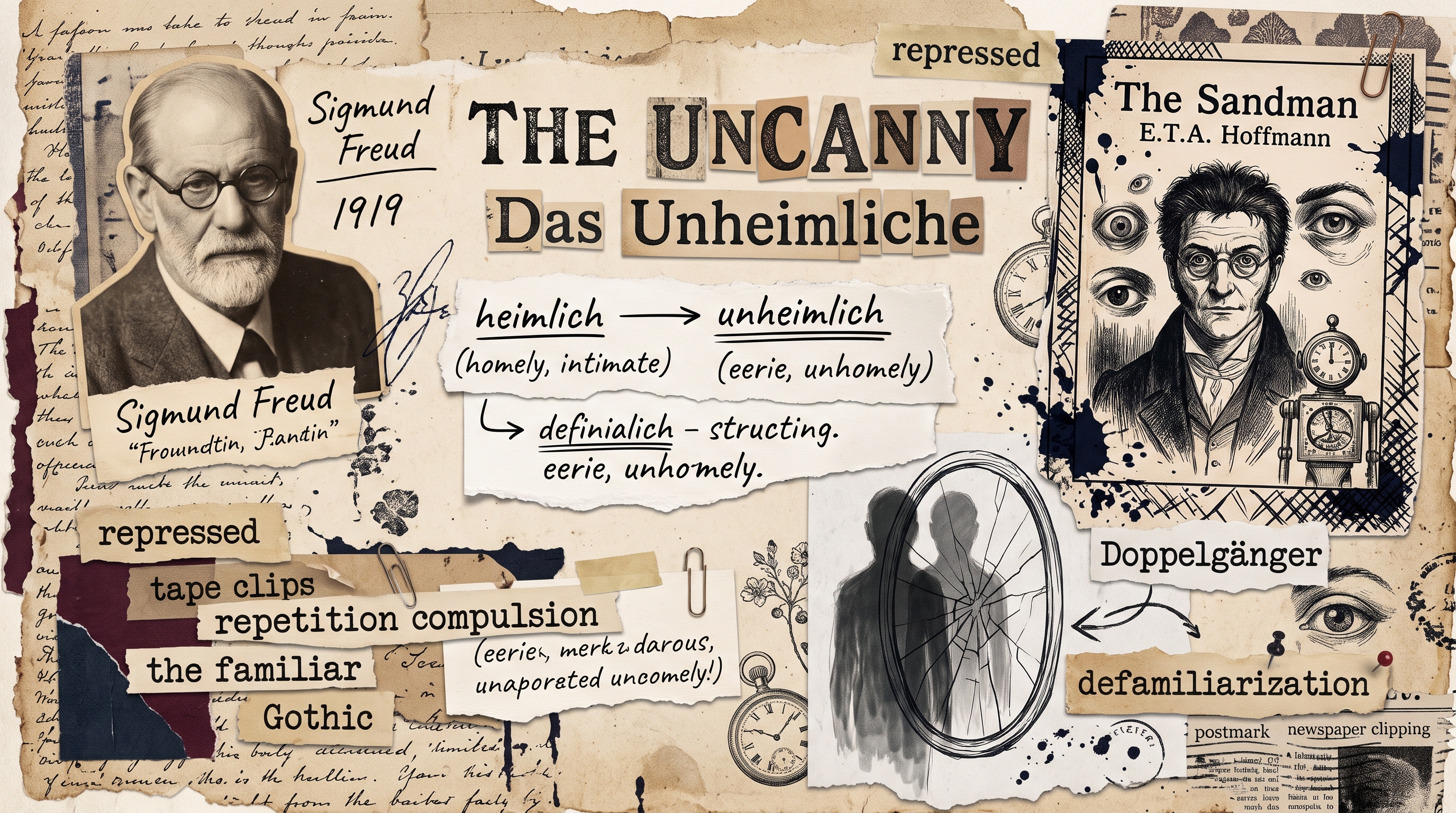
The systematic study of the uncanny across twentieth-century aesthetics, psychoanalysis, and spatial theory is anchored by two foundational masterworks: Sigmund Freud's 1919 treatise The Uncanny (Das Unheimliche) and architectural historian Anthony Vidler's 1992 monograph The Architectural Uncanny: Essays in the Modern Unhomely. Freud executes an epistemological rupture in classical aesthetics, shifting inquiry from the harmonious and beautiful toward the disturbing realm of creeping dread. Through a philological analysis of the German adjective heimlich (homely, secret) and its dialectical convergence with unheimlich (unhomely, eerie), Freud demonstrates that the uncanny is not an encounter with the alien or unknown, but rather the return of the familiar (heimisch) that was once repressed. In direct historical and spatial complement, Anthony Vidler transposes Freud's psychoanalytic trope into contemporary architectural and urban criticism. Vidler demonstrates that architecture—historically sanctified as humanity's primary physical envelope for shelter, bodily integrity, and psychological centeredness (Heim)—paradoxically became in modernity the preeminent apparatus for generating spatial vertigo, corporeal fragmentation, and metaphysical homelessness. Together, Freud and Vidler trace the trajectory of the unhomely from the subterranean corridors of the unconscious mind into the warped grids, domestic sabotages, and post-traumatic voids of the built environment.
1. The Dual Horizons of the Uncanny: Mind and Space
Throughout the history of Western aesthetics, critical inquiry was dominated by harmony, proportion, and sensory pleasure.[1] When negative or destabilizing affects were addressed, classical philosophy elevated them to the sublime—a state of awe, vastness, or physiological terror that ultimately reaffirms human cognitive dignity and moral transcendence, as formulated by Edmund Burke and Immanuel Kant.[2][3]
Sigmund Freud and Anthony Vidler represent two complementary movements that overturned this classical framework, isolating the uncanny as an autonomous, distressing aesthetic category that resists comforting moral elevation:[1:1][4]
| Analytical Dimension | Sigmund Freud (Das Unheimliche, 1919) | Anthony Vidler (The Architectural Uncanny, 1992) |
|---|---|---|
| Disciplinary Locus | Psychoanalysis, psychosexual depth psychology, and literary aesthetics | Architectural history, post-structural spatial criticism, and urban theory |
| Primary Vector | Inside-Out: The unconscious psyche projecting repressed complexes onto external reality | Outside-In: The built environment actively defamiliarizing the domestic shelter and bodily envelope |
| Core Definition | The terrifying return of the intimately familiar (heimisch) after repression | The spatialization of estrangement; the domestic refuge mutating into an alienating trap |
| Primary Structural Site | The fractured ego, the Doppelgänger, and the maternal body as original Heim | The modern dwelling, the corporeal tectonic envelope, and the metropolitan grid |
| Theoretical Foil | Ernst Jentsch's cognitive "intellectual uncertainty" (1906) | Modernist functionalist utopianism (Bauhaus, Le Corbusier) & Postmodern historicist kitsch |
| Landmark Cultural Artifacts | E.T.A. Hoffmann's The Sandman; Otto Rank's The Double; Wilhelm Jensen's Gradiva | Edgar Allan Poe's House of Usher; Eisenman's House VI; Tschumi's Follies; Libeskind's Jewish Museum |
| Diagnostic Resolution | Psychoanalytic insight, reality testing, and conscious working-through | Deconstructive critique, historical mourning, and exposure of spatial ideology |
2. Sigmund Freud: The Psychoanalytic Archaeology of Das Unheimliche (1919)
In his 1919 essay, Sigmund Freud undertakes an atypical foray of psychoanalysis into philosophical aesthetics, defining the discipline not as the theory of the beautiful, but as the science of the qualities of feeling (die Lehre von den Qualitäten des Fühlens).[1:2]
Philological Archaeology: The Coincidence of Opposites
Before examining clinical phenomena or literary narratives, Freud investigates the linguistic history of the German adjective heimlich across dictionaries, folklore, and idiomatic usage.[1:3] He discovers that the word contains a profound internal contradiction:[1:4][5]
                     ┌──► Phase 1: Belonging to the house (Heim), familiar, intimate, secure
                     │
DAS HEIMLICH ────────┼──► Phase 2: Withdrawn from view, kept secret, clandestine, hidden
                     │
                     └──► Phase 3: Dialectical Inversion into DAS UNHEIMLICHE
                                   (The secret breaks enclosure and steps into plain view)
- The Primary Semantic Trajectory: Belonging to the house (Heim), intimate, comfortable, friendly, tame, and providing domestic warmth against external chaos.[1:5]
- The Secondary Semantic Trajectory: Withdrawn from the knowledge of others, secret, kept hidden from observation, clandestine, and withheld from daylight.[1:6]
Through this second trajectory, heimlich undergoes a dialectical transformation until it merges with its lexical antonym, unheimlich (the unhomely, eerie, or uncanny). What is heimlich (secretly hidden within the domestic enclave) becomes unheimlich the moment that concealed secret breaks through its enclosure and confronts conscious sight.[1:7]
To bridge philology with psychoanalysis, Freud cites Idealist philosopher Friedrich Wilhelm Joseph von Schelling:[1:8]
"Unheimlich nennt man alles, was im Geheimnis, im Verborgenen... bleiben sollte und hervorgetreten ist."
("Uncanny is the name for everything that ought to have remained secret and hidden, and yet has come to light.") — Friedrich Schelling[1:9]
Schelling's axiom provides Freud with his decisive thesis: the uncanny is not something utterly alien or unknown, but something that was once intimately familiar (heimisch) to the psyche, and has become alienated only through the process of psychological repression.[1:10][6] The negative prefix un- does not denote a simple external absence; rather, the prefix un- functions as the token of repression (die Marke der Verdrängung).[1:11]
The Theoretical Antagonism: Freud vs. Ernst Jentsch (1906)
Freud explicitly frames his essay as a refutation of the prevailing psychological model of the uncanny, published thirteen years earlier by German psychologist Ernst Jentsch in On the Psychology of the Uncanny (Zur Psychologie des Unheimlichen, 1906).[7]
| Analytical Axis | Ernst Jentsch (1906) | Sigmund Freud (1919) |
|---|---|---|
| Disciplinary Framework | Cognitive, perceptual, and experimental psychology | Psychoanalytic and psychosexual depth psychology |
| Core Mechanism | Intellectual Uncertainty (intellektuelle Unsicherheit) | Unconscious Certainty (The Return of the Repressed) |
| Cognitive Nature | Conscious cognitive hesitation between categories | Unconscious dread reawakened by infantile trauma |
| Exemplary Figure | The lifelike automaton / doll (Olympia) | The castrating Sandman / loss of the eyes |
| Diagnostic Resolution | Rational categorization and intellectual clarity | Psychoanalytic insight and working through repression |
Jentsch positioned the uncanny as an acute failure of cognitive orientation occurring when an object resists clear perceptual classification—most notably the doubt as to whether an apparently living entity is actually inanimate (e.g., lifelike waxworks, mannequins, mechanical androids), or conversely, whether an inanimate object might possess organic life.[7:1]
Freud dismantles Jentsch's cognitive framework on three clinical and interpretive grounds:[1:12]
- Intellectual Uncertainty is Neither Necessary Nor Sufficient: Human beings frequently encounter ambiguous or unfamiliar phenomena without feeling uncanny dread. Conversely, deeply uncanny experiences occur when there is zero intellectual doubt regarding what is being observed.[1:13]
- The Childhood Paradox of the Doll: Young children play with inanimate dolls, treat them as living companions, and openly desire their animation without experiencing terror. If the confusion between animate and inanimate were inherently uncanny, children would be perpetually terrified of their toys. The dread only emerges in adulthood, demonstrating that a developmental transformation—namely, psychological repression—must be operating.[1:14]
- From Cognitive Hesitation to Psychosexual Conflict: Uncanny dread is not an intellectual puzzle of conscious classification, but an affective convulsion rooted in the unconscious. The horror does not stem from "not knowing" what an object is; it stems from the unconscious psyche recognizing all too well a repressed childhood fear or discarded belief that has returned to haunt waking life.[1:15][6:1]
Literary Exegesis: Hoffmann's The Sandman and Castration Anxiety
To demonstrate the explanatory power of psychoanalysis over Jentsch's cognitive model, Freud presents an exegesis of E.T.A. Hoffmann's Romantic Gothic tale The Sandman (Der Sandmann, 1816).[1:16][8]
While Jentsch attributed the story's uncanny impact to the lifelike female automaton Olympia, Freud demonstrates that Olympia is merely a subordinate plot device reflecting protagonist Nathanael's infantile narcissism.[1:17][7:2] The true engine of psychological dread across Hoffmann's narrative is the mythical, menacing figure of The Sandman—the abusive lawyer Coppelius and later the optical peddler Giuseppe Coppola—who tears out children's eyes with glowing coals.[1:18][8:1]
Drawing upon clinical psychoanalysis and classical mythology (notably Sophocles' Oedipus Rex), Freud establishes that the fear of damaging or losing one's eyes is a psychological substitute and symbolic displacement for castration anxiety:[1:19][9]
- The Ocular Substitute: In the unconscious symbolic economy, the precious, vulnerable, protruding organ of sight represents the male genital organ; blinding constitutes paternal castration.[1:20]
- The Split Paternal Imago: Nathanael's psychosexual conflict is dramatized through a divided father figure: the loving, protective father who shields him during nocturnal alchemical experiments, and the sadistic monster (Coppelius/Coppola) who threatens to unscrew his joints and incinerate his eyes.[1:21]
- The Collapse of Narcissism: Olympia does nothing but sigh and gaze passively into Nathanael's eyes through Coppola's enchanted pocket-lens, functioning as a compliant mirror reflecting Nathanael's own unintegrated ego. When Nathanael discovers Spalanzani and Coppola wrestling over Olympia—snatching the doll back and forth until Coppola runs off with the eyeless, mechanical torso, leaving her bloody glass eyes discarded on the floor—Nathanael confronts the unvarnished trauma of castration. This unmediated return of the repressed shatters his sanity, culminating in homicidal frenzy and suicide.[1:22][8:2]
Freud's Taxonomy of Uncanny Triggers: Two Operational Engines
Freud systematically categorizes uncanny phenomena into two distinct psychoanalytic engines, distinguishing between anxieties that stem from repressed individual developmental complexes and those that arise from surmounted collective cultural beliefs:[1:23]
                               ┌──► 1. The Doppelgänger (Otto Rank's Double: immortality turned to death omen)
                               │
            ┌── ENGINE 1: ─────┼──► 2. Repetition Compulsion & The Death Drive (Thanatos / Wiederholungszwang)
            │   Return of      │
            │   Repressed      ├──► 3. Severed Limbs & Anatomical Dismemberment (Castration / Corps Morcelé)
            │   Infantile      │
            │   Complexes      └──► 4. The Maternal Body (The Womb as the Ultimate Forgotten Heim)
UNCANNY ────┤
TRIGGERS    │                  ┌──► 1. Classical Animism (Attributing Living Agency to Inanimate Matter)
            │                  │
            └── ENGINE 2: ─────┼──► 2. Omnipotence of Thoughts (Allmacht der Gedanken / The Evil Eye)
                Revival of     │
                Surmounted     ├──► 3. Return of the Dead (Ghosts, Apparitions, and Premature Burial)
                Primitive      │
                Beliefs        └──► 4. Involuntary Automatism & Madness (Human Exposed as Mechanical Machine)
Engine 1: The Return of Repressed Infantile Complexes
- The Doppelgänger (The Double): Drawing on Otto Rank's pioneering 1914 study Der Doppelgänger, Freud traces the evolution of the mirror reflection, shadow, and spiritual twin.[1:24][10] In archaic culture and infantile primary narcissism, the creation of the double served as an ego-defense mechanism against bodily annihilation, ensuring survival beyond physical death. However, as the ego develops an internal critical faculty (the conscience or ego-ideal), this primitive narcissistic projection inverts: the double ceases to guarantee immortality and transforms into a terrifying omen of death, psychic fragmentation, and mortality.[1:25][10:1]
- Repetition Compulsion (Wiederholungszwang) and the Death Drive: The involuntary recurrence of identical events, numbers, or spatial coordinates evokes a sense of demonic helplessness.[1:26] Freud recounts his own disorientation in an Italian provincial town, where every attempt to escape an unsavory quarter returned him to the exact same street three consecutive times.[1:27] In Beyond the Pleasure Principle (1920), Freud linked this involuntary repetition to the Death Drive (Thanatos)—the primal biological urge within organic life to return to the inorganic state.[1:28][11] Uncanny repetition signals the unconscious death drive asserting mechanical dominance over the conscious will.
- Severed Limbs and Anatomical Dismemberment: Disembodied hands, detached heads, and dancing feet provoke visceral horror because they literalize psychosexual mutilation, rupturing bodily integrity and anticipating Jacques Lacan's corps morcelé.[1:29]
- The Mother's Body as the Ultimate Heim: Freud addresses the clinical observation that neurotic male patients find female genitalia uncanny. He explains that the maternal womb represents the original, universal dwelling place (Heimat) of human consciousness. The uncanny feeling toward reproductive anatomy arises from the repression of infantile incestuous attachments; the former home is transformed by psychic censorship into an estranged, forbidding abyss.[1:30]
Engine 2: The Revival of Surmounted Primitive Beliefs
Civilized consciousness has theoretically discarded archaic modes of thinking through scientific rationalism; yet these ancient cognitive pathways remain preserved in the unconscious:[1:31][12]
- Classical Animism: Populating the natural world with spirits and attributing intentionality to handmade objects. When an inanimate automaton or silicone android exhibits lifelike gazes, dormant animistic beliefs are momentarily confirmed, provoking dread.[1:32][13]
- The Omnipotence of Thoughts (Allmacht der Gedanken): The magical conviction that internal wishes, curses, or envious thoughts possess the power to alter external reality directly.[1:33][14] When a secret, momentary flash of anger coincides with an acquaintance's real-world disaster, the civilizational ego is seized by uncanny guilt.
- Involuntary Automatism, Epilepsy, and Madness: Witnessing epileptic seizures or catatonic madness evokes dread not out of simple sympathy, but because it exposes that behind the comforting facade of spiritual autonomy and free will, mechanical biological reflexes are secretly operating the human organism.[1:34][7:3]
The Ontological Divide: Reality vs. Creative Literature
Freud concludes with an epistemological distinction between the uncanny experienced in waking life and the uncanny encountered in imaginative literature:[1:35]
- The Uncanny in Actual Reality: The uncanny in real life is fragile and highly restricted. It requires a temporary breakdown of reality testing (Realitätsprüfung), occurring only when an event makes discarded primitive beliefs or repressed complexes appear physically real. The moment a rational explanation is provided, the dread vanishes immediately.[1:36]
- The Uncanny in Creative Literature: The author commands absolute sovereignty over the ontological ground rules of the fictional world.[1:37]
- In pure fairy tales (Märchen) or mythologies (the Brothers Grimm, The Arabian Nights), talking animals and severed heads provoke zero uncanny dread, because magic is the established convention of the genre; primitive beliefs cannot be "reawakened" as surmounted because they were never renounced within that world.[1:38]
- The literary uncanny achieves maximum potency only when the author establishes a naturalistic setting mimicking the reader's everyday reality, and then subtly breaches that reality.[1:39] By forcing the reader to apply standard reality testing to an ostensibly realistic world, the subsequent emergence of supernatural or coincidental phenomena plunges the reader into profound psychoanalytic terror.[1:40]
3. Anthony Vidler: Spatializing the Unhomely in Architecture (1992)
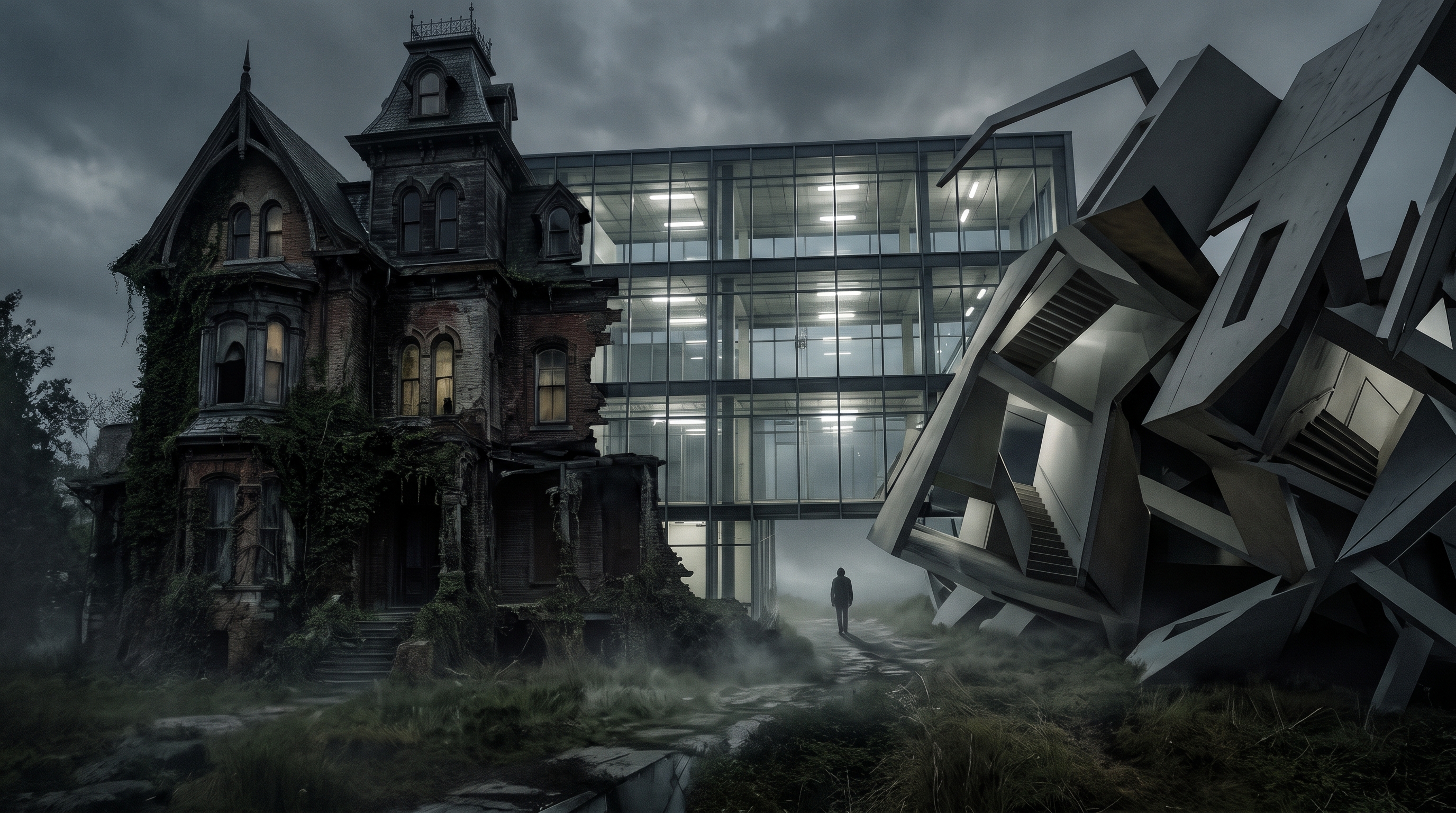
In his landmark 1992 monograph The Architectural Uncanny: Essays in the Modern Unhomely, architectural historian Anthony Vidler transposed Freud's psychoanalytic and linguistic insights into contemporary spatial criticism.[4:1]
Vidler demonstrates that architecture—historically sanctified as humanity's primary physical envelope for shelter, psychological stability, and domestic centeredness (the ultimate Heim)—paradoxically became in modernity the preeminent apparatus for generating spatial vertigo, bodily dread, and existential estrangement.[4:2]
The Spatialization of Repression: Projection vs. Masonry
Vidler establishes an essential epistemological foundation: the uncanny is not an inherent physical property of stone, concrete, or glass.[4:3] A wall, corridor, or doorway cannot be intrinsically uncanny in its physical materiality; rather, the architectural uncanny is an aesthetic representation of a psychological projection:
"The uncanny is not a property of the space itself nor can it be provoked by any particular spatial conformation; it is, in its aesthetic dimension, a representation of a mental state of projection that precisely elides the boundaries of the real and the unreal in order to provoke a disturbing ambiguity, a slippage between waking and dreaming." — Anthony Vidler, The Architectural Uncanny (1992)[4:4]
Because the private home is the primary repository for intimate human vulnerabilities, somatic memories, and psychic repressions, it is uniquely susceptible to turning inside out. When the domestic envelope fails to conceal what should remain hidden, the safe domestic haven undergoes sudden defamiliarization, confirming Theodor W. Adorno's famous diagnosis in Minima Moralia that "dwelling, in the proper sense, is now impossible."[4:5]
The Three Registers of the Modern Unhomely
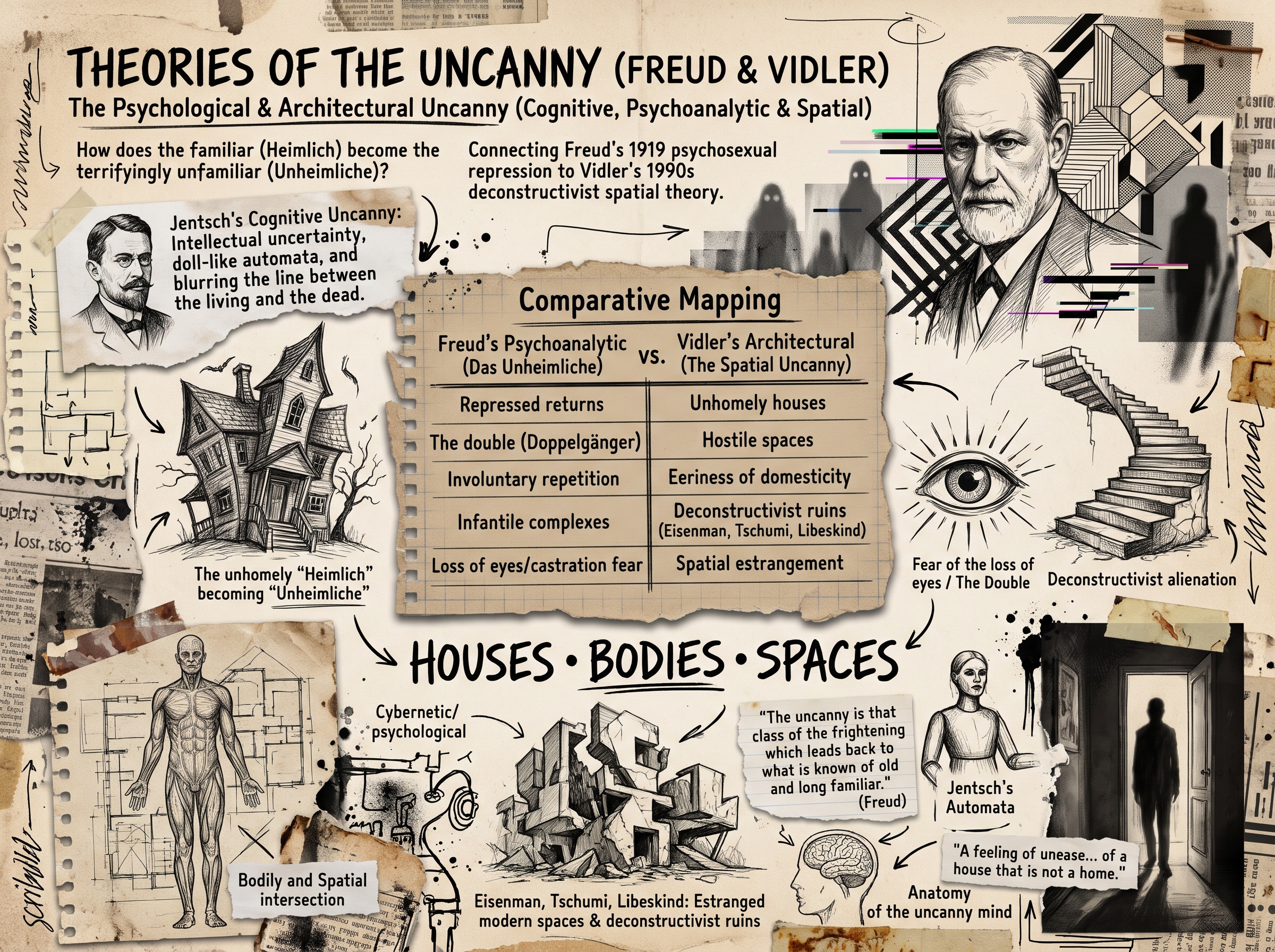
Vidler organizes spatial pathology into three interrelated registers: Houses, Bodies, and Spaces.[4:6]
| Register | Thematic Focus | Core Pathologies & Architectural Manifestations |
|---|---|---|
| 1. Houses | Domesticity Defamiliarized | • The Gothic Haunted House (Poe's House of Usher) • Buried Cities & Domestic Archaeology (Pompeii, Wilhelm Jensen's Gradiva) • Glass Modernism & Transparent Panopticons (The Bauhaus School, Le Corbusier) |
| 2. Bodies | The Tectonic & The Corporeal | • Collapse of the harmonious Vitruvian humanist body • Lacanian fragmented body (corps morcelé) • Prosthetic, exploded architecture & anatomical rupture |
| 3. Spaces | Metropolitan Pathologies & Neuroses | • Urban agoraphobia & post-Haussmann vertigo (Carl Westphal, 1871) • The metropolitan labyrinth & commodified flânerie (Benjamin) • The blasé defense shield & sensory overstimulation (Simmel) |
1. Houses: Domesticity Defamiliarized
- The Gothic Haunted House: In 19th-century Romanticism, Edgar Allan Poe's The Fall of the House of Usher established the haunted mansion as an externalized, collapsing psyche.[4:7] The zig-zag fissure running down the facade and the premature entombment of Madeline in subterranean vaults literalize the return of the repressed, where architectural masonry acts as a sentient corporeal skin that collapses when psychic balance is annihilated.[4:8]
- Buried Cities and Domestic Archaeology: Freud's reading of Wilhelm Jensen's Gradiva linked archaeological excavation in Pompeii to psychoanalytic uncovering. Intact bedrooms and dining tables preserved beneath volcanic ash represent domestic life frozen at the catastrophic moment of trauma.[4:9]
- The Modernist Panopticon: High modernism—including The Bauhaus School and Le Corbusier's concept of the dwelling as a "machine for living in" (machine à habiter)—attempted to exorcise the Gothic haunted house through hygienic geometry and transparent glass curtain walls.[4:10] However, by eliminating shadows, cellars, and attics, modernism created a new, colder uncanny: the panoptic dwelling where the inhabitant is permanently exposed to an unrelenting, clinical gaze.[4:11]
2. Bodies: The Tectonic and the Corporeal
- The Vitruvian Humanist Ideal Shattered: Classical architecture (from Vitruvius to Alberti and Leonardo da Vinci) grounded spatial proportion in the idealized, symmetrical human body (the Vitruvian Man). Modern architecture severed this bond.[4:12]
- The Lacanian Fragmented Body (Corps Morcelé): Vidler links avant-garde and deconstructivist architecture to Jacques Lacan's concept of the infant's primordial fear of bodily dismemberment. Walls tilt at disorienting angles, structural frames burst through skins, and interior voids mimic missing limbs or open anatomical cavities.[4:13]
3. Spaces: Metropolitan Pathologies & Spatial Neuroses
- Agoraphobia and Urban Vertigo: Vidler details the late-19th-century medicalization of spatial panic by German psychiatrist Carl Westphal, who diagnosed agoraphobia (fear of open spaces) in Berlin in 1871. Monumental boulevards and barren plazas carved out by urban modernizers (such as Baron Haussmann in Paris) stripped pedestrians of protective containment, triggering paralyzing spatial vertigo.[4:14]
- The Urban Labyrinth and Simmel's Blasé Shield: Incorporating Walter Benjamin's analysis of The flâneur and Georg Simmel's sociology in The Metropolis and Mental Life, Vidler demonstrates how the modern capitalist metropolis turned the street into an alienating labyrinth, compelling urbanites to adopt a detached blasé attitude as an armored defense against sensory bombardment.[4:15]
4. Architectural Manifestations: Deconstructivism & The Post-Utopian Void
Composed in the immediate wake of the landmark 1988 "Deconstructivist Architecture" exhibition at the Museum of Modern Art (MoMA) in New York, curated by Philip Johnson and Mark Wigley, Vidler's treatise served as the preeminent theoretical companion to the movement.[3:1][4:16] Vidler explained how Deconstructivism operationalized post-structuralist philosophy—specifically Jacques Derrida's deconstruction and hauntology—into physical masonry, steel, and glass.[12:1][4:17]
| Architectural Paradigm | Spatial & Structural Organizing Principle | Tectonic Expression & Psychological Affect |
|---|---|---|
| Classical Architecture | Anthropomorphic Harmony & Structural Closure | Symmetrical equilibrium, human-scaled proportions (Vitruvian ideal), secure domestic sanctuary. |
| High Modernism | Rationalized Functionalism & Machine Hygiene | Transparent glass grids, eradication of shadow, clinical surveillance, panoptic exposure. |
| Deconstructivism | Post-Structuralist Rupture & Event-Space | Warped axes, fragmented envelopes, inaccessible voids, somatic vertigo, and spatial dread (Eisenman, Tschumi, Coop Himmelb(l)au, Libeskind). |
Peter Eisenman: Autonomous Grids and Domestic Sabotage
Peter Eisenman systematically sabotaged traditional domestic comfort. Influenced by syntactic linguistics and Jacques Derrida, Eisenman sought to liberate architecture from anthropocentric utility, shelter, and humanistic meaning:[12:2][4:18]
- House VI (Frank Residence, 1975): Eisenman inserted an architectural column directly adjacent to the dining table—preventing dinner guests from sitting together—and cut a structural glass void into the master bedroom floor between the couple's twin beds, ensuring that the private domestic interior was permanently interrupted by architectural alienation.[4:19]
- Memorial to the Murdered Jews of Europe (Berlin): Eisenman deployed a vast, rolling field of 2,711 concrete stelae arranged on a warped grid. As visitors descend into the field, the pavement dips and the stelae rise above head-height, stripping away metropolitan sound and sightlines to evoke profound spatial disorientation, agoraphobic dread, and historical mourning.[4:20]
Bernard Tschumi: Programmatic Disjunction and the Parc de la Villette
Bernard Tschumi's master plan for the Parc de la Villette in Paris (1982–1998) rejected the pastoral, comforting tradition of the classical urban park in favor of cinematic montage and post-structuralist disjunction:[3:2][4:21]
- The Point-Grid of Follies: Tschumi superimposed three autonomous structural systems: points, lines, and surfaces. On a strict 120-meter Cartesian coordinate grid, he distributed thirty-five bright red, deconstructed architectural folies—exploded cubes fabricated from enameled steel that perform no single functional purpose.[3:3][4:22]
- Event-Architecture: Tschumi argued that architecture cannot be separated from the events and violence that transpire within it. By repeating identical geometric variations across an open landscape, the park provokes a disquieting sense of mechanical repetition, spatial fragmentation, and cinematic estrangement.[4:23]
Coop Himmelb(l)au: Tectonic Explosion and Winged Rupture
Austrian architectural cooperative Coop Himmelb(l)au (Wolf D. Prix and Helmut Swiczinsky) famously declared: "Architecture must blaze, burn, hurt, and tear."[3:4] Their landmark project analyzed within the context of Vidler's uncanny is the Rooftop Remodeling Falkestrasse in Vienna (1988):[3:5][4:24]
- The Parasitic Intrusion: Slicing through a historic 19th-century bourgeois apartment roof with an explosive skeletal structure of bent steel pipes, taut cables, and jagged glass planes, the design destabilized the monumental permanence of the historical city, physically manifesting the violence, impermanence, and psychic unrest of late-twentieth-century civilization.[3:6][4:25]
Daniel Libeskind: Spatializing Absence and Historical Trauma
Although Daniel Libeskind's Jewish Museum Berlin (opened in 2001) reached completion after Vidler's 1992 text, Vidler recognized Libeskind's project Between the Lines as the ultimate physical manifestation of the post-traumatic architectural uncanny:[7:4][4:26]
- The Zigzag and the Straight Line: Libeskind organized the building around two colliding lines: a jagged, frantic zigzag structure intersected by a straight, unyielding line of empty space—the Void (Leerstelle).
- The Architecture of Absence: Unheated, unlit, and raw-concrete, the central vertical voids cut through the entire height of the museum, physically barring the visitor from entering. The building materializes the historical catastrophe of the Holocaust not through representational monuments, but through the uncanny, somatic presence of unfillable emptiness.[7:5][4:27]
Rachel Whiteread: House (1993) and Solidified Negative Space
In subsequent writings expanding upon The Architectural Uncanny, Vidler analyzed British sculptor Rachel Whiteread's monumental public artwork House (1993):[7:6][4:28]
- Casting the Void: Whiteread sprayed liquid concrete into the interior of an abandoned Victorian terraced house in East London before peeling away the outer brick walls. The resulting sculpture was a solid, monumental cast of the home's empty interior air.[7:7]
- The Sarcophagus of Memory: Sockets, door frames, stairwells, and window bays were turned inside out into stone extrusions. House stood as the ultimate monument to the unhomely: privatized domestic sanctuary turned into a sealed, impenetrable mausoleum, capturing the violent gentrification and historical erasure of working-class domesticity.[7:8][4:29]
5. Comparative Synthesis: Freud vs. Vidler
| Analytical Dimension | Sigmund Freud (Das Unheimliche, 1919) | Anthony Vidler (The Architectural Uncanny, 1992) |
|---|---|---|
| Epistemic Foundation | Repression and the divided unconscious subject | Spatial defamiliarization and the unhomely built environment |
| Linguistic Anchor | Semantic inversion of heimlich (homely/secret) into unheimlich | Spatialization of the Heim; the domestic sanctuary turning inside out |
| Primary Locus of Vulnerability | The human ego, the gaze (eyes), and somatic integrity | The domestic dwelling, the building facade, and the urban threshold |
| Core Psychological Mechanism | Return of repressed infantile complexes & revival of surmounted animism | Projection of internal anxieties, bodily dismemberment, and spatial trauma onto masonry |
| Conception of the Body | Oedipal body subject to castration, blindness, and drive repetition | Classical Vitruvian body shattered into the Lacanian corps morcelé |
| Critique of Prior Paradigms | Refutes Jentsch's "intellectual uncertainty" and classical beauty aesthetics | Refutes modernist functionalist utopianism and postmodern historicist pastiche |
| Spatial Scale | Intimate, domestic, and bodily (the womb, the bedroom, the town street) | Architectural, urban, and geopolitical (the house, the metropolis, the monument) |
| Material Expression | The doll Olympia, the Sandman, severed hands, mechanical doubles | Eisenman's columns, Tschumi's Follies, Libeskind's voids, Whiteread's cast air |
| Ultimate Resolution | Reality testing (Realitätsprüfung) and psychoanalytic insight | Deconstructive critique, bodily confrontation with emptiness, and historical mourning |
6. Contemporary Interrogations, Cybernetics & The Extended Uncanny
Freud and Vidler's formulations continue to fertilize cutting-edge inquiries across cognitive science, cybernetics, and psychopathology:[1:41][4:30]
Masahiro Mori and the Robotics Uncanny Valley
In 1970, Japanese roboticist Masahiro Mori formulated the hypothesis of The Uncanny Valley (Bukimi no Tani).[13:1] Mori observed that as robots, mannequins, and computer-generated avatars appear increasingly human, human emotional affinity rises steadily. However, when an artificial figure reaches approximately 85–95% human fidelity, affinity abruptly plunges into acute revulsion before rising again at 100% human perfection.[13:2]
- Mori's cybernetic curve directly synthesizes Freud and Jentsch: subtle physical anomalies (glassy gaze, unnatural micro-movements, cold silicone skin) activate dormant animistic expectations, reawakening unconscious anxieties surrounding corpses, automatons, and the death drive.[13:3][15]
- Contemporary developments in synthetic AI voice modulation—analyzed in The Auditory Uncanny Valley (Voice & AI Assistants)—extend this dynamic to the acoustic realm, where near-human artificial voices trigger cognitive revulsion when prosodic rhythms subtly falter.
Jacques Lacan: Extimité and the Objet Petit a
French psychoanalyst Jacques Lacan expanded Freud's das Unheimliche during his 1962–1963 seminar on Anxiety (L'angoisse).[16] Lacan coined the neologism extimité (extimacy, or "intimate exteriority") to describe that which is simultaneously the most intimate, central core of the subject, yet radically external, alien, and foreign.[16:1] For Lacan, the uncanny occurs when the protective shield of the Symbolic order is breached, and the subject encounters the objet petit a—the unassimilable real object of desire and terror that exposes the fundamental lack (manque) and constitutive division of the human ego.[16:2]
Phenomenological Psychopathology: Louis Sass on Hyperreflexivity
In contemporary clinical psychology and phenomenology, Louis Sass - Phenomenological Psychopathology and the Self utilizes the architecture of the uncanny to illuminate the experiential world of schizophrenia.[17] Sass demonstrates that schizophrenic delusion is characterized by hyperreflexivity: an exaggerated self-consciousness where the tacit, unreflective background of ordinary life becomes an alien, hyper-salient spectacle. The patient experiences the everyday domestic world as artificial, staged, and profoundly uncanny, mirroring the collapse of the Heim into terrifying theatricality.[17:1]
🎴 Interactive Web Practice (Comprehension Check)
Question 1 (Philology & The Freudian Dialectic of Repression): How does Sigmund Freud resolve the lexical paradox of the German adjective heimlich (homely/familiar), and what does its convergence with unheimlich reveal about the psychoanalytic etiology of uncanny dread?
Answer: Sigmund Freud resolves the semantic paradox of heimlich by demonstrating that the word evolves along two distinct, diverging lexical trajectories across the German language. In its first and most common usage, heimlich signifies that which belongs to the home (Heim)—denoting what is domestic, comfortable, intimate, friendly, and securely protected from external threats. However, in its second usage, documented in dictionaries by Daniel Sanders and Karl Gutzkow, heimlich comes to mean that which is withdrawn from the sight of strangers, concealed, kept secret, clandestine, and carefully hidden away from observation.
Through this second trajectory, heimlich undergoes an internal semantic inversion until it coincides precisely with its apparent antonym, unheimlich (the unhomely, eerie, or uncanny). Freud adopts Friedrich Schelling's famous philosophical definition—that the uncanny is "everything that ought to have remained secret and hidden, and yet has come to light"—to bridge lexicography with psychoanalysis.
Psychoanalytically, this convergence proves that the uncanny is not an encounter with something completely unknown, bizarre, or foreign to the human mind. Rather, the uncanny is an experience of something that was once deeply familiar (heimisch), intimate, and native to the unconscious psyche, but was subsequently driven out of conscious awareness through the psychic mechanism of repression. When an external perception or event bypasses ego-defenses and causes this repressed material to unexpectedly re-emerge, it is experienced not with warm recognition, but with terrifying defamiliarization. The negative prefix un- does not indicate an absolute absence of familiarity; it functions as the psychoanalytic marker of repression (die Marke der Verdrängung).
Question 2 (Cognitive Uncertainty vs. Castration Anxiety: Freud vs. Jentsch): Why does Freud reject Ernst Jentsch's concept of "intellectual uncertainty" regarding the automaton Olympia, and how does his counter-reading of E.T.A. Hoffmann's The Sandman reframe the origin of the uncanny in psychosexual terms?
Answer: In his 1906 essay On the Psychology of the Uncanny, Ernst Jentsch argued that the uncanny is primarily a cognitive phenomenon caused by "intellectual uncertainty" (intellektuelle Unsicherheit)—specifically, a state of perceptual hesitation when an observer cannot determine whether an apparently living entity is inanimate (such as a lifelike automaton, mannequin, or wax figure), or conversely, whether an inanimate object might secretly possess organic life. Jentsch cited E.T.A. Hoffmann's Gothic tale The Sandman as the prime literary illustration of this effect, locating the uncanny in the lifelike mechanical doll Olympia.
Freud completely rejects Jentsch's cognitive framework on multiple clinical and interpretive grounds:
- Inadequacy of Cognitive Uncertainty: Freud points out that intellectual uncertainty is neither necessary nor sufficient for uncanny dread. Human beings routinely encounter ambiguous or unfamiliar phenomena without experiencing uncanny terror, while deep uncanny shudders frequently strike when there is zero intellectual doubt regarding what is being observed. Furthermore, young children treat inanimate dolls as living beings with complete comfort, showing that the confusion between living and inert matter is not intrinsically terrifying until adulthood, after psychological repression has taken hold.
- The True Source of Dread in The Sandman: Freud demonstrates that Olympia is merely a subordinate plot device reflecting protagonist Nathanael's infantile narcissism. The genuine engine of dread across Hoffmann's narrative is the mythical monster of the Sandman himself (embodied by the abusive lawyer Coppelius and later the optician Coppola), who threatens to tear out children's eyes and feed them to his owl-beaked offspring on the moon.
- Ocular Trauma as Castration Anxiety: Drawing on psychoanalytic clinical findings and classical mythology (such as Oedipus blinding himself in punishment for parricide and incest), Freud asserts that the fear of damaging or losing one's eyes is a symbolic displacement of castration anxiety. The Sandman represents the punitive, terrifying father-figure who threatens sexual mutilation.
Question 3 (Spatial Transposition & Vidler's Three Registers): How does Anthony Vidler translate Freud's philological dialectic of heimlich and unheimlich into spatial criticism, and how do Houses, Bodies, and Spaces manifest this pathology?
Answer: Anthony Vidler transposes Freud's philological insight into architectural theory by arguing that architecture—historically sanctified as humanity's primary physical envelope for domestic shelter, psychological centeredness, and bodily refuge (the ultimate Heim)—is uniquely susceptible to becoming unhomely. The uncanny is not an inherent material property of stone or glass, but an aesthetic representation of a mental projection that blurs boundaries between real and unreal. When the domestic envelope fails to contain the vulnerabilities and repressions it was built to hide, the familiar sanctuary mutates into an uncanny trap.
Vidler categorizes this spatial pathology across three registers:
- Houses (Domesticity Defamiliarized): Gothic fiction (Poe's House of Usher) externalizes the psyche into decaying masonry; Pompeii's buried ruins parallel archaeological and psychoanalytic excavation; and Modernist glass architecture (the Bauhaus, Le Corbusier's "machine for living"), in attempting to eliminate shadows, produces a cold, panoptic uncanny where inhabitants are permanently exposed to clinical surveillance.
- Bodies (The Corporeal Envelope): Classical Vitruvian anthropomorphic harmony (buildings mirroring the intact human body) is shattered in modernity. Deconstructivist architecture (Eisenman, Coop Himmelb(l)au, Tschumi) projects Jacques Lacan's "fragmented body" (corps morcelé) into space using warped grids, exploded structural skins, and architectural prosthetics.
- Spaces (Metropolitan Pathologies): Late-19th-century urban transformations (Haussmann's Parisian boulevards) induced medicalized spatial neuroses like agoraphobia (Westphal), while Walter Benjamin's flâneur and Georg Simmel's blasé urbanite illustrate how the capitalist metropolis became an unhomely labyrinth demanding psychological detachment.
Question 4 (Deconstructivism, Lacan's Fragmented Body & Post-Utopian Voids): In what ways does Deconstructivist architecture break with classical Vitruvian anthropomorphism, and how do architects like Peter Eisenman and Daniel Libeskind physicalize historical and psychic trauma?
Answer: Classical architectural tradition from Vitruvius through Renaissance humanism (Alberti, Leonardo da Vinci) grounded architectural proportion, beauty, and equilibrium in the idealized, symmetrical, and intact human body (the Vitruvian Man). The temple or dwelling was conceived as an organic, unified body reinforcing the human subject's sense of physical coherence and rational mastery.
Deconstructivist architecture violently ruptures this humanist bond. Vidler links this movement to Jacques Lacan's concept of the "fragmented body" (corps morcelé)—the infantile anxiety of somatic dismemberment preceding the mirror stage. Architects externalize this psychic fracture through warped axes, non-rectilinear geometries, and structural ruptures:
- Peter Eisenman: In House VI, Eisenman sabotages domestic intimacy by placing an obstructive column against the dining table and cutting a glass void into the floor between the bedroom's twin beds. In his Berlin Holocaust Memorial, 2,711 concrete stelae on a undulating grid produce agoraphobic vertigo and severe sensory isolation, forcing the visitor into an experiential labyrinth of mourning.
- Daniel Libeskind: In the Jewish Museum Berlin, Libeskind organizes the building around the vertical Void (Leerstelle)—a raw, unheated, unlit concrete chasm that pierces the structure. Rather than using representational monuments, Libeskind materializes the catastrophic rupture of the Holocaust through the physical presence of inaccessible, unfillable emptiness.
Resonant Notes
The following notes in the vault share direct thematic, psychoanalytic, and spatial connections with Sigmund Freud and Anthony Vidler's formulations of the uncanny:
🔴 Psychoanalysis, Repression & The Divided Subject
- Sigmund Freud — The vault's foundational intellectual biography on Freud's psychoanalytic revolution; The Uncanny marks Freud's preeminent contribution to aesthetics, establishing how unconscious defense mechanisms (repression, the repetition compulsion, castration anxiety, and the death drive) govern cultural, literary, and emotional experience.
- Jacques Lacan — Lacan extends Freud's das Unheimliche through his concepts of extimité (intimate exteriority) and the objet petit a, locating the uncanny at the traumatic threshold where the unassimilable Real ruptures the Symbolic order and estranges the divided subject from their own internal core.
- Jokes and Their Relation to the Unconscious — Freud's companion 1905 aesthetic treatise exploring how unconscious processes negotiate psychic censorship; while jokes utilize condensation and displacement to circumvent repression through pleasurable social laughter, the uncanny marks an involuntary, terrifying collapse of repression.
- Louis Sass - Phenomenological Psychopathology and the Self — Sass's phenomenological analysis of schizophrenia and hyperreflexivity—where the tacit, unreflective background of consciousness decontextualizes into an alien, menacing spectacle ("the truth-taking stare")—provides the clinical psychiatric counterpart to Freud's uncanny estrangement of the familiar.
- Fyodor Dostoevsky (1821-1881) — Dostoevsky's novella The Double (Dvoynik) serves as a foundational literary embodiment of Freud and Otto Rank's Doppelgänger thesis, dramatizing Yakov Petrovich Golyadkin's psychological disintegration as his identical duplicate usurps his social identity and drives him into madness.
- Aldous Huxley's Heaven and Hell (1956) — Huxley's exploration of "negative transfiguration" and the infernal antipodes of human consciousness—where familiar perceptual boundaries dissolve into autonomous, terrifying, and claustrophobic forms—directly mirrors Freud's uncanny return of repressed psychic contents.
🟡 Cognitive Science, Animism & The Uncanny Valley
- On the Psychology of the Uncanny (Zur Psychologie des Unheimlichen) — Ernst Jentsch's seminal 1906 essay serves as Freud's primary theoretical antagonist; Jentsch attributes uncanny dread to cognitive "intellectual uncertainty" regarding animate vs. inanimate boundaries, establishing the earliest framework for psychological defamiliarization.
- The Uncanny Valley (不気味の谷現象) & The Auditory Uncanny Valley (Voice & AI Assistants) — Masahiro Mori's cybernetic hypothesis and its acoustic counterpart modernize Freud and Jentsch's insights, mapping how humanoid androids, prosthetics, and synthetic voices plunge into revulsion when subtle anomalies breach expectations of organic human life.
- Animism — Freud identifies classical animism—the archaic belief that inanimate matter possesses soul, spirit, and intentionality—as a surmounted cognitive worldview whose momentary confirmation in material reality provokes acute uncanny terror.
- Déjà Vu & Déjà vu - Psychologists are exploring this creepy feeling of having already lived through an experience before — Both phenomena share the core experiential architecture of the uncanny: an acute cognitive clash between familiarity and strangeness, where a novel perception feels inexplicably pre-experienced and uncomfortably alienated.
- Cognitive Dissonance — Examines the acute psychological tension and affective discomfort generated when an individual encounters contradictory schemas or sensory cues (such as an automaton exhibiting human behavior), mirroring the cognitive rupture underlying uncanny affects.
- Apophenia — The human cognitive compulsion to detect meaningful patterns, conspiracies, and intentional designs in random data reflects the uncanny resurgence of "the omnipotence of thoughts" and primitive magical thinking.
🟢 Modernist Architecture, Spatial Estrangement & Gothic Literature
- The Bauhaus School — The Bauhaus pioneered the International Style—championing functionalism, transparent glass curtain walls, and industrial geometry. Vidler diagnoses this utopian rationalist impulse as the very mechanism that dismantled domestic intimacy, eradicating shadows and producing the unhomely modern metropolis.
- Jacques Derrida — Derridean deconstruction underpins the Deconstructivist architectural movement (Eisenman, Tschumi, Coop Himmelb(l)au) that Vidler analyzes; dislocating structural centers, exposing interior voids, and architectural "hauntology" physically materialize Derrida's subversion of fixed metaphysical presence.
- The Sublime & Edmund Burke-The Physiological Sublime — Classical aesthetic philosophy contrasted beauty with the awe and terror of the sublime; Freud and Vidler spatialize Burke's physiological sublime triggers—obscurity, darkness, vastness, and privation—into modern psychological and architectural voids.
- The Nightmare — Henry Fuseli's iconic painting physically manifests the uncanny threshold between sleep and waking reality, the incubus as oppressive double, and repressed psychosexual terror, serving as an aesthetic forerunner to psychoanalytic criticism.
- Edgar Allan Poe (1809-1849) — Poe's Gothic fiction (William Wilson, The Fall of the House of Usher) embodies Freud and Vidler's primary uncanny tropes: the persecutory Doppelgänger, bodily fragmentation, premature burial, and the decaying domestic mansion as an externalized, collapsing psyche.
- Franz Kafka (1883-1924) — Kafka's narratives literalize the uncanny by dismantling the domestic envelope from within—whether through bodily metamorphosis within the family bedroom (The Metamorphosis) or inescapable, irrational bureaucratic architecture (The Trial).
- Walter Benjamin (1892–1940) & The flâneur — Benjamin's analysis of the flâneur, Parisian arcades, and the spectacle of the crowd in The Arcades Project provides Vidler with the theoretical archetype for metropolitan estrangement, illustrating how urban infrastructure induces agoraphobia and spatial paranoia.
- The Metropolis and Mental Life & Georg Simmel (1858-1918) — Simmel's diagnosis of metropolitan mental life, the blasé attitude, and the abstracting power of the money economy establishes the sociological groundwork for Vidler's urban uncanny and the psychological detachment of city dwellers.
- Giorgio de Chirico (1888-1978) & René Magritte — Metaphysical and Surrealist painters who systematically exploit uncanny techniques: de Chirico's deserted Italian piazzas, exaggerated shadows, and faceless mannequins evoke spatial dread, while Magritte defamiliarizes mundane domestic objects to shatter perceptual complacency.
- Henry James (1843—1916) — James's Gothic masterpiece The Turn of the Screw exemplifies the literary uncanny through sustained epistemic hesitation, where ghostly apparitions in a stately English country house blur the boundaries between objective supernatural menace and the subjective projection of repressed sexual hysteria.
- Don DeLillo Major Themes Analysis — DeLillo extends the uncanny into the postmodern landscape of consumer capitalism, revealing how sterile supermarket aisles, corporate brand mantras, and toxic clouds defamiliarize middle-class suburban sanctuary into unhomely existential dread.
- The Dehumanization of Art — José Ortega y Gasset's 1925 analysis of avant-garde art rejecting sentimental humanism in favor of pure, estranging conceptual forms parallels Freud and Vidler's exploration of artistic defamiliarization.
- Travis Bickle — Scorsese and Schrader's alienated protagonist in Taxi Driver dramatizes the urban uncanny, converting his taxi into a claustrophobic isolation chamber while his confrontational mirror monologue exemplifies the fractured, paranoid Doppelgänger.
References
Sigmund Freud / The Uncanny (Das Unheimliche) (1919) / In The Standard Edition of the Complete Psychological Works of Sigmund Freud, Volume XVII / MIT Press Archive ↩︎ ↩︎ ↩︎ ↩︎ ↩︎ ↩︎ ↩︎ ↩︎ ↩︎ ↩︎ ↩︎ ↩︎ ↩︎ ↩︎ ↩︎ ↩︎ ↩︎ ↩︎ ↩︎ ↩︎ ↩︎ ↩︎ ↩︎ ↩︎ ↩︎ ↩︎ ↩︎ ↩︎ ↩︎ ↩︎ ↩︎ ↩︎ ↩︎ ↩︎ ↩︎ ↩︎ ↩︎ ↩︎ ↩︎ ↩︎ ↩︎ ↩︎
Immanuel Kant / Critique of Judgment (1790) / Translated by Werner S. Pluhar / Hackett Publishing (1987) / Hackett Publishing ↩︎
Philip Johnson and Mark Wigley / Deconstructivist Architecture (MoMA Exhibition Catalog) / Museum of Modern Art (1988) / Museum of Modern Art ↩︎ ↩︎ ↩︎ ↩︎ ↩︎ ↩︎ ↩︎
Anthony Vidler / The Architectural Uncanny: Essays in the Modern Unhomely / MIT Press (1992) / MIT Press ↩︎ ↩︎ ↩︎ ↩︎ ↩︎ ↩︎ ↩︎ ↩︎ ↩︎ ↩︎ ↩︎ ↩︎ ↩︎ ↩︎ ↩︎ ↩︎ ↩︎ ↩︎ ↩︎ ↩︎ ↩︎ ↩︎ ↩︎ ↩︎ ↩︎ ↩︎ ↩︎ ↩︎ ↩︎ ↩︎ ↩︎
Daniel Sanders / Wörterbuch der deutschen Sprache (1860) / Otto Wigand / Bayerische Staatsbibliothek ↩︎
Nicholas Royle / The Uncanny / Routledge (2003) / Routledge ↩︎ ↩︎
Ernst Jentsch / On the Psychology of the Uncanny (Zur Psychologie des Unheimlichen) (1906) / Translated by Roy Sellars / Angelaki: Journal of the Theoretical Humanities (1997) / Taylor & Francis Online ↩︎ ↩︎ ↩︎ ↩︎ ↩︎ ↩︎ ↩︎ ↩︎ ↩︎
E.T.A. Hoffmann / The Sandman (Der Sandmann) (1816) / In The Golden Pot and Other Tales / Translated by Ritchie Robertson / Oxford World's Classics / Project Gutenberg ↩︎ ↩︎ ↩︎
Harold Bloom / Sigmund Freud's The Interpretation of Dreams / Chelsea House Publishers / Infobase Publishing ↩︎
Otto Rank / The Double: A Psychoanalytic Study (Der Doppelgänger) (1914) / Translated by Harry Tucker Jr. / University of North Carolina Press (1971) / UNC Press ↩︎ ↩︎
Sigmund Freud / Beyond the Pleasure Principle (1920) / Translated by James Strachey / W. W. Norton & Company (1990) / W. W. Norton & Company ↩︎
Mark Wigley / The Architecture of Deconstruction: Derrida's Haunt / MIT Press (1993) / MIT Press ↩︎ ↩︎ ↩︎
Masahiro Mori / The Uncanny Valley (Bukimi no Tani) (1970) / Translated by Karl F. MacDorman and Takashi Minato / IEEE Robotics & Automation Magazine (2012) / IEEE Xplore ↩︎ ↩︎ ↩︎ ↩︎
Sigmund Freud / Totem and Taboo: Resemblances Between the Mental Lives of Savages and Neurotics (1913) / Translated by James Strachey / W. W. Norton & Company / W. W. Norton ↩︎
Karl F. MacDorman and Hiroshi Ishiguro / The uncanny advantage of using androids in cognitive and social science research / Interaction Studies (2006) / John Benjamins ↩︎
Jacques Lacan / The Seminar of Jacques Lacan, Book X: Anxiety (1962–1963) / Translated by A. R. Price / Polity Press (2014) / Polity Books ↩︎ ↩︎ ↩︎
Louis A. Sass / Madness and Modernism: Insanity in the Light of Modern Art, Literature, and Thought / Harvard University Press (1994) / Harvard University Press ↩︎ ↩︎