Metaphysical Art and Surrealism (De Chirico & Magritte)
🗂️ Interactive Notebook: Open Study Companion (Video Summary, Flashcards, Mind Map) ↗
In twentieth-century modernism and philosophical aesthetics, the systematic subversion of sensory perception and rational space is anchored by two foundational masters of visual defamiliarization: Italian pioneer Giorgio de Chirico (1888–1978), the founder of Pittura Metafisica (Metaphysical Art), and Belgian Surrealist René Magritte (1898–1967), the preeminent visual philosopher of semiotics and representation. While French Surrealism—led by André Breton—sought to liberate unconscious desires through psychic automatism, visceral delirium, and Freudian dream analysis, both de Chirico and Magritte pursued a conscious, hyper-lucid, and anti-expressionist art that treated painting as rigorous epistemological inquiry. De Chirico synthesized Friedrich Nietzsche's philosophy of the enigma, Arthur Schopenhauer's aesthetic detachment, and Renaissance geometry to create deserted Mediterranean piazzas, claustrophobic arcades, elongated shadows, and faceless mannequins where linear perspective ruptures into existential agoraphobia and temporal paralysis. In direct intellectual succession, Magritte's revelatory encounter in 1922 with de Chirico's The Song of Love ignited his mature aesthetic: adopting the flat, deadpan clarity of commercial advertising and bourgeois interiors to methodically sever ordinary objects (pipes, bowler hats, green apples, mirrors, easels) from their utilitarian contexts. Merging de Chirico's spatial alienation with Magritte's semiotic sabotage, this dossier examines how both painters mobilized the uncanny (das Unheimliche) to prove that reality is an enigmatic construction, anticipating post-structuralist critiques of language, Michel Foucault's deconstruction of mimesis, and Jean Baudrillard's hyperreal simulacrum.
1. Philosophical Foundations and Intellectual Crucibles
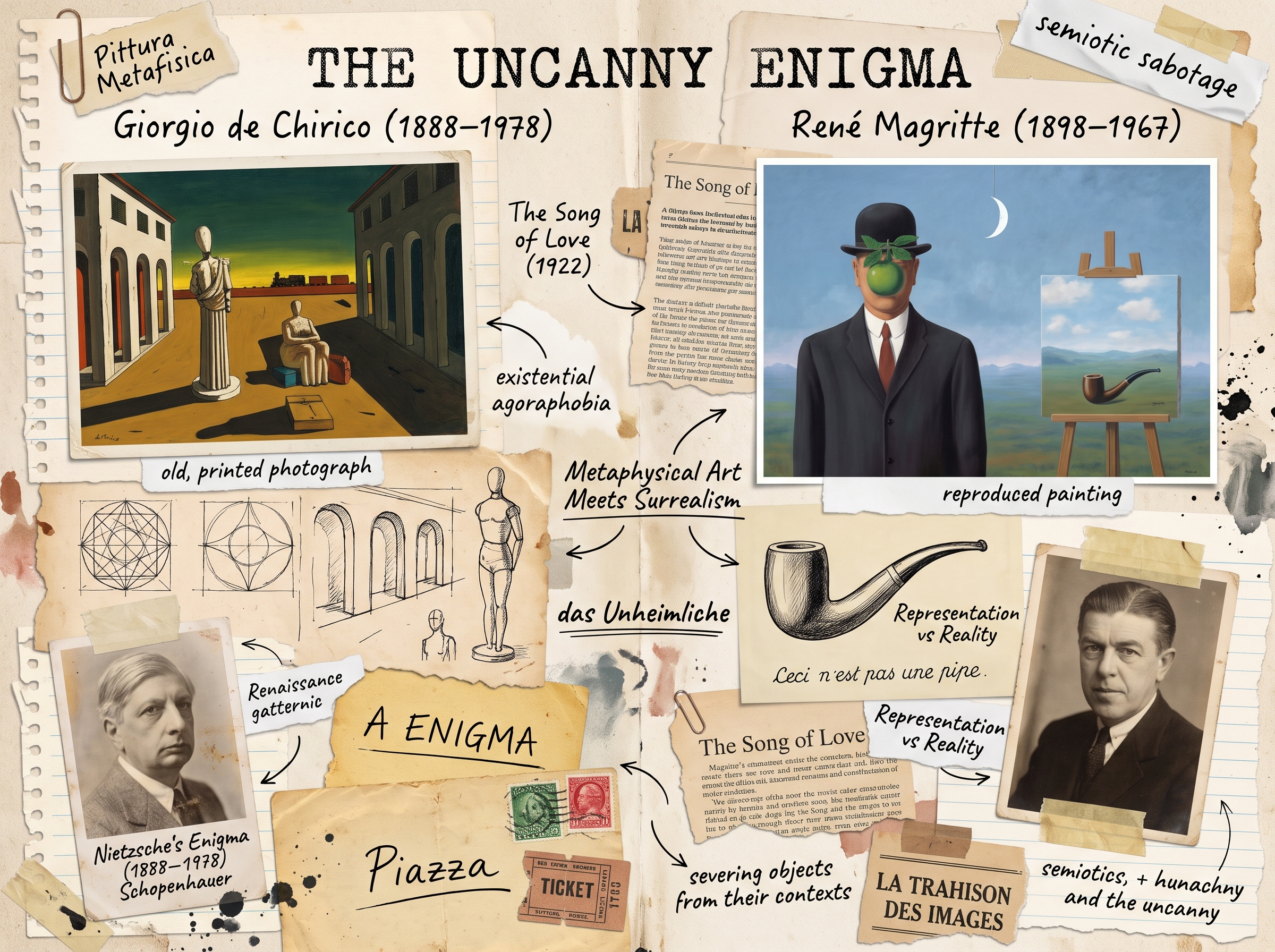
The dialogue between Metaphysical Art and Belgian Surrealism represents one of the most consequential lineages in modern cultural history. Rather than viewing the canvas as a surface for expressive emotional discharge, formalist abstraction, or decorative impression, both painters approached visual art as painted philosophy—a vehicle for dismantling the viewer's unreflective faith in common-sense reality.[1][2]
| Analytical Axis | Giorgio de Chirico (Pittura Metafisica) | René Magritte (Belgian Surrealism) |
|---|---|---|
| Philosophical Bedrock | Arthur Schopenhauer (Will and Representation); Friedrich Nietzsche (The Enigma); Arnold Böcklin | Continental epistemology; semiotics; Ludwig Wittgenstein; Michel Foucault |
| Aesthetic Arena | Deserted Mediterranean piazzas, classical arcades, railway viaducts, claustrophobic Ferrara workshops | Bourgeois domestic interiors, suburban parlors, window frames, ordinary skies, streetlamps |
| Primary Mechanism | Spatial & Temporal Dislocation: Polycentric perspective, raking shadows, frozen clocks, mannequins | Semiotic & Contextual Displacement (Dépaysement): Severing words from objects and images from reality |
| Operational Target | Rational architecture, spatial orientation, and the continuity of historical time | Naive realism, mimesis, and the unexamined equation of resemblance with truth |
| Attitude toward Freud | Vehement rejection; painting is a conscious philosophical inquiry, not a symptom of neurosis | Fierce resistance; rejected psychological automatism and biographical psychoanalysis |
| Commercial / Studio Background | Classical academic training (Munich); engineering influence (railway infrastructure) | Wallpaper designer (Peters-Lacroix); commercial advertising and catalogue graphic design (Studio Dongo) |
| Institutional Relationship | Championed by Apollinaire; later excommunicated by Breton (1928); executed serial self-replicas | Split from Breton's Parisian circle; founded Brussels group; mocked market via Période Vache |
Giorgio de Chirico: The Nietzschean Enigma and Schopenhauerian Detachment
Giorgio de Chirico was born in Volos, Greece, to Italian parents; his father, Evaristo de Chirico, was a prominent railway engineer constructing the Thessalian network.[1:1] This biographical backdrop permanently inscribed locomotives billowing steam behind walled horizons, arched transit viaducts, and station clocks into his pictorial vocabulary.
Studying at the Munich Academy of Fine Arts (1906–1909), de Chirico absorbed three decisive intellectual influences that forged Pittura Metafisica:[2:1][3]
- Arnold Böcklin and Max Klinger: German Symbolists demonstrated that realistic draftsmanship could be deployed to render supernatural dread, mythological anxiety, and melancholic interiority.[2:2]
- Arthur Schopenhauer: In The World as Will and Representation, Schopenhauer argued that ordinary perception is locked within the principle of sufficient reason—viewing objects strictly through their causal utility. True aesthetic genius requires wrenching an object out of its practical relationships, isolating it in pure stillness to confront its uncanny thing-in-itself (Ding an sich).[3:1]
- Friedrich Nietzsche: Nietzsche’s revelation of the world as an impenetrable enigma (Rätsel) and his intense affinity for the geometric clarity and deep autumn melancholia of Turin's piazzas taught de Chirico that modern cities conceal an ancient, non-human dread. Art must not express personal emotion; it must expose the uncanny strangeness of existence.[3:2][4]
"To live in the world as in an immense museum of strange things, of curious toys that change their appearance, that we as children broke to see how they were made inside, and then, disappointed, realized they were empty." — Giorgio de Chirico[4:1]
René Magritte: Commercial Clarity and the Catalyst of The Song of Love
René Magritte was born in Lessines, Belgium. His formative training at the Académie Royale des Beaux-Arts in Brussels proved disappointingly conservative.[5] In the early 1920s, Magritte supported himself by designing wallpaper for the Peters-Lacroix factory and creating commercial advertisements, fashion catalogues, and sheet-music covers at Studio Dongo, an agency he ran with his brother Paul.[6]
This commercial graphic background provided Magritte with his signature visual idiom: flat, uninflected brushwork, crisp linear contours, literal lighting, and the objective, deadpan clarity of a trade catalogue. Magritte weaponized this bourgeois clarity against bourgeois complacency itself.[6:1]
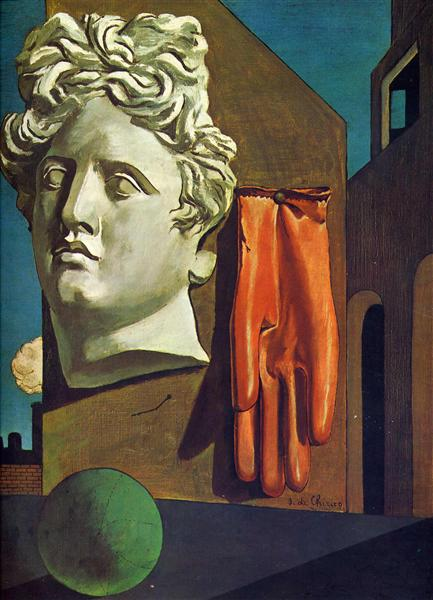
Around 1922–1923, poet Marcel Lecomte showed Magritte a black-and-white reproduction of de Chirico's The Song of Love (Le chant d'amour, 1914). The sight of a classical plaster bust of Apollo, a giant red rubber surgical glove, and a distant steam train juxtaposed on a wooden wall fundamentally transformed his life:[7]
"My eyes saw thought for the first time... This triumphant poetry supplanted the stereotyped effect of traditional painting. It represented a complete break with the mental habits of artists who were prisoners of talent, virtuosity, and all the little aesthetic specialities." — René Magritte[7:1]
De Chirico demonstrated to Magritte that visual art could transcend technical display and formalist abstraction, functioning instead as a direct, poetic investigation into the nature of thought, signs, and physical reality.[7:2]
2. The Mechanics of Defamiliarization: Spatial Vertigo vs. Semiotic Sabotage
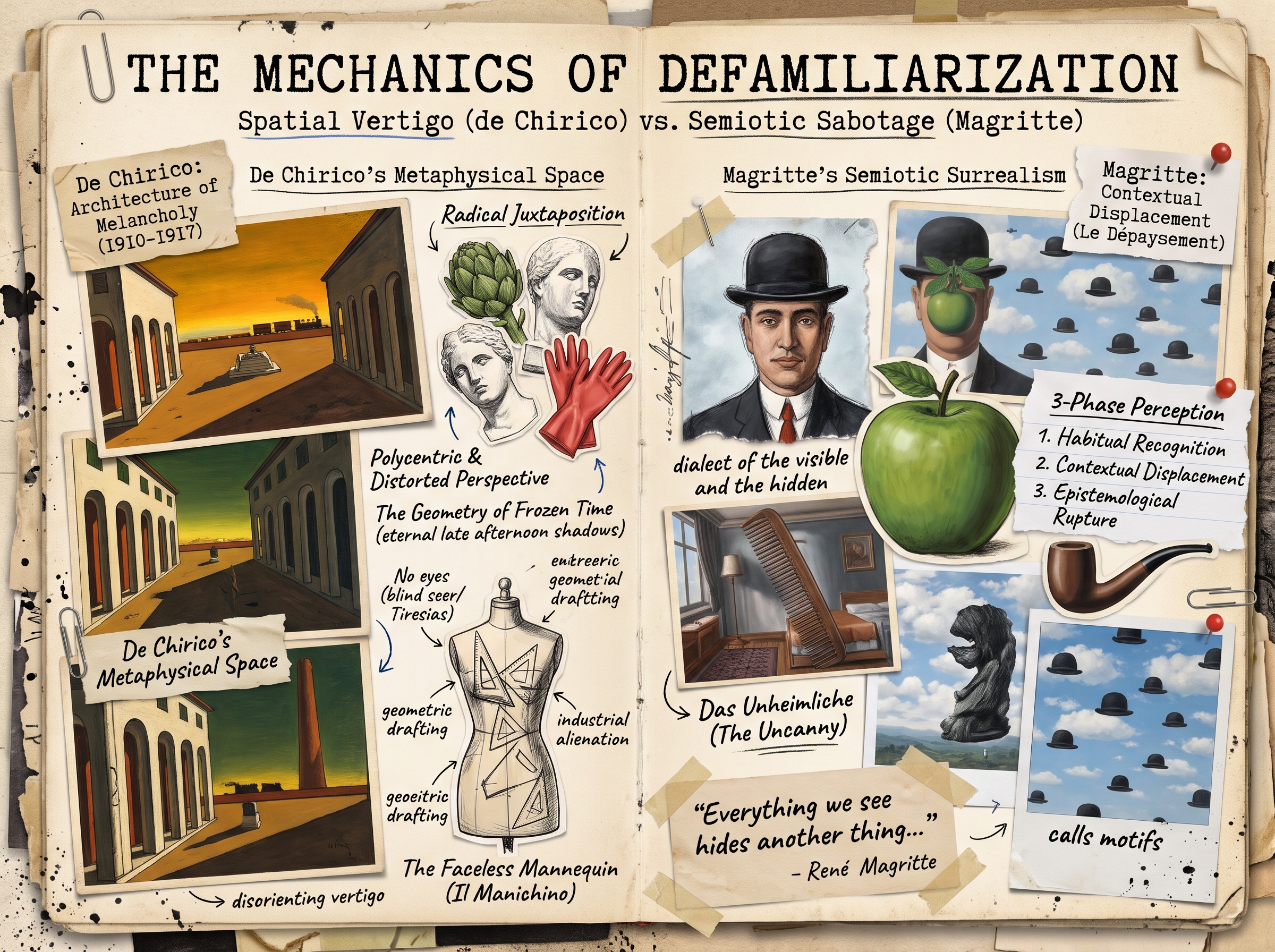
While linked by a shared devotion to the uncanny (das Unheimliche), de Chirico and Magritte executed their defamiliarization through distinct technical vectors: de Chirico worked through spatial and architectural distortion, whereas Magritte operated through semiotic and contextual displacement.[4:2][8]
De Chirico's Metaphysical Space: The Architecture of Melancholy
Between 1910 and 1917—first in Florence and Paris, then in the military psychiatric hospital at Ferrara—de Chirico codified Pittura Metafisica through four primary formal strategies:[1:2][4:3]
- Polycentric and Distorted Perspective: De Chirico systematically violated the mathematical harmony of Renaissance single-point perspective. By forcing multiple conflicting vanishing points and steeply raked, stage-like ground planes into a single image, he destabilized the viewer's vestibular equilibrium, inducing agoraphobic vertigo and spatial disorientation.[4:4]
- The Geometry of Frozen Time: Bathed in the low, raking, amber light of an eternal Mediterranean late afternoon, de Chirico's piazzas project unnaturally long, menacing shadows across desolate flagstones. Station clocks and sundials register ambiguous, paralyzed hours, suspending the canvas in an uneasy pause before an imminent, unspoken catastrophe.[1:3]
- Radical Juxtaposition of Decontextualized Objects: Green artichokes, plaster casts of Greco-Roman deities, medical rubber gloves, geometric biscuits, drafting triangles, and factory smokestacks are violently severed from functional chains of meaning and forced into sterile proximity, transforming ordinary reality into an insoluble cryptogram.[2:3]
- The Faceless Mannequin (Il Manichino): Introduced in 1914, articulated tailors' dummies, seamstress armatures, and geometric drafting mannequins replace living human inhabitants. Marked with stitching lines, compasses, and wooden braces, these figures externalize modern industrial alienation while evoking blind mythological seers (such as Tiresias) who perceive truths inaccessible to natural human eyes.[2:4][4:5]
Magritte's Semiotic Surrealism: Contextual Displacement (Le Dépaysement)
In contrast to Salvador Dalí’s fluid, melting dreamscapes or Max Ernst's automatic frottages, Magritte refused to distort the physical anatomy of objects. Instead, he painted ordinary items—pipes, bowler hats, green apples, combs, mirrors, easels, clouds—with meticulous, photographic clarity, deploying contextual displacement (le dépaysement):[6:2][8:1]
| Phase of Perception | Operational Mechanism | Phenomenological & Cognitive Impact |
|---|---|---|
| 1. Habitual Recognition | Familiar object embedded in routine domestic use (e.g., pipe, apple, window) | Passive, unreflective cognitive processing; the object is taken for granted as an immutable utility. |
| 2. Contextual Displacement | Object extracted from utilitarian chains, subjected to scale mutation, or placed in impossible proximity | Perceptual shock; the functional network collapses, forcing conscious intellectual contemplation. |
| 3. Epistemological Rupture | Direct clash between hyper-realistic rendering and contradictory logical or spatial structure | Acute cognitive dissonance; activation of the Freudian uncanny (das Unheimliche); deconstruction of mimesis. |
Magritte formulated his core metaphysics around the dialectic of the visible and the hidden:
"Everything we see hides another thing, we always want to see what is hidden by what we see. There is an interest in that which is hidden and which the visible does not show us. This interest can take the form of a quite intense feeling, a sort of conflict, one might say, between the visible that is hidden and the visible that is present." — René Magritte[9]
For Magritte, concealment is not a temporary defect waiting to be corrected by sharper observation; it is an inescapable condition of reality. Every visible surface is an opaque screen that conceals what lies behind it, while simultaneously provoking human desire to penetrate the veil.[9:1]
3. Semiotics, Language, and Representation: Foucault on Magritte
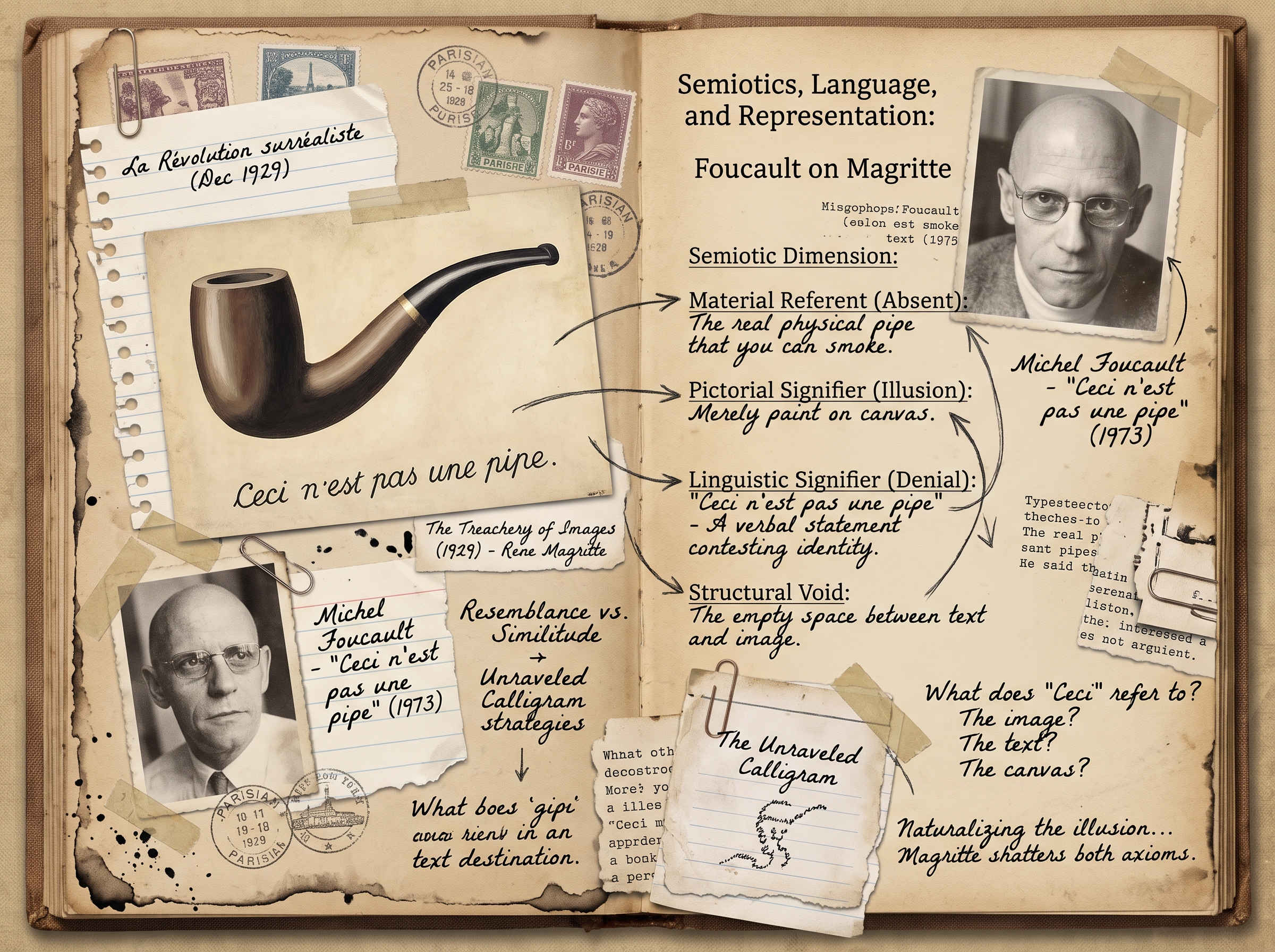
Magritte's most profound intellectual breakthrough was recognizing that Western visual culture had spent five centuries conflating three separate entities: the material object (referent), the mental concept (signified), and the physical representation (signifier).[10]
In December 1929, Magritte published his illustrated manifesto "Les Mots et les Images" (Words and Images) in the final issue of La Révolution surréaliste, demonstrating through eighteen visual propositions that an object's name is completely arbitrary, and that an image can replace a word just as a word can replace an object.[6:3]
Michel Foucault's Ceci n'est pas une pipe (1973)
In 1973, French philosopher Michel Foucault published his celebrated archaeological treatise Ceci n'est pas une pipe (This Is Not a Pipe), analyzing Magritte's semiotic deconstructions following a series of philosophical exchanges with the painter.[10:1]
| Semiotic Dimension | Manifestation in The Treachery of Images | Epistemological Function |
|---|---|---|
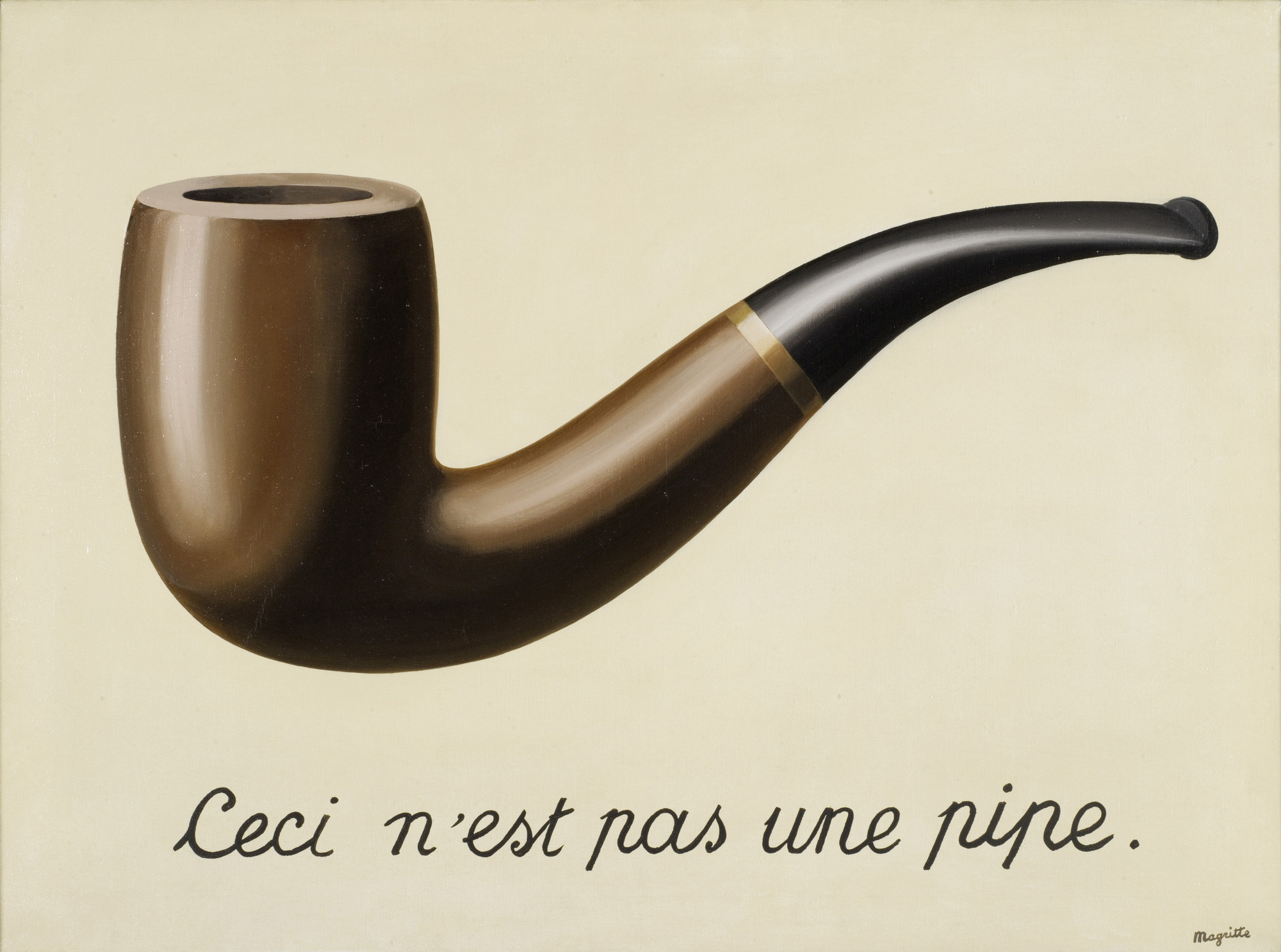
| Material Referent | The physical wooden/briar smoking pipe | Absent: The real-world object that can be packed with tobacco, lit, held, and smoked. |
| Pictorial Signifier | Hyper-realistic oil rendering of a pipe | Illusion: Merely colored pigment arranged on primed canvas; an optical likeness. |
| Linguistic Signifier | Schoolbook cursive script: "Ceci n'est pas une pipe" | Propositional Denial: A verbal statement explicitly contesting identity with the object. |
| Structural Void | The white, empty space separating text and image | The Ontological Fissure: Exposes the arbitrariness of signs; destroys naive realism. |
Foucault demonstrated that since the Renaissance, Western painting had rested upon two unchallenged, foundational axioms:[10:2]
- The Subordination of Text to Image (or Image to Text): Western art strictly separated linguistic signs from plastic images. One was always subservient: either the text served as a label explaining the canvas, or the painting served as an illustration embodying the text.[10:3]
- The Equivalence of Resemblance and Affirmation: To paint a recognizable likeness of an object was implicitly to declare: "This is that object." The spectator instinctively equated visual resemblance with ontological identity.[10:4]
Magritte systematically shattered both axioms simultaneously:[10:5]
- The Unraveled Calligram: In a classical calligram (such as those by Guillaume Apollinaire (1880–1918)), words form the visual contours of the object they name, uniting text and image in mutual affirmation. Magritte created an unraveled, negative calligram: the cursive text sits beneath the image, but instead of naming it, explicitly denies identity ("This is not a pipe").
- The Ambiguity of "Ceci" (This): What does the demonstrative pronoun "This" refer to? Does it mean this painted image is not a pipe? This sentence is not a pipe? This entire canvas is not a pipe? Or that the concept of a pipe is not a pipe?
- Resemblance vs. Similitude: Resemblance presupposes a primary, sovereign original model that commands and validates its copies. Similitude, by contrast, operates through a lateral network of circulating copies that lack any foundational origin. Magritte severed representation from its metaphysical anchor, anticipating the postmodern critique of the sign.[10:6]
4. Masterpieces and Comparative Analysis
The visual dialogues constructed by de Chirico and Magritte constitute a unified catalog of philosophical puzzles rendered in pigment:
Masterpieces of Giorgio de Chirico
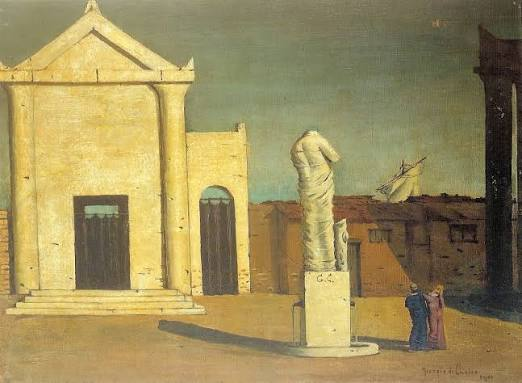
The Enigma of an Autumn Afternoon (L'énigme d'un après-midi d'automne, 1910)
Conceived in Florence's Piazza Santa Croce, this canvas marks the inaugural breakthrough of Pittura Metafisica. The central marble statue of Dante is stripped of historical identity, transformed into a blind classical monument silhouetted against an unyielding, pale sky. A high brick curtain wall slices through the plaza, behind which the mast of an invisible sailing vessel glides past—an impossible maritime intrusion that ruptures geographical logic. The painting establishes de Chirico's signature atmosphere: blinding Mediterranean clarity married to impenetrable silence.[1:4]
The Nostalgia of the Infinite (La nostalgie de l'infini, 1911–1913)
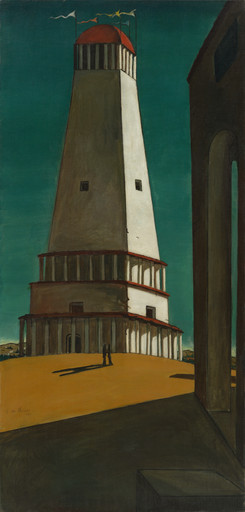
Dominated by an immense, square stone tower piercing a green-tinted sky, this canvas demonstrates de Chirico's mastery of the architectural sublime. Two miniscule, featureless silhouettes stand in the deep foreground shadow, dwarfed by the colossal, monolithic masonry. The exaggerated low-angle perspective, juxtaposed with the steep ramp and trembling porticoes, induces acute agoraphobic anxiety. The tower operates not as functional shelter, but as a monument to metaphysical estrangement and human finitude.[4:6]
The Song of Love (Le chant d'amour, 1914)
One of the most consequential canvases of modern art, The Song of Love features an oversized red surgical rubber glove nailed to a wooden partition alongside a classical plaster bust of the Apollo Belvedere and a green sphere. In the background, a dark railway train glides past behind a brick wall under an empty sky. By violently juxtaposing an ancient symbol of humanistic beauty with an industrial latex artifact, de Chirico executed the supreme visual manifestation of defamiliarization—the very painting that broke Magritte's heart and revealed to him that art could depict thought.[7:3]
The Disquieting Muses (Le muse inquietanti, 1916–1918)
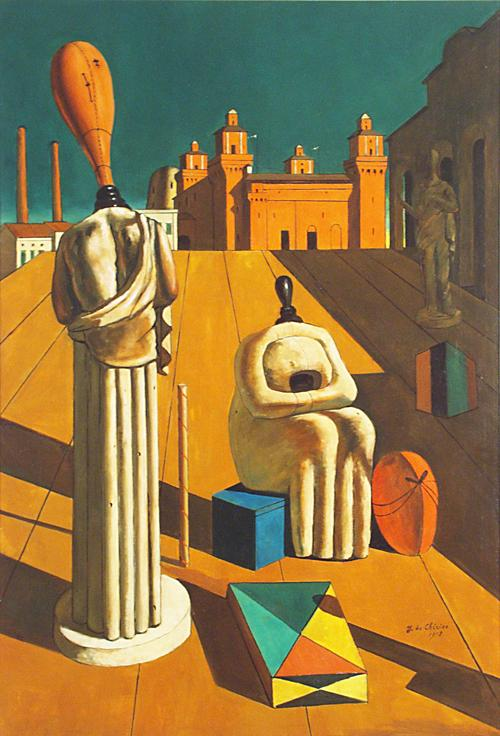
Painted during de Chirico's internment at the Ferrara neuropsychiatric hospital, this work synthesizes his metaphysical motifs. On a steeply tilted wooden stage overlooking the red-brick Castello Estense and a modern factory smokestack, two draped mannequins stand in silent vigil. One figure possesses the head of a smooth tailor's dummy; the other has had its head removed, resting at its feet like an African tribal mask. Surrounded by brightly colored geometric solids and drafting instruments, these mute muses stand as uncanny sentinels of mechanized modern existence.[2:5]
Masterpieces of René Magritte
The Treachery of Images (La Trahison des images, 1929)
Magritte's definitive semiotic manifesto depicts a meticulously rendered briar pipe hovering above cursive schoolbook script: "Ceci n'est pas une pipe" ("This is not a pipe"). The canvas generates instant cognitive friction by dividing a single concept into two warring sign systems (pictorial likeness vs. linguistic proposition). Magritte exposes the foundational error of human perception: confusing the representation with the thing represented. As Magritte remarked: "Could you stuff my pipe? No, it's just a representation, is it not? So if I had written on my picture 'This is a pipe,' I would have been lying!"[6:4]
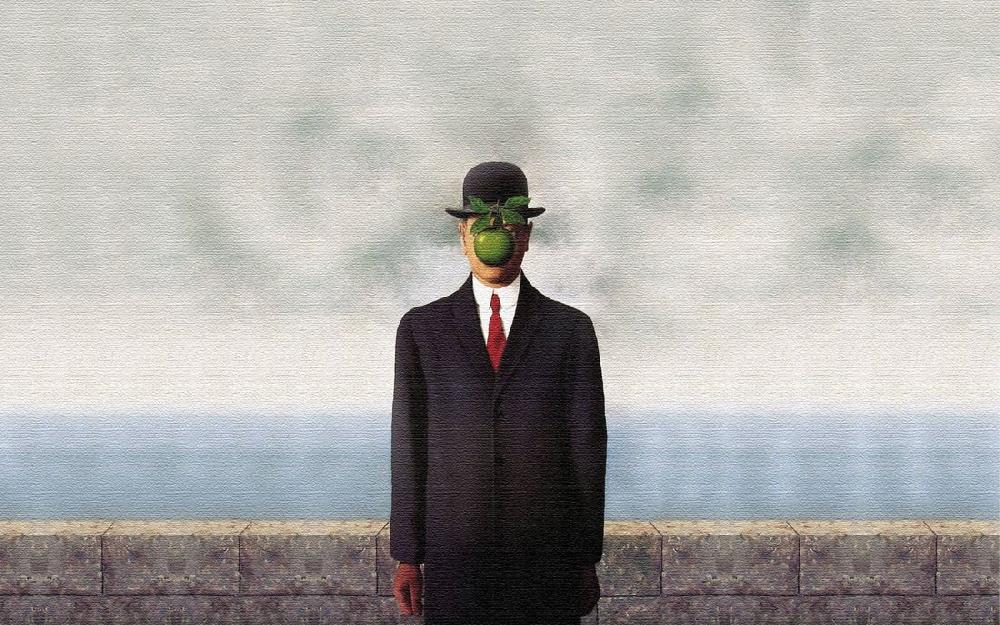
The Son of Man (Le Fils de l'homme, 1964)
Painted as a self-portrait late in his career, The Son of Man stands as a radical subversion of traditional portraiture and bourgeois identity. A stiffly posed man in a charcoal overcoat and bowler hat stands before a low sea wall and a cloud-swept sky. Directly in front of his face hovers a vibrant green apple, nearly concealing his features save for a single eye peering through the leaves. The portrait delivers all conventional social signifiers of identity, class, and respectability, only to deny the viewer the essential revelation of the human countenance.[9:2]
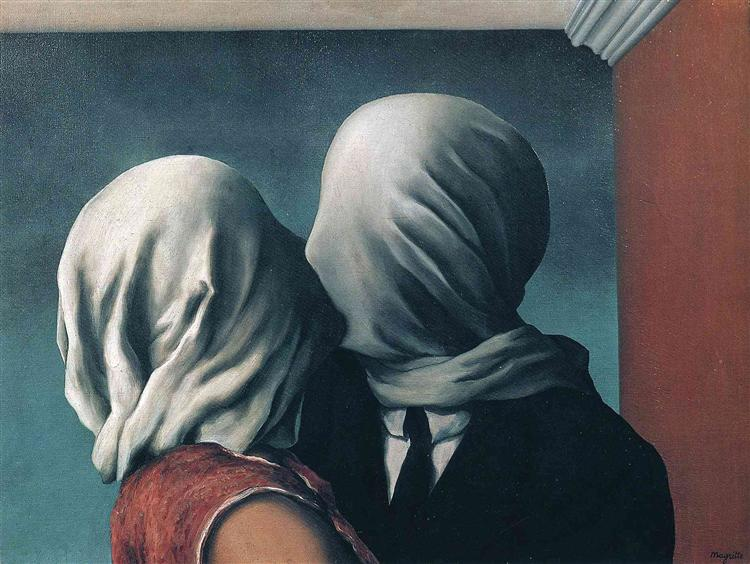
The Lovers (Les Amants, 1928)
Executed during Magritte's Parisian period, The Lovers portrays two figures locked in an embrace, their heads completely swathed in white fabric as they attempt to kiss through the barrier. Set against an ambiguous domestic wall, the canvas transforms an act of intimate communion into an experience of profound isolation, blindness, and sensory frustration.[7:4] The fabric visually externalizes the impossibility of absolute interpersonal communion: even in closest proximity, human beings remain separated by the opaque fabrics of ego, projection, and language.
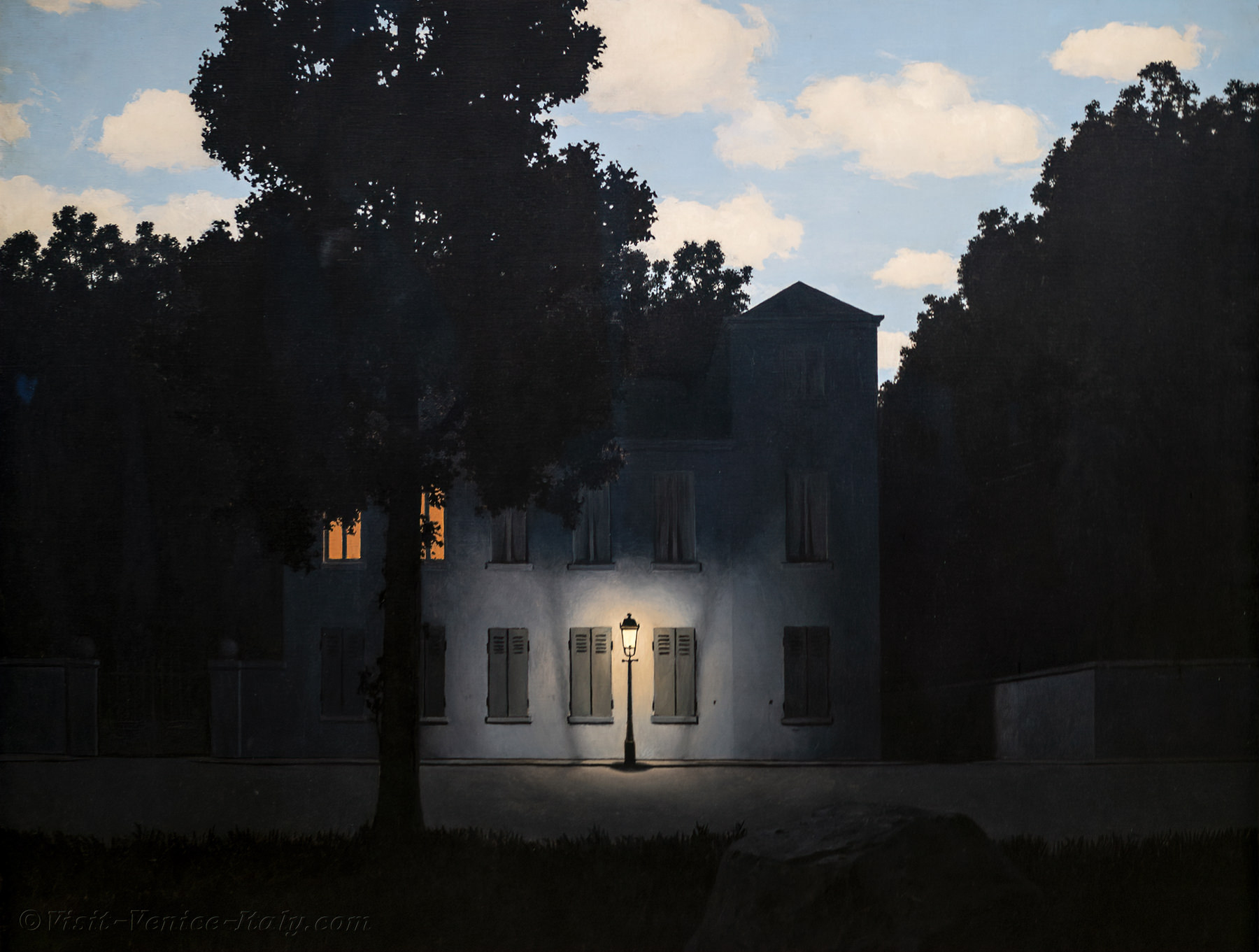
The Empire of Light Series (L'Empire des lumières, 1949–1964)
Across twenty-seven oil paintings and gouaches, Magritte executed this definitive exploration of temporal paradox. A tranquil, shadowy bourgeois street scene—enshrouded in deep nocturnal darkness and illuminated by a solitary glowing streetlamp—is crowned by an expansive, luminous daylight sky filled with soft white cumulus clouds.[8:2] By unifying two mutually exclusive temporal states (day and night) into a single, seamless, and optically unified composition, Magritte achieves visual poetry without resorting to physical distortion.
Comparative Analysis of Core Paintings
| Thematic Vector | Giorgio de Chirico (Pittura Metafisica) | René Magritte (Belgian Surrealism) | Comparative Dialectic |
|---|---|---|---|
| Architectural Threshold | The Nostalgia of the Infinite (Colossal stone tower, dwarfed figures, deep shadows) | The Human Condition (Easel aligned over open window, matching external view) | De Chirico spatializes existential insignificance; Magritte deconstructs painting as an illusion of an accessible external reality. |
| Object Juxtaposition | The Song of Love (Plaster Apollo bust + surgeon's rubber glove + train) | The Treachery of Images (Hyper-realistic pipe + "Ceci n'est pas une pipe") | De Chirico ruptures functional utility to reveal the enigma; Magritte ruptures the bond between language, image, and physical referent. |
| The Human Figure | The Disquieting Muses (Faceless wooden mannequins, tailor dummies, drafting tools) | The Son of Man (Bowler-hatted clerk obscured by hovering green apple) | De Chirico replaces human beings with mechanized, blind seers; Magritte preserves bourgeois conformity while obstructing identity. |
| Domestic Alienation | The Enigma of the Hour (Paralyzed clocks, empty arcades, solitary shadows) | The Lovers (Cloth-shrouded kissing figures, domestic molding, barred touch) | De Chirico turns the city into an unhomely tomb; Magritte exposes the intimate domestic sanctuary as a site of sensory estrangement. |
| Temporal Paradox | The Enigma of an Autumn Afternoon (Frozen late-afternoon raking light, stopped time) | The Empire of Light (Simultaneous nocturnal streetscape beneath brilliant daytime sky) | De Chirico petrifies duration into an eternal, ominous pause; Magritte fuses mutually exclusive temporal states into harmonious contradiction. |
5. Subverting the Institution of Art: Classicism, Replicas, and Mutinies
Both painters developed contentious, rebellious relationships with the avant-garde establishment—specifically André Breton's authoritarian Parisian Surrealist circle—and each launched deliberate assaults against the modernist art market and the bourgeois cult of "artistic authenticity."[2:6][6:5]
                             THE AVANT-GARDE REBELLION
                                        │
           ┌────────────────────────────┴────────────────────────────┐
           ▼                                                         ▼
GIORGIO DE CHIRICO                                        RENÉ MAGRITTE
• "Return to Craftsmanship" (1919)                        • Brussels Group vs. Paris Automatists (1927)
• Classical Old Master tempera/glazes                     • Bourgeois clerk camouflage (The Bowler Hat)
• Formal Excommunication by Breton (1928)                 • "Sunlit Surrealism" / Renoir Period (1943–47)
• Serial Self-Replicas & Backdating                       • The Provocative Période Vache (1948)
  └── Prefiguring Warhol & The Simulacrum                   └── Sabotaging Parisian cultural arrogance
Giorgio de Chirico: The "Return to Order" and Serial Self-Replication
Following World War I, de Chirico experienced a profound aesthetic revulsion against the avant-garde. In 1919, he published his polemical manifesto, "The Return of Craftsmanship" (Il ritorno al mestiere), in the journal Valori plastici.[11] De Chirico renounced modernism, abstraction, and the vanguard as technically bankrupt, calling for a return to Renaissance and Baroque studio techniques, meticulous draftsmanship, egg tempera, and oil glazes modeled after Raphael, Titian, and Courbet.[11:1]
The Parisian Surrealists viewed this classical turn as an unforgivable ideological betrayal. In 1928, Breton organized a vitriolic mock-retrospective titled Here Lies Giorgio de Chirico, exhibiting his early metaphysical canvases alongside funeral wreaths.[2:7]
In response, an embittered de Chirico launched an audacious counter-offensive against modernist dealers and collectors:[3:3]
- Serial Self-Replicas: Because the market valued only his 1910–1918 Metaphysical works while ignoring his contemporary classical output, de Chirico began painting dozens of exact replicas and thematic variations of his celebrated early canvases (The Disquieting Muses, Piazza d'Italia).[3:4]
- Deliberate Backdating: He systematically signed early dates (e.g., 1914 or 1916) onto canvases executed in the 1940s or 1950s, flooding the market with intentional anachronisms and sparking legendary legal battles with auction houses.[3:5]
- Postmodern Precursor: While mid-century critics dismissed this practice as cynical forgery or creative decline, Pop Artists and postmodern theorists re-evaluated de Chirico's serial multiplication. Andy Warhol celebrated de Chirico in a 1982 series ("He made the same painting over and over. I liked that"), recognizing that de Chirico had systematically deconstructed the Walter Benjaminian "aura" of the unique masterpiece, anticipating Jean Baudrillard's simulacrum—where the copy destabilizes the privileged status of the original.[3:6]
René Magritte: Bourgeois Camouflage and Stylistic Mutinies
Unlike the flamboyant Salvador Dalí or the bohemian boasters of Montparnasse, Magritte lived as a quiet, bowler-hatted bourgeois clerk in the Brussels suburb of Jette, painting in his dining room on a tidy easel without splashing pigment.[6:6] This was a calculated strategy of bourgeois camouflage: by dressing like an anonymous insurance clerk, Magritte operated as an ideological saboteur in plain sight.[6:7]
Furthermore, Magritte executed two radical, deliberate disruptions of his own signature style:
- The "Renoir Period" / "Sunlit Surrealism" (Surréalisme en plein soleil, 1943–1947): Living under brutal Nazi occupation in Brussels, surrounded by deportations, terror, and food rationing, Magritte refused to paint dark, grim apocalyptic allegories. Instead, he staged an aesthetic mutiny by adopting the luminous, impressionistic palette and feathery brushwork of Pierre-Auguste Renoir.[12] Magritte declared that during catastrophic misery, the artist's duty was not to mirror despair, but to radiate charm and joy as an act of psychological resistance.[12:1]
- The Période Vache ("Cow Period", May 1948): Invited to hold his first major post-war solo exhibition in Paris at the Galerie du Faubourg, Magritte sought revenge against French critics who had condescended to Belgian art for decades.[13] In under six weeks, he produced thirty deliberately crude, garish, and cartoonish paintings executed in a style reminiscent of grotesque comic strips and Fauvism.[13:1] Figures sprouted pipes from their foreheads and noses swelled into sausages. The Parisian public was profoundly scandalized; not a single canvas sold. Having detonated the pretentious pieties of the French art market, Magritte quietly returned to his polished, deadpan figurative style, having demonstrated that "style" is merely an arbitrary costume.[13:2]
6. Comparative Synthesis: De Chirico vs. Magritte
| Analytical Axis | Giorgio de Chirico (Pittura Metafisica) | René Magritte (Belgian Surrealism) |
|---|---|---|
| Historical Dates | 1888–1978 (Born in Volos, Greece; worked in Munich, Florence, Paris, Ferrara, Rome) | 1898–1967 (Born in Lessines, Belgium; worked in Brussels, Paris, Jette) |
| Philosophical Precursors | Schopenhauer, Nietzsche, Böcklin, Greek mythology, Renaissance treatises | Wittgenstein, Nougé, Foucault, semiotics, structural linguistics |
| Primary Arena of Action | Public space: Deserted Italian piazzas, classical colonnades, railway stations, towers | Domestic space: Bourgeois parlors, window easels, streetlamps, wallpapered bedrooms |
| Temporal Dynamic | Paralyzed, late-afternoon autumn stillness; frozen transit clocks; stopped duration | Simultaneous co-presence of contradictory states (day/night in Empire of Light) |
| Primary Figure | The articulated, stitched tailor's mannequin (Il Manichino); blind ancient statue | The bowler-hatted anonymous clerk (everyman); fabric-shrouded lovers |
| Linguistic Strategy | Classical, poetic titles (The Song of Love, The Melancholy of Departure) | Aggressive semiotic sabotage; contradictory captions (The Treachery of Images) |
| Role of the Uncanny (Das Unheimliche) | Architectural agoraphobia; the domestic envelope turned into an alienated ruin | Cognitive dissonance; the familiar domestic item revealed as an opaque enigma |
| Institutional Counter-Strategy | "The Return of Craftsmanship" (1919); serial self-replication; deliberate backdating | Subversive bourgeois camouflage; "Sunlit Surrealism"; the provocative Période Vache (1948) |
| Postmodern Legacy | Deconstruction of artistic "aura" and originality; precursor to Warhol and simulation | Deconstruction of mimesis and language; precursor to Conceptual Art and post-structuralism |
🎴 Interactive Web Practice (Comprehension Check)
Question 1 (Philosophical Foundations & The Revelation of Thought): How did Giorgio de Chirico's synthesis of Arthur Schopenhauer and Friedrich Nietzsche establish the framework of Pittura Metafisica, and what did René Magritte mean when he claimed that viewing de Chirico's The Song of Love allowed his eyes to "see thought for the first time"?
Answer: Giorgio de Chirico synthesized Arthur Schopenhauer's aesthetic doctrine—that aesthetic contemplation requires severing an object from the principle of sufficient reason and utilitarian chains to reveal its uncanny thing-in-itself (Ding an sich)—with Friedrich Nietzsche's revelation of the world as a profound enigma (Rätsel). From Nietzsche's ecstatic encounters with the melancholy, late-afternoon light and classical architecture of Turin, de Chirico derived the insight that modern cities harbor an ancient, non-human dread.
When René Magritte encountered a reproduction of de Chirico's The Song of Love (1914) around 1922–1923, it shattered his previous commitments to Cubist and Futurist formalism. De Chirico’s violent pairing of a classical plaster bust of Apollo with a red rubber surgical glove and a railway train demonstrated to Magritte that painting’s primary calling was neither optical sensation (Impressionism) nor formal dexterity, but an epistemological inquiry into the mystery of existence. For Magritte, "seeing thought" meant that visual art could bypass emotional sentimentality and technical display to construct pure, poetic, and philosophical propositions through the contextual displacement of objects.
Question 2 (Spatial Vertigo vs. Semiotic Sabotage): Contrast the specific compositional and formal mechanisms through which de Chirico produces the architectural uncanny with the semiotic strategies Magritte deploys to deconstruct naive realism.
Answer: De Chirico and Magritte defamiliarize reality through distinct formal and conceptual vectors:
- De Chirico's Spatial Vertigo (The Architectural Uncanny): De Chirico operates through the manipulation of perspective, light, and geometry. He systematically distorts Renaissance single-point perspective by forcing multiple conflicting vanishing points and steeply tilted ground planes into a single composition, inducing vestibular disorientation and agoraphobic dread. He bathes desolate piazzas in the raking amber light of late afternoon, projecting unnaturally long, ominous shadows from invisible entities beyond the frame, while frozen station clocks paralyze temporal progression. Finally, he populates these spaces with faceless, articulated wooden mannequins, externalizing modern industrial alienation and activating the uncanny threshold between animate life and mechanical automaton.
- Magritte's Semiotic Sabotage (Deconstructing Mimesis): Magritte operates not by warping physical geometry, but through flat, deadpan, and illustrative realism. Utilizing dépaysement (contextual displacement), he extracts ordinary, mass-produced items (bowler hats, pipes, apples, combs, easels) from functional domestic contexts and places them into impossible, contradictory, or scale-warped arrangements. Furthermore, in works like The Treachery of Images and Words and Images, Magritte dismantles the traditional equivalence between resemblance and affirmation, inserting propositional cursive script beneath hyper-realistic images to expose the unbridgeable ontological void between the material referent, the mental signified, and the pictorial signifier.
Question 3 (Foucault's Archaeological Critique): How does Michel Foucault's analysis in Ceci n'est pas une pipe dismantle the two foundational axioms of Western painting since the Renaissance, and what is the function of the "unraveled calligram"?
Answer: In Ceci n'est pas une pipe (1973), Michel Foucault demonstrates that Western painting since the Renaissance rested upon two unspoken, axiomatic principles:
- The Subordination of Text to Image (or vice versa): Language and plastic representation were strictly separated; either the image illustrated the text, or the text named and explained the image.
- The Equivalence of Resemblance and Affirmation: If an image visually resembled an object, it was tacitly assumed to affirm: "This is that object."
Question 4 (Institutional Mutinies: Serial Replicas and the Période Vache): How did de Chirico's serial replication of his Metaphysical canvases and Magritte's Période Vache function as ideological critiques of the modern art market and avant-garde orthodoxy?
Answer: Both painters mounted radical, deliberate revolts against the modernist art market and the authoritarian Parisian Surrealist circle led by André Breton:
- De Chirico's Serial Replicas & Simulation: After publishing "The Return of Craftsmanship" in 1919 and being formally excommunicated by Breton in 1928, de Chirico turned the modernist market against itself. Resenting dealers and collectors who valued only his early Metaphysical period (1910–1918) while ignoring his classical output, de Chirico painted dozens of exact replicas and thematic variations of his celebrated masterpieces, deliberately backdating them to the 1910s. While critics condemned this as cynical commercial forgery, artists like Andy Warhol and postmodern theorists recognized it as a radical deconstruction of the Walter Benjaminian "aura" and the cult of the unique original, anticipating Jean Baudrillard's concept of the hyperreal simulacrum.
- Magritte's Période Vache (1948): Invited to hold his first post-war solo exhibition in Paris, Magritte launched an aggressive strike against the condescension of French cultural elites toward Belgian artists. In six weeks, he produced thirty violently crude, garish, and cartoonish works executed in a grotesque comic-strip and Fauvist style, featuring vulgar caricatures and neon colors. The exhibition thoroughly scandalized Parisian critics and collectors. Having exposed and mocked the commercial pretension and narrow dogmatism of the Parisian vanguard, Magritte immediately returned to his polished, deadpan figurative style, proving that stylistic branding is merely an arbitrary costume.
Resonant Notes
The following notes in the vault share direct thematic, philosophical, and aesthetic connections with Giorgio de Chirico and René Magritte:
🔴 The Uncanny, Spatial Dread & Architectural Alienation
- Theories of the Uncanny (Freud & Vidler) — The vault's foundational masterwork on the uncanny; Anthony Vidler's architectural analysis of the modern unhomely (unheimlich) provides the spatial theory directly visualized in de Chirico's deserted arcades, while Sigmund Freud's return of the repressed illuminates Magritte's contextual displacement of ordinary domestic artifacts.
- On the Psychology of the Uncanny (Zur Psychologie des Unheimlichen) — Ernst Jentsch's 1906 thesis locating the uncanny in intellectual uncertainty regarding whether an entity is animate or inanimate perfectly explains the psychological dread provoked by de Chirico's faceless mannequins and Magritte's petrified human figures.
- The Uncanny Valley (不気味の谷現象) — Masahiro Mori's cybernetic hypothesis detailing the acute emotional recoil triggered by near-human artificial entities provides the modern cognitive framework for de Chirico's articulated drafting dummies and Magritte's faceless everymen.
- Louis Sass - Phenomenological Psychopathology and the Self — Sass's analysis of schizophrenic Trema and the "truth-taking stare"—a state of hyperreflexivity where ordinary objects lose their tacit, functional background and loom with menacing, unnamable significance—mirrors the hyper-articulated stillness of both painters.
- Edgar Allan Poe (1809-1849) & Franz Kafka (1883-1924) — Literary counterparts of spatial paranoia and bureaucratic estrangement. Poe's externalized architectural psyches and Kafka's opaque, labyrinthine spaces provide the narrative equivalent of de Chirico's claustrophobic piazzas and Magritte's bowler-hatted clerks.
- Cognitive Dissonance — Magritte's visual paradoxes systematically induce cognitive dissonance by forcing the brain to simultaneously hold contradictory perceptions (e.g., daytime sky and nighttime street in The Empire of Light).
- The Interface Theory of Perception (ITP) — Donald Hoffman's cognitive model demonstrates that human perception is an evolved desktop interface rather than a veridical window onto objective reality, validating Magritte's philosophical insistence that our visual representations must never be mistaken for external truth.
🟡 Philosophy of the Enigma, Representation & Semiotics
- Michel Foucault — Author of Ceci n'est pas une pipe (1973); Foucault provides the preeminent post-structuralist treatise on Magritte, dissecting how the painter collapsed Renaissance mimesis, unraveled the calligram, and separated resemblance from affirmation.
- Friedrich Nietzsche (1844-1900) & Friedrich Nietzsche — Nietzsche's philosophy of the world as an impenetrable enigma and his aesthetic reveling in the architectural melancholy of Turin formed the philosophical bedrock for de Chirico's Pittura Metafisica.
- Schopenhauerian Pessimism — Arthur Schopenhauer's aesthetic theory posited that genius requires isolating an object from causal utility into pure representation, directly inspiring de Chirico's extraction of mundane objects from functional life.
- Jacques Lacan — Magritte's The Treachery of Images visually enacts Lacan's radical bar of repression between signifier and signified (
), while Not to Be Reproduced subverts the Lacanian mirror stage by barring the subject from self-recognition. - Defining a Simulacrum — Jean Baudrillard's hyperreality and the precession of simulacra illuminate de Chirico's late serial self-replication and Magritte's semiotic fissures, where copies circulate without reference to an underlying, authentic original.
- Henri Bergson — Bergson's distinction between spatialized clock-time and lived duration (durée) illuminates de Chirico's frozen station clocks and petrified Mediterranean shadows.
- The Sublime & Theories of the Sublime (Longinus, Burke & Kant) — De Chirico transposes the natural sublime into an architectural and metaphysical sublime, where towering stone monuments and immense urban voids evoke existential awe and human insignificance.
- Ludwig Wittgenstein — Wittgenstein's critique of language-games and meaning-as-use confirms Magritte's semiotic propositions in Words and Images, demonstrating that words possess no inherent metaphysical bond to the objects they designate.
🟢 Avant-Garde Disruption, Modernism & Institutional Critique
- The Avant-Garde — Explores the historical evolution of modern vanguard movements; de Chirico's pre-war canvases catalyzed visual Surrealism, while his later classical turn and Magritte's Période Vache staged radical rebellions against avant-garde dogma.
- Theories of the Avant-Garde (Poggioli & Bürger) — Peter Bürger's institutional critique illuminates how Breton's circle attempted to canonize Surrealism as an institutional movement, and how de Chirico's serial replicas and Magritte's commercial parodies sabotaged the museum apparatus.
- Guillaume Apollinaire (1880–1918) — Apollinaire was de Chirico's earliest Parisian champion, coining the term "surrealism" and defending metaphysical painting, while his calligrams served as the historical foil for Magritte's semiotic subversions.
- The Dehumanization of Art — José Ortega y Gasset's 1925 thesis on modern art methodically purging sentimental, human-centered realism in favor of pure, detached aesthetic structures is epitomized by de Chirico's mannequins and Magritte's deadpan figurative clarity.
- The Work of Art in the Age of Mechanical Reproduction & Walter Benjamin (1892–1940) — Benjamin's analysis of the liquidation of the traditional artistic "aura" illuminates de Chirico's late-career serial multiplication and Magritte's commercial graphic precision, both of which embraced mechanical reproducibility over romantic originality.
- Paul Klee (1879–1940) — Contemporary modernist whose enigmatic visual runes and metaphysical investigations of reality beneath physical appearance parallel de Chirico's and Magritte's painted philosophy.
- The flâneur & The Painter of Modern Life, a seminal 1863 essay by French poet and art critic Charles Baudelaire — Baudelaire's modern stroller is inverted by both painters: de Chirico's flâneur drifts through cities completely evacuated of human life, while Magritte's flâneur is camouflaged as the anonymous, bowler-hatted bourgeois everyman.
References
Museum of Modern Art (MoMA) / Giorgio de Chirico / moma.org ↩︎ ↩︎ ↩︎ ↩︎ ↩︎
Tate / Metaphysical Art / tate.org.uk ↩︎ ↩︎ ↩︎ ↩︎ ↩︎ ↩︎ ↩︎ ↩︎
Estorick Collection / Giorgio de Chirico / estorickcollection.com ↩︎ ↩︎ ↩︎ ↩︎ ↩︎ ↩︎ ↩︎
James Thrall Soby / Giorgio de Chirico / The Museum of Modern Art, New York (1955) / moma.org ↩︎ ↩︎ ↩︎ ↩︎ ↩︎ ↩︎ ↩︎
Museum of Modern Art (MoMA) / René Magritte Biography / moma.org ↩︎
David Sylvester / Magritte: The Silence of the World / Harry N. Abrams (1992) / abramsbooks.com ↩︎ ↩︎ ↩︎ ↩︎ ↩︎ ↩︎ ↩︎ ↩︎
James Thrall Soby / René Magritte / The Museum of Modern Art, New York (1965) / moma.org ↩︎ ↩︎ ↩︎ ↩︎ ↩︎
Anne Umland / Magritte: The Mystery of the Ordinary, 1926–1938 / The Museum of Modern Art, New York (2013) / moma.org ↩︎ ↩︎ ↩︎
Harry Torczyner / Magritte: Ideas and Images / Harry N. Abrams (1977) / abramsbooks.com ↩︎ ↩︎ ↩︎
Michel Foucault / This Is Not a Pipe (Ceci n'est pas une pipe) / Translated by James Harkness / University of California Press (1983) / ucpress.edu ↩︎ ↩︎ ↩︎ ↩︎ ↩︎ ↩︎ ↩︎
Giorgio de Chirico / Il ritorno al mestiere (The Return of Craftsmanship) / Valori plastici, Vol. 1, No. 11–12 (1919) ↩︎ ↩︎
Sarah Whitfield / Magritte / The South Bank Centre / Hayward Gallery (1992) / southbankcentre.co.uk ↩︎ ↩︎
Marcel Paquet / René Magritte: Thought Rendered Visible / Taschen (2000) / taschen.com ↩︎ ↩︎ ↩︎