Dutch Disease and the Resource Curse
🗂️ Interactive Notebook: Open Study Companion (Video Summary, Flashcards, Mind Map) ↗
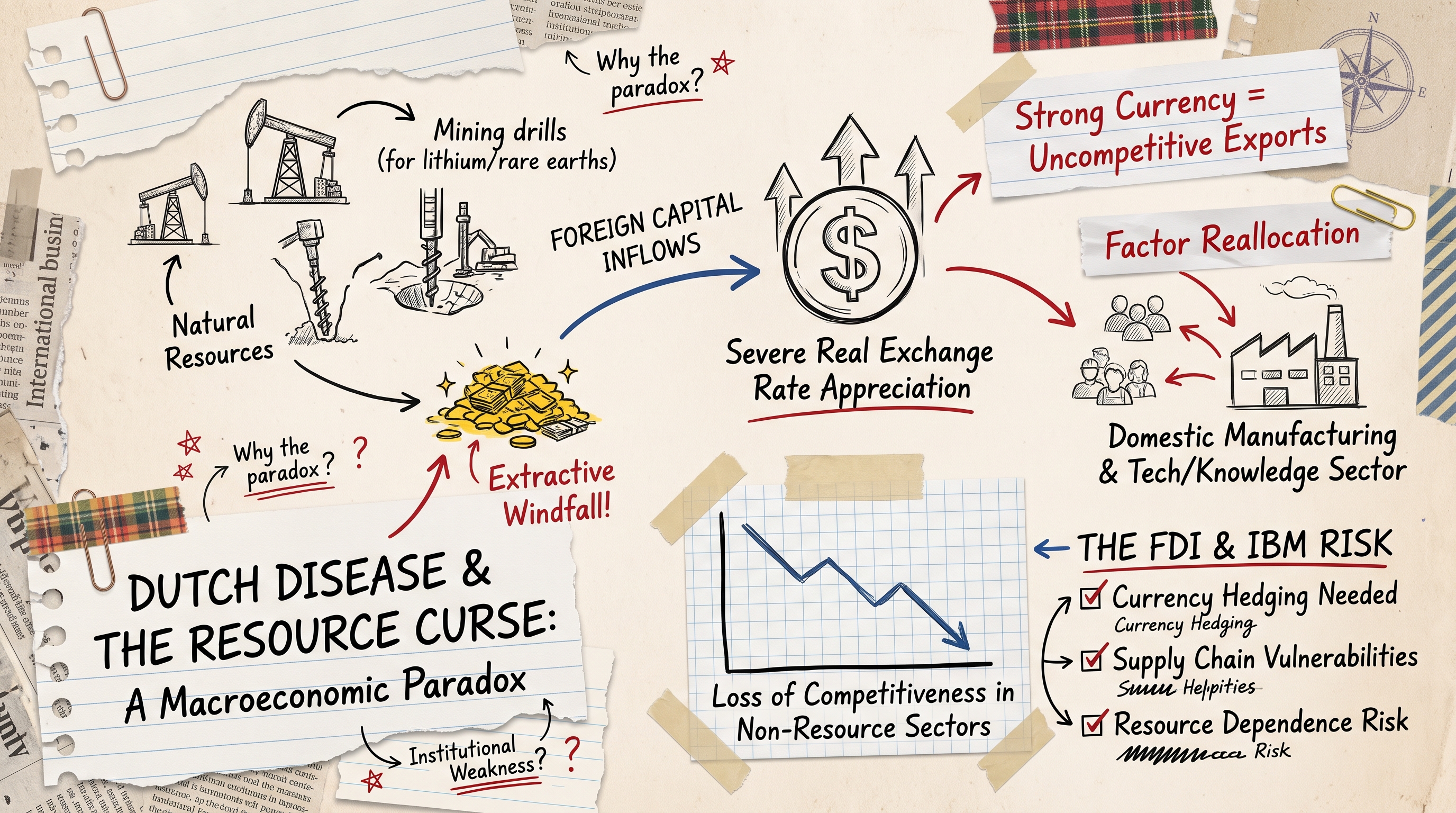
Dutch Disease and the broader Resource Curse describe the macroeconomic and institutional paradox in which an extractive windfall—such as crude oil, natural gas, lithium, or rare earth elements—triggers massive foreign capital inflows and severe real exchange rate appreciation. Rather than catalyzing broad-based prosperity, currency appreciation and factor reallocation starve domestic manufacturing and knowledge-intensive export sectors of competitiveness. For international business management (IBM) executives, understanding these mechanisms is indispensable for evaluating foreign direct investment (FDI) risk, designing resilient global supply chains, and executing long-horizon currency hedging strategies (examined in IBM - International Financial Management).
Theoretical Heritage and Intellectual Lineage
The conceptual evolution from narrow currency-induced de-industrialization to systemic developmental failure spans four decades of macroeconomic and political economy scholarship.
Origins of "Dutch Disease" (1959–1977)
In 1959, the Netherlands discovered the massive Slochteren natural gas field in the province of Groningen. Rapid exploitation transformed the Dutch economy into a major net energy exporter, generating unprecedented current account surpluses and foreign currency inflows. Paradoxically, rather than lifting all domestic industries, the windfall coincided with stagnant capital investment, declining manufacturing output, and rising structural unemployment throughout the 1970s.
In its November 26, 1977 issue, The Economist coined the term "Dutch Disease" to diagnose this contradiction of "external health and internal ailment."[1] As booming gas exports drove up the value of the Dutch guilder, non-gas tradable goods became prohibitively expensive on international markets, hollowing out the nation's industrial base.[2]
Neoclassical Formalization: The Corden-Neary Model (1982)
While The Economist identified the empirical symptoms, economists W. Max Corden and J. Peter Neary established the foundational neoclassical analytical framework in 1982.[3] Their core general equilibrium model divides a small open economy into three distinct sectors:
- The Booming Tradable Sector: Extractive commodities (hydrocarbons, minerals, critical metals) whose prices are determined exogenously on global markets.
- The Lagging Tradable Sector: Traditional manufacturing, high-tech exports, and industrial agriculture, which also face fixed international prices and cannot pass domestic cost increases onto foreign buyers (paralleling factor allocation dynamics analyzed in Baumol's Cost Disease).
- The Non-Tradable Sector: Domestic services, construction, real estate, and retail trade, whose prices clear domestically based on local supply and demand.[2:1]
Expansion into the "Resource Curse" (1993–1995)
By the early 1990s, development economists observed that Dutch Disease was merely one macroeconomic transmission channel within a wider developmental trap. In 1993, economic geographer Richard Auty formally introduced the "Resource Curse" thesis, demonstrating that mineral-rich developing nations systematically underperformed resource-poor peers in GDP growth and industrial diversification.[4]
In 1995, Jeffrey Sachs and Andrew Warner provided the seminal econometric validation of Auty's thesis.[5] Analyzing cross-country growth regressions between 1970 and 1989, Sachs and Warner proved a robust, statistically significant inverse relationship between natural resource export intensity and long-term economic growth—even after controlling for geography, trade openness, and initial income levels.[5:1] Their endogenous growth framework highlighted a vital dynamic cost: manufacturing generates positive "learning-by-doing" externalities and human capital spillovers, whereas enclave extractive sectors do not.[2:2]
Core Macroeconomic Mechanisms
When a resource windfall—or an analogous surge in foreign aid, sovereign borrowing, or sector-specific FDI—hits an economy, structural distortion operates through two primary channels identified by Corden and Neary, compounded by exchange rate dynamics.[2:3]
1. The Resource Movement Effect (Direct De-industrialization)
As commodity prices spike or major reserves come online, the marginal product of labor and capital in the booming extractive sector surges. Extractive firms offer substantial wage premiums to attract skilled engineers, technicians, logistics operators, and financial capital away from both the lagging manufacturing sector and the non-tradable service sector.
- Wage Distortion: Domestic manufacturers, acting as price-takers in global markets, cannot raise output prices to match extractive-sector wages without destroying operating margins.[3:1]
- Enclave Caveat: Because modern hydrocarbon and hard-rock mineral extraction are highly capital-intensive rather than labor-intensive, direct labor migration into mining is often modest; nevertheless, localized bottlenecks in specialized engineering, construction, and transport infrastructure remain severe.[1:1]
2. The Spending Effect (Indirect De-industrialization)
In practice, the spending effect exerts far greater macroeconomic force than the resource movement effect.[1:2] Surging resource royalties, corporate tax receipts, and windfall profits dramatically expand national income and public fiscal expenditure. As households and governments spend this newfound wealth domestically, demand rises across both tradable and non-tradable goods.
- Excess demand for tradable goods is satisfied via cheaper imports without altering world prices.
- Excess demand for non-tradable goods (commercial real estate, infrastructure, healthcare, hospitality) encounters inelastic domestic supply, driving up non-tradable prices (
) relative to fixed tradable prices ( ). - Rising profitability in services pulls remaining labor and capital out of manufacturing and into the domestic service economy, tipping the scales of national factor allocation and triggering indirect de-industrialization.[3:2]
3. Real Exchange Rate Appreciation
Regardless of a nation's monetary regime, the spending effect forces an appreciation of the Real Exchange Rate (
- Under Floating Exchange Rates: Massive conversions of foreign petrodollars or mineral export receipts into local currency bid up the nominal exchange rate (
rises).[2:4] Domestic manufactured exports immediately become overvalued abroad, while foreign imports flood the domestic market. - Under Fixed/Pegged Exchange Rates: To defend the currency peg, the central bank absorbs incoming foreign exchange reserves and expands the domestic money supply (unless fully sterilized). Unsterilized monetary expansion fuels domestic inflation (
rises), producing the exact same real exchange rate appreciation and eroding export competitiveness via domestic cost inflation.[2:5]
Commodity supercycles are inherently transitory, yet industrial destruction exhibits hysteresis (path dependence). When commodity prices inevitably crash and the currency depreciates, bankrupted manufacturing plants, dismantled supplier networks, and emigrated R&D talent do not automatically regenerate—leaving non-resource export capacity on life support. The economy is left structurally hollowed out and exposed to severe balance-of-payments crises (explored in IBM - Global Market Dynamics and Transaction Cost Economics).[5:2]
Political Economy and Institutional Dimensions
Whereas Dutch Disease explains price and factor distortions, the broader Resource Curse incorporates institutional and political pathologies that amplify volatility into systemic state failure (complementing insights in Institutional Voids and The CAGE Distance Framework):[6]
- The Rentier State Dynamic: When sovereign treasuries derive the bulk of their revenue from external resource rents rather than broad-based domestic taxation, the fiscal social contract between state and citizenry fractures. Freed from accountability to taxpayers, governments face diminished pressure to maintain transparent courts, property rights, or regulatory efficiency, while utilizing patronage and security spending to entrench incumbents (in stark contrast to rational-legal bureaucracy in Max Weber (1864-1920)).[6:1]
- Rent-Seeking and Voracity Effects: Point-source resources (deepwater oil, kimberlite diamond pipes, lithium salars) create concentrated pools of economic rent. Rather than investing entrepreneurial talent into Schumpeterian innovation or value-added manufacturing, domestic elites compete for extraction licenses, state subsidies, and tariff protection—diverting societal capital into unproductive lobbying.
- Pro-Cyclical Fiscal Traps: During commodity booms, governments frequently fall into the trap of using inflated resource revenues as collateral to borrow heavily on international sovereign debt markets, funding rigid public wage bills and white-elephant infrastructure projects that are fundamentally built on sand. When spot prices collapse, credit markets freeze simultaneously with falling tax receipts, causing fiscal budgets that resemble a house of cards to trigger sovereign defaults, capital controls, or sudden asset expropriations.[6:2]
Comparative Empirical Archetypes
Institutional quality prior to resource discovery largely determines whether an extractive boom degrades into a curse or serves as a managed developmental asset.[6:3]
| Jurisdiction | Primary Windfall Sector | Institutional & Policy Response | Macroeconomic & Industrial Outcome |
|---|---|---|---|
| Norway | North Sea Oil & Gas | Strict offshore sterilization via Sovereign Wealth Fund (GPFG) and statutory fiscal spending cap (Handlingsregelen).[7] | Preserved maritime, engineering, and knowledge-intensive export competitiveness; avoided severe krone overvaluation. |
| Netherlands (1960s–70s) | Groningen Natural Gas | Initial windfall channeled into expanded social welfare transfers and public wages rather than offshore sterilization. | Guilder appreciation, manufacturing contraction, and structural unemployment prior to 1982 Wassenaar wage-restraint reforms.[1:3] |
| Chile | Copper & Brine Lithium | Counter-cyclical Structural Balance Rule, offshore stabilization funds (ESSF), and independent central banking.[8] | Mitigated acute exchange rate volatility, though downstream industrial diversification beyond primary processing remains an active policy challenge.[8:1] |
| Venezuela / Nigeria | Crude Oil | Pro-cyclical fiscal expansion, dual/pegged exchange rate distortions, patronage, and import-substitution subsidies. | Near-total collapse of non-oil agriculture and manufacturing; acute vulnerability to oil price shocks and hyperinflationary spirals. |
As global decarbonization accelerates demand for lithium, cobalt, nickel, copper, and rare earth elements, a new wave of Dutch Disease pressures confronts resource-endowed emerging markets.[8:2] Producer states are increasingly rejecting pure raw-ore export models in favor of resource nationalism—deploying export bans on unprocessed ore (e.g., Indonesian nickel) and local-content refining mandates to force downstream value-chain capture within domestic borders (examined in The CAGE Distance Framework and Institutional Voids).[4:1]
Strategic Implications for International Business Management (IBM)
For multinational enterprises (MNEs), corporate strategists, and institutional investors, Dutch Disease dynamics alter the competitive calculus across market entry, global footprint design, and corporate treasury management.
1. Foreign Direct Investment (FDI) & Market Entry Screening
MNEs must disaggregate FDI strategy by sector exposure when evaluating resource-booming host countries (analyzed in IBM - Global Market Entry):
- Export-Platform FDI Vulnerability: Establishing low-cost manufacturing or IT/business-process outsourcing hubs in an economy entering a resource boom is perilous. Rapid real currency appreciation and upward wage contagion from extractive and construction booms can erase labor-cost arbitrage within three to five years, turning an export hub unprofitable.
- Market-Seeking Non-Tradable Opportunity: Conversely, the spending effect creates lucrative tailwinds for market-seeking FDI in non-tradable or import-competing consumer segments—such as luxury retail, private healthcare, urban commercial real estate, telecommunications, and civil engineering—provided the MNE creates exit flexibility ahead of commodity downturns.
- Obsolescing Bargain Risk: Extractive and infrastructure investors face heightened geopolitical hazard at the peak of commodity price cycles. Host governments flush with windfall confidence possess maximum leverage to renegotiate concession contracts, hike royalty rates, or mandate joint-venture equity transfers, placing foreign capital directly in the crosshairs of state expropriation (a classic asset-specificity hold-up analyzed in Transaction Cost Economics and IBM - International Business Law).
2. Global Supply Chain Architecture & Reshoring Strategy
- Supplier Fragility in Lagging Sectors: Tier-2 and Tier-3 industrial component suppliers domiciled in commodity-dependent nations suffer chronic margin compression during booms (due to strong local currencies and high labor/utility costs) and working-capital starvation during busts (when sovereign credit ratings downgrade). Procurement officers must map sub-tier exposure to petro-currencies and mineral-linked economies, utilizing China+1, nearshoring, or reshoring into diversified industrial ecosystems to insulate production schedules (examined in IBM - International Business Strategy).
- Downstream Processing Bottlenecks: In critical mineral supply chains (EV batteries, permanent magnets, grid storage), MNEs can no longer rely solely on arm's-length commodity off-take agreements. Navigating export restrictions requires co-investing in midstream refining and precursor facilities alongside state-owned enterprises while managing local infrastructure deficits in power and water.[8:3]
3. Corporate Treasury & Currency Hedging Frameworks
- Commodity-Linked FX Exposure: Currencies of resource-intensive economies—often termed commodity currencies (ranging from liquid majors like the AUD, CAD, and NOK to emerging currencies like the CLP, BRL, COP, and KZT)—exhibit strong positive beta to global terms-of-trade shocks.
- Natural Hedging vs. Financial Derivatives:
- An MNE exporting manufactured goods from a resource-booming nation incurs costs in an appreciating local currency while earning USD or EUR revenues—creating a severe operating exposure squeeze. Treasury teams should structure natural hedges by denominating debt service, imported intermediate inputs, and executive compensation in foreign currencies, supplemented by long-dated FX forwards or cross-currency swaps (explored in IBM - International Financial Management).
- Conversely, MNEs selling imported goods into a booming commodity economy enjoy inflated hard-currency margins during the boom, but face repatriation traps (FX rationing, capital controls, or sudden 30–50% maxi-devaluations) when commodity prices revert. Proactive dividend sweeping, leading-and-lagging intercompany payables, and commodity-linked put options (e.g., hedging host-country FX exposure via correlated crude oil or copper derivatives when local FX forward markets are illiquid) are vital defensive tools.
Policy Mitigation Benchmarks: Evaluating Sovereign Resilience
Before committing long-term immobile capital to a resource-rich jurisdiction, IBM executives should audit whether the host state deploys proven macroeconomic sterilization instruments:
- Offshore Sovereign Wealth Funds (SWFs): Modeled on Norway's Government Pension Fund Global (GPFG), investing all state resource revenues strictly in foreign equities, fixed income, and real estate prevents foreign currency from being converted into domestic currency, directly neutralizing nominal appreciation.[7:1]
- Structural Fiscal Rules: Norway's Handlingsregelen caps annual budget transfers from the SWF at the fund's expected long-term real rate of return (historically 3%), decoupling annual public spending from volatile spot oil prices and ensuring fiscal authorities draw the line against pro-cyclical political budget expansion.[7:2]
- Counter-Cyclical Stabilization Buffers & Productivity Reinvestment: Channeling permitted fiscal withdrawals exclusively into supply-side productivity enhancers—public R&D, port/grid logistics, and STEM education—lowers unit production costs in the lagging manufacturing sector, offsetting residual real exchange rate pressure.[2:6]
Natural resource wealth is neither an automatic developmental engine nor an inevitable macroeconomic sentence; rather, it acts as an institutional magnifier.[6:4] For multinational firms, tracking a host nation's non-resource fiscal balance, real effective exchange rate trajectory, and SWF governance provides an early-warning radar for industrial competitiveness and geopolitical stability.
🎴 Interactive Web Practice (Comprehension Check)
Question 1 (The Corden-Neary Model & Direct vs. Indirect De-industrialization): How do the Resource Movement Effect and the Spending Effect interact to hollow out domestic manufacturing, and why does real exchange rate appreciation occur regardless of whether a country maintains a floating or pegged currency regime?
Answer: In the Corden-Neary (1982) model, de-industrialization occurs across two distinct channels:
- The Resource Movement Effect (Direct De-industrialization): The resource boom raises the marginal product of labor and capital in the extractive sector, bidding up domestic wages and drawing skilled technical and engineering talent away from manufacturing. Because manufacturers are price-takers on world markets, they cannot pass higher labor costs onto global buyers without losing competitiveness.
- The Spending Effect (Indirect De-industrialization): Extractive royalties and export revenues dramatically expand domestic aggregate demand. While tradable goods can be imported at fixed world prices, excess demand for non-tradables (services, construction, real estate) encounters inelastic local supply, driving up the relative price of non-tradable goods ($P_N$). High service margins pull the remaining capital and labor out of manufacturing.
Question 2 (The Rentier State & The Obsolescing Bargain): Why does the Resource Curse produce institutional degradation in developing nations, and how does the concept of the "obsolescing bargain" create acute hold-up risk for foreign multinational investors?
Answer: The Resource Curse extends beyond price mechanisms into institutional pathology:
- The Rentier State Dynamic: When a sovereign government generates the vast majority of fiscal revenue from external resource rents rather than broad-based domestic income and corporate taxation, the democratic accountability link between state and citizenry breaks down. Rulers are insulated from public scrutiny, underinvest in independent commercial courts and regulatory transparency, and rely on clientelism, patronage networks, and security spending to entrench incumbency. Elites abandon Schumpeterian productive innovation to engage in destructive rent-seeking over extraction licenses and subsidies.
- The Obsolescing Bargain (Hold-Up Hazard): Drawing on Raymond Vernon's obsolescing bargain model and Transaction Cost Economics (Williamson), foreign investors in mining and energy possess substantial bargaining power ex ante when the host government requires exploration capital and proprietary technology. However, once billions of dollars in non-redeployable capital expenditure (high site and physical asset specificity) are sunk into the ground, bargaining power shifts decisively to the host state. At the peak of commodity price cycles, host governments frequently face populist pressure to renegotiate contracts, escalate royalty tax rates, impose export quotas, or unilaterally expropriate assets, holding up the foreign multinational.
Question 3 (Strategic IBM Responses & Sovereign Sterilization Benchmarks): How should multinational enterprises structure foreign direct investment (FDI) and corporate treasury operations in resource-booming economies, and what institutional criteria indicate that a host nation is effectively mitigating Dutch Disease?
Answer: Multinational corporations and institutional investors manage Dutch Disease through targeted strategic screening and treasury engineering:
- Disaggregating FDI Modes: MNEs should avoid or hedge export-platform manufacturing in resource-booming nations, as real currency appreciation and wage contagion rapidly eliminate labor arbitrage advantages. Conversely, MNEs can capitalize on the spending effect by pursuing market-seeking FDI in non-tradable sectors (e.g., healthcare, premium retail, telecommunications, commercial infrastructure), while maintaining liquid balance sheets and flexible exit strategies before the commodity supercycle peaks.
- Corporate Treasury Structuring: Firms exporting from resource nations must implement natural hedges by denominating operating debt, input purchases, and capital expenditures in foreign currencies (USD/EUR) to match sales revenues. Firms operating domestically in commodity economies should utilize proactive dividend sweeping and leading-and-lagging intercompany payments to prevent capital from being trapped by sudden currency devaluations or capital controls during commodity busts.
- Evaluating Sovereign Sterilization Benchmarks: Before making long-horizon capital commitments, executives must audit whether the sovereign host maintains: (a) an Offshore Sovereign Wealth Fund that invests 100% of extractive revenues abroad to neutralize nominal currency appreciation (modeled on Norway's GPFG); (b) a Structural Fiscal Rule (e.g., Chile's Structural Balance Rule or Norway's Handlingsregelen) that caps annual budget spending to expected long-term returns; and (c) counter-cyclical reinvestment of fiscal withdrawals into public infrastructure, STEM education, and logistics that lower unit production costs in the lagging manufacturing sector.
Resonant Notes
The following notes in the vault share direct thematic, sociological, and strategic connections with Dutch Disease and the Resource Curse:
🔴 International Business Strategy, Governance & Market Entry
- The CAGE Distance Framework — Pankaj Ghemawat's diagnostic evaluates how administrative distance and resource nationalism create unilateral barriers, highlighting natural resource extraction as an acute trigger of state protectionism and host-government intervention.
- Institutional Voids — Demonstrates how resource-rich emerging economies (petrostates) frequently lack specialized market intermediaries, transparent courts, and regulatory institutions despite high headline GDP per capita.
- Transaction Cost Economics — Ronald Coase and Oliver Williamson's framework of asset specificity and opportunism explains the obsolescing bargain in mining and energy concessions, where sunk site-specific investments leave multinational enterprises vulnerable to host-state hold-up.
- IBM - Global Market Entry — Operationalizes foreign direct investment (FDI) decisions in commodity-dependent economies, distinguishing vulnerable export-platform manufacturing from lucrative domestic market-seeking ventures.
- IBM - International Financial Management — Examines real exchange rate volatility, terms-of-trade shocks, commodity currency betas, and corporate treasury hedging instruments (natural hedges, cross-currency swaps).
- IBM - International Business Law — Analyzes the legal frameworks governing sovereign concession contracts, stabilization clauses, bilateral investment treaties (BITs), and international arbitration against resource nationalism.
- IBM - International Business Strategy — Details how multinational enterprises construct resilient global value chains and diversify supplier footprints to buffer against host-country factor cost shocks.
- IBM - Global Market Dynamics — Explores macroeconomic imbalances, terms-of-trade volatility, balance-of-payments crises, and commodity supercycles that drive Dutch Disease across emerging markets.
🟡 Macroeconomic Dynamics, State Capacity & Institutional Economics
- Baumol's Cost Disease — Offers a direct structural parallel to Dutch Disease, modeling how productivity-driven wage increases in a booming sector propagate across lagging sectors, driving up non-tradable unit costs.
- Agglomeration Theory — Explains how resource windfalls distort spatial and industrial clustering, drawing engineering and logistical capital away from innovation hubs into isolated extractive enclaves.
- Max Weber (1864-1920) — Weber's distinction between formal rational-legal bureaucracy and patrimonial authority illuminates the rentier state, where sovereign resource rents entrench patronage networks and erode bureaucratic calculability.
- Karl Marx - Economic and Philosophic Manuscripts of 1844 — Situates extractive enclave economies within critical political economy, analyzing the alienation of raw material extraction divorced from holistic human development.
- Shareholder Primacy (Milton Friedman) — Connects corporate resource extraction incentives with institutional governance debates over whether state-owned resource windfalls belong to broad citizen stakeholders or ruling elites.
🟢 Metaphoric Cognitive Models & Strategic Discriminations
- built-on-sand — Illustrates how public spending booms, sovereign borrowing surges, and unhedged corporate expansion predicated on peak commodity prices are fundamentally built on sand, bound to collapse when terms of trade turn.
- fall-into-a-trap — Captures the recurring macroeconomic vulnerability where sovereign governments fall into the trap of pro-cyclical fiscal expansion and unsustainable public debt during windfall booms.
- on-life-support — Metaphorically diagnoses the precarious state of non-resource manufacturing and trade-exposed agriculture, which are left on life support by acute currency overvaluation.
- tip-the-scales — Conceptualizes how an extractive windfall abruptly tips the scales of domestic factor prices, drawing labor and capital away from diversified industrial production.
- in-the-crosshairs — Frames the geopolitical and operational exposure of foreign multinational concessions, placed directly in the crosshairs of host-government resource nationalism during commodity peaks.
- a-house-of-cards — Embodies the structural fragility of rentier economies whose fiscal budgets, civil service payrolls, and sovereign debt ratings resemble a house of cards during commodity downturns.
- draw-the-line — Represents the critical sovereign policy discipline where fiscal authorities must draw the line between domestic budget spending and offshore capital sterilization.
- throw-a-wrench-in-the-works — Captures how sudden terms-of-trade shocks and currency devaluations throw a wrench in the works of corporate planning and global supply chain logistics.
References
The Economist / The Dutch Disease (November 26, 1977, pp. 82–83) / Wikipedia Overview & Archival Citation ↩︎ ↩︎ ↩︎ ↩︎
Christine Ebrahimzadeh / Dutch Disease: Wealth Managed Unwisely (Finance & Development) / imf.org ↩︎ ↩︎ ↩︎ ↩︎ ↩︎ ↩︎ ↩︎
W. Max Corden & J. Peter Neary / Booming Sector and De-Industrialisation in a Small Open Economy (The Economic Journal, 1982) / ResearchGate Summary ↩︎ ↩︎ ↩︎
Richard M. Auty / Sustaining Development in Mineral Economies: The Resource Curse Thesis (Routledge, 1993) / Google Books ↩︎ ↩︎
Jeffrey D. Sachs & Andrew M. Warner / Natural Resource Abundance and Economic Growth (NBER Working Paper No. 5398, 1995) / nber.org ↩︎ ↩︎ ↩︎
Jeffrey A. Frankel / The Natural Resource Curse: A Survey of Diagnoses and Some Prescriptions (Harvard Kennedy School Working Paper No. 233) / hks.harvard.edu ↩︎ ↩︎ ↩︎ ↩︎ ↩︎
Norwegian Ministry of Finance / The Norwegian Fiscal Policy Framework & Government Pension Fund Global / regjeringen.no ↩︎ ↩︎ ↩︎
UNCTAD / Critical Minerals, Critical Decisions: Industrial Policy for the Energy Transition / unctad.org ↩︎ ↩︎ ↩︎ ↩︎