The CAGE Distance Framework
🗂️ Interactive Notebook: Open Study Companion (Video Summary, Flashcards, Mind Map) ↗
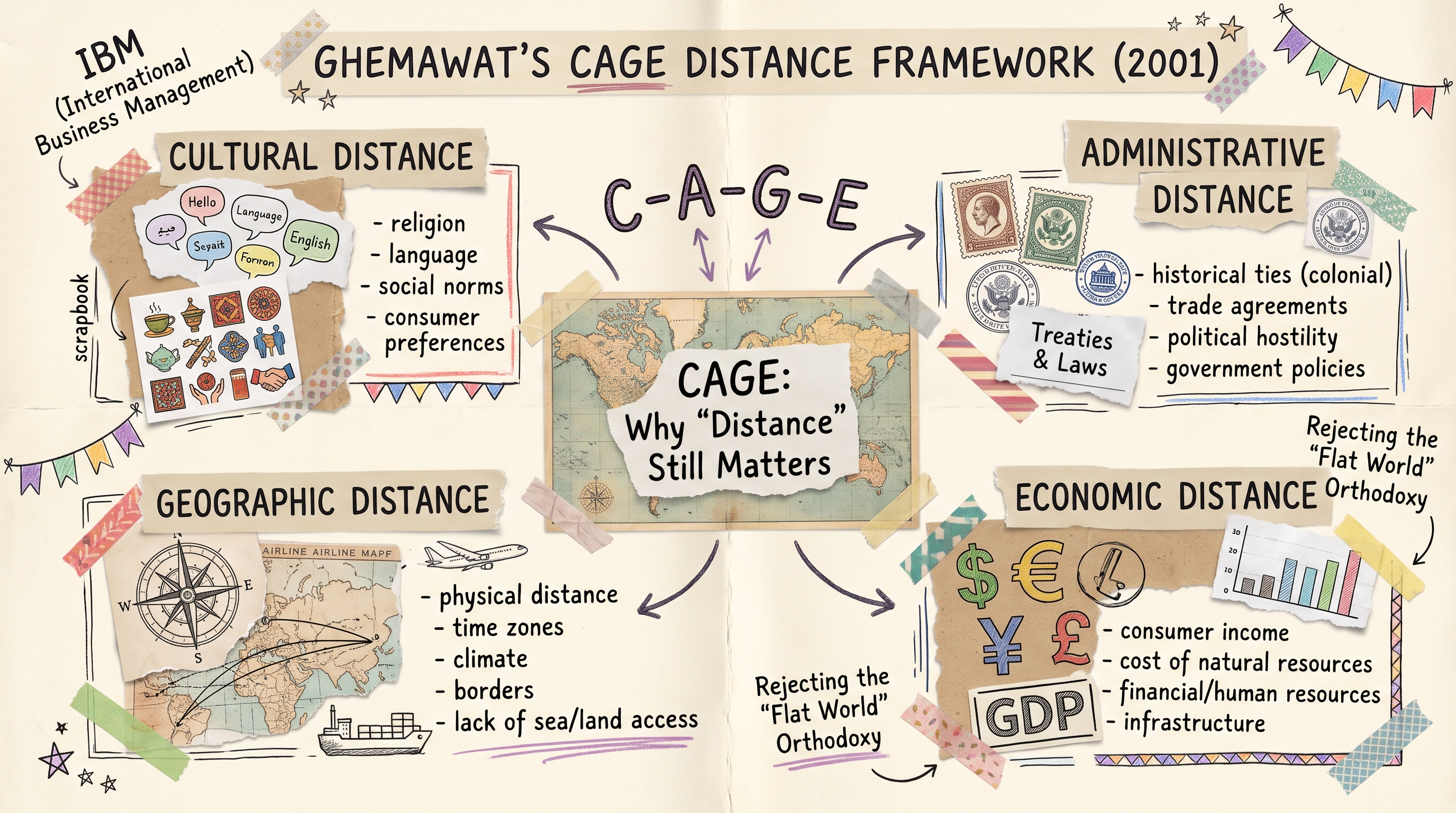
Ghemawat's CAGE Distance Framework (introduced in 2001) provides an analytical diagnostic for international business management (IBM) that systematically evaluates cross-border market entry risks.[1] Rejecting the "Flat World" orthodoxy of frictionless globalization, Pankaj Ghemawat demonstrates that international expansion failures rarely stem from physical separation alone; rather, they result from four distinct, compounding dimensions of bilateral and unilateral friction: Cultural, Administrative, Geographic, and Economic distance.[1:1]
Theoretical Heritage & The "Semiglobalized" Reality
Introduced by Harvard Business School professor Pankaj Ghemawat in his seminal September 2001 Harvard Business Review article, Distance Still Matters: The Hard Reality of Global Expansion, the CAGE framework emerged as an empirical corrective to late-20th-century globalization euphoria.[1:2] Throughout the 1990s and early 2000s, popular business literature—later epitomized by Thomas Friedman's 2005 thesis The World Is Flat—posited that telecommunications, fiber-optic networks, and digital workflows had effectively erased national borders and leveled the global competitive playing field.[2]
Ghemawat directly dismantled this assumption by introducing the concept of semiglobalization, arguing that most economic activity—including foreign direct investment (FDI), trade flows, capital markets, and human communication—remains overwhelmingly localized rather than borderless.[3] Prior to CAGE, corporate strategists relied heavily on Country Portfolio Analysis (CPA), a market-selection methodology focused almost exclusively on aggregate macroeconomic indicators such as national Gross Domestic Product (GDP), per capita consumer wealth, and propensity to consume (examined in IBM - Global Market Dynamics and IBM - Global Market Entry).[1:3] Because CPA emphasizes top-line revenue potential while ignoring the structural costs and institutional risks of cross-border operations, firms routinely fall into the trap of market-size myopia—overestimating the attractiveness of massive foreign markets while fatally underestimating the friction required to penetrate them.[1:4]
Ghemawat anchored the CAGE framework in econometric gravity models of trade, which hold that bilateral trade is positively correlated with economic mass (GDP) and negatively correlated with distance.[1:5] Citing empirical data from economists Jeffrey Frankel and Andrew Rose, Ghemawat highlighted how non-geographic distance attributes drastically reshape cross-border trade volumes:[1:6]
- Physical Distance: Countries 5,000 miles apart conduct only 20% of the bilateral trade predicted if those same nations were 1,000 miles apart (a 1% increase in physical distance reduces trade by 1.1%).[1:7]
- Colonial Heritage: A historical colony-colonizer link boosts bilateral trade by 900% (a tenfold increase) compared to nations lacking historical ties.[1:8]
- Monetary & Trade Unions: Sharing a sovereign currency increases bilateral trade by 340%, while shared membership in a regional trading bloc increases trade by 330%.[1:9]
- Linguistic & Border Ties: Sharing a common official language increases trade by 200%, while sharing a physical land border increases trade by 80%.[1:10]
The Four Dimensions of Distance
The CAGE framework disaggregates cross-border friction into four distinct dimensions. Each dimension encompasses both bilateral attributes (differences measured between a specific home-country and target-country pair) and unilateral attributes (internal institutional or structural characteristics of an individual nation that impede all foreign entrants).[3:1]
1. Cultural Distance
Cultural distance measures differences in social norms, unwritten societal rules, belief systems, and interpersonal communication patterns that govern how individuals interact and how consumers perceive value.[1:11] Unlike statutory regulations, cultural attributes are tacit, deeply embedded, and slow to change, making them difficult for outsiders to audit prior to market entry (explored in IBM - International Marketing and The Provenance Paradox):[1:12]
- Linguistic Friction: Differences in spoken and written languages directly affect products with high linguistic content (such as software, publishing, and media broadcasting) while elevating internal transaction costs in cross-border management.[1:13]
- Communication Context (High-Context vs. Low-Context): Drawing on anthropologist Edward T. Hall's intercultural communication model, friction intensifies when firms cross between low-context cultures (such as the United States, Germany, and Scandinavia—where meaning is explicit, literal, and codified in legal contracts) and high-context cultures (such as Japan, China, and Arab nations—where communication relies heavily on implicit non-verbal cues, social hierarchy, and long-term interpersonal trust).[4]
- Religious Norms & Social Taboos: Divergent religious doctrines dictate dietary restrictions (such as Halal or Kosher standards in food retail), acceptable advertising imagery, gender roles, financial structures (such as Islamic banking prohibitions on interest), and workweek schedules.[1:14]
- Ethnic Networks & Insularity: The presence or absence of connective diaspora networks shapes bilateral trust, consumer receptivity toward foreign brands, and local partner reliability.[3:2]
High-Sensitivity Industries: Media and entertainment, food and beverages, consumer apparel, personal care, and products tied to cultural or national identity.[1:15]
2. Administrative & Political Distance
Administrative (or political) distance encompasses formal legal, historical, institutional, and regulatory differences between sovereign states (analyzed in IBM - International Business Law).[1:16] Ghemawat identified unilateral government policies—both in the target market and occasionally in the home market (such as U.S. Foreign Corrupt Practices Act restrictions)—as the most pervasive barriers to cross-border competition:[1:17]
- Historical & Colonial Ties: Shared legal origins (such as British common law vs. Napoleonic civil code) and historical administrative links drastically lower institutional unfamiliarity.[1:18] Conversely, active geopolitical hostility can reduce trade to virtually zero even when cultural and geographic proximity are high (for example, bilateral trade between India and Pakistan).[1:19]
- Trade Treaties & Regional Blocs: Preferential trade agreements (such as the European Union or USMCA) dismantle tariffs, quotas, and customs friction, whereas non-member entrants face protectionist barriers, local-content mandates, and foreign direct investment (FDI) equity caps.[1:20]
- Sovereign Currency Stability & Capital Controls: Divergent monetary regimes introduce foreign exchange volatility, profit repatriation restrictions, and inflation risk (examined in IBM - International Financial Management).[1:21]
- Institutional Infrastructure & Corruption Indices: Weak property rights, arbitrary judicial enforcement, intellectual property piracy, and high sovereign corruption indices impose severe operational hazards on multinational enterprises (MNEs).[1:22]
According to Ghemawat, target governments are most likely to erect unilateral administrative barriers when a domestic industry meets one or more political sensitivity criteria:[1:23]
- Large Employers: Sectors representing massive domestic voting blocs (such as European or Japanese agriculture).[1:24]
- National Champions: Industries viewed as symbols of national modernity, prestige, or security (such as aerospace, semiconductors, and telecommunications).[1:25]
- Everyday Staples & Entitlements: Sectors providing essential daily goods (food staples, fuel, electricity) or services viewed as basic human rights (healthcare), prompting state price controls and strict quality mandates.[1:26]
- Natural Resource Extraction: Oil, gas, and mining assets perceived as sovereign national heritage, where foreign multinationals face acute risks of expropriation or resource nationalism.[1:27]
3. Geographic Distance
Geographic distance extends well beyond radial miles or kilometers between national capitals; it captures physical, topographical, and infrastructural barriers that impede the movement of physical goods, personnel, and real-time information (connected to spatial economics in Agglomeration Theory):[1:28]
- Physical Separation & Land Borders: Greater spatial separation directly inflates maritime, rail, and air freight costs while increasing inventory transit times.[1:29]
- Topography & Landlockedness: Mountain ranges, non-navigable river systems, and lack of sovereign ocean ports severely penalize bulk trade; according to Frankel and Rose's gravity data, direct ocean access alone boosts trade by 50%.[1:30]
- Time Zones & Climate: Wide longitudinal separation across time zones degrades synchronous managerial coordination, real-time customer support, and distributed R&D workflows.[3:3] Harsh climates and distinct disease environments further complicate physical asset durability and expatriate deployment.[3:4]
- Logistics & Communications Bottlenecks: Weak domestic transportation networks (potholed highways, incompatible rail gauges, congested port terminals) and fragile telecommunications or power grids create severe last-mile distribution bottlenecks inside the host country.[3:5]
High-Sensitivity Industries: Bulk commodities with low value-to-weight ratios (cement, steel, chemicals), fragile or perishable goods (fresh produce, dairy), and services requiring simultaneous physical presence or real-time coordination (local retail banking, operational consulting).[1:31]
4. Economic Distance
Economic distance reflects disparities in consumer wealth, macroeconomic stability, factor costs, and commercial ecosystem sophistication between home and host countries.[1:32] Unlike cultural or administrative distance—where similarity almost always favors trade—economic distance can either obstruct standardized business models or create lucrative arbitrage opportunities across global value chains (analyzed in Transaction Cost Economics):[3:6]
- Per Capita Income & Purchasing Power Parity (PPP): Vast disparities in GDP per capita and PPP alter consumer price elasticity, package-size preferences, and willingness to pay for premium product features.[1:33] Companies whose competitive advantage relies on economies of experience and standardized operational replication struggle when entering markets with radically different income profiles (see Bottom of the Pyramid and Reverse Innovation).[1:34]
- Factor Cost Profiles: Variations in the cost and quality of labor, natural resources, energy, and capital determine whether a firm should replicate its home-country value chain or unbundle labor-intensive stages offshore.[3:7]
- Supplier Network & Distribution Sophistication: Emerging markets frequently lack specialized Tier-2/Tier-3 component suppliers, cold-chain logistics, modern big-box retail channels, and consumer credit penetration, forcing foreign entrants to either internalize supply chains or overhaul their operating models.[3:8]
High-Sensitivity Industries: Luxury goods, household appliances, automotive manufacturing, big-box discount retail (where business models rely on high-volume inventory turnover and supplier integration), and labor-intensive manufacturing.[1:35]
Comparative Matrix of CAGE Dimensions
| Dimension | Key Bilateral Attributes (Country Pairs) | Key Unilateral Attributes (Host Country) | Most Vulnerable Industries & Products |
|---|---|---|---|
| Cultural | Different languages; divergent religions; high- vs. low-context communication; lack of ethnic/diaspora networks. | Social insularity; traditionalism; rigid class or caste hierarchies. | Television/media; publishing; food and beverages; culturally embedded consumer goods. |
| Administrative | Absence of colonial ties; non-overlapping trade blocs; different currencies; geopolitical hostility. | Tariffs and FDI caps; weak rule of law; corruption; non-convertible currency; state-owned monopolies. | Healthcare/pharmaceuticals; energy and mining; telecommunications; defense; agriculture; banking. |
| Geographic | Physical mileage; absence of shared land border; wide time-zone gaps; divergent climates. | Landlocked geography; rugged topography; port congestion; poor internal transport and digital infrastructure. | Cement, steel, and bulk chemicals; perishable foods; fragile goods; synchronous professional services. |
| Economic | Wide gaps in per capita income and PPP; asymmetric labor, capital, and resource costs. | Small aggregate GDP; fragmented retail distribution; shallow supplier networks; low credit availability. | Discount mass retail; luxury brands; automobiles; consumer electronics; labor-intensive assembly. |
Empirical Case Applications in International Business
Ghemawat and subsequent international business scholars illustrate the diagnostic power of CAGE through prominent corporate expansions where ignoring multidimensional distance destroyed shareholder value—and where respecting it unlocked disciplined growth.
Star TV in Asia (Market-Size Myopia)
Launched in 1991 and acquired by Rupert Murdoch's News Corporation, Star TV aimed to broadcast standardized English-language satellite television programming across Asia, dazzled by the region's massive population and rapid GDP growth.[1:36] Relying on naive Country Portfolio Analysis, management assumed Asian audiences were "media-starved" and would readily consume Western programming.[1:37]
- CAGE Failure: Star TV ignored Cultural Distance (television carries extreme linguistic and cultural specificity; Indian and Chinese audiences strongly preferred local-language content) and Administrative Distance (target governments tightly regulated foreign ownership of broadcast media to prevent cultural imperialism and protect state broadcasters).[1:38] Star TV suffered roughly $500 million in cumulative losses during the 1990s before heavily investing in localized language programming and regional joint ventures.[1:39]
Tricon Global Restaurants (Disciplined Portfolio Rationalization)
In the late 1990s, Tricon Restaurants International (TRI)—the parent company of KFC, Pizza Hut, and Taco Bell—faced severe debt-service obligations and limited cash flow while operating thinly across dozens of international markets.[1:40]
- CAGE Application: Under international president Pete Bassi, TRI re-evaluated its global portfolio through the lens of distance rather than raw population size.[1:41] Whereas pure GDP/population rankings favored massive distant emerging markets, accounting for Geographic and Administrative Distance (specifically NAFTA trade integration and proximity to Dallas headquarters) dramatically elevated Mexico's strategic value, turning a middle-tier market on paper into one of TRI's top global priorities for capital allocation.[1:42]
Walmart's Asymmetric Global Footprint
Walmart's international expansion demonstrates how an operational model reliant on standardized supply-chain replication responds to CAGE friction.[5] In Mexico and Canada—markets characterized by shared borders (low Geographic Distance) and NAFTA/USMCA integration (low Administrative Distance)—Walmart successfully adapted pricing for Mexico's lower PPP (Economic Distance) and achieved market dominance.[5:1] Conversely, in high-distance markets, Walmart encountered severe headwinds: in Japan, high Cultural and Economic Distance (consumer preference for daily fresh small-lot shopping and deeply entrenched multi-tier keiretsu wholesale networks) stymied its everyday-low-price big-box model, while in India, high Administrative Distance (strict FDI prohibitions on multi-brand foreign retail) forced Walmart to enter strictly via a cash-and-carry wholesale joint venture before later pivoting to e-commerce acquisition (contrasted with the localized adaptation principles in Glocalization).[5:2]
Strategic Integration: Linking CAGE to the AAA Triangle
In his 2007 book Redefining Global Strategy: Crossing Borders in a World Where Differences Still Matter, Ghemawat connected the diagnostic CAGE Framework with a prescriptive strategic response toolkit known as the AAA Triangle (detailed in IBM - International Business Strategy):[3:9]
Once managers map the specific CAGE distances affecting their industry, they must optimize across three distinct strategic mechanisms:[3:10]
- Adaptation (Adjusting to Differences): Modifying products, branding, governance, or business models to reduce Cultural and Administrative friction—for example, localizing media content, tailoring food formulations, or forming local joint ventures to satisfy regulatory mandates (as examined in Glocalization and IBM - International Marketing).[3:11]
- Aggregation (Overcoming Differences): Utilizing regional hubs, shared platforms, and standardized product architectures to achieve economies of scale across countries grouped by low Geographic or Administrative distance (such as pan-European or North American regionalization).[3:12]
- Arbitrage (Exploiting Differences): Turning Economic or Administrative distance into a source of competitive advantage rather than a liability—for example, offshoring software engineering to India to capture skilled labor-cost differentials, or situating capital-raising entities in jurisdictions with favorable tax and legal regimes.[3:13]
"Companies routinely overestimate the attractiveness of foreign markets. They become so dazzled by the sheer size of untapped markets that they lose sight of the vast difficulties of pioneering new, often very different territories." — Pankaj Ghemawat, Distance Still Matters (2001)[1:43]
🎴 Interactive Web Practice (Comprehension Check)
Question 1 (Country Portfolio Analysis vs. CAGE & Gravity Models): Why does traditional Country Portfolio Analysis (CPA) lead multinational enterprises into "market-size myopia," and how do econometric gravity models correct this distortion?
Answer: Traditional Country Portfolio Analysis (CPA) evaluates foreign market opportunities primarily through macroeconomic indicators like Gross Domestic Product (GDP), per capita income, and demographic population size. This produces market-size myopia because it treats market potential as a pure function of aggregate consumer volume while ignoring the multidimensional frictions and institutional costs required to access those consumers.
- Econometric gravity models of trade—empirically pioneered by Jeffrey Frankel and Andrew Rose and integrated by Pankaj Ghemawat into CAGE—demonstrate that cross-border trade flows are not borderless. Bilateral commerce declines precipitously with physical distance (a 1% increase in distance reduces trade by 1.1%), while non-geographic alignment (such as shared currency, bilateral trade treaties, common language, or colonial heritage) multiplies trade volumes by between 80% and 900%. Consequently, a physically closer or institutionally aligned market of modest size often yields far higher risk-adjusted returns than a massive but distant and institutionally alien market.
Question 2 (Disaggregating CAGE Dimensions & Industry Sensitivity): How do bilateral attributes differ from unilateral attributes across the CAGE dimensions, and why are certain industries disproportionately vulnerable to administrative and cultural distance?
Answer: In the CAGE framework:
- Bilateral Attributes: Measure the relative difference or historical relationship between a specific home-country and host-country pair (e.g., shared language, historical colonial ties, common currency, or physical border adjacency).
- Unilateral Attributes: Reflect domestic structural characteristics of the host country that affect all foreign entrants equally, regardless of origin (e.g., landlocked topography, general sovereign corruption, port infrastructure bottlenecks, or closed retail monopolies).
Question 3 (Strategic Execution & The AAA Triangle): How does Ghemawat's AAA Triangle (Adaptation, Aggregation, Arbitrage) translate CAGE diagnostic findings into actionable international business strategies?
Answer: While CAGE diagnoses cross-border friction, the AAA Triangle prescribes how multinational corporations should respond strategically:
- Adaptation: Focuses on boosting local responsiveness and revenue by tailoring products, marketing, and organizational models to bridge Cultural and Administrative distances (e.g., altering food ingredients for religious dietary standards or forming local joint ventures to comply with foreign investment mandates).
- Aggregation: Focuses on realizing global economies of scale by grouping regional operations across countries with low Geographic or Administrative distance, using regional platforms, standardized modular product architectures, and centralized hubs (e.g., pan-European distribution centers).
- Arbitrage: Focuses on exploiting cross-border disparities—turning Economic and Administrative distances from barriers into profit engines by unbundling value chains to locate specific operations where factor costs (labor, capital, materials) or regulatory regimes are most advantageous (e.g., business process outsourcing to India or manufacturing in Southeast Asia).
Resonant Notes
The following notes in the vault share direct thematic, sociological, and strategic connections with The CAGE Distance Framework:
🔴 International Business Strategy, Governance & Market Entry
- IBM - Global Market Entry — Operationalizes CAGE diagnostics into practical entry mode selection, evaluating when high cross-border distance necessitates joint ventures, licensing, or wholly owned foreign direct investment (FDI).
- IBM - International Business Strategy — Details the Integration-Responsiveness grid and Ghemawat's AAA Triangle (Adaptation, Aggregation, Arbitrage), illustrating how multinational corporations balance global scale with localized distance adaptation.
- IBM - International Marketing — Examines the marketing challenges of Cultural and Economic distance, detailing product adaptation, brand positioning, and localized communication across high-context versus low-context societies.
- IBM - International Business Law — Explores the formal institutional and regulatory barriers that compose Administrative Distance, including bilateral investment treaties, cross-border arbitration, and foreign ownership caps.
- IBM - Global Market Dynamics — Analyzes the macro-environmental forces and multilateral trade institutions that shape cross-border business environments and unilateral distance attributes.
- Transaction Cost Economics — Williamson and Coase provide the organizational economics foundation for CAGE, demonstrating how cross-border transaction costs and asset specificity prevent pure open-market contracting in foreign expansion.
- Competitive Strategy — Michael Porter's industry structure and generic strategies framework provides the foundational strategy toolkit that CAGE adapts for cross-border geographic and institutional environments.
🟡 Global Macroeconomics, Innovation & Market Topography
- Glocalization — Analyzes the operational strategy of central product design paired with local cultural customization, illustrating the practical mechanics of Ghemawat's Adaptation mechanism.
- Reverse Innovation — Explores how high Economic Distance compels multinational enterprises to abandon Western product modifications and develop clean-sheet innovations in emerging markets that later flow back to developed economies.
- Bottom of the Pyramid — C.K. Prahalad's framework for serving the world's poorest consumers demonstrates how bridging massive Economic Distance requires radically overhauled business models and price-performance metrics.
- The Provenance Paradox — Investigates how Cultural and Administrative distance biases consumer perceptions against goods originating from developing nations, forcing foreign entrants to deploy provenance-management strategies.
- Agglomeration Theory — Bridges Geographic Distance with economic geography, explaining why firms cluster in localized industrial ecosystems and why spatial concentration persists despite digital connectivity.
- Every Business Is a Software Business - Core Frameworks and Enterprise Transformation — Examines how digital platforms, cloud architecture, and modular APIs attempt to compress Geographic Distance while encountering deep Administrative and Cultural roadblocks.
🟢 Metaphoric Cognitive Models & Strategic Discriminations
- frictionless — Conceptualizes the baseline illusion of Thomas Friedman's "Flat World" hypothesis, which Ghemawat refutes by proving that international borders and institutional frictions persist in a semiglobalized economy.
- level-the-playing-field — Embodies the late-1990s globalization myth that technological networks had universally equalized global competition across sovereign boundaries.
- fall-into-a-trap — Captures the recurring executive failure of Country Portfolio Analysis, where corporate strategists fall into the trap of market-size myopia by conflating raw demographic scale with operational viability.
- built-on-sand — Illustrates the structural vulnerability of foreign market expansions that ignore non-geographic distance dimensions, demonstrating how standardized business models transplanted into alien cultural or administrative soils are built on sand.
- draw-the-line — Represents the crucial strategic threshold where global executives draw the line between standardized global aggregation and localized operational adaptation.
- uncharted-territory — Conceptualizes the high-risk institutional domain foreign entrants step into when pioneering cross-border markets without preliminary CAGE diagnostic auditing.
References
Pankaj Ghemawat / Distance Still Matters: The Hard Reality of Global Expansion / Harvard Business Review ↩︎ ↩︎ ↩︎ ↩︎ ↩︎ ↩︎ ↩︎ ↩︎ ↩︎ ↩︎ ↩︎ ↩︎ ↩︎ ↩︎ ↩︎ ↩︎ ↩︎ ↩︎ ↩︎ ↩︎ ↩︎ ↩︎ ↩︎ ↩︎ ↩︎ ↩︎ ↩︎ ↩︎ ↩︎ ↩︎ ↩︎ ↩︎ ↩︎ ↩︎ ↩︎ ↩︎ ↩︎ ↩︎ ↩︎ ↩︎ ↩︎ ↩︎ ↩︎ ↩︎
Thomas L. Friedman / The World Is Flat: A Brief History of the Twenty-First Century / Wikipedia ↩︎
Pankaj Ghemawat / Redefining Global Strategy: Crossing Borders in a World Where Differences Still Matter / Harvard Business School Publishing ↩︎ ↩︎ ↩︎ ↩︎ ↩︎ ↩︎ ↩︎ ↩︎ ↩︎ ↩︎ ↩︎ ↩︎ ↩︎ ↩︎
Edward T. Hall / Beyond Culture (High-Context and Low-Context Cultures) / Wikipedia ↩︎
Kurt Stuke / Walmart: CAGE Model International Expansion Case Analysis / kurtstuke.com ↩︎ ↩︎ ↩︎