Transaction Cost Economics
🗂️ Interactive Notebook: Open Study Companion (Video Summary, Flashcards, Mind Map) ↗
Transaction Cost Economics (TCE) and the Theory of the Firm explain why economic activity is organized within hierarchical firms—including vast multinational enterprises (MNEs)—rather than executed exclusively through decentralized open-market exchanges. Originating with Ronald Coase's seminal 1937 inquiry and operationalized by Oliver Williamson in the 1970s and 1980s, TCE demonstrates that markets are not frictionless.[1][2] When transactions involve bounded rationality, opportunism, and high asset specificity, the costs of searching, negotiating, monitoring, and enforcing contracts in the open market exceed the bureaucratic costs of internal governance.[3][2:1] Consequently, firms internalize transactions under unified ownership to mitigate hold-up risks, safeguard proprietary knowledge across borders, and economize on total coordination costs.[4][5]
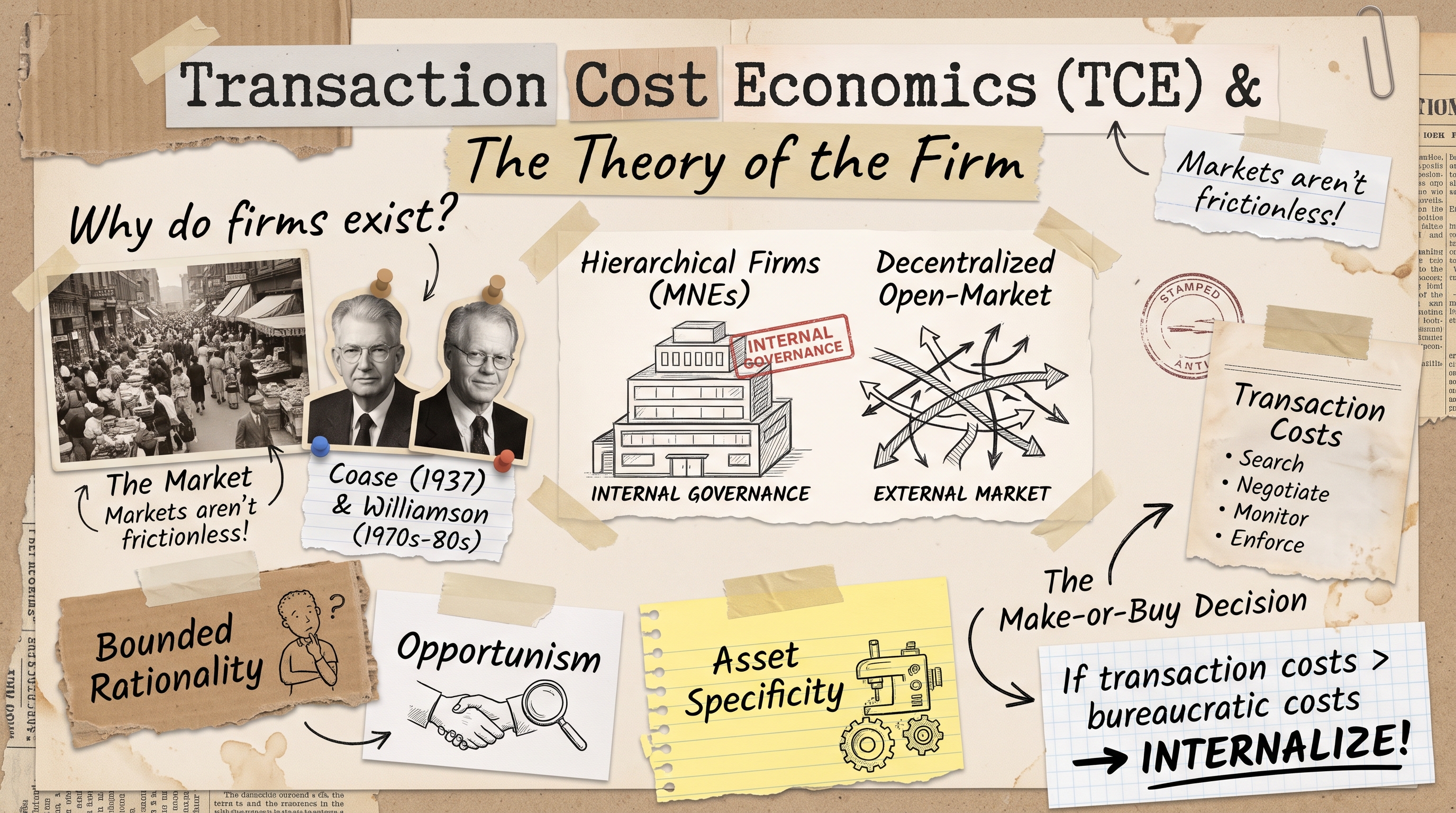
The Coasean Foundation: Why Do Firms Exist?
In neoclassical microeconomic theory, the price mechanism ("the invisible hand") is treated as an effortless, costless coordinator of resources, while the firm is reduced to a "black box" production function converting inputs into outputs.[3:1] In his landmark 1937 paper, The Nature of the Firm, Ronald Coase challenged this orthodoxy by posing a deceptively simple question: if the price mechanism efficiently coordinates economic activity, why do administrative hierarchies ("islands of conscious power") exist at all?[1:1][3:2]
Coase identified that using the price mechanism incurs real economic costs.[3:3] Rather than operating in a zero-friction vacuum, market participants face distinct ex ante and ex post frictions:
- Price Discovery Costs: Determining relevant market prices and identifying qualified counterparties.[3:4]
- Negotiation and Contracting Costs: Drafting separate contracts for every individual exchange of intermediate inputs, labor tasks, and contingencies.[1:2][3:5]
- Inspection and Enforcement Costs: Verifying output quality, policing contractual compliance, and settling disputes when unforeseen disruptions arise.[3:6]
"The main reason why it is profitable to establish a firm would seem to be that there is a cost of using the price mechanism. The most obvious cost of 'organizing' production through the price mechanism is that of discovering what the relevant prices are." — Ronald H. Coase (1937)[1:3]
The Coasean Boundary Condition (Equimarginal Principle)
Coase argued that a firm supersedes the market by replacing a series of individual spot contracts with an overarching, incomplete authority contract—most visibly in the employment relationship, where an employee agrees to follow managerial direction within specified limits in exchange for fixed remuneration.[1:4][4:1] However, Coase also answered the inverse question: why doesn't the entire economy merge into one giant factory?[3:7]
Internalizing transactions introduces diminishing returns to management:
- Bureaucratic Rigidity and Spatial Dispersion: As a firm grows larger and transactions become more heterogeneous or geographically dispersed, administrative coordination costs rise.[1:5]
- Resource Misallocation Mistakes: Entrepreneurs and executives increasingly fail to place factors of production in their highest-value uses compared to decentralized market signals.[1:6]
- Weakened Incentives: Insulated from competitive market pressures, internal divisions suffer from blunted cost sensitivity.[5:1]
Therefore, a firm expands strictly up to the Coasean margin: the point at which the marginal cost of organizing an extra transaction within the firm equals the marginal cost of carrying out that same transaction through an open-market exchange (or within another firm), defining exactly where executive leadership draws the line between internal hierarchy and external contracting.[1:7][3:8]
Coase's 1937 theory of the firm is frequently conflated with the "Coase Theorem" derived from his 1960 paper The Problem of Social Cost (and formally named by George Stigler).[3:9] The Coase Theorem states that if transaction costs were zero and property rights were clearly defined, private parties would bargain costlessly to a Pareto-efficient allocation regardless of initial legal entitlements.[3:10][6] Coase explicitly emphasized in his 1991 Nobel Lecture that the zero-transaction-cost world was never meant as a description of reality, but rather as a theoretical stepping stone ("blackboard economics") to prove that positive transaction costs are the primary reason legal rules, property rights, and corporate hierarchies matter in the real world.[3:11]
Williamson's Operationalization: Behavioral & Transactional Microfoundations
While Coase established the conceptual trade-off between markets and firms, his framework remained difficult to test empirically because "transaction costs" could easily become a tautological catch-all.[6:1] Beginning with Markets and Hierarchies (1975) and culminating in The Economic Institutions of Capitalism (1985), Oliver Williamson—awarded the 2009 Nobel Prize in Economic Sciences—transformed Coase's insight into a predictive science by establishing the transaction as the basic unit of analysis and specifying the exact behavioral and environmental variables that cause market failure.[2:2][4:2][6:2]
Behavioral Assumptions
Williamson replaced the hyper-rational, benign agent of neoclassical economics with contractual man, defined by two behavioral realities:
- Bounded Rationality: Drawing directly on Herbert Simon's research (detailed in Satisficing (Herbert Simon)), Williamson posited that human actors are "intendedly rational, but only limitedly so."[4:3][7] Because neurophysiological and computational capacities are finite, economic actors cannot foresee every future state of nature, calculate all probabilistic outcomes, or draft complete contingent contracts.[2:3][7:1] Consequently, all complex long-term contracts are inherently incomplete.[2:4][5:2]
- Opportunism: Williamson defined opportunism as "self-interest seeking with guile."[2:5][4:4] Beyond straightforward negotiation, opportunism encompasses strategic withholding or distortion of information, shirking, moral hazard, and reneging on implicit promises when circumstances shift.[2:6][4:5] Not every economic actor behaves opportunistically at all times, but because boundedly rational principals cannot reliably distinguish opportunistic agents from trustworthy ones ex ante, governance structures must be designed to safeguard against opportunistic exploitation ex post.[2:7][6:3]
Dimensions of Transactions
Whether bounded rationality and opportunism actually break market exchange depends on three observable dimensions of the transaction itself:
- Asset Specificity: The degree to which durable investments made to support a particular transaction cannot be redeployed to alternative uses or alternative users without a substantial sacrifice of productive value.[5:3] Williamson identified asset specificity as the single "big locomotive" driving Transaction Cost Economics.[2:8][5:4]
- Uncertainty: Both environmental/parametric uncertainty (unpredictable shifts in demand, technology, regulations, or macroeconomics) and behavioral uncertainty (strategic nondisclosure or difficulty verifying partner performance).[2:9][4:6] Without asset specificity, uncertainty simply results in switching suppliers; paired with high asset specificity, uncertainty forces costly, contentious renegotiations every time a disturbance hits.[5:5]
- Frequency: How often a transaction recurs (one-off, occasional, or recurrent).[2:10] Setting up specialized internal governance hierarchies entails substantial fixed administrative overhead; high transaction frequency allows firms to amortize those fixed bureaucratic costs across high volumes.[2:11]
Bounded Rationality alone merely creates contractual gaps that cooperative partners could adjust amicably. Opportunism alone is neutralized if competitive spot markets allow instant switching at zero cost. Asset Specificity alone poses no hazard if contracts are complete and courts enforce them perfectly. Internalization becomes imperative only when all three converge: incomplete contracts (bounded rationality) expose sunk, non-redeployable investments (asset specificity) to strategic exploitation (opportunism) amid changing conditions (uncertainty).[2:12][4:7][6:4]
Asset Specificity, Quasi-Rents, and the Hold-Up Problem
To explain why specialized investments trigger vertical integration, Williamson and contemporaneous scholars Benjamin Klein, Robert Crawford, and Armen Alchian (1978) formalized the mechanics of Fundamental Transformation and appropriable quasi-rents.[2:13][8]
The Fundamental Transformation
Prior to signing a contract (ex ante), a market may feature large-numbers bidding: dozens of qualified suppliers compete fiercely on price and quality.[4:8] However, once the winning supplier invests in specialized tooling, custom software, or co-located facilities tailored exclusively to the buyer, the relationship undergoes a Fundamental Transformation into an ex post bilateral monopoly (small-numbers bargaining).[2:14][4:9] Neither party can costlessly walk away: the supplier cannot sell its custom output elsewhere without steep losses, and the buyer cannot immediately source an identical substitute from generalist rivals.[4:10][5:6]
Appropriable Quasi-Rents and Hold-Up
Klein, Crawford, and Alchian (1978) demonstrated that asset-specific investments generate appropriable specialized quasi-rents—defined as the excess value of an asset in its current specialized use over its salvage value in its next-best alternative use.[8:1]
If a supplier builds a specialized stamping press costing $10 million that yields $1.5 million per year making parts for Buyer A, but has a scrap or resale value to Buyer B of only $2 million, the remaining $8 million of sunk value represents an appropriable quasi-rent.[8:2] Once the investment is sunk, Buyer A can opportunistically "hold up" the supplier—wielding contract termination as a lethal bargaining chip to demand steep price cuts—knowing the supplier will rationally accept any price that covers variable operating costs plus the $2 million salvage floor.[8:3] Conversely, if Buyer A faces peak seasonal demand and cannot source components elsewhere on short notice, the supplier can hold up Buyer A by feigning equipment breakdowns or demanding emergency surcharges.[8:4]
Anticipating ex post hold-up, rational firms recognize that specialized commercial partnerships lacking unified governance are fundamentally built on sand, refusing to make efficient specialized investments ex ante unless protected by credible commitments or unified vertical ownership.[6:5][8:5]
As analyzed by Klein, Crawford, and Alchian (1978), automobile manufacturing in the early 20th century shifted from open wooden carriages to closed metal bodies requiring expensive, model-specific stamping dies.[8:6] In 1919, General Motors (GM) signed a 10-year exclusive supply contract with Fisher Body to protect Fisher from hold-up after investing in GM-specific dies, setting price at variable cost plus a 17.6% markup.[8:7] When demand for closed-body cars surged far beyond expectations in the mid-1920s, the rigid long-term contract became severely maladapted: Fisher allegedly exploited the cost-plus formula via inefficient labor practices and refused GM's requests to co-locate body plants directly adjacent to GM assembly lines (fearing greater site-specific lock-in).[8:8] In 1926, GM resolved the bilateral hold-up and adaptation deadlock by acquiring full ownership of Fisher Body—illustrating vertical integration when long-term contracts fail under high asset specificity and demand uncertainty.[8:9]
Williamson's Six Types of Asset Specificity
In Comparative Economic Organization (1991), Williamson codified six distinct forms of asset specificity that empirically drive make-or-buy boundaries:[5:7]
- Site Specificity: Successive production stages located "cheek-by-jowl" (e.g., a mine-mouth coal power plant or a chemical refinery adjacent to an input pipeline) to economize on inventory and transportation expenses; once built, physical relocation is prohibitively expensive.[5:8]
- Physical Asset Specificity: Specialized machine tools, dies, molds, or custom semiconductor photomasks engineered exclusively for a single client's product design.[5:9]
- Human Asset Specificity: Firm-specific knowledge, tacit team routines, proprietary coding architectures, and "learning-by-doing" accumulated by employees that have far lower productivity outside the specific organizational context.[5:10]
- Dedicated Assets: Discrete expansions of general-purpose plant capacity undertaken strictly at the behest of one major buyer; although the machinery isn't technically custom, losing that buyer leaves the supplier with massive, unabsorbed excess capacity.[5:11]
- Brand Name Capital: Reputational investments (particularly salient in franchising and distribution networks) where quality shading by an independent downstream partner directly degrades the value of the shared trademark.[5:12]
- Temporal Specificity: Akin to technological non-separability, where the value of an input depends critically on precise, split-second timing of delivery or execution (e.g., perishable agricultural cold chains, maritime port unloading, or newspaper printing presses), empowering suppliers to extract rents via strategic delay.[5:13]
Discrete Structural Alternatives: Markets, Hybrids, and Hierarchies
Williamson demonstrated that economic governance is not a binary switch between pure spot markets and total vertical integration, but a spectrum of discrete structural alternatives—Markets, Hybrids, and Hierarchies—each supported by a distinct contract law regime and offering systematic trade-offs between incentive intensity and coordinated adaptability.[5:14]
| Governance Attribute | Market | Hybrid (Alliances / Franchising / Long-Term Contracts) | Hierarchy (Unified Firm / MNE) |
|---|---|---|---|
| Asset Specificity Fit | Low ( | Intermediate ( | High ( |
| Incentive Intensity | High-powered (actors keep 100% of net cost savings) | Semi-strong (shared residuals, royalty/penalty clauses) | Low-powered (salaried employees; weak link to effort) |
| Administrative Controls | Nil (rely on market prices) | Moderate (joint steering committees, audits) | Strong (authority, internal audits, career ladders) |
| Autonomous Adaptation (Type A) | Strong (instant response to local price signals) | Semi-strong | Weak (slow bureaucratic reaction to external prices) |
| Coordinated Adaptation (Type C) | Weak (bilateral haggling and hold-up deadlock) | Semi-strong (mutual adjustment within contract bounds) | Strong (fiat resolves disputes without bargaining) |
| Contract Law Regime | Classical Contract Law (strict legal rules; litigation) | Neoclassical Contract Law (excuse doctrine; third-party arbitration) | Forbearance (courts refuse internal business disputes; hierarchy is its own court of ultimate appeal) |
The Law of Forbearance and Bureaucratic Trade-Offs
A pivotal contribution of Williamson's 1991 synthesis is explaining why internal hierarchies succeed where inter-firm contracts fail: the legal doctrine of forbearance.[5:15] Whereas courts readily adjudicate disputes between two independent firms over contract technicalities, courts systematically refuse to hear disputes between two internal divisions of the same corporation over transfer prices, delivery delays, or technical specifications (under the business judgment rule).[5:16] Consequently, hierarchy serves as its own court of ultimate appeal.[5:17] Senior executives possess fiat—the authority to compel internal information disclosure, audit cost books directly, and mandate coordinated realignment (Type C adaptation) without prolonged legalistic haggling.[5:18]
However, moving from Market to Hierarchy incurs bureaucratic costs: incentive intensity degrades because division managers cannot claim the full residual profits of their innovations without triggering internal politicking, influence costs, and selective intervention failures ("impossible selective intervention"). Within sprawling corporate apparatuses, individual contributors risk being reduced to an interchangeable cog in the machine, insulated from market signals and driven strictly by administrative compliance.[2:15][5:19] Thus, Williamson's discriminating alignment hypothesis dictates that transactions—which differ in their attributes (specificity, uncertainty, frequency)—are aligned with governance structures—which differ in their costs and competencies—in a transaction-cost-economizing way (detailed in IBM - Understanding Organizational Structure).[6:6][5:20]
Extension to International Economics: Internalization Theory & The Multinational Enterprise
While Coase and Williamson developed TCE primarily around domestic vertical integration, international business scholars applied the exact Coasean logic across national borders to answer the central question of international economics: Why do Multinational Enterprises (MNEs) engage in Foreign Direct Investment (FDI) instead of simply exporting goods or licensing their proprietary technology to independent foreign firms?[9][10]
In a frictionless neoclassical trade world (e.g., Heckscher-Ohlin models), capital and goods move via trade or portfolio flows, and domestic innovators would effortlessly monetize overseas markets by selling blueprints, patents, or brand licenses to local host-country firms—who already know the local language, regulations, and consumer tastes, thereby avoiding the liability of foreignness.[9:1][11]
Buckley & Casson (1976) and Hennart (1982): Cross-Border Market Imperfections
In The Future of the Multinational Enterprise (1976), Peter Buckley and Mark Casson—alongside parallel work by Jean-François Hennart (1982) and Alan Rugman (1981)—formulated Internalization Theory, establishing that MNEs exist specifically to internalize cross-border intermediate product markets that suffer from acute transaction cost failures.[9:2][10:1] While vertical raw-material integration (e.g., aluminum smelting and bauxite mining, or petroleum refining) relies directly on Williamson's physical and site asset specificity, horizontal MNE expansion is overwhelmingly driven by market failures in intangible knowledge, R&D, and brand reputation.[9:3][10:2]
Cross-border arm's-length licensing breaks down due to four severe transaction hazards (explored in IBM - International Business Law):
- Arrow's Information Paradox (Buyer Uncertainty): Formulated by Kenneth Arrow (1962), the fundamental paradox of trading information on the open market is that a foreign licensee cannot accurately assess the commercial value of proprietary know-how until the licensor reveals it; yet once revealed, the licensee has effectively acquired the knowledge for free and can opportunistically walk away or underbid.[12]
- Incomplete Appropriability & Dissipation Risk: Knowledge acts like a public good within a firm—once R&D is sunk, marginal transmission cost is low—but intellectual property rights (IPRs) across sovereign jurisdictions are notoriously weak, uneven, or costly to enforce.[9:4][12:1] Licensing advanced manufacturing processes to a foreign contractor risks creating a direct global competitor once the contract expires or leaks via employee mobility.[9:5][12:2]
- Tacitness of Know-How (Human Asset Specificity): Cutting-edge organizational capabilities and complex engineering processes are often tacit, uncodified, and embedded in team routines.[5:21][9:6] Transferring tacit knowledge across borders via written licensing contracts incurs prohibitive specification and training costs compared to transferring personnel and unified management systems inside a wholly owned subsidiary.[9:7]
- International Brand Externality (Free-Riding): When an MNE licenses a global trademark to independent foreign operators, an opportunistic licensee in one country may cut corners on quality to boost local short-term margins while degrading the MNE's global brand equity—a classic externality requiring costly cross-border policing that wholly owned equity control eliminates.[5:22][9:8]
- Government Interventions & Transfer Pricing: Sovereign borders introduce tariffs, capital controls, and corporate tax differentials that create additional market distortions, incentivizing MNEs to internalize cross-border flows of intermediate inputs and IP within a unified corporate boundary.[9:9]
Synthesis: Dunning's OLI (Eclectic) Paradigm
John H. Dunning (1977, 1979) integrated Transaction Cost / Internalization Theory with industrial organization and trade location theory into the overarching OLI (Eclectic) Paradigm of international production (examined in IBM - Global Market Entry and IBM - International Business Strategy):[13][11:1]
- O — Ownership Advantages: The firm possesses proprietary firm-specific assets (
, such as patents, proprietary tech, or brand equity) and multi-plant transactional coordination capabilities ( ) sufficient to outweigh the liability of foreignness against entrenched local competitors.[11:2] - L — Location Advantages: Host-country immobile endowments—such as lower factor costs, proximity to key customers, natural resources, cluster ecosystems, or tariff barriers—make producing abroad cheaper than producing at home and exporting.[13:1][11:3]
- I — Internalization Advantages: Direct TCE application—cross-border transaction costs (opportunism, Arrow's information paradox, hold-up, IP dissipation, and quality control costs) make exploiting Ownership advantages internally via wholly owned FDI cheaper and safer than selling or leasing those rights via arm's-length licensing or franchising.[13:2][11:4]
| International Entry Mode | Ownership Advantage (O) | Location Advantage (L) | Internalization Advantage (I) | Underlying TCE Rationale |
|---|---|---|---|---|
| Licensing / Franchising | Yes | No / Foreign Partner | No | Low cross-border transaction costs; codified IP; strong legal enforcement allows arm's-length contracting.[11:5] |
| Exporting | Yes | No (Home favored) | Yes | Domestic production internalized, while cross-border trade costs/tariffs remain lower than overseas plant setup.[11:6] |
| Foreign Direct Investment (MNE) | Yes | Yes (Host favored) | Yes | High asset specificity / tacit knowledge / IP dissipation makes market licensing fail; foreign production internalized under hierarchy.[13:3][11:7] |
Theoretical Critiques & Contemporary Frontiers
Despite serving as the bedrock of modern organizational and international economics, the Coase-Williamson TCE paradigm faces enduring critiques and ongoing theoretical evolution:
- Neglect of Capabilities and Value Creation (Resource-Based & Knowledge-Based Views): Scholars such as Kogut and Zander (1993) and Barney (1991) critique TCE for focusing almost exclusively on negative opportunism avoidance rather than positive capability creation. Even in a hypothetical world with zero opportunism, firms and MNEs might still outperform markets because organizations serve as superior social communities for combining, creating, and transferring tacit knowledge through shared identity and coding languages.
- "Bad for Practice" & Self-Fulfilling Opportunism: Sumantra Ghoshal and Peter Moran (1996) famously argued that designing corporate hierarchies strictly around the assumption of human opportunism—using heavy surveillance and rigid controls—actively crowds out intrinsic motivation and trust, creating a pathological self-fulfilling prophecy that breeds the very opportunism it sought to curb (a critique directly echoing Douglas McGregor, The Human Side of Enterprise's Theory X dynamics).
- Relational Governance & Network Alliances: Sociological institutionalists (e.g., Mark Granovetter's embeddedness) and alliance researchers note that repeated interactions, social norms, and reputational networks (such as Japanese keiretsu supply chains) enable high-asset-specificity investments without full vertical ownership, expanding the viability of the "Hybrid" zone beyond Williamson's early skepticism.[4:11][5:23]
- Digital Platforms & Falling Search Costs (The Modern Coasean Shift): Modern digital ecosystems, APIs, cloud computing, and algorithmic marketplaces drastically lower Coasean search, coordination, and monitoring costs.[1:8] Consistent with Coase's original 1937 equimarginal logic, lower external transaction costs have caused vertical disintegration ("the fissured workplace"), global value chain (GVC) modularization, and asset-light platform orchestrators (examined in Platform Enshittification)—yet wherever frontier AI architectures, custom silicon (e.g., proprietary chip design/foundry lock-in), or uncodifiable IP create extreme asset specificity, Coasean-Williamsonian vertical internalization remains fiercely resurgent.[1:9][6:7]
🎴 Interactive Web Practice (Comprehension Check)
Question 1 (The Coasean Margin & Boundary of the Firm): According to Ronald Coase, why do administrative hierarchies exist if markets are efficient, and what economic mechanism dictates the exact size and boundary of a firm?
Answer: Ronald Coase demonstrated that utilizing the price mechanism is not costless; market participants incur real transaction costs, including price discovery, contract negotiation, and inspection/enforcement. Hierarchical firms emerge because coordinating production through managerial authority and incomplete employment contracts is often cheaper than drafting separate spot contracts for every individual exchange.
However, internalizing transactions introduces diminishing returns to management, including bureaucratic rigidity, spatial coordination drag, weakened incentives, and resource misallocation mistakes. Consequently, the firm expands strictly up to the Coasean margin: the threshold where the marginal cost of organizing an extra transaction internally equals the marginal cost of executing it through an open-market exchange.
Question 2 (The Fundamental Transformation & The Hold-Up Problem): How do bounded rationality, opportunism, and asset specificity interact in Oliver Williamson's framework to produce the hold-up problem?
Answer: In Williamson's framework, transaction failure requires the convergence of three factors:
- Bounded Rationality: Human cognitive limitations ensure that complex, long-term contracts are inherently incomplete and cannot anticipate every future contingency.
- Opportunism: Economic actors act with self-interest and guile, willing to exploit contractual gaps or renegotiate in bad faith.
- Asset Specificity: Investments in specialized physical tooling, site location, or human skills cannot be redeployed without a severe loss of value, creating appropriable quasi-rents.
Question 3 (Internalization Theory & Dunning's OLI Paradigm): Why do multinational enterprises (MNEs) choose foreign direct investment (FDI) over arm's-length licensing when commercializing proprietary knowledge overseas?
Answer: Under Internalization Theory (Buckley & Casson) and John Dunning's OLI Paradigm, arm's-length cross-border licensing fails due to acute market imperfections in intermediate knowledge assets:
- Arrow's Information Paradox: A prospective foreign buyer cannot determine the fair market value of proprietary know-how without inspecting it, but once disclosed, the buyer acquires the knowledge without paying.
- Weak Cross-Border IP Enforcement & Dissipation: In foreign jurisdictions with fragile legal regimes, licensing risks transferring core capabilities to a contractor who may breach the agreement or become a future global rival.
- Tacit Knowledge: High human asset specificity means complex operational routines and engineering capabilities cannot be codified easily into written licensing terms.
Resonant Notes
The following notes in the vault share direct thematic, sociological, and strategic connections with Transaction Cost Economics:
🔴 Organizational Architecture, Governance & Strategic Management
- IBM - Global Market Entry — Operationalizes Internalization Theory and Dunning's OLI framework into practical market entry strategies, contrasting exporting, strategic alliances, licensing, and wholly owned FDI based on cross-border transaction hazards and political risk.
- IBM - Understanding Organizational Structure — Details how corporations structure internal administrative hierarchies (functional, multidivisional M-form, and matrix designs) to minimize internal coordination costs, exercise fiat, and manage the bounded rationality of senior leadership.
- IBM - International Business Strategy — Analyzes the strategic integration-responsiveness grid, demonstrating how multinational enterprises balance global scale economies with localized operational adaptation while navigating cross-border contracting friction.
- IBM - International Business Law — Examines the cross-border legal frictions and contract law regimes analyzed by Williamson, detailing international arbitration, choice of law clauses, and the enforcement limits of intellectual property rights (IPRs).
- Competitive Strategy — Michael Porter's Five Forces and value chain frameworks provide the industrial organization counterpart to TCE, illustrating how buyer/supplier bargaining power and switching costs dictate whether firms build, buy, or partner.
- Douglas McGregor, The Human Side of Enterprise — McGregor's Theory X and Theory Y illuminate the human limits of Williamsonian hierarchy; while TCE emphasizes monitoring and formal controls to deter opportunism, McGregor demonstrates that excessive surveillance breeds the very distrust and cynicism it aims to prevent.
- From Cogs to Collaboration - The Evolution of Management Thought — Situates Coase and Williamson within the broad intellectual arc of administrative history, contrasting classical Taylorist command structures with modern decentralized, capability-driven paradigms.
🟡 Microeconomic Foundations, Information Dynamics & Cognitive Limits
- Satisficing (Herbert Simon) — Simon's formulation of bounded rationality and administrative decision-making provides the indispensable cognitive microfoundation for Williamson's incomplete contracting thesis, proving that omniscient optimization is cognitively impossible.
- Game Theory — Formalizes the strategic dynamics of opportunism, bilateral monopoly, and credible commitments through models like the Prisoner's Dilemma, showing how repeated games and governance safeguards mitigate opportunistic defection.
- Shareholder Primacy (Milton Friedman) — Connects Coase's Chicago School lineage and Ronald Coase's critique of central planning to modern corporate governance, exploring how neoclassical agency theory parallels Williamsonian transaction cost governance.
- Max Weber (1864-1920) — Weber's rational-legal bureaucracy and monocratic administrative hierarchy describe the precise sociological apparatus of Williamson's "Hierarchy," highlighting the trade-off between formal procedural calculability and bureaucratic ossification.
- Platform Enshittification — Analyzes the modern digital inversion of the Coasean margin, illustrating how digital platforms leverage APIs, algorithmic matching, and cloud architecture to slash external search and coordination costs, only to subsequently extract rents from captive users and locked-in merchants.
- Karl Marx - Economic and Philosophic Manuscripts of 1844 — Marx's critique of alienated labor under industrial capitalism offers a critical materialist perspective on Coasean employment contracts, where workers surrender operational autonomy to hierarchical authority in exchange for wages.
🟢 Metaphoric Cognitive Models & Strategic Discriminations
- frictionless — Conceptualizes the baseline illusion of neoclassical economics and the Coase Theorem, where markets are imagined as frictionless until positive transaction costs, opportunism, and asset specificity intervene.
- a-bargaining-chip — Embodies the tactical leverage and appropriable quasi-rents exploited during bilateral hold-up deadlocks, where specialized asset investments are weaponized to extract unilateral contract renegotiations.
- cog-in-the-machine — Captures the extreme internal division of labor inside large corporate hierarchies, where human actors are organized as functional components subject to administrative fiat and low-powered incentives.
- draw-the-line — Represents the central strategic imperative of the Coasean margin and make-or-buy analysis: determining where executive leadership draws the line between internal organizational hierarchy and external market contracting.
- built-on-sand — Illustrates the structural vulnerability of complex, long-term commercial partnerships that lack unified governance or credible safeguards, revealing how specialized investments without protective ownership are built on sand.
References
Ronald H. Coase / The Nature of the Firm (Economica, Vol. 4, No. 16, 1937) / Wikipedia Overview ↩︎ ↩︎ ↩︎ ↩︎ ↩︎ ↩︎ ↩︎ ↩︎ ↩︎ ↩︎
Oliver E. Williamson / The Economic Institutions of Capitalism: Firms, Markets, Relational Contracting (1985) / Wikipedia Overview ↩︎ ↩︎ ↩︎ ↩︎ ↩︎ ↩︎ ↩︎ ↩︎ ↩︎ ↩︎ ↩︎ ↩︎ ↩︎ ↩︎ ↩︎ ↩︎
Ronald H. Coase / The Institutional Structure of Production (1991 Nobel Prize Lecture) / NobelPrize.org ↩︎ ↩︎ ↩︎ ↩︎ ↩︎ ↩︎ ↩︎ ↩︎ ↩︎ ↩︎ ↩︎ ↩︎
Oliver E. Williamson / Markets and Hierarchies: Analysis and Antitrust Implications (1975) / Internet Archive ↩︎ ↩︎ ↩︎ ↩︎ ↩︎ ↩︎ ↩︎ ↩︎ ↩︎ ↩︎ ↩︎ ↩︎
Oliver E. Williamson / Comparative Economic Organization: The Analysis of Discrete Structural Alternatives (Administrative Science Quarterly, Vol. 36, No. 2, 1991) / University of Illinois Archive ↩︎ ↩︎ ↩︎ ↩︎ ↩︎ ↩︎ ↩︎ ↩︎ ↩︎ ↩︎ ↩︎ ↩︎ ↩︎ ↩︎ ↩︎ ↩︎ ↩︎ ↩︎ ↩︎ ↩︎ ↩︎ ↩︎ ↩︎ ↩︎
Oliver E. Williamson / Transaction Cost Economics: The Natural Progression (2009 Nobel Prize Lecture) / NobelPrize.org PDF ↩︎ ↩︎ ↩︎ ↩︎ ↩︎ ↩︎ ↩︎ ↩︎
Herbert A. Simon / Administrative Behavior: A Study of Decision-Making Processes in Administrative Organization / Wikipedia Overview ↩︎ ↩︎
Benjamin Klein, Robert G. Crawford, and Armen A. Alchian / Vertical Integration, Appropriable Rents, and the Competitive Contracting Process (1978) & Fisher-GM Analysis / George Mason Law & Economics Center ↩︎ ↩︎ ↩︎ ↩︎ ↩︎ ↩︎ ↩︎ ↩︎ ↩︎ ↩︎
Peter J. Buckley and Mark Casson / Internalization Theory & The Theory of the Multinational Enterprise / Wikipedia Overview ↩︎ ↩︎ ↩︎ ↩︎ ↩︎ ↩︎ ↩︎ ↩︎ ↩︎ ↩︎
Peter J. Buckley and Mark Casson / The Future of the Multinational Enterprise (1976) / UNESCO Digital Library ↩︎ ↩︎ ↩︎
Lorraine Eden and Li Dai / Rethinking the O in Dunning's OLI/Eclectic Paradigm (Multinational Business Review) / VoxProf Publications PDF ↩︎ ↩︎ ↩︎ ↩︎ ↩︎ ↩︎ ↩︎ ↩︎
Kenneth J. Arrow / Economic Welfare and the Allocation of Resources for Invention (1962) / NBER Chapter PDF ↩︎ ↩︎ ↩︎
John H. Dunning / The Eclectic Paradigm (OLI Model) of International Production / Wikipedia Overview ↩︎ ↩︎ ↩︎ ↩︎