Aesthetic Autonomy, Negative Dialectics & Kitsch (Adorno & Greenberg)
🗂️ Interactive Notebook: Open Study Companion (Video Summary, Flashcards, Mind Map) ↗
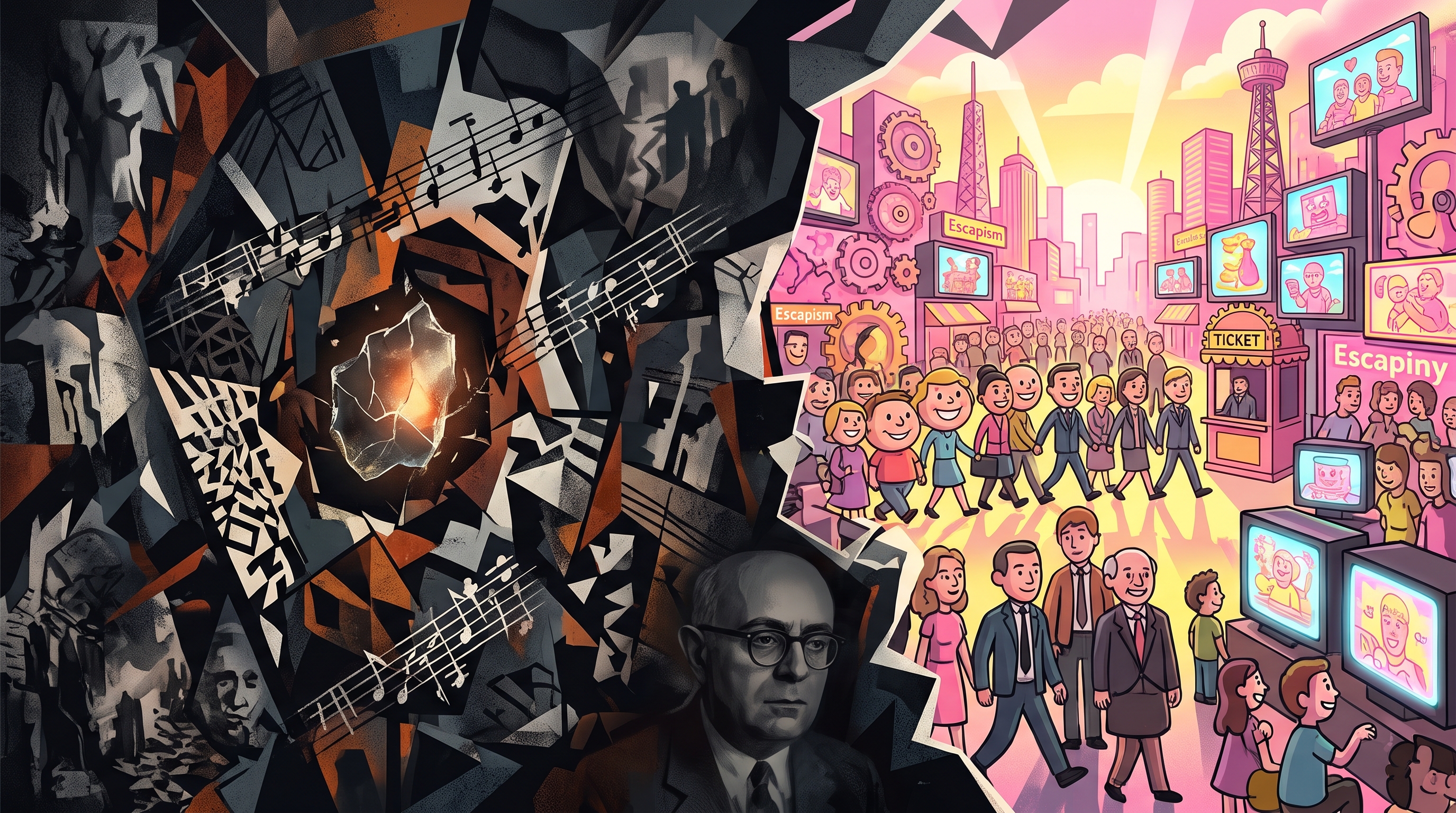
In twentieth-century aesthetics, cultural sociology, and critical theory, the survival of authentic art within administered capitalist society is anchored by two towering paradigms: American art critic Clement Greenberg's foundational manifesto Avant-Garde and Kitsch (1939) and German philosopher Theodor W. Adorno's posthumous masterwork Aesthetic Theory (Ästhetische Theorie, 1970). Both thinkers confront the identical civilizational crisis: the rise of industrialized mass culture—what Adorno and Max Horkheimer famously conceptualized as the culture industry (Kulturindustrie)—which threatens to liquidate genuine aesthetic experience by converting art into consumable, standardized kitsch. For Greenberg, the avant-garde preserves artistic purity by retreating into medium-specificity and abstract self-reflection ("imitating the processes of art" rather than nature). For Adorno, authentic modernist art maintains an irreconcilable double character (Doppelcharakter): it is simultaneously autonomous (governed by its internal formal laws, aloof from utilitarian commerce) and a socio-historical social fact (fait social, crystallizing the contradictions of the capitalist totality). Rejecting both bourgeois sentimental escapism and didactic socialist realism, Adorno positions the hermetic, dissonant artwork as a reservoir of truth content (Wahrheitsgehalt)—a non-affirmative witness to historical suffering that preserves the non-identical. Together, Greenberg and Adorno establish the theoretical bridge linking classical aisthesis and Kantian disinterested contemplation to Peter Bürger's institutional critique of autonomous bourgeois art.
1. The Historical Genealogy of Aesthetic Autonomy: From Aisthesis to the Autonomous Institution
To comprehend how aesthetic autonomy became the primary battleground of twentieth-century modernism, one must trace the historical transformation of sensation from primary, embodied perception into an isolated, self-legislating bourgeois institution.[1][2]
Classical Aisthesis vs. Modern Aesthetics
The discipline of aesthetics originated from a fundamental historical bifurcation:[2:1]
- Classical Aisthesis (Ancient Greek: αἴσθησις): Derived from the verb aisthanomai ("I perceive, feel, or apprehend by the senses") with etymological roots linked to "breathing in" or somatic inhalation. In classical philosophy (Plato's skepticism toward sensory flux versus Aristotle's rehabilitation of sensory cognition in De Anima and emotional catharsis in Poetics), aisthesis designated the unmediated contact of bodily sense organs with physical reality prior to reflective conceptualization (noēsis), as explored across From Mythos to Ataraxia - A Survey of Ancient Greek Philosophy and Perception vs. Apperception.[2:2][3]
- The Enlightenment Invention of Aesthetics (1750): German rationalist Alexander Gottlieb Baumgarten appropriated the Greek root to coin aesthetics (aesthetica) in his 1750 treatise, defining it as the "science of sensitive knowing" (scientia cognitionis sensitivae) to complement Cartesian logic.[2:3] David Hume subsequently formulated the empirical "standard of taste" (1757), investigating how collective consensus among cultivated critics establishes aesthetic norms—a dynamic deconstructed in Good Taste and Naïve Realism.[4]
| Aesthetic Paradigm | Primary Domain | Epistemological Status | Social & Functional Locus | Mode of Perception |
|---|---|---|---|---|
| Classical Aisthesis | Epistemology, biology, and natural philosophy | Somatic apprehension of empirical reality; pre-reflective contact | Embedded in civic life, religious ritual, and artisanal craft (technē) | Visceral, embodied, multisensory engagement |
| Enlightenment Aesthetics (Kant) | Philosophy of taste, beauty, and judgment | Subjective universality; free play of Imagination and Understanding | Autonomous philosophical faculty; separation of pure art from utility | Disinterested contemplation; purposiveness without purpose |
| Bourgeois Aestheticism (L'art pour l'art) | Autonomous fine art institutions | Radical severance from ethical, political, and economic ends | Compensatory emotional solace for the bourgeois individual | Solitary, contemplative absorption in the gallery or private salon |
| Critical Modernist Dialectic (Adorno) | Negative dialectics and social critique | Negative truth content (Wahrheitsgehalt); witness to historical suffering | Double character: autonomous formal law (Formgesetz) and social fact (fait social) | Strenuous intellectual immersion; shock of formal dissonance |
| The Culture Industry (Adorno & Greenberg) | Mass production, consumer commodities, kitsch | Ideological false consciousness; simulated emotion; exchange value | Totalitarian propaganda; mass-market entertainment; market circulation | Passive distraction; pre-digested sentimental recognition |
Immanuel Kant and the Architecture of Autonomy
In the Critique of the Power of Judgment (Kritik der Urteilskraft, 1790), Immanuel Kant codified the foundational doctrine of aesthetic autonomy through four decisive moments:[5]
- Disinterested Satisfaction (Wohlgefallen ohne Interesse): Aesthetic judgment is stripped of all "interest"—it does not depend on a desire to possess, exploit, consume, or morally evaluate the object. One appreciates an object purely for its presented form.[5:1]
- Purposiveness Without Purpose (Zweckmäßigkeit ohne Zweck): An aesthetic object appears harmonious and unified as if designed for an intentional end, yet it serves no practical, utilitarian, or moral function.[5:2]
- Subjective Universality: Aesthetic delight claims universal validity (sensus communis) through the free play (freies Spiel) of Imagination (Einbildungskraft) and Understanding (Verstand), without being tethered to a determinate concept.[5:3]
The Sociological Emergence of the "Institution of Art"
As analyzed by Peter Bürger in Theories of the Avant-Garde (Poggioli & Bürger), aesthetic autonomy was not an eternal metaphysical truth, but a specific historical product of bourgeois capitalism:[6]
- Sacral Art (High Middle Ages): Embedded in religious liturgy; functioned as a collective cult object carrying what Walter Benjamin identified in The Work of Art in the Age of Mechanical Reproduction as ritual "aura."[6:1]
- Courtly Art (Absolutist Era): Served aristocratic representational display, glorifying princely power.[6:2]
- Bourgeois Art (18th–19th Century): With the rise of the free market, art severed its direct ties to church and court, establishing the institution of art (Institution Kunst)—the apparatus of museums, independent galleries, academic salons, and art criticism.[6:3]
Drawing upon Herbert Marcuse's 1937 treatise "The Affirmative Character of Culture", critical theory reveals the profound contradiction of this autonomy:[6:4][7]
- The Critical Horizon: By refusing means-end capitalist rationality, autonomous art preserves a utopian sanctuary for human freedom, beauty, and non-instrumental relationship that bourgeois society denies in practice.[7:1]
- The Affirmative / Compensatory Trap: Because those utopian ideals are cordoned off in an isolated cultural sphere, art functions as a compensatory safety valve, pacifying social discontent and stabilizing the existing order without transforming material reality.[6:5][7:2]

2. Clement Greenberg: Avant-Garde and Kitsch (1939)
In the autumn of 1939, against the catastrophic backdrop of the outbreak of World War II and the Moscow Show Trials, thirty-year-old American art critic Clement Greenberg published "Avant-Garde and Kitsch" in the Marxist-Trotskyist literary journal Partisan Review.[8] The essay established the intellectual framework for American postwar modernism, formulating an absolute, existential demarcation between the avant-garde and kitsch.[8:1]
The Defensive Secession of the Avant-Garde
Greenberg argued that when a society's cultural foundations begin to petrify and decay into static Alexandrian academicism, creative vitality can survive only through a radical secession.[8:2] The Western modernist avant-garde emerged not merely to experiment with novel techniques, but to rescue high culture from the debasing pressures of capitalist commercialization:[8:3]
- The Flight from the Market: Seeking to liberate art from ideological manipulation and bourgeois philistinism, the vanguard abandoned common subject matter, storytelling, and public representation.[8:4]
- "Imitating the Processes of Art": Greenberg declared that while traditional academic art "imitated nature" (mimesis), the genuine avant-garde discovered its true theme in the medium itself:[8:5]
"The avant-garde poet or artist tries in effect to imitate God by creating something valid solely on its own terms, in the way nature itself is valid... In turning his attention away from subject matter of common experience, the poet or artist turns it in upon the medium of his own craft." — Clement Greenberg, Avant-Garde and Kitsch (1939)[8:6]
- Medium-Specificity and Flatness: In subsequent foundational essays (notably "Modernist Painting", 1960), Greenberg codified this principle into a formalist teleology: the historical destiny of each art form is to purge itself of effects borrowed from other mediums.[9] Painting must purge narrative literature, theatrical illusion, and three-dimensional sculpture, embracing the unique, irreducible physical property of its medium: flatness (the two-dimensional plane). This trajectory led inexorably from Édouard Manet and Impressionism through Cubism to the Abstract Expressionism of Jackson Pollock and Mark Rothko.[8:7][9:1]
The Etymology and Anatomy of Kitsch
On the opposing pole of modernity's cultural ledger stood kitsch—the industrial shadow of the avant-garde.[8:8]
- Etymological Roots: The term Kitsch emerged in the art markets of Munich in the 1860s and 1870s, used by painters and dealers to denote cheap, marketable sketches and sentimental pictures.[10] Linguistic origins point to the regional German dialect verb kitschen ("to scrape up mud from the street," or "to knock furniture together hastily / to make something look antique"), alongside verkitschen ("to pawn or sell off cheaply"). A popular alternative etymology links it to English tourists mispronouncing the word "sketch" while demanding quick, picturesque souvenirs of Bavarian landscapes.[10:1][11]
- The Product of Industrial Urbanization: Greenberg demonstrated that kitsch was born directly of the Industrial Revolution and universal literacy. Prior to industrialization, traditional folk art existed as an authentic rural culture independent of aristocratic high art. When peasant populations migrated into urban factories, they became cut off from rural folk traditions while lacking the leisure, education, and economic security to appreciate difficult high art.[8:9]
- Ersatz Culture: Capitalist urban markets filled this void by manufacturing an ersatz substitute: mass-produced, commercialized commodities that simulated the aesthetic experience of high culture at zero cognitive cost.[8:10]
Greenberg's Four Structural Diagnostics of Kitsch
- Pre-Digested Affect: High art demands strenuous cognitive, emotional, and interpretive labor. Kitsch incorporates the intended emotional response directly into the object itself. It offers instant, effortless gratification—nostalgia, tearful empathy, or patriotic fervor—sparing the spectator all interpretive work.[8:11]
- Formal Parasitism: Kitsch invents no techniques of its own. It is an unoriginal parasite that pillages the mature, canonized discoveries of past avant-garde and classical movements (particularly late Romanticism), stripping those devices of their original critical tension and deploying them as decorative formulas.[8:12]
- Imitation of Effects rather than Processes: While the avant-garde imitates the creative process of making, kitsch imitates the effects of art. As Greenberg famously observed, where an educated spectator contemplating Pablo Picasso looks at the formal syntax, plastic values, and spatial tensions, the peasant looking at Ilya Repin's realistic battle paintings immediately recognizes the narrative subject matter, experiencing an effortless, unmediated emotional payoff.[8:13]
- Mechanical Reproducibility and Commercial Utility: Kitsch requires industrial assembly, mechanical reproduction, and commercial distribution channels. It transforms the artwork into a disposable commodity whose value is governed strictly by market sales.[8:14]
                   THE CULTURAL BIFURCATION (GREENBERG, 1939)
                                       │
            ┌──────────────────────────┴──────────────────────────┐
            ▼                                                     ▼
     THE AVANT-GARDE                                            KITSCH
  • Medium-Specificity & Flatness                        • Pre-Digested Emotion & Sentiment
  • Imitates the PROCESSES of Art                        • Imitates the EFFECTS of Art
  • Demands Strenuous Intellectual Labor                 • Offers Effortless, Instant Gratification
  • Autonomous, Hermetic, Difficult                      • Parasitic on Past Breakthroughs
  • Preserves High Culture in Isolation                  • Tool of Commercial Markets & Totalitarian State
The Political Weaponization: Totalitarian Kitsch
Greenberg mounted a prophetic political critique: kitsch was not merely bad taste; it was the chosen cultural instrument of authoritarian and totalitarian regimes.[8:15]
Why did Nazi Germany, Fascist Italy, and the Stalinist Soviet Union violently suppress the modernist avant-garde (branding it "degenerate art" or "bourgeois formalism") in favor of sentimental, realistic kitsch (Socialist Realism and Aryan pastoral heroic realism)?[8:16]
- Totalitarian regimes did not enforce kitsch because their dictators personally lacked taste, but because kitsch was an incomparable instrument for mass mobilization, psychological pacification, and state propaganda.[8:17]
- Demanding critical distance and intellectual autonomy, avant-garde art provokes individual reflection and doubt. Kitsch, conversely, flatters the mass audience's existing habits, requires no intellectual effort, and manufactures a collective, sentimental illusion of unity—a dynamic explored across Dystopian Counterpoints - Brave New World vs. Nineteen Eighty-Four and George Orwell (1903-1950).[8:18]
3. Theodor W. Adorno: Negative Dialectics, the Culture Industry, and Aesthetic Theory
While Greenberg defended aesthetic autonomy from an Anglo-American formalist perspective, Theodor W. Adorno mounted a vastly deeper philosophical and sociological defense in his posthumously published masterwork Ästhetische Theorie (1970).[1:1][12]
Composed between 1961 and 1969 and edited after Adorno's sudden death by his widow Gretel Adorno and student Rolf Tiedemann, the treatise synthesizes dialectical materialism, German Idealism (Hegel and Kant), and modernist aesthetics into a monument of negative dialectics.[1:2][13]
Textual Architecture, Parataxis, and the Dedication to Samuel Beckett
- The Method of Parataxis: Adorno structured Aesthetic Theory around Friedrich Hölderlin's poetic technique of parataxis—arranging arguments in dense, non-hierarchical constellations around an intellectual center rather than through linear, deductive syllogisms.[13:1] The form of the book deliberately mirrors its anti-systemic content, refusing to impose a totalizing conceptual order upon fragmented aesthetic phenomena.[13:2]
- The Dedication to Samuel Beckett: Adorno planned to dedicate the monograph to Irish playwright Samuel Beckett. For Adorno, Beckett's bleak, stripped-down postwar masterpieces (Endgame, Waiting for Godot, The Unnamable) stood as the supreme exemplars of authentic modernism. Beckett's refusal of lyrical consolation and narrative illusion bore uncompromising witness to the catastrophe of twentieth-century history.[1:3][12:1]
"It is self-evident that nothing concerning art is self-evident anymore, not its inner life, not its relation to the world, not even its right to exist." — Opening Sentence of Aesthetic Theory[13:3]
The Double Character of Art: Autonomy and Social Fact
The central theoretical pillar of Aesthetic Theory is Adorno's dialectical formulation of art's double character (Doppelcharakter):[1:4][12:2]
Adorno rejects both vulgar Marxist economism (which reduces art to a mere superstructure reflecting class interests) and bourgeois aestheticism (which isolates art into a realm of pure, timeless beauty):[12:3]
- Autonomy (Autonomie): By emancipating itself from religious ritual and courtly panegyric, art constitutes its own internal, immanent formal law (Formgesetz).[1:5] Autonomous art refuses to obey the capitalist law of universal exchange value: it serves no direct commercial, administrative, or utilitarian purpose. It is precisely through this uselessness that art mounts its primary social critique: autonomous art criticizes society simply by virtue of its sovereign existence, standing as an uncompromising negation of a totally commodified world.[12:4]
- Social Fact (Fait Social): Borrowing the concept from Émile Durkheim, Adorno insists that art remains irreducibly social.[1:6] Crucially, art does not become social by painting factory smokestacks, portraying proletarian misery, or shouting political slogans. Rather, historical antagonisms, productive forces, and technological developments sediment directly into the artwork's medium as unsolved problems of artistic form.[12:5][13:4]
- The Leibnizian Windowless Monad: Adorno conceptualizes the autonomous artwork as a Gottfried Wilhelm Leibniz-style "windowless monad." Even while sealing its borders against the outside empirical world to achieve formal coherence, the internal fissures, tensions, and fractures of the closed aesthetic object register the historical trauma and structural contradictions of the external capitalist totality.[12:6][13:5]
Mimesis, Instrumental Rationality, and Identity Thinking
Extending the critique initiated with Max Horkheimer in Dialectic of Enlightenment (1947), Adorno analyzes the historical struggle between instrumental rationality (Zweckrationalität) and mimesis:[12:7][14]
- Identity Thinking (Identitätsdenken): In everyday capitalist administration and modern technoscience, instrumental reason violently reduces diverse, qualitative realities to calculable abstractions, interchangeable commodities, and exploitable resources. Everything heterogeneous is forced to conform to the identity of the concept or the price tag.[12:8]
- The Preservation of Mimesis: Mimesis represents the archaic, non-conceptual affinity of the human organism with otherness, nature, and the non-identical. While civilizational self-preservation progressively repressed mimesis in favor of mastery and control, authentic modern art rescues mimesis by yoking advanced rationality (technical construction, material discipline, compositional rigor) to the service of non-conceptual expression.[12:9][13:6]
- Non-Violent Synthesis: Through artistic technique, the artwork unifies fragmented, disparate materials without crushing their particularity. Autonomous art thus models a reconciled relationship between subject and object, demonstrating how rationality can organize difference without dominating or obliterating it.[12:10]
Truth Content (Wahrheitsgehalt) and the Enigmatic Quality
Against Kant's subjectivism (which confines aesthetic value to the spectator's subjective feeling of taste) and Hegel's speculative idealism (which reduces the artwork to a sensory illustration of an unfolding philosophical concept), Adorno anchors truth content (Wahrheitsgehalt) objectively inside the immanent formal structure of the artifact:[1:7][12:11]
- The Enigmatic Quality (Rätselcharakter): Authentic artworks present themselves as insoluble riddles. They speak a non-discursive, enigmatic language that invites interpretation while permanently resisting complete conceptual exhaustion.[13:7]
- The Reciprocal Need of Art and Philosophy: Art cannot articulate its own truth conceptually without destroying its aesthetic form; conversely, philosophy cannot access the non-identical without freezing it into dogmatic categories. Aesthetics is the dialectical space where philosophy and art interpret and complete one another.[12:12]
- Negativity and Suffering: In an unfree, damaged world structured by systemic exploitation and historical slaughter, truth content cannot be positive or affirmative. Authentic art gives voice to that which official history represses: physical suffering, existential dissonance, and the unredeemed trauma of human history.[12:13][13:8]
Semblance (Schein), Dissonance, and the Category of the Ugly
- The Collapse of Harmonious Semblance: Classical and bourgeois aesthetics rested upon harmonious illusion (Schein), presenting a symmetrical, reconciled totality that tacitly assured spectators that the cosmos was rational, beautiful, and whole.[12:14] Following the twentieth-century horrors of the Holocaust and total war—crystallized in Adorno's famous 1949 dictum that "to write poetry after Auschwitz is barbaric"—harmonious beauty became an ideological lie, complicit with administrative violence and mass murder.[12:15][15]
- Dissonance as the Voice of Truth: Modern art shatters harmonious semblance by admitting the ugly, the jagged, the fragmented, and the dissonant into its formal syntax.[16] In the twelve-tone atonal compositions of Arnold Schoenberg, the nightmare parables of Franz Kafka, and the claustrophobic void of Beckett, dissonance becomes the aesthetic voice of historical catastrophe.[1:8][12:16]
- Natural Beauty (das Naturschöne): Adorno rehabilitates natural beauty—banished by Hegel—as the primary historical trace of the non-identical (das Nichtidentische). Authentic art must not copy scenery (which degenerates into postcard kitsch), but imitate the silent, non-signifying dignity of nature, which stubbornly refuses to be used, bought, or subordinated to human utility.[12:17][13:9]
Autonomous Art vs. Committed Art: The Polemic with Sartre and Brecht
Adorno mounts an uncompromising critique against Jean-Paul Sartre's doctrine of "committed literature" (littérature engagée) and Bertolt Brecht's didactic epic theatre:[12:18]
- The Pitfall of Didactic Commitment: When an artist forces an artwork to communicate an explicit political moral, party platform, or anti-fascist thesis, the work must inevitably adopt the communicative, discursive language of the administrative apparatus. By speaking the transparent language of everyday utility, committed art unwittingly confirms the very structures of reification it seeks to challenge.[12:19]
- The Subversive Autonomy of Modernism: Hermetic, autonomous masterworks—such as Kafka's The Castle or Picasso's Guernica—strike a far deeper blow against false consciousness. By dismantling narrative cohesion, spatio-temporal continuity, and syntax, autonomous art shatters the spectator's habituated cognitive conditioning, preserving radical alterity without degrading itself into political advertising.[12:20]
| Analytical Dimension | Autonomous Modernist Art (Adorno) | The Culture Industry (Kulturindustrie) |
|---|---|---|
| Governing Production Logic | Internal formal necessity (Formgesetz); non-instrumental | Subordinated to market research, assembly-line production, profit |
| Receptivity Mode | Demands strenuous intellectual immersion and contemplation | Promotes passive distraction, immediate recognition, consumption |
| Formal Architecture | Dissonant, fragmented, challenging, non-affirmative | Formulaic, predictable, smoothed-out, harmonized, kitsch |
| Socio-Political Function | Negation of exchange value; silent refuge of suffering | Pacification of the working class; reconciliation with the status quo |
| Ontological Status | Objective truth content (Wahrheitsgehalt) | Pure exchange value, ideological simulation, and false consciousness |
4. The Theoretical Spectrum of Kitsch and Bad Taste
Beyond Greenberg and Adorno, twentieth-century intellectual history produced an expansive philosophical literature diagnosing kitsch as an ethical failure, an existential defense mechanism, and an ideological instrument:[10:2][11:1]
Hermann Broch: The Ethical Failure of Kitsch (1933/1950)
In his landmark essays "The Evil in the Value System of Art" (1933) and "Notes on the Problem of Kitsch" (1950), Austrian modernist novelist Hermann Broch defined kitsch not as bad art, but as an ethical catastrophe:[17]
- Closed vs. Open Value Systems: True art represents an open ethical system that seeks radical truth about the human condition, which subsequently crystallizes into beauty as a byproduct. Kitsch, by contrast, is a closed, dogmatic system that reverses this teleology: it substitutes the ethical imperative of aiming for the Good (truth) with the purely aesthetic goal of aiming for the Beautiful (mere effect).[17:1]
- The Ethical Impostor: The maker of kitsch does not seek to produce "good work," but to produce an agreeable "pleasurable effect." In Broch's stark judgment, kitsch represents "the element of evil in the value system of art" because it traffics in counterfeit currency: offering comforting, pre-packaged prettiness to mask mortality and moral responsibility.[17:2]
Milan Kundera: Totalitarian Kitsch and the "Second Tear" (1984)
In The Unbearable Lightness of Being (1984), Czech novelist Milan Kundera expanded the critique of kitsch into existential ontology and political totalitarianism:[18]
"Kitsch causes two tears to flow in quick succession. The first tear says: How nice to see children running on the grass! The second tear says: How nice to be moved, together with all mankind, by children running on the grass! It is the second tear that makes kitsch kitsch." — Milan Kundera, The Unbearable Lightness of Being (1984)[18:1]
- The Absolute Denial of Shit: Kundera defines kitsch as the categorical exclusion of everything from human existence that is essentially unacceptable, messy, bodily, or tragic. In the realm of politics, "totalitarian kitsch" reigns when all doubts, ironies, and individual differences are eradicated in favor of compulsory, tearful collective brotherhood (the May Day parade, patriotic spectacles, monolithic party solidarity). Any voice that questions the universal harmony is condemned as a cynic or traitor.[18:2]
Umberto Eco: The Semiotic Structure of Bad Taste (1964)
In The Open Work (specifically the section "The Structure of Bad Taste"), Italian semiotician Umberto Eco dissected kitsch through communication theory:[19]
- The Structural Lie: While genuine art constructs an "open work" that requires the audience to actively decode its ambiguous poetic syntax, kitsch operates as a communicative structural lie. It consumes the exhausted formal breakthroughs of past avant-gardes and packages them specifically to stimulate a pre-programmed, automatic reflex in the consumer, while pretending to provide a profound, transformative aesthetic experience.[19:1]
- Eco demonstrated how the canonization of "good taste" and the bourgeois condemnation of kitsch often masks an unreflective naïve realism, wherein dominant cultural elites mistake their contingent class preferences for universal objective metrics.[19:2]
Susan Sontag: Kitsch vs. Camp (1964)
In her landmark essay "Notes on 'Camp'", American critic Susan Sontag established the crucial boundary separating kitsch from the sensibility of Camp:[20]
- Sincerity vs. Quotation Marks: Kitsch is produced and consumed with earnestness and a lack of self-awareness; it genuinely believes in its sentimental tears or gilded grandeur.[20:1]
- The Camp Inversion: Camp is an ironic, sophisticated, and playful aestheticism that appreciates kitsch objects precisely because of their failed seriousness, theatrical artifice, and exaggerated excess. While kitsch is an intrinsic quality of an unreflective object, Camp is a subjective way of looking at things through quotation marks—a critical posture mobilized within queer and counter-cultural communities to subvert heteronormative bourgeois decorum, as explored across Counter-Culture.[20:2]
Postmodern Commodity Sculpture and Neo-Kitsch
In late-twentieth-century postmodernism, the rigid modernist boundary dividing high avant-garde autonomy from low commercial kitsch collapsed:
- Pop Art: Andy Warhol and Roy Lichtenstein dissolved Greenberg's divide, dragging commercial packaging (Campbell's Soup cans, Brillo boxes) and pulp comic strips directly into the museum, embracing mass mechanical reproduction.[6:6][8:19]
- Jeff Koons and Neo-Kitsch: Koons elevated consumer trinkets (porcelain figurines of Michael Jackson and Bubbles, oversized inflatable balloon animals cast in high-mirror stainless steel) into multi-million-dollar sculptures. Koons deliberately purged modernist guilt, claiming to embrace the viewer's unreflective appetite for banality, luxury signifiers, and instant pleasure—materializing Jean Baudrillard's hyperreal simulacrum and late-capitalist spectacle analyzed in Don DeLillo Major Themes Analysis.[21]
- Takashi Murakami and Superflat: Merged classical Japanese Edo painting with the commercial otaku kitsch of anime and manga, reflecting commercial consumer psychology.
- Odd Nerdrum: The Norwegian painter declared himself a "Kitsch painter," rejecting modernist irony and institutional conceptual art in favor of sentimental, dramatic Rembrandt-style figurative painting to protest the sterile intellectualism of contemporary art academies.[22]
5. The Great Modernist Debates & Comparative Synthesis
The dialogue between Adorno, Greenberg, and their contemporaries constitutes the core dialectic of twentieth-century aesthetic theory:
| Analytical Axis | Clement Greenberg (1939, 1960) | Theodor W. Adorno (1970) | Peter Bürger (1974) | Walter Benjamin (1936) |
|---|---|---|---|---|
| Core Masterwork | Avant-Garde and Kitsch; Modernist Painting[8:20][9:2] | Ästhetische Theorie (Aesthetic Theory)[13:10] | Theorie der Avantgarde (Theory of the Avant-Garde)[6:7] | The Work of Art in the Age of Mechanical Reproduction[23] |
| Disciplinary Locus | Formalist art criticism, medium-specificity | Critical Theory, negative dialectics, Frankfurt School | Historical materialism, institutional critique | Materialist media theory, cultural sociology |
| Primary Vector of Autonomy | Medium-specificity (purging literature from painting; flatness) | Double character: autonomous formal law and historical social fact | The bourgeois "institution of art" separated from life-praxis | Traditional cultic "aura" liquidated by industrial reproduction |
| Evaluation of the Vanguard | High modernism protects purity by seceding from commercial kitsch | Modernist dissonance (Beckett, Kafka) preserves non-identical truth | Historical Avant-Garde (Dada, Surrealism) attacked the institution itself | Avant-garde montage shatters passive bourgeois contemplation |
| Diagnosis of Kitsch / Mass Culture | Industrial surrogate culture; pre-digested affect; totalitarian tool | The Culture Industry; standardized commodity pacifying consciousness | Commercialized product resulting from art's bourgeois institutional isolation | Mass reproduction carries progressive, democratic revolutionary potential |
| Mode of Reception | Disinterested, refined visual discernment of formal quality | Strenuous cognitive immersion; intellectual confronting dissonance | Shock; active collective agitation and institutional awakening | Distracted collective consumption (e.g., the cinema audience) |
| Explanation of Avant-Garde Crisis | Creeping kitsch and middlebrow culture diluting high art standards | The total administration of late capitalism threatening all autonomy | The vanguard failed: the resilient museum absorbed anti-art into commodities | Technology permanently destroyed the ritual basis of artistic aura |
Adorno vs. Greenberg: Medium Purity vs. Dialectical Friction
While both defended the avant-garde against kitsch, Adorno and Greenberg operated from irreconcilable philosophical foundations:[8:21][12:21]
- Greenberg's defense of autonomy was formalist and medium-specific: art progresses by purifying itself of foreign elements (painting eliminating depth, literature, and narrative to achieve pure flatness).[9:3]
- Adorno vehemently rejected this formalist purification as undialectical. For Adorno, art's autonomy does not arise from formal purity, but from the internal dialectical friction between form and sedimented historical content.[12:22] A purely formalist painting that ignores social antagonisms degenerates into decorative bourgeois wallpaper—another variety of kitsch.[12:23]
Adorno vs. Walter Benjamin: The Debate Over Aura and Mass Culture
In their celebrated correspondence throughout the 1930s, Adorno and Benjamin clashed over the political efficacy of modern media:[12:24][23:1]
- In The Work of Art in the Age of Mechanical Reproduction (1936), Benjamin argued that mechanical reproduction liquidates the traditional, aristocratic aura of the artwork. By stripping art of its unique ritual presence, technologies like cinema enable democratic collective reception, transforming the passive spectator into an active, critical examiner.[23:2]
- Adorno replied with skepticism: mass culture under capitalism is not democratizing; it is the culture industry—a standardized apparatus that manipulates consciousness and pacifies political revolt.[12:25] High modernist art and mass culture, Adorno famously maintained, are "two torn halves of an integral freedom, to which however they do not add up."[12:26]
Adorno and Greenberg vs. Peter Bürger: The Critique of Autonomous Art
In Theory of the Avant-Garde (1974), Peter Bürger mounted a critique against both Greenberg and Adorno:[6:8]
- Bürger argued that Greenberg and Adorno dogmatically elevated Modernism (which leaves the bourgeois institution of art intact) while failing to grasp the radical rupture executed by the Historical Avant-Garde (Dada, early Surrealism, Russian Constructivism).[6:9]
- The historical avant-garde did not seek to retreat into medium-specificity (Greenberg) or hermetic formal dissonance (Adorno); rather, it sought the sublation of art into life-praxis (Aufhebung der Kunst in die Lebenspraxis)—dismantling the museum, the art market, and aesthetic autonomy to fuse creative energy directly with everyday revolutionary reality.[6:10]
6. Contemporary Theoretical Expansions: Rancière, Decolonial Aisthesis & Digital Kitsch
The dialogue between aesthetic autonomy and kitsch continues to shape twenty-first-century philosophy, political theory, and digital culture:[2:4][24]
Jacques Rancière: The Distribution of the Sensible
French philosopher Jacques Rancière reformulated the politics of aesthetics in The Politics of Aesthetics (2000) and Aisthesis (2011), bypassing the rigid dichotomy between modernist autonomy and kitsch:[24:1][25]
- Le Partage du Sensible ("The Distribution of the Sensible"): Aesthetics is fundamentally political because it governs the implicit perceptual framework determining what is visible, audible, and sayable in a given social order. It dictates who has the recognized capacity to speak articulately, versus whose speech is dismissed as inarticulate noise.[24:2]
- The Aesthetic Regime of Art: In modernity, art liberated itself from the ancient "Representative Regime" (which enforced strict hierarchical rules matching styles to noble or peasant subjects). In the Aesthetic Regime, all hierarchical genres collapsed: any ordinary subject, mundane object, or vernacular voice can become valid material for art. For Rancière, modern art's political power resides not in its hermetic isolation (Adorno) or formal purity (Greenberg), but in its capacity to construct dissensus—reconfiguring the shared sensory fabric of reality.[24:3][25:1]
Decolonial Aisthesis: Unlearning Eurocentric Norms
In Latin American decolonial philosophy, scholars such as Walter Mignolo and Rolando Vázquez challenge the universalist claims of both Kantian autonomy and critical theory:[26]
- The Coloniality of Taste: Mignolo argues that during the European Enlightenment, the narrowing of universal human aisthesis (embodied, ancestral sense-making) into normative philosophical aesthetics operated as a central pillar of the "colonial matrix of power." Non-Western, indigenous, and sacred sensory practices were systematically devalued as primitive craft, decorative folklore, or kitsch.[26:1]
- Decolonial Aisthesis: Represents the active unlearning of Eurocentric aesthetic canons, reclaiming ancestral, communal, and embodied ways of sensing, feeling, and world-making outside the dictates of capitalist commodification and institutional art markets.[26:2]
Digital Kitsch, Algorithmic Feeds, and the Culture Industry 2.0
In contemporary digital ecosystems, Adorno and Greenberg's warnings regarding the culture industry have reached algorithmic realization:[1:9][8:22]
- Platform Micro-Aesthetics: On TikTok and Instagram, aesthetic experience has fragmented into countable digital commodities (Cottagecore, Dark Academia, Vaporwave). These curated mood boards operate as pure simulacra, where lifestyle signifiers circulate independently of physical material grounding.[21:1]
- Generative AI and Algorithmic Kitsch: Generative image and text models (trained on vast datasets of human cultural production) embody the ultimate crystallization of Greenbergian kitsch: hyper-polished, frictionless, and pre-digested imagery engineered to stimulate immediate dopamine responses. The contemporary challenge, anticipated by Conceptual Writing and Digital Poetics (Goldsmith & Perloff), is whether human agency can rescue critical dissonance when culture itself is automated by predictive algorithms.[27]
🎴 Interactive Web Practice (Comprehension Check)
Question 1 (Adorno's Double Character vs. Greenberg's Medium Purity): Contrast Clement Greenberg's concept of modernist autonomy with Theodor W. Adorno's dialectical formulation of art's "double character" (Doppelcharakter). How does each explain the artwork's resistance to commodification?
Answer: While both Clement Greenberg and Theodor W. Adorno champion the autonomy of modernist art against commercial degradation, their theoretical mechanisms and explanations of resistance diverge fundamentally:
- Greenberg's Formalist Medium-Specificity: Greenberg locates autonomy in the purification of the artistic medium. In response to the threat of commercial kitsch and academic decay, the avant-garde secedes from common social representation and narrative, turning inward to "imitate the processes of art." For painting, this means systematically purging three-dimensional sculptural illusions and literary storytelling to embrace its unique, irreducible physical essence: two-dimensional flatness. Art resists commodification by becoming formally hermetic, difficult, and self-referential, preserving high cultural standards in isolation from mass society.
- Adorno's Dialectical Double Character (Doppelcharakter): Adorno completely rejects Greenberg's formalist purification as undialectical. For Adorno, an authentic artwork is simultaneously an autonomous form (governed by its internal formal law, Formgesetz) and a socio-historical social fact (fait social). Art does not achieve autonomy by erasing society; rather, historical antagonisms, economic forces, and technological developments sediment directly into the artwork's medium as unsolved problems of form. Functioning like a Leibnizian "windowless monad," the artwork closes its boundaries against utilitarian commerce, yet its internal fissures and formal dissonances register the historical trauma of the capitalist totality. Art's resistance to commodification resides precisely in its absolute uselessness: by refusing to obey the capitalist law of universal exchange value, autonomous art stands as a silent, non-affirmative indictment of a totally administered world.
Question 2 (The Culture Industry vs. Totalitarian Kitsch): How do Clement Greenberg, Theodor W. Adorno, and Milan Kundera analyze the political function of kitsch in totalitarian regimes and late-capitalist democracies?
Answer: All three thinkers diagnose kitsch not as harmless bad taste, but as a dangerous instrument of ideological control, emotional manipulation, and political pacification:
- Greenberg (Avant-Garde and Kitsch): Totalitarian regimes (Nazi Germany, Fascist Italy, Stalin's Soviet Union) violently suppressed the modernist avant-garde while promoting sentimental, realistic kitsch (Socialist Realism and Aryan heroic pastoralism) because kitsch flatters the masses, demands zero intellectual labor, and manufactures an illusion of collective unity. Kitsch provides authoritarian states with an incomparable vehicle for state propaganda and mass mobilization.
- Adorno & Horkheimer (The Culture Industry): In capitalist consumer democracies, kitsch is industrialized into the culture industry (Kulturindustrie). Through standardized, formulaic cultural commodities (Hollywood cinema, pop music, popular magazines), the culture industry provides pre-packaged emotional release that pacifies the working class, integrates individuals into the capitalist apparatus, and extinguishes the critical consciousness required for genuine political revolt.
- Milan Kundera (Totalitarian Kitsch & The Second Tear): Kundera defines kitsch as the "absolute denial of shit"—the categorical exclusion of everything tragic, messy, or contradictory from existence. His concept of the "second tear" illustrates the compulsory conformism of totalitarian kitsch: the first tear is moved by a sentimental image, while the second tear is moved by the collective self-righteousness of being moved together with all mankind. In political totalitarianism, this manufactured sentimentality enforces mandatory collective brotherhood, treating any individual doubt, irony, or dissent as treason.
Question 3 (Truth Content, Dissonance & The Polemic on Commitment): Why does Adorno argue that autonomous, dissonant modernism (Beckett, Kafka) possesses greater political "truth content" (Wahrheitsgehalt) than politically committed or didactic art (Brecht, Sartre)?
Answer: Adorno rejects politically committed or didactic art (littérature engagée or Tendenzkunst) because it inevitably borrows the communicative, instrumental language of the existing social administration. In attempting to deliver explicit socialist, anti-fascist, or moral messages, didactic art subordinates aesthetic form to a pre-established conceptual thesis. By speaking in the transparent, communicative prose of means-end rationality, committed art flatters the audience's reified consciousness, leaving the fundamental perceptual structures of capitalist domination completely unchallenged.
Conversely, autonomous modernist works—exemplified by Samuel Beckett's stripped-down plays, Franz Kafka's bureaucratic nightmares, and Arnold Schoenberg's atonal twelve-tone compositions—refuse discursive moralizing:
- Formal Dissonance: Modern art shatters harmonious semblance (Schein)—the traditional aesthetic illusion that the universe is whole and reconciled. Following the catastrophic trauma of Auschwitz, harmonious beauty became an ideological lie. Modernism admits the fragmented, the jagged, the ugly, and the dissonant directly into its formal syntax.
- Preserving the Non-Identical: By fracturing narrative coherence, perspective, and grammatical syntax, autonomous modernism shatters habituated perception from within. Its radical formal difficulty preserves non-identical human suffering that cannot be smoothed over by official ideology. For Adorno, authentic truth content (Wahrheitsgehalt) resides not in political slogans, but in the uncompromising dissonance of the autonomous form itself.
Question 4 (Aesthetic Autonomy and the Avant-Garde Challenge): How does Peter Bürger's Theory of the Avant-Garde critique both Greenberg and Adorno's defense of autonomous art, and why did the Historical Avant-Garde ultimately fail?
Answer: In Theorie der Avantgarde (1974), Peter Bürger mounts a historical-materialist critique against both Clement Greenberg and Theodor W. Adorno:
- Bürger's Critique of Greenberg and Adorno: Bürger contends that both Greenberg and Adorno conflated formalist Modernism with the Historical Avant-Garde (Dada, early Surrealism, Russian Constructivism). Modernism attacks past stylistic conventions while leaving the bourgeois institution of art intact; the modernist painting or poem still demands to be contemplated as an autonomous, self-contained masterpiece inside a museum or gallery. In contrast, the Historical Avant-Garde launched an institutional self-critique aimed at the framing apparatus itself: the museum, the art market, the cult of individual genius, and the passive contemplation of the bourgeois spectator.
- Sublation into Life-Praxis (Aufhebung in die Lebenspraxis): The true objective of the historical vanguard was the Hegelian sublation of art into everyday life-praxis: abolishing the social isolation of autonomous art while preserving its emancipatory, creative power to reorganize society along non-alienated lines.
- The Failure and Institutional Recuperation: Bürger concludes that the Historical Avant-Garde suffered total structural failure. It did not dismantle the institution of art nor liberate life-praxis. Instead, the bourgeois art institution demonstrated immense resilience: it absorbed anti-art weapons (Duchamp's readymades, Dada collages, Surrealist manifestos), placed them on museum pedestals, and transformed them into high-value investment commodities. This failure led Bürger to dismiss the postwar Neo-Avant-Garde (Pop Art, Nouveau Réalisme) as an inauthentic farce that merely repeated historic anti-art techniques within an institution that now enthusiastically celebrated them as high art.
Resonant Notes
The following notes in the vault share direct thematic, sociological, and philosophical connections with Theodor W. Adorno, Clement Greenberg, and the dialectic of aesthetic autonomy and kitsch:
🔴 Critical Theory, Frankfurt School & Dialectical Philosophy
- Walter Benjamin (1892–1940) & The Work of Art in the Age of Mechanical Reproduction — Adorno's closest intellectual interlocutor; their legendary debate over the decay of the ritual "aura," film technology, and the political efficacy of mass culture remains the cornerstone of modern critical aesthetics.
- Walter Benjamin's The Arcades Project — Benjamin's monumental study of nineteenth-century Paris, saved and edited posthumously by Adorno, analyzing how commodity fetishism, arcades, and phantom forms condition modern metropolitan perception.
- Walter Benjamin’s Theses on the Philosophy of History — Directly parallels Adorno's critique of Enlightenment progress and historicism, viewing civilization and cultural monuments as documents of historical barbarism.
- Georg Lukács's formulation of reification (Verdinglichung) in History and Class Consciousness (1923) — Lukács's theory of reification and commodity fetishism provided the foundational conceptual machinery that Adorno and Horkheimer extended into the culture industry and negative dialectics.
- Hegelian Philosophy-Geist, Actuality, and the Dialectics of Recognition & Georg Wilhelm Friedrich Hegel (1770–1831) — Hegel's dialectic represents the indispensable bedrock of Adorno's thought; however, in Negative Dialectics and Aesthetic Theory, Adorno revolts against Hegel's drive for totalizing identity and affirmative closure ("The whole is the false").
- Immanuel Kant-The Transcendental Sublime — Kant's Critique of Judgment established the classic doctrine of aesthetic autonomy and disinterested satisfaction, which Greenberg formalizes and Adorno reinterprets dialectically through historical materialism.
- Continental Philosophy — Comprehensive survey tracing the trajectory of Western Marxism, phenomenology, and critical theory that informs the intellectual environment of Adorno's Frankfurt School.
- Jürgen Habermas's The Structural Transformation of the Public Sphere — The second-generation Frankfurt School critique of Adorno's aesthetic pessimism, pivoting from negative dialectics toward communicative rationality, discourse ethics, and democratic institutions.
🟡 Modernism, Autonomy & Theories of the Avant-Garde
- Theories of the Avant-Garde (Poggioli & Bürger) — The primary theoretical foil to Adorno and Greenberg's aesthetic models; encapsulates Peter Bürger’s critique of high-modernist autonomy and Renato Poggioli’s sociology of agonistic movements, analyzing the tension between formal purity and institutional self-critique.
- The Avant-Garde — Overarching historical hub tracing the evolution of vanguard aesthetics from romantic bohemia to institutionalized shock and postmodern recuperation.
- The Dehumanization of Art — José Ortega y Gasset's 1925 diagnosis of modernist antipopularity; while Ortega adopts an aristocratic lens, his description of modern art purging sentimental human drama directly anticipates Adorno and Greenberg's defense of difficult, autonomous modernism against mass kitsch.
- Franz Kafka (1883-1924) — Adorno's paradigm of literary modernism; Kafka's literal expressions of an alienated world refuse allegorical reduction, exemplifying how unresolved social contradictions sediment into pristine, terrifying narrative forms.
- Paul Klee (1879–1940) & The Bauhaus School — Explores the modernist integration of constructive technique, craftsmanship (technē), and aesthetic autonomy, examining the delicate threshold between functional design and non-instrumental form.
- The Painter of Modern Life, a seminal 1863 essay by French poet and art critic Charles Baudelaire & The flâneur — The historical emergence of modern aesthetic autonomy under nineteenth-century capitalism, tracking how the artist negotiated the urban crowd before the onset of the total culture industry.
- Anthony Vidler-The Architectural Uncanny — Explores Adorno's famous thesis from Minima Moralia that "dwelling, in the proper sense, is now impossible," demonstrating how modernist architecture embodies somatic anxiety and structural estrangement.
- Juxtaposition — Analyzes the deliberate placement of contrasting elements as a formal and perceptual catalyst, exploring how montage, simultaneous contrast, and defamiliarization generate emergent aesthetic meaning.
- Conceptual Writing and Digital Poetics (Goldsmith & Perloff) — Marjorie Perloff and Kenneth Goldsmith explore conceptual writing and procedural poetics, examining how digital information abundance shifts aesthetic focus from romantic original creation to data management, framing, and curation.
🟢 Mass Culture, Kitsch, Semiotics & Political Aesthetics
- George Orwell (1903-1950) & Dystopian Counterpoints - Brave New World vs. Nineteen Eighty-Four — Milan Kundera's formulation of "totalitarian kitsch"—the absolute denial of contradiction, messiness, and doubt—mirrors Orwellian doublethink and state propaganda, where sentimental patriotic iconography masks systemic state brutality.
- Aldous Huxley's Brave New World (1932) — Huxley's "feelies" represent the technological zenith of the culture industry: an immersive sensory apparatus engineered to deliver immediate, effortless haptic stimulation, systematically eliminating existential interiority and tragic depth in exchange for state-managed hedonic pacification.
- Defining a Simulacrum & Don DeLillo Major Themes Analysis — Jean Baudrillard's post-Marxist semiotics and DeLillo's postmodern fiction illustrate how late-stage consumer capitalism realizes Adorno's darkest warnings: the complete replacement of authentic truth content with self-referential simulations, brand mantras, and hyper-curated visual micro-identities.
- Georg Simmel's Tragedy of Culture & The Metropolis and Mental Life — Simmel's diagnosis of objective culture outstripping subjective capacity provided the vital sociological framework that Adorno translated into his critique of consumer capitalism and reified consciousness.
- Zygmunt Bauman's sociological framework of Liquid Modernity — Examines the post-panoptic dissolution of solid institutional structures, tracking the transition from Adorno's administered society to deregulated, precariously privatized consumer culture.
- Good Taste and Naïve Realism — Explores the cognitive and social psychology of aesthetic judgment, illustrating how bourgeois audiences project normative moral standards onto artworks, reinforcing Adorno and Eco's critiques of mass cultural consumption.
- Consumer Behavior and the Architecture of Influence — Explores the psychological mechanisms, sensory branding, and nostalgia triggers that commercial marketers exploit to manufacture mass-market kitsch and accelerate consumer acquisition.
- Counter-Culture — Examines how underground subcultures mobilize kitsch and Camp as deliberate acts of aesthetic subversion against highbrow institutional authority, only for consumer capitalism to subsequently recuperate and commodify those transgressive aesthetics.
- McLuhan's The Medium is the Message & Marshall McLuhan (1911-1980) — Interrogates how media structures dictate cognitive perception; while McLuhan examines technical affordances neutrally, Adorno diagnoses their ideological role in pacifying political consciousness.
- Epistemology of Preference-Avijjā, Māna, and the Emptiness of Aesthetic Taste in Buddhist Philosophy — Deconstructs the rigid dichotomy between high art and kitsch by demonstrating that aesthetic preference functions as an ego-protective construct rooted in māna (conceit), revealing the ultimate emptiness (śūnyatā) of both elitist refinement and vulgar sentimentalism.
References
Stanford Encyclopedia of Philosophy / Adorno's Aesthetics / plato.stanford.edu ↩︎ ↩︎ ↩︎ ↩︎ ↩︎ ↩︎ ↩︎ ↩︎ ↩︎ ↩︎
Stanford Encyclopedia of Philosophy / The Concept of the Aesthetic / plato.stanford.edu ↩︎ ↩︎ ↩︎ ↩︎ ↩︎
D. W. Hamlyn / Koine Aisthesis in Aristotle's De Anima / The Monist, Vol. 52, No. 2 (1968) / JSTOR ↩︎
David Hume / Of the Standard of Taste (1757) / In Essays: Moral, Political, and Literary / Liberty Fund (1987) / oll.libertyfund.org ↩︎
Immanuel Kant / Critique of the Power of Judgment (Kritik der Urteilskraft, 1790) / Translated by Paul Guyer and Eric Matthews / Cambridge University Press (2000) / cambridge.org ↩︎ ↩︎ ↩︎ ↩︎
Peter Bürger / Theory of the Avant-Garde / Translated by Michael Shaw / University of Minnesota Press (1984) / University of Minnesota Press ↩︎ ↩︎ ↩︎ ↩︎ ↩︎ ↩︎ ↩︎ ↩︎ ↩︎ ↩︎ ↩︎
Herbert Marcuse / The Affirmative Character of Culture (1937) / In Negations: Essays in Critical Theory / MayFlyBooks (2009) / mayflybooks.org ↩︎ ↩︎ ↩︎
Clement Greenberg / Avant-Garde and Kitsch / Partisan Review, Vol. 6, No. 5 (1939), pp. 34–49 / Partisan Review Archive ↩︎ ↩︎ ↩︎ ↩︎ ↩︎ ↩︎ ↩︎ ↩︎ ↩︎ ↩︎ ↩︎ ↩︎ ↩︎ ↩︎ ↩︎ ↩︎ ↩︎ ↩︎ ↩︎ ↩︎ ↩︎ ↩︎ ↩︎
Clement Greenberg / Modernist Painting (1960) / In Art in Theory 1900–2000, edited by Charles Harrison and Paul Wood / Blackwell Publishing (2002) ↩︎ ↩︎ ↩︎ ↩︎
Tomas Kulka / Kitsch and Art / Pennsylvania State University Press (1996) / psupress.org ↩︎ ↩︎ ↩︎
Matei Calinescu / Five Faces of Modernity: Modernism, Avant-Garde, Decadence, Kitsch, Postmodernism / Duke University Press (1987) / dukeupress.edu ↩︎ ↩︎
Lambert Zuidervaart / Adorno's Aesthetic Theory: The Redemption of Illusion / MIT Press (1991) / mitpress.mit.edu ↩︎ ↩︎ ↩︎ ↩︎ ↩︎ ↩︎ ↩︎ ↩︎ ↩︎ ↩︎ ↩︎ ↩︎ ↩︎ ↩︎ ↩︎ ↩︎ ↩︎ ↩︎ ↩︎ ↩︎ ↩︎ ↩︎ ↩︎ ↩︎ ↩︎ ↩︎ ↩︎
Theodor W. Adorno / Aesthetic Theory (Ästhetische Theorie, 1970) / Translated by Robert Hullot-Kentor / University of Minnesota Press (1997) / upress.umn.edu ↩︎ ↩︎ ↩︎ ↩︎ ↩︎ ↩︎ ↩︎ ↩︎ ↩︎ ↩︎ ↩︎
Max Horkheimer and Theodor W. Adorno / Dialectic of Enlightenment (Dialektik der Aufklärung, 1947) / Translated by Edmund Jephcott / Stanford University Press (2002) / sup.org ↩︎
Theodor W. Adorno / Cultural Criticism and Society (1949) / In Prisms / Translated by Samuel and Shierry Weber / MIT Press (1983) ↩︎
Karl Rosenkranz / Aesthetics of the Ugly (Ästhetik des Hässlichen, 1853) / Translated by Andrei Pop and Mechtild Widrich / Bloomsbury Academic (2015) ↩︎
Hermann Broch / Notes on the Problem of Kitsch (1950) / In Kitsch: The World of Bad Taste, edited by Gillo Dorfles / Universe Books (1969) ↩︎ ↩︎ ↩︎
Milan Kundera / The Unbearable Lightness of Being / Translated by Michael Henry Heim / Harper & Row (1984) / harpercollins.com ↩︎ ↩︎ ↩︎
Umberto Eco / The Open Work (Opera aperta, 1962) / Translated by Anna Cancogni / Harvard University Press (1989) / hup.harvard.edu ↩︎ ↩︎ ↩︎
Susan Sontag / Notes on "Camp" / Partisan Review, Vol. 31, No. 4 (1964), pp. 515–530 / monoskop.org ↩︎ ↩︎ ↩︎
Jean Baudrillard / Simulacra and Simulation / Translated by Sheila Faria Glaser / University of Michigan Press (1994) / press.umich.edu ↩︎ ↩︎
Odd Nerdrum / On Kitsch / Kagge Forlag (2001) / nerdrum.com ↩︎
Walter Benjamin / The Work of Art in the Age of Mechanical Reproduction (1936) / In Illuminations, edited by Hannah Arendt / Schocken Books (1968) ↩︎ ↩︎ ↩︎
Jacques Rancière / The Politics of Aesthetics: The Distribution of the Sensible / Translated by Gabriel Rockhill / Continuum (2004) / bloomsbury.com ↩︎ ↩︎ ↩︎ ↩︎
Jacques Rancière / Aisthesis: Scenes from the Aesthetic Regime of Art / Translated by Zakir Paul / Verso Books (2013) / versobooks.com ↩︎ ↩︎
Walter D. Mignolo and Rolando Vázquez / Decolonial Aesthesis: Colonial Wounds/Decolonial Healings / Social Text Periscope (2013) / socialtextjournal.org ↩︎ ↩︎ ↩︎
Kenneth Goldsmith / Uncreative Writing: Managing Language in the Digital Age / Columbia University Press (2011) / cup.columbia.edu ↩︎